By Dashnor Kaloçi
Memorie.al / Although King Zog during the entire 15-year period he remained in power (1925–1939) did not allow multipartyism, the monarchical regime that ruled Albania in those years had almost no difference from most of the various Western states, which had a centuries-old consolidated democracy. Alongside a liberalized market economy, among other things, Zog’s monarchical regime also offered its citizens full freedom of the press, based on the most advanced laws of Western states, which caused the Albanian press of those years to have a great development not only in the quantity of newspapers and numerous magazines published, but also in the quality of their content.
With the exception of the Royal Family, which at that time was legally forbidden from being criticized or slandered in the press, every Albanian or foreign citizen had the right to write without fear about everyone else, from the Prime Minister down to the simplest official of the royal administration of that time. Based on this fact, at that time many Albanian publishers had various polemics in the press with the highest state leaders, such as the Prime Minister, the Speaker of Parliament, the Finance Ministers, other members of the Monarchist government cabinets, as well as with many senior officials of the local administration.
Besides freedom of the press, what placed Albania of those years on a par with other Western European states was also its political and parliamentary life, which developed as if there were a real opposition that opposed the government at every step. This is made known not only by the press of those years, where political and parliamentary life was widely reflected, but also by archival documents that shed light on the numerous debates held in the governments and Parliament of that time, on various problems. So strong was the parliamentary struggle during the years of Zog’s Monarchy, that from time to time sharp conflicts arose between the government and Parliament, related to the laws that the government sent to the deputies for approval.
Moreover, the frequent clashes between government and parliament not infrequently created governmental crises, as in the case of the government of Prime Minister Mehdi Frashëri, which on November 6, 1936, was overthrown by the votes of the parliamentary deputies, after it had failed to carry out a series of tasks assigned by the deputies. But what were the real reasons for the conflict between the Frashëri government and the Parliament of that time, which forced the deputies not to give the requested vote of confidence and to overthrow that cabinet?
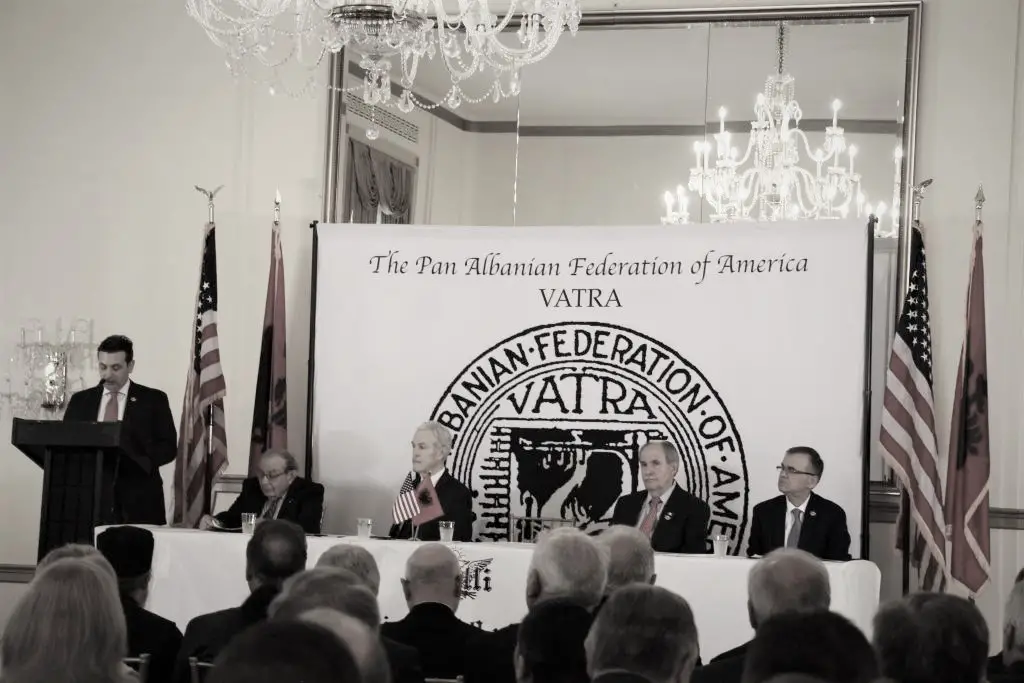
For all this, etc., we are informed by several writings from the newspapers of those days (November 1936), which conveyed in detail all the developments of the conflict between the government of Mehdi Frashëri and the deputies of the Parliament chaired by Koço Kota. One of those newspapers of that time, which dedicated entire pages to the government-parliament conflict, was the newspaper “VATRA”, from which we have selected several writings, which we are publishing below in this article, without making any changes to the language written in the years of Zog’s monarchy.
The newspaper “Vatra” on the Frashëri government: Two times “Bravo”
Two “bravos” belong to the Frashëri Cabinet: The first belongs to the fact that it preferred to leave power rather than let a decree-law that affected the interests of the people be overthrown, and the second bravo is related to the manly stance it held towards some deputies who, for more personal reasons, tried to discredit it by overthrowing the decree-laws. We do not know what conclusion the conflict that flowed completely unexpectedly and unforeseen between the Cabinet and the Chamber (Parliament, our note) will have, but what is known and has been ascertained within these hours in various circles of the capital is this: The Frashëri Cabinet, even if it falls, falls while holding high the flag of dignity.
Even if it falls, morally it emerges triumphant. From the 15 gold francs that the people paid today per year for road tax, Mr. Mehdi Frashëri’s Government reduced it to only 6. The deputies, instead of accepting the decree-law with compliments for the paternal care it showed towards the people they represent, come out and spend all their volume to convince other colleagues that that decree-law should be rejected, and the people should continue to pay 15 francs. It has been said and remembered that Ministers are novices in parliamentary maneuvers. Yesterday’s Chamber session proved the opposite.
It proved that it is the long-experienced deputies who have no clue about parliamentary tactics and maneuvers. We prove it: When the Government’s decree-law on the transfer of credits and on automobile expenses of Ministers was overthrown in that very session, the Cabinet made no sound. It accepted the overthrow and accepted that in it there were things that perhaps better not to exist. But when it came to the decree-law on roads, the Government went all the way. It put the issue to a vote of confidence. Because in that decree-law, the rights of the people were defended, the poor were supported, and the rich who always evade tax payments were condemned. But the long-experienced deputies let themselves be caught in the trap of “the novices”.
For there is not a single listener of yesterday’s gathering, nor anyone who learned the course of the conflict, who is not also an opponent of the Government, and who has not condemned the stance of those deputies who wanted to overthrow the Government, even though this defends the rights of the people, and who has not complimented the Cabinet that decided to sacrifice itself in the field of measuring up to the poor people. Mehdi Frashëri’s Government may also leave. That point does not interest us today.
What interests us today is the fact that the cabinet achieved an extraordinary parliamentary success, that it knew how to prove it is ready to sacrifice itself when trying to fulfill its mission towards the people, and that it gave occasion to ascertain, for the postponement (cancellation) of their decision for the turn, that the deputies are capable of creating issues but not also of taking responsibility when the turn comes to finally decide on the issue created among them.
The press’s prediction of the governmental crisis
In the circles of the Chamber (Parliament), it is presented that a governmental crisis is certain today after lunch. A large majority of deputies will not give a vote of confidence to the Government. The issue of the day, there is no need to emphasize, is the stance of the Government in power or not. The general opinion, based on dry facts as presented in Parliament, is that the Chamber of Deputies will not give the vote of confidence requested yesterday by the Government on the occasion of the decree-law on road obligations. This is the general thought that dominates today in various circles of the Capital. Now let us expose the movements that were noted today before noon on the part of the deputies and on the part of the Government.
Around 9:30, the Prime Minister went to the Palace (King Zog’s Royal Palace), and returned after half an hour to the Prime Minister’s office. At 10 o’clock, the Speaker of Parliament led the members of the parliamentary commission to the palace to present to the Sovereign the Chamber’s response to the Throne Message that was read on the occasion of the opening of the ongoing session. In some circles more interested in the created situation, it is believed that the Prime Minister and the Speaker of Parliament together with Mr. Fejzi Alizoti have talked particularly with the King about the conflict that occurred in yesterday’s session. But nothing was learned about these conversations.
Meanwhile, according to information we managed to gather from reliable sources, it results that the Government remains steadfast in its view expressed yesterday before the Chamber, saying that a vote of confidence will be requested again today. Based on parliamentary circles, the Government today must be overthrown. According to these circles, today at noon it was ascertained that a large majority of deputies have decided with all their minds not to give the vote of confidence to the government.
To complete the chronicle, we add some details about the development of today’s discussions, and we predict based on some information that occurred in the minute the newspaper goes to press. As soon as the meeting opens, therefore, a deputy will take the floor and will address some questions to the Prime Minister, and after Mr. Mehdi Frashëri’s answers are finished, yesterday’s proposal of the Prime Minister will be put to the vote immediately. The result of this vote will be, as we said above, in favor of the Government’s defeat.
Debates in Parliament
Quite unexpectedly, in yesterday’s session, the Government was forced to put the issue of confidence. – The cause was given by the decree-law on roads. -Parliament postponed the meeting for today. -Yesterday afternoon at 3:45, the Parliamentary meeting opened under the chairmanship of Mr. Koço Kotta, with the participation of the entire Ministerial body. The draft-law on the amendment of articles 16 and 35 of the Fundamental Statute (Constitution of the Kingdom) is put into discussion (in principle). Long discussions were held around this draft-law.
In these discussions, Mr. Hiqmet Delvina, Thoma Orollogai, Mihal Kaso, Fiqri Rusi took part, expressing their opinions on the changes to be made to the articles of the Statute, but they all opposed the basis of the population, as the registrations made to date are not exact, and they asked that some modalities be made to the project presented by the Government. The Prime Minister, Mr. Mehdi Frashëri, gives long explanations regarding these changes, but Mr. Fejzi Alizoti opposes, saying that since we will not have a complete registration, he is against the changes.
After Mr. Ferit Vokopola, Eshref Frashëri also spoke, and after the Prime Minister’s second explanation, the project was accepted in principle and sent to the commission. The draft-law on the Agricultural Bank of Albania was accepted for the last time, the draft-law on the approval of agreements concluded between the Royal Government and the Bank of Naples, the draft-law on the addition of a fund of 40,000 gold francs to the budget of the Ministry of Internal Affairs, the General Directorate of Health.
Likewise, the draft-law on the transfer of a fund of 2,000 gold francs to the budget of the Higher Institutes and the Ministry of Finance was accepted in principle and sent to the commission, as well as the decree-law on the replacement of the company “Portland Cemento Shkodra”. The decree-law on the creation of a sub-office of a chemist, alcohol and alcoholic beverages controller, with a salary of 350 gold francs per month, is taken into discussion to be accepted in principle.
Even around this project, long discussions are held. Mr. Thoma Orollogai, Fejzi Alizoti, Mihal Kaso, Jashar Erebara opposed the acceptance of this project, while Mr. Kasëm Radovicka proposes that it be accepted. Finally, Prime Minister Mr. Mehdi Frashëri and Finance Minister Mr. Rrok Gera speak, and with their arguments and reasoning, they finally convince the Chamber to accept it in principle.
The overthrow of the government, after receiving only 3 votes
The Government was overthrown at 16:00 by the Chamber. – The new cabinet will be formed quickly to have time to vote on the Statute articles for elections until Tuesday. – Who can form the next government? (Subtitles of the newspaper “Vatra”). The information we gave to the public yesterday with the first edition found truth in the conclusion given yesterday afternoon at 4 o’clock by the largest majority of deputies. In fact, Parliament with 36 deputies overthrew the draft-law on workers, and compelled, since its overthrow would also bring down the Government, the Frashëri Cabinet is no longer in power.
Before the afternoon session gathered and a few minutes before the meeting opened, it began to circulate in the corridors of Parliament that the Government would not come to the session, as in a meeting it had today at noon at the Prime Minister’s office, it had decided to resign. However, this news did not prove true. All the members of the Cabinet with Mr. Frashëri at the head appeared together, and it was even noted that they were all in good humor. Meanwhile, the boxes and galleries of the Chamber were filled.
Rarely does Parliament present such a scene. Foreigners, high officials, people, have long occupied the available places, while a large majority stood outside the building, prevented by the police due to lack of space. When Mr. Kota (Speaker of Parliament, Koço Kota) opens the meeting and the list of deputies is read, a great silence takes over the hall. The observations of the deputies and the public are directed sometimes at the ministerial benches, sometimes at Mr. Hiqmet Delvina, Mihal Kaso, Seit Toptani, and Eshref Frashëri, who were the first in yesterday’s meeting to open the campaign against the overthrow of the decree-law that caused the governmental crisis.
After some discussions which we are publishing extensively below, the deputies are invited by the Speaker of the Chamber to exercise their right on the proposal presented by the Government. The anticipated conclusion did not change. The Government was overthrown, and from 4 o’clock, the Frashëri Cabinet is resigned. The second legislature of the Kingdom, which showed itself so mild during 4 years, minus 4 days, towards the previous Governments, in these last days appeared dynamic, and if the Frashëri cabinet managed to overcome the storm that attacked it in the first days of its existence, it did not have the same fate now at the end of the Legislature.
After the conclusion of the vote, on the faces of the large majority of deputies, signs of satisfaction were noted, while in some circles the question was raised as to who would take the place of the resigned Government. As a chronic duty and with due reserve, we note that according to whispers up and down, the new Prime Minister is presented as Mr. Kota, or Mr. Berati (Dhimitër Berati), who could form the Cabinet also with one or two colleagues from the resigned government.
It is meanwhile a general thought, regardless of the persons who will form the new Government, that the crisis will end within 24 hours, since it is necessary that the new Cabinet must vote on the Statute article regarding the election term until Tuesday at midnight, as the term of this session also ends on that date. Voted for the Government: Mr. Asim Jakova, Maliq Bushati, and Kasëm Radovicka. Abstained: Mr. Vasil Avrami, Faik Dishnica, and Tefik Mborja.
Reasons for the governmental crisis
Besides the three deputies who gave the vote of confidence and the few others who abstained, the others denied confidence to the Government in yesterday’s session, and the cabinet after this result was considered resigned. We spoke about the causes and interpretations that accompanied the governmental crisis in yesterday’s leading article. Today we will examine the reality of the crisis from another point of view. Whoever follows the flows of our political life with attention will have noticed, certainly, that for the first time in many years, Parliament takes directly the responsibility of causing a governmental crisis.
Although late, i.e., after 24 hours of reflection and consultations, the parliamentary chronicle notes that the overthrow of the Government was caused after the national representation withdrew its confidence. Previous governments had left power by a decision of resignation taken among its members, and no case had arisen where Parliament took responsibility for causing a crisis. To be objective and to go deep into the matter, it is necessary to emphasize that the Chamber of Deputies found itself unexpectedly before the dilemma of the crisis.
The crisis was caused by the Government itself, and everything was left to be understood that the Cabinet’s decision to burden Parliament with the responsibility for the crisis had not been premeditated, but was conceived during the discussions of the session before last and was matured within 5 minutes that occupied the Ministers’ meeting in one of the Parliament’s rooms. That the crisis dilemma came unexpectedly is also admitted by the fact that the deputies appeared disoriented when the Prime Minister put the rejection or acceptance of the decree-law as a matter of confidence, and the deputies, although they withdrew for consultations, could not respond immediately, and the Speaker had to postpone the meeting for yesterday afternoon.
But if the initiative to conclude the crisis in this way belongs to the government, it must be affirmed, and this interests us more today, that Parliament, although after 24 hours, responded to the governmental gesture with a purely parliamentary act. The Chamber had it in its hands to force the crisis by withholding confidence, by accepting the decree-law, since against it only 3-4 deputies had spoken in the previous session, while the others had not compromised themselves. Regardless of the causes that pushed Parliament to overthrow the government, in yesterday’s decision of the Chamber, we like to see the inauguration of a new period in parliamentary life.
We like to believe that the deputies from now on will exercise control over the government with greater efficiency, as we of “Vatra” have always requested. Since a control that can also end in dismissal, restrains the government from wrongdoing. If in the Frashëri Cabinet the parliamentary sanction was put into effect for strong reasons, according to our opinion, this error does not stem from the system that was inaugurated itself, but from the fact that the Cabinet did not stand well in the eyes of this Chamber from the beginning.
But when a Parliament emerges with free votes and from this Parliament a government is formed, we are completely convinced that the exercise of the parliamentary right to withdraw confidence from the Government is destined to ensure us a good administration of executive power. From this point of view, looking at the responsibility taken yesterday by the Chamber, to end in a governmental crisis, we salute with pleasure the exercise of parliamentary right, but on condition that this right will not be limited only to these deputies and only against the Frashëri Cabinet.
The government’s mistakes that irritated Parliament
(Yesterday’s Parliamentary session). At 3:43, Speaker Koço Kotta opens the meeting and with a few words explains the postponement of the two decree-laws on roads and the government’s proposal that accepting or not accepting these decree-laws constitutes a matter of confidence; it is decided that the parliamentary vote will be nominal. Mr. Andon Beça says that: since when this government was presented, I have given it a vote of confidence with pleasure, I wish to justify the reason why I no longer give it.
1) That the government did not care at all about the petitions presented to it by the elders of Fushë-Mbret in Elbasan, regarding the non-settlement of emigrants in that place, as it was not sufficient even for the residents. 2) For the arbitrary actions of the Minister of Education, as even the manifestations in Elbasan were caused by him regarding the issue of the Normal School, and 3), for the manner of poor administration by the Minister of Internal Affairs with some imprisonments and internments in Porto Palermo of some Elbasan residents.
The nominal vote continues, finally 36 voted against, Mr. Asim Jakova, Maliq Bushati, and Kasëm Radovicka in favor, while Faik Dishnica, Tefik Mborja, and Vasil Avrami abstained. Finally, Prime Minister Mr. Frashëri takes the floor and thanks Parliament for the order of the vote. Regarding the reasons presented by Mr. A. Beça, he would be ready to answer, but since Parliament withdrew confidence, they do not see it necessary, therefore they ask permission to leave. With that, Speaker Mr. Kotta, closes the meeting at 3:50.
Prime Minister Frashëri thanks journalists
(Council of Ministers meeting). The Council of Ministers immediately gathered and discussed for 2 hours and 25 minutes. Mr. Mehdi Frashëri had the kindness to receive journalists, to whom he made these declarations: “First of all, I want to thank the press and journalists for the good words and support they have given to the Government. The Government, now after the vote of no confidence by Parliament, based on Article 113 of the Statute, decided to resign, which it will submit to His Majesty the King (today at 9:30)”. / Memorie.al