
By Fatmira Nikolli
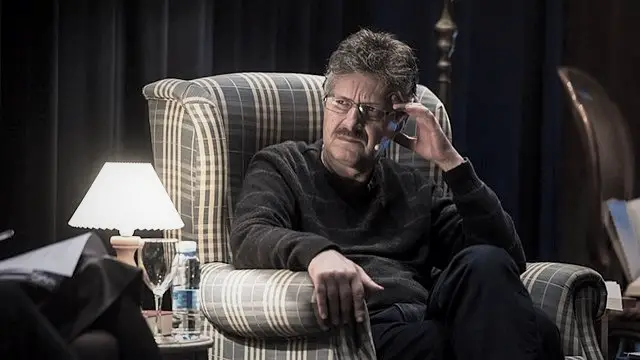
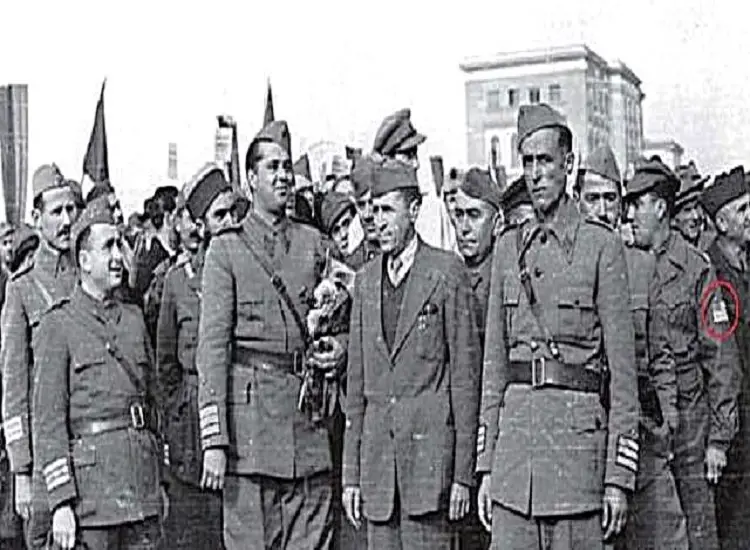
Memorie.al / “The communists won the war, but turned into a gang of murderers.” Unwilling to give ex cathedra lectures, the writer Bashkim Shehu focused (during the meeting on public discourse) on two aspects: first, the treatment of the communist period by the print media, and second, the zombification of Enver Hoxha. In the first part, he criticizes the presence in the media of former communist persecutors, while in the second part, he appears to take a certain stance regarding the reassessment of historical figures, when he says that; “the war (the National Liberation War) was used politically as a myth that legitimized the dictatorship of the victors.”
The original title of his speech was: “Past present continuous: the shadows of the past in public discourse.”
The full speech by Bashkim Shehu:
First and foremost, I must say that the position of an Albanian coming from abroad to speak about Albania’s problems is a difficult one. It is difficult in the sense that it might sound as if one is giving ex cathedra lectures. On the one hand, there is an obligation to exercise critical sense. On the other hand, there is the risk that, by exercising critical sense, one might resemble a character from Kafka’s “The Penal Colony,” the foreign traveler, arrogating to oneself a status of superiority by virtue of coming from outside. And there is all the more risk of sounding this way precisely because, in truth, I am not a foreigner. I will continue, hoping that this situation can be overcome.
The topic I will speak about – that of the shadows of the past or the inertias of the past in public discourse in Albania – is very broad and cannot be exhausted with a short presentation. I will touch upon only two aspects.
THE FIRST ASPECT: consists of the treatment of the communist period by the print media. I would cite as a positive example an article by Uran Butka, on the reprisals that followed the bomb thrown at the Soviet embassy in 1951: based on documented facts, and accompanied by analytical commentary that provides the proper context for that highly significant event. Facts only make sense within context, Wittgenstein insisted.
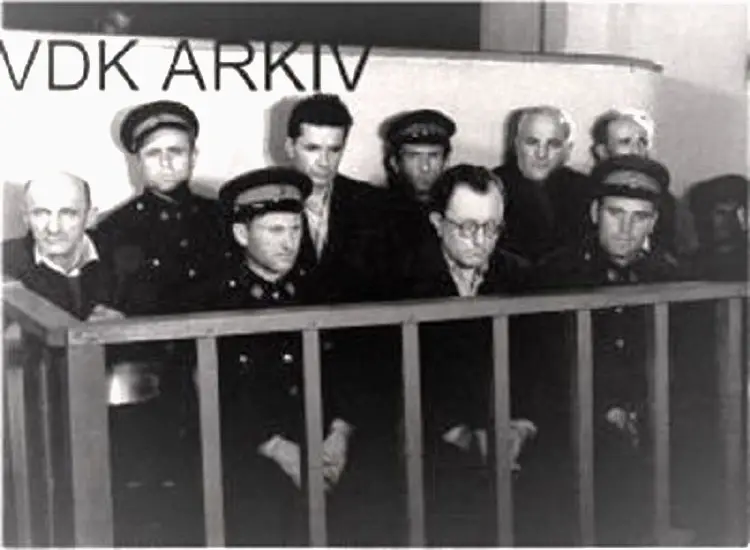
The complete opposite is seen in a large number of press publications concerning that period of recent history. The most paradigmatic case is that of reproducing the protocols of the judicial farces. They are presented to today’s public without any contextualization and without any evaluative explanation. Or rather, evaluative explanations are indeed found in such publications, but they are those given by the rulers of that time, through the mouths of the prosecutors and judges of those trials.
The extraction of events from their historical context also manifests through sensationalism. Past events are presented as sensations of the day. This runs counter to the nature of history, because moments of history acquire meaning only as part of a narrative that has continuity, a narrative where different factual events are connected to each other in such a way as to render them explainable, whether as causes and effects, or as correlations that give facts the quality of interacting factors.
The modality of sensation is the fragment, the isolated event, singled out as an exclusive super-event with a glare that blinds you, as an absolute meta-event that obscures everything else. The modality of history is precisely the opposite: it is the illumination of events through one another. Or, to adapt to the narrow spaces offered by a daily newspaper, it is contextualization through authorial commentary and interpretations that synthesize a broad knowledge of history.
A phenomenon akin to those described is the selection of people who express themselves on Albania’s communist past, through interviews or articles, or even through the publication in extenso of their books in newspapers. I am referring to former persecutors of various levels, from former rulers to former assistant executioners. Naturally, aside from the sort of respect that some journalists show towards former rulers, judging by how they question the latter during interviews, there is no shortage of judgments made by former persecutors and assistant executioners about their victims.
This does not happen in all newspapers, but I have the impression that in some of the most important ones, when it comes to the dictatorship, the presence of characters of the aforementioned kind is overwhelming compared to the presence of victims or those inclined to empathize with victims. I said this is my impression, and I have no statistical data to support it, if such a thing can be supported or refuted statistically.
Nevertheless, in today’s Albania, there exists a far from marginal opinion that, for history, those who have suffered should not have a voice, because, precisely because they have suffered, they are filled with grudges and, therefore, cannot be objective. Meanwhile, the concern for objectivity seems to be somewhat conveniently forgotten when the perpetrators or co-perpetrators of suffering and their former flatterers and sycophants speak about history.
A question might arise: what do these things have to do with European integration? I think they are relevant precisely because the process of European integration, begun the day after World War II, has at its foundations a firm “no” to the horrors of the past, a “never again.” And a firm “no” to the past does not mean closing one’s eyes to it, but that the past should be constantly in the eyes of memory.
To complete this answer, I refer to Habermas, for whom the greatest moral concern is “the irreversibility of past sufferings – the injustice done to innocent people, who were mistreated, humiliated and killed – while man has no power to rectify this.” And, with a deeply imperative connotation, he adds: the “lost hope of resurrection” is often felt as “a great emptiness.” Based on this thought of Habermas, we must say that, since we cannot undo the injustices of the past, let us at least do justice in our collective memory.
THE SECOND ASPECT: that I wish to touch upon regarding public discourse on the recent historical past, is the zombification of Enver Hoxha. It is a recycling transformation that occurs in the psyche of some politicians and some historians and is projected from there into public discourse, increasingly so lately. It is a mental abracadabra that, in its rationalized form (in the Freudian sense of the word), sounds more or less like this: “Indeed, the dictatorship period was bad, although it had some good things, but the epic of the National Liberation War cannot be denied under any circumstances, and since Enver Hoxha was its leader, Enver Hoxha’s figure cannot be entirely denied.”
So, the first step is the division into two periods, the second step is the splitting of Enver Hoxha in two, as if he were the viscount in Italo Calvino’s book, and one of the two halves is good, and then the third step is the reattachment of the two halves, just like a circus trick where the illusionist splits a man inside a box in two with a sword and pulls him out alive and unharmed. And the reattachment of the two halves is unavoidable, if only for the sake of what is called the “complexity of great historical figures,” besides which this reattachment seems to be aided by some of the good things attributed to the evil half, such as schools, healthcare, veterinary services, or national sovereignty.
But let us pause for a moment on the good half, on the National Liberation War. It is no coincidence that a historian such as Hobsbawm considers the Albanian resistance as one of the most important on a European scale, and it is no coincidence that the British sent most of their aid to the partisans. But at the same time, we must not forget that the political direction of the National Liberation War was oriented from its very beginnings, in 1942, towards the establishment of a single-party regime, that is, towards the establishment of a communist dictatorship.
The consequence of that strategy is the executions of opponents outside and inside the Communist Party even at that time. Let us remember that Enver Hoxha was not a military man, but was the political leader of the war. And let us recall an assessment made on the eve of liberation by Sejfulla Malëshova, one of the communist leaders. “We have been successful militarily,” he says more or less, “but not politically, and if we continue like this, we will end up as a gang of murderers.”
And that is exactly what they turned into, Enver Hoxha and all his comrades, precisely because they continued down the path they had started. Meanwhile, between the military and political dimensions of the National Liberation War, there was a certain relationship: the war was used politically as a myth that legitimized the dictatorship of the victors. Wittingly or unwittingly, some politicians and historians use it this way today, when they identify it with the leadership of Enver Hoxha.
Again, the question might arise: what does this have to do with Albania’s European future? What do these two things have to do with each other? I would answer again that they have a great deal to do with each other, especially if we look at something happening currently in Europe. The strengthening of xenophobic and racist parties in a number of European countries is ugly, undoubtedly, but even uglier is the adoption or imitation, even partial, of the agenda of these extremist forces by parties with a distinguished democratic pedigree. Today, things are said about immigrants and certain ethnic groups that, until a few decades ago, were unimaginable.
This change has multiple causes, but one of these causes seems to be the fading of that imperative memory upon which the new Europe began to be built after World War II. If we do not remember and understand the past, it returns, in one way or another. Membership in the European Union is no guarantee that this will not happen. The unfortunately most interesting example is Hungary, which had a transition relatively more normal than Albania’s, but today it is the most anti-liberal country in Europe (excluding some former Soviet republics) and is one of the countries where racism shows itself with the least shame.
And this example is unfortunately the most interesting because the positioning towards the past by a central political actor, Viktor Orbán and his party FIDESZ, takes two opposite and equally erroneous forms. The first form is that of the time when communism had just been overthrown and FIDESZ was a liberal party newly emerged from the student movement. Back then, the past did not exist for them. Their positioning towards the past tended to be such that it can be formulated as follows: we are young, we are unstained by the past, and therefore, we have the moral right to say what should be done with the past, and we say that the past should not be spoken of.
The second form is the present one: Viktor Orbán condemns the communist past for the sake of his ambitions for authoritarian power, as a cosmetic for his authoritarianism. The past takes revenge by being recycled into another form. This is what happens when the past is condemned for narrowly partisan or personal purposes, and not out of that concern Habermas speaks of, regarding the impossibility of undoing the sufferings of innocent people and resurrecting the slain. The disregard for the injustices of the past and the political abuse of them are two sides of the same coin. A coin which, like the obol for the ferryman of death, is placed in the mouth of the corpse of democratic ideals to traverse not only the Acheron, but also the river Lethe of oblivion.
I reiterate, I do not pretend to teach anyone anything. To conclude, I return to Franz Kafka’s short story with which I began. Its final episode is this: after having visited the commander’s secret grave with the inscription that the day will come when he will return, the foreign traveler sets off to leave, and a native who has just escaped punishment begs him to take him along, but the traveler refuses. I am both the one, and the other. / Memorie.al