
Memorie.al – The publication “Semih Pashallari, the Silent Architect” written by Ismihan Pirgu Pashallari in 2011, undertakes to answer the question of what it means to be an architect of significant works in Albania, while working and living under the communist regime. The book was written during the architect’s lifetime but was published after his death. Semih Pashallari passed away on November 21, 2008. Ismihan Pirgu is the architect’s daughter, which facilitated the securing of archival materials, the architect’s projects which are located in the funds of the archives of the Institute of Design No. 1. The publication is rich with photos and sketches from this archive and the family archive.
Although the goal was not the scientific documentation of her father’s work. Such an objective could never be claimed by someone close to the subject, who does not spare praise, such as: “the great, the brilliant, etc.”! The goal was not that, but the author feels that this biography is equally justified to break the silence regarding her father’s work. Seeing that his name does not exist when talking about the objects realized during the socialist period. And it is to this period that his contribution belongs.
The author noticed that in the 1985 Albanian Encyclopedic Dictionary, this man’s name is not mentioned at all: Aiming to achieve the best, most beautiful and economical constructions, and within short deadlines, the A.P.S. (Albanian Party of Labor) gave dignified works that, both in terms of function and the forms and materials used, are valuable achievements.
Among the most well-known works are the Palace of the Headquarters of the Central Committee of the PPSH (Party of Labour of Albania), the Grand Palace of Culture, the National Historical Museum, the “Gjergj Kastriot Skënderbeu” Museum in Krujë, the National Gallery of Arts, tourist hotels in Gjirokastër, Përmet, and Krujë, residential blocks on “Enver Hoxha” Boulevard in Fier and Tirana, sports palaces in Tirana, Vlorë, Korçë, and Elbasan, holiday homes in Vlorë and Korçë, the martyrs’ cemeteries, the building of the Institute of Lung Diseases in Tirana, etc.
Architects of this period are mentioned, such as; Skënder Luarasi, Anton Lufi, Besim Daja, Sokrat Mosko, Valentina Pistoli, Koço Miho, Klement Kolaneci, etc. Nowhere is Semih Pashallari…?! He participated as a processor of the foundations for the headquarters of the Central Committee, was a participant in the project and realization of the Palace of Culture, work for which he was decorated by the Presidium of the People’s Assembly with the “Order of Labor of the First Class” in 1966.
He is the designer of the building of the Albanian Radio and Television “realized by him because no one else would undertake it given the economic conditions required,” emphasizes Pirgu. “He was a savior and achiever in difficult situations for the completion of the project-plans of the Ministry and the Institute of Design No. 1, but he belongs to that category which does not conform to the norms of the communist regime. Engineer Semih was neither with the party, nor against it; did politics not interest him.”
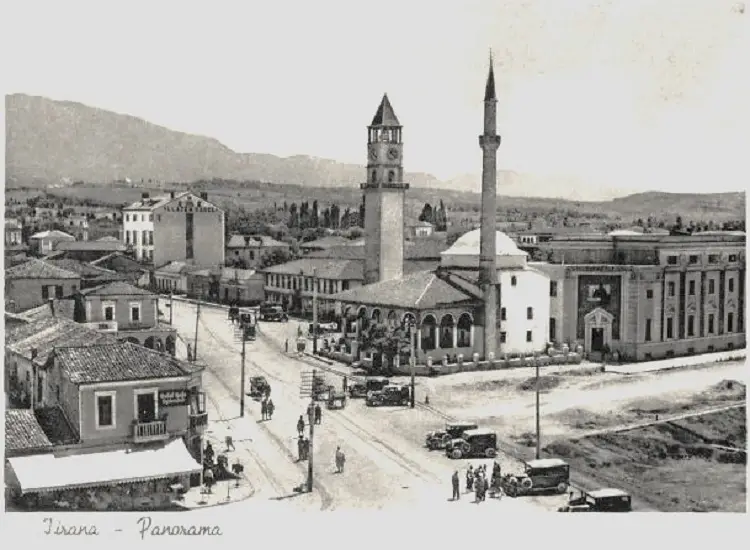
This is the first work published about this figure of Albanian architecture. The author has attempted to include the architect’s memories from when the Palace of Culture was being built, the abandonment of the project by the Russians in 1961, and the total change that awaited the initial project-idea, to transform into a giant complex that entered the heart of the “Skënderbe” area as if by force, next to the Et’hem Bej Mosque and on the ruins of Tirana’s old bazaar.
These memories, coming at an advanced age of the architect, have documentary value for one of the objects that today divides both the opinion of specialists and that of citizens in two.
The author asks engineer Semih if he can tell the truths about the Palace of Culture, for which she had been a witness, as she was at an age where she understood something and remembered many things. She writes: “I know that within the Institute, a brochure about the Palace was published where the name of Semih Pashallari, decorated by the Presidium of the People’s Assembly with the ‘Order of Labor of the First Class’ for the construction of the Palace of Culture, is not mentioned anywhere, and whom many of the engineer’s colleagues jokingly called ‘Semih the Palace’.”
Because…; He was the grandson of a grandfather who was executed by firing squad and an uncle sentenced to death and executed by hanging with a rope upon the communists coming to power. Semih Pashallari was born in Tirana in 1926 to Sadi and Fitret Pashallari. His father, Sadi, was the son of Aksarajli Mehmet Pasha of Turkey, educated in Paris for engineering.
He married Fitret, the daughter of Fejzi bej Alizoti, the General Secretary of the first Albanian government of Ismail Qemali, among other things. Fejzi Alizoti was executed by firing squad in the Special Court of 1945. The name of Sadi Pashallari constitutes a chapter unto itself. His hand can be seen everywhere in Tirana. Sadi is the first engineer of the Municipality of Tirana.
He is the designer of the Tirana Municipality building (former Executive Committee), the Presidency of the Assembly (today the Puppet Theater), the former Italian Legation (the building of the former Political Persecutees), the World Bektashi Headquarters, the Children’s Home, etc., and all works from the Monarchy period. From 1945 until the end of his life, he worked at the Ministry of Defense.
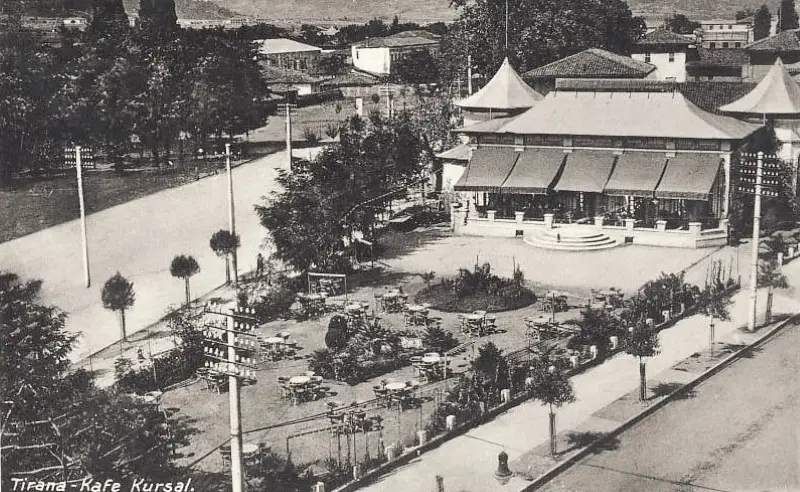
The family was settled in a villa in the middle of a wheat field not far from what would become “Skënderbej Square”. There, little Semih saw a combine harvester for the first time. He retains memories of walks with his parents and relaxing at the “Kursal” Café, which had a beautiful garden and where music was played. The golden time. Difficulties would follow. The three children of the Pashallaris did not have an easy time with their education. Semih finished scientific high school, began working as a draftsman at the Design Enterprise, and many vicissitudes were needed for him to complete his university studies at night.
He was the maternal nephew of Riza Alizoti, a mining engineer, sentenced to death and hung by rope in Kuçovë in 1947. His two little daughters, as daughters of an “enemy of the people,” grew up in the Pashallari house. Until the day the family was evicted from the beautiful villa, which was blown up to make way for an embassy. “These have been the reasons for which the communist regime created silence regarding my father’s career and work. He was hindered from reaching the height he deserved,” writes Ismihan Pirgu.
The life of the young Pashallaris under the communist regime was conditioned by this mood, sometimes oppressive and sometimes somewhat liberating, of the Party’s policies. If Semih Pashallari finished his studies in his late youth, due to the so-called “stain in his biography” – this was a great phantom that also followed his children, who could not benefit from university studies. The author of this book was not allowed to pursue studies.
Regarding this, she recalls: “From the window of the house, we saw a theater spectacle every day. A part of the yard was occupied by the dormitory of the Higher Institute of Physical Education. A school which, personally, even though I was a famous athlete and national champion, its regime at times forbade me from attending. In that villa today sits the residence of the Egyptian ambassador. Today we are forced to watch others live there”!
Thus, the communist regime on one hand decorated the architect Semih Pashallari with medals and Orders of Labor of the First Class, and on the other hand “crushed his heart.” He worked until he retired at the Institute of Design No. 1. He continued to design on commission. The Namazgja Mosque is one of the last important projects that was not implemented. Colleagues and contemporaries value Semih Pashallari as one of the fathers of Albanian rationalism in architecture, a deep connoisseur of details and the internal technology of construction and implementation, with creative flair.
Semih Pashallari recalls: “The history of the Palace of Culture began as a gift from the Russians to the Albanians. At first, they brought three variants for the project-idea. It was a low two-story building. The studio that had undertaken it was called ‘Mosk-projekti’, its chief was named Budusof. They came to Albania to show these three variants to the Albanian government.
After they presented them to the government and the government made its observations, the Soviet group left three or four people in Tirana to make these changes, and later another one came. This group stayed here to correct the project-idea. To help the group with the new drawings, they assigned me and Sokrata. We were placed to work in the ministry’s library hall, together with the Soviets…!
After our government gave its opinions and agreed on the presented project-idea, the Soviets left for their country and from there they began to send projects only for the part that was to be worked on, thus they always had us in their hands. They sent the foundations, the basements, and some sections of the project-idea. During the execution work, they appointed Sokrata as the supervisor, since he knew Russian. At the time the basements were being built, relations with the Soviets broke down.
They left and never returned, abandoning the work; they had now become enemies with us. Then the government decided we would do it with our own forces. They appointed a list of personnel consisting of a group of architects and engineers…! Initially, this group consisted of Anton Lufi, Skënder Luarasi, Eqerem Dobi, Besim Daja, and Sokrat Mosko as designers, and Misto Mele, Koço Miho, and myself as co-authors…!
Meanwhile, the government decided again that the Palace of Culture should be made larger, to be expanded and not remain in that volume the Soviet leaders had envisioned…! Everything had to be changed.” / Memorie.al