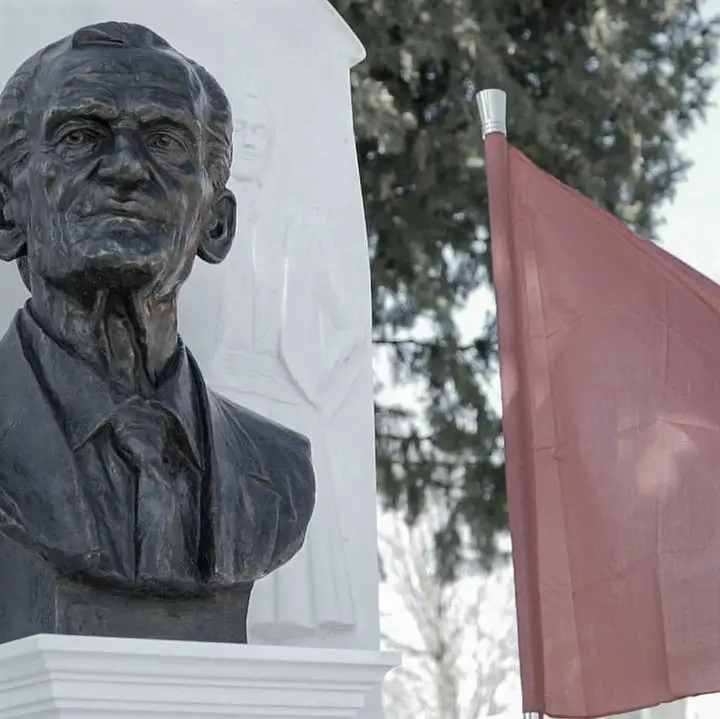
– Lefter Çipa, the “unknown”, not just as a recollection –
Memorie.al / The qualifier “unknown” simply does not suit Lefter Çipa, because even those who have never met him in person have encountered his poems and songs, thus creating the most complete acquaintance with his soul. Beyond any doubt, the soul contains within itself only the essential aspects of a person’s character, those that define his character, activities, and creativity in life, leaving some incidental phenomena to be taken by the wind of oblivion. However, even these incidental phenomena are part of a person’s life, and it happens that they too leave a mark, especially when they appear as wounds of life.
I – It is incidental that Lefter Çipa’s birth date is recorded as February 14, 1942, in the village of Pilur, according to the civil status register; it would have been incidental even if it were correct, but for the sake of truth, we must clarify that Lefter Çipa was neither born on February 14, 1942, nor, even less, in Pilur. Lefter Çipa was born in the third autumn of 1941, in the area of Mount Çajup, where Andrea Çipa’s family was with their livestock. Lefter’s birth and a health problem of his mother, who had just given birth, delayed the family’s return to Pilur; they returned with the livestock around mid-December 1941.
Surely you will rush to ask: why didn’t the family register him in December, when they returned to Pilur, but “dragged it out” even further? The reason is very simple: the people of Pilur worry about increasing the number of sons at the hearth and livestock in the pen, but when it comes to registering them, they always delay. They would register sons even two or three years late, to postpone their military service, while they wouldn’t register livestock at all to avoid paying taxes. In reality, Lefter Çipa, being registered a few months after his birth, was registered more “quickly” than “his time would have come” compared to his fellow villagers of the same age.
It is precisely at this moment that Lieutenant Luigi Moretti “intervenes”, who at that time was all-powerful in Himarë. It happened that in early February 1942, Moretti went to Pilur to verify the gap in births in the civil status registers of Himarë. In Pilur, he was surprised to see the village square swarming with children, and there he understood that the villagers were not registering their newborn children, but he could not figure out the reason. Nevertheless, his duty told him to gather the village men and, after a short speech, he ordered them to go urgently to Himarë and register the unregistered children, otherwise there would be consequences.
Since Andrea Çipa, Lefter’s father, was at the mountain pasture with the livestock, he was informed of the problem after two days when he came home; so the next day he took the downhill road to Himarë, grumbling against the Italian lieutenant who had made him lose a day of grazing the livestock for no good reason. When he arrived at the civil status office in Himarë, his spite had not yet left him, so when the clerk asked him: when was his son born and what name would he give him, he replied curtly: – “He was born to me today and I will call him Lefter. Maybe we’ll be ‘leftened’ (liberated) once and for all from these people.” It was February 14, 1942.
II – Registration on February 14, 1942, was a coincidence and had no effect on Lefter Çipa’s life, but the family’s move from Pilur to the city of Vlorë in 1950, in response to the demand for labor in the newly established N.B. “Vlora” and their settlement in the “Pusi i Mezinit” neighborhood, no matter how ordinary it may seem, was decisive in shaping Lefter Çipa’s creative world. From a mountain village childhood, where the wind whistled like a song, he descended to a city where the glory of history spoke to him on every alley.
If in Pilur he ran barefoot and in old clothes, here he learned to walk with a serious gait and always dressed with finesse. He completed the 7-year school and then the Reserve school for bricklayers. That was all the official environment of Vlorë could offer this small, curious boy from Pilur. His thirst for culture and art would be recognized later, when they saw that through his efforts he completed several specialization courses in directing, acting, and mass culture. It was the time when he began to organize the artistic groups and the amateur stage of the “Vlora” Agricultural Enterprise, where he had started working as a laborer.
There, fate touched him – a fate that had the face of the musician Themistokli Mone, who brought this charming and elegant young man closer and began to help him with the musical numbers for his stage, later bringing him closer to the “Vlonjate Trio”. He developed his passion also during his two years of military service, served in Maliq of Korçë; indeed, in the Ministry of Defense’s ‘Cultural Marathon’, the group he led became republic champion. After completing military service, he returned to Vlorë and, in the absence of a better opportunity, resumed work as a laborer in the olive groves, but meanwhile he did not give up his passion for art and continued to direct the artistic activity of the Agricultural Enterprise.
This work increased his contacts and friendship with Themistokli Mone, who, seeing his gift for creating verses brought him close to the “Vlonjate Trio”.
III – The “Vlonjate Trio” was created on one of the last days of May 1950 and consisted of baritone Konstandin Thana (Shkodër, May 21, 1929 – February 2013) – “kthyes” (the one who throws back), originally from Shkodra but his family had settled in Vlorë before World War II; the Vlorë tenor Reshat Osmani (Vlorë, January 14, 1928 – Vlorë, November 10, 1994) – “marrës” (the one who takes); and soprano Besharete Ismaili (Vlorë, 1930) – “marrëse” (the one who takes). In 1953, alto Meliha Doda (Tirana, May 25, 1933) – “marrëse”, originally from Prizren, joined this group, replacing Besharete Ismaili. On the day of its formation, the “Vlonjate Trio” had young singers: Reshat Osmani was 25, Konstandin Thana was 26, and Meliha Doda was 22. In the 1970s, Kleopatra Skarço from Narta would also join the group.
With this composition, this formation continued its activity until the 1980s. The songs of the “Vlonjate Trio” are rightly considered part of the urban folk music repertoire of Vlorë in the second half of the 20th century. The songs were accompanied by a formation of musical instruments such as clarinet, violin, tambourine, etc. It was the most charming and most sought-after formation in every city of Albania, although they had their activity center in the city of Vlorë; several other cities like Lushnja and Gjirokastra formed their own trios. The “Vlonjate Trio” gave concerts not only in every city of Albania but also abroad: in Kosovo, Bulgaria, Romania, Poland, China, Egypt, etc. At the 1957 World Folk Song Festival in Moscow, the “Vlonjate Trio” achieved third place – a great success, considering the time of this musical group’s activity. We recall that the first song of the Vlonjate trio is “Ku këndojnë zogat o” (Where the birds sing, oh), while the end of their activity dates to the late 1980s.
The “Vlonjate Trio” functioned as follows: the two men were the “taker” and the “thrower” of the song, while the third was the woman’s voice. It was a form of singing by three people, like the trio song of Dukat, except that was an iso-polyphonic song, while the “trio” was a form of folk song with elements of the Lab group. Lefter Çipa came close to this group.
IV – Lefter Çipa was called by Themistokli Mone to join the “Vlonjate Trio”. He had known Lefter from his amateur activities at the “Vlora” Agricultural Enterprise; he had a musical ear, knew the notes, so he invited him to collaborate with the trio’s musical formation – a collaboration that was crowned with a series of successful songs. Thus, the song “Thëllëzat kur hedhin valle” (The partridges when they dance) has lyrics by Lefter Çipa and music by Themistokli Mone.
“The partridges that dance, oh partridges
They dance slowly, oh partridges
Come out, see, you partridges-o
That takes our dance smoothly-o
Partridges up and down, oh partridges
How beautiful with charm, oh partridges
Come out, see, you partridges-o
That takes our dance smoothly-o”
Likewise, Lefter Çipa wrote the lyrics for the songs: “Në një arë në një lëndinë” (In a field, in a meadow), “O ky bregu i detit, ka bilbila shumë” (Oh this seashore, has many nightingales), “Në ato male mbi Sopot” (In those mountains above Sopot), “Ku je rritur je bërë kaqe/xhan xhan moj manushaqe” (Where you grew up you became a sweetheart/dear dear oh violet), “Dy pëllumba mbi çati” (Two doves on the roof), “Aromë portokalli” (Orange scent), “Vashëza në zall të lumit” (Little girl on the river gravel) or “Dy thëllëza në një portë” (Two partridges at one gate), etc. The characteristic of this collaboration was the fact that their songs could also be sung in choirs. For example, the Army Ensemble sang the song “Në ato male mbi Sopot”. Generally, when talking about Lefter Çipa, this part of his life and this artistic contribution are forgotten, but we must characterize precisely this period as the “sprouting” phase of Lefter’s poetic and musical creative “sapling”. His engagement with the “Vlonjate Trio” increased his self-demand for a high artistic level in his creativity. His life in the city of Vlorë cultivated in him an urban culture in social and family relations.
V – In reality, many singers have sung songs with lyrics by Lefter Çipa over the years, such as: Irini Qirjako – “Bejka Pilurjote”, Mentor Xhemali – “Tre burra të lartë” (Three tall men – the Frashëri brothers), Përparime Zilfaj – “Bënça e zallit” (Bënça of the gravel), Aurela Gaçe – “Tundu Bejke e bardhë” (Shake yourself, white Bejke), “Ylli përmbi buzë” (The star above the lip) – Petrit Lulo, “Moj ti e xhindosurë” (Oh you, the enchanted one) – Geno Selfo, Gjirokastër, “Të mirë fluturim këmisha” (Good flight, shirt), “S’të kam harruar” (I haven’t forgotten you) – Mariza Ikonomi, “Fry moj erë” (Blow, oh wind) – Mentor Xhemali, as well as many songs by Hysni Zela and Eftim Llambros, etc., but that is another topic.
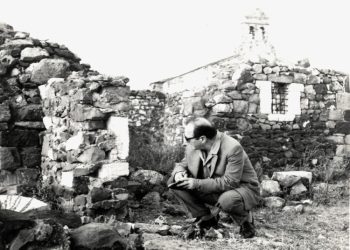
VI – If we stop at the song “Vlora jonë, qytet i bukur” (Our Vlora, beautiful city), which is also a creation of Lefter Çipa, we must emphasize that he wrote it as a tribute of respect to Themistokli Mone and Petro Marko. Few people know that Lefter Çipa had an idol, and that was Petro Marko. Few people know that Lefter Çipa did not write on a computer, but wrote himself on a typewriter, and from January 12, 2013, he wrote only with Petro Marko’s typewriter, donated by his daughter Ariantita Marko. To inherit Petro Marko’s typewriter is like inheriting some great patriotic citadel, known for its wars and heroic resistance, where every stone drips with glory.
Below we present the real text of the song: “Vlora jonë qytet i bukur” as follows:
“Our Vlora, beautiful city,
All around with olives,
Boys and girls like butterflies,
Will always return to you.
Wait for us, oh dear Vlora,
Wait for us,
Dream at night, song by day,
You are for us.
With olives and oranges,
The shore filled with lemons,
Boys and girls like young deer,
The bosom of our Vlora gives birth to them.
Wait for us, oh dear Vlora,
Wait for us,
Dream at night, song by day,
You are for us.”
Themistokli Mone composed music for this text, but surprisingly, the members of the “Vlonjate Trio” were given a modified text in the version: “Boys and girls like butterflies / Raised by Mother Party” and with the stale refrain… “Wait for us, oh dear Party / Wait for us / Guard for our victories / You have us”. If you study the real text, a creation of Lefter Çipa, the lyricism and youthful spirit stand out, which could not be otherwise because that song was written for the youth of Vlora. The original text had no connection, however distant, with the party, but Lefter “forgot” that with a successful text, one could only sing to the party, and every “forgetfulness” had its cost. In fact, the text had been changed, and this external interference in the text was a political signal for the poet and composer. Themistokli Mone fell silent and began to stay alone, while Lefter Çipa spoke as he always spoke. The scenario that played out is unknown, but in 1966, the movement against bureaucracy began, and the Çipa family was sent back to Pilur, where Lefter started working as a bricklayer. It took until 1968 for him to be appointed Head of the Cultural Hearth in Pilur, from where he began his triumphant march in Albanian folkloristics.
VII – Lefter Çipa’s arrival in Pilur resembled a meteor falling to earth; the noise and “flames” spread in every direction. In a mountain village where the inhabitants usually wear woolen clothes – from gaiters, shirts, jackets to “poture” type trousers – a 24-year-old local boy returns from the city, dressed in a thin, white suit like cigarette paper! As if that weren’t enough, he had a black shirt (God forbid, where he “poftisi” did / find that?) and over it he had thrown a white “kullaro” (type of coat) that was visible from afar. Do you want more? I tell you so you know: a man should smell of raki or tobacco, but here this boy of Çipa seemed to “drink” lavender instead of raki. If that were all, okay, but there was more. Don’t think he wore opinga (traditional shoes) like all the people of Pilur. Oh no, his white shoes could be seen from afar, and inside them, a pair of flowered socks bewildered the whole world. The village buzzed with comments about Lefter’s clothes; the young people defended him, the old people said he was the “thirteenth of the Quran”. I remember that even among the people of Pilur living in Saranda, they talked about this “Quran” one, but they added that he was supposed to be white, not black.
But one day they heard on the village club radio a song by the “Vlonjate Trio” and someone said that Lefter Çipa had “carré” (created/brought) that song. The song pleased the old people because it talked about some partridges that dance and sing, just like the village girls on Easter Sunday in the village square. There, the view towards Lefter changed – from a sideways, somewhat disdainful look, to a direct, warm one. Little by little, people got used to Lefter’s “urban” clothing; indeed, when they found out that he not only knew how to “carré” verses but also knew how to “put the song”, the melody, to those verses, and even knew how to sing, then they called him “our boy”, thus giving him his “naturalization in Pilur”. Very soon they would learn that this boy was a “giant” of art.
VIII –Giants do not stumble on their own, but those who want to hinder them make the ground slippery on their path, so that they slip. That’s what happened to Lefter Çipa with a “song” sung in the carriage of a cooperative “ZIS” on the Himarë-Pilur road. It was an October day in 1972, and the zonal competition was taking place in Himarë. The festival jury, with the aim of “helping” the Himarë group, awarded first place to two groups – the Himarë group and the Pilur group. The people of Pilur did not like this “tie” with Himarë, but they could do nothing. The Himarë group had sung the song: “Çan anija shqiptare / Nëpër dallgë e në stuhi / Kapiten shoku Enver / E drejton me zotësi” (The Albanian ship cuts through / Through waves and storms / Captain Comrade Enver / Steers it with skill) – which was in line with the political line of the time, regardless of whether it was not in line with art and the caprice of the people of Pilur.
Someone from the Pilur group remembered that these days there had been a defection with the ship “De Rada”, whose captain, Vasil Malai, also a member of the Party plenum of the district, had escaped with his entire family – 32 people in total – an escape that caused a great stir.
The Pilur group, while returning by the cooperative’s car from Himarë to Pilur, suddenly began to sing the Himarë group’s song, but with new lyrics: “Çan De Rada shqiptare / Nëpër dallgë e në stuhi / Kapiten Vasil Malai / Po marshon për në Greqi” (The Albanian De Rada cuts through / Through waves and storms / Captain Vasil Malai / Is marching to Greece). The song tasted to the people of Pilur like revenge against the people of Himarë, “who wanted to be equal to Pilur”, but the incident and the song’s lyrics were reported to the State Security people; indeed, it was added that “the text was improvised on the spot by Lefter Çipa”. Lefter was urgently called to the Department of Internal Affairs in Vlorë. The situation was tense because of the escape itself, and the Security wanted to vent its anger somewhere. All the people of Pilur held their breath, waiting for the developments, because they knew what “Security’s anger” meant. They also knew well that if Lefter Çipa “fell”, Pilur and its people would be rolled over.
Lefter was the wide-branched tree that protected everyone from rain and heat. Therefore, through other people, the Pilurians informed Hysni Kapo and explained to him that Lefter Çipa had nothing whatsoever to do with that text and that song. Hysni Kapo wanted only that; he told the Vlorë leaders: to resolve the incident according to the laws, but to think about how the Vlorë district would be represented at the Gjirokastër Folklore Festival without Pilur! The signal was clear, so this intervention saved Lefter Çipa from prison, but not from punishment. He was removed from the position of Head of the Cultural Hearth and sent to work as an educator, as a laborer with a pickaxe in production, in agriculture. As part of the punishment, in 1974 he was not appointed as head of the Pilur group for the celebrations of the 30th anniversary of the Permet Congress; instead, they appointed an agronomist (?) who created verses, and for this occasion he had prepared a song text that began with the verses: “Shokë e shoqe përmetarë / Patriot e atdhetarë” (Comrades from Permet, men and women / Patriots and patriots), etc. To climb to the top of “28 thousand stars” or “White Bejke” and end up singing songs of the type “comrades from Permet” is a howl equal to a howl…!
The group protested and declared that they would not go to Permet at all if they were not given a song with lyrics by Lefter Çipa; moreover, the melodic line should be prepared by Lefter and he himself should be the group leader, present in Permet. The group’s protest frightened the district leaders, so they were forced to “rehabilitate” Lefter Çipa. Thus it happened that in Permet, the Pilur group appeared with the song: “Në Përmet u bë kuvendi / Edhe u zhvillua kongresi / Kur nga lufta tundej vendi / U vendos sovraniteti / Nga trimat e zemerekut / Dalur nga gryk e dyfekut” (In Permet the assembly was held / And the congress took place / When the country was shaken by war / Sovereignty was decided / By the brave men of the hearth / Come out from the mouth of the rifle).
IX – Lefter Çipa was a creator of a special type. Everyone says that Lefter “put” the melody to the poetic texts he created, the group sang it, and thus the Pilur song was born. The truth with Lefter Çipa is quite different. If Lefter Çipa were to “put the melody” to his poetic texts, then we would be dealing with a poet and a composer who unite (even in one person) and create a song to be sung. That’s how, for example, the songs of light music festivals work, but not the creativity of Lefter Çipa. Lefter Çipa’s creativity is totally different.
If in light music the poetic texts are “dressed in the shirt” of melody, Lefter Çipa’s texts are born “with a shirt already on”. This is not a literary figure; this is the truth expressed through a literary figure. The melodic line of Lefter Çipa’s songs is “inside” the poetic verses, just as the kernel is inside the fruit. Lefter Çipa did not tire of “dressing” his verses with melody; he and the group tried to “liberate” the melody from within the verses. He, when he wrote the poetic verses, to himself, inside himself, “sang” them.
This explains why, when he presented the poetic text to the group, he also presented the melodic line – certainly in its main lines. Then the song group, together with Lefter, would sit down and work on the details, whether these were details of the text’s words or details of the melodic line. This work did not finish in a day or a month. There have been cases where a song text and its melodic line were worked on for 4-5 months, every day and several hours a day. To work in the iso-polyphonic group of Pilur led by Lefter Çipa would tire and exhaust you in the full sense of the word more than fulfilling a norm with a pickaxe in agriculture. But it was precisely the love for art, the passion for song of the group members that created that monument of iso-polyphonic art made of songs, among them many masterpieces of iso-polyphony.
X – Lefter Çipa created over 1250 songs, which have been sung by iso-polyphonic groups such as that of Pilur, which he led from 1968 onwards, the polyphonic groups of Himarë, Bënça, Dhërmi, Gjirokastër, Vlorë, Lapardha, the State Ensemble of Songs and Dances, as well as dozens of other artistic ensembles in Albania, Kosovo, Macedonia, or various singers, etc. In reality, Lefter Çipa’s songs will increase even more because all his verses are full of melody. Time will bring another artist like him who will “liberate” the melody from within the verses, and then researchers will expand the range of their studies on Lefter Çipa’s creativity.
When speaking of Lefter Çipa’s literary creativity, everyone mentions the publication of 18 books, while in fact his publications are 19 books, because the latest publication must be included: “Njerëz me dritë”: Refleksione, intervista, poema, letra, sentence, epistolate, vlerësime (“People with Light”: Reflections, interviews, poems, letters, sentences, epistolates, appreciations) – published by M&B Publications in early 2021. / Memorie.al