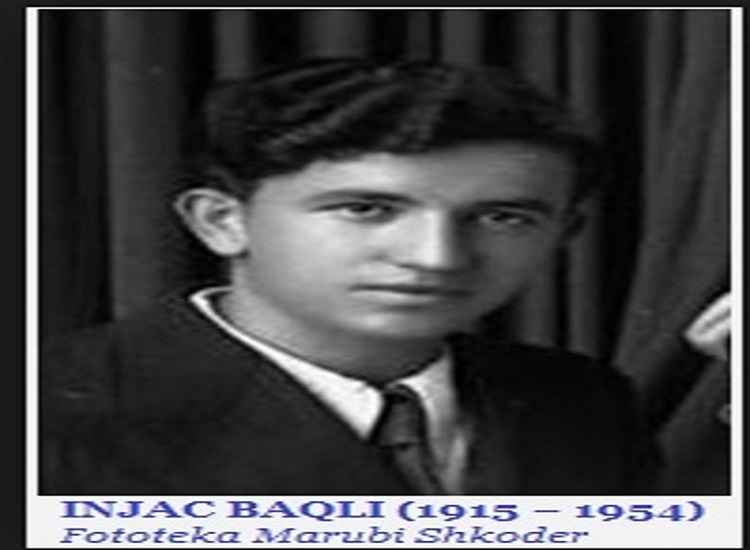
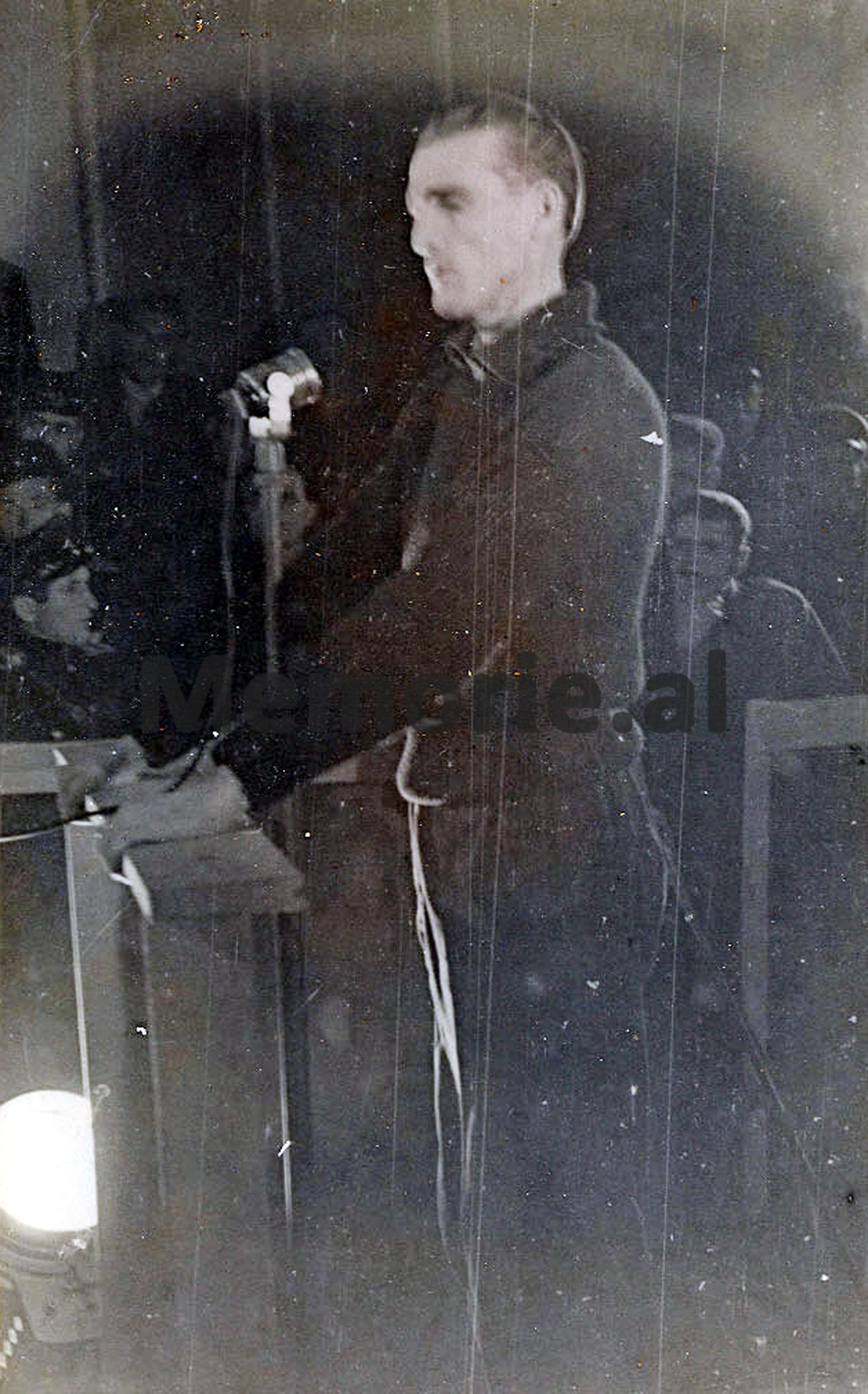

Memorie.al / Injac Baqli were born in Shkodër in 1915. He was an employee at the Albanian State Bank in Shkodër. A large, healthy man, ruddy-complexioned, with curly hair – always well-kept and combed. He appeared even more handsome because he was always seen smiling. Known in narrow circles for his subtle humor. His bearing revealed a true intellectual. I did not know him closely, but I know that he had a great friendship with Prof. Gaspër Ugashi, as they were also each other’s child’s godparent. You would often see him near “Dugajtë e Reja” (The New Shops), because he passed that way on his way to work at the bank. He left me with an impression during those days that I never saw again: I was reminded of the highlanders’ saying: “Better not to have something that even a rifle cannot do to you!” But this saying was before Slavocommunism became known in Albania.
What communism does to you, not even a rifle can do it to you! On December 22, 1952, Injac Baqli was arrested by the State Security (Sigurimi). His home was searched, and in his mother’s chest a revolver was found. Enough to initiate criminal proceedings. When the investigations begin, it seems as if the case is about illegal possession of a weapon, but that is not the case!
Injac’s mother takes responsibility, saying that the revolver was left with her for safekeeping by lawyer Paulin Pali before he attempted to escape, as he was her nephew. The investigations begin on December 26, 1952. During the course of the proceedings, the revolver case becomes increasingly tangled.
Marko Markoja, then chairman of the neighborhood People’s Council, declares: “Injac had a beautiful revolver back in the Italian time, which he wore in his belt, and as far as I remember, this revolver here does not seem to me to be the revolver that Injac had.” The possibility arises that there was another revolver in Injac’s house.
The house is searched a second time, but nothing is found. Injac admits that the revolver he had during the Italian time he handed in when weapons were surrendered, therefore; “what Marko remembers is not actually this one here, because this one is not mine.”
The interrogator, Second Lieutenant Fahri Kraja, finding himself faced with a stubborn person, begins investigations along the track of “agitation and propaganda against the People’s Power” – a very well-known track in communist interrogations, used to incarcerate someone even without any evidence. A list of about 80 people is the persons with whom Injac has spoken.
There are listed all the residents of the neighborhood according to the order of courtyard gates, the neighborhood chairman, members of the neighborhood council, the party secretary, work colleagues, former schoolmates, old women of the neighborhood who chatted in the evenings on benches by the courtyard gates, etc.
The interrogator listens attentively to how Injac is “unraveling”, but when he asks what all these names are, Injac replies: “You asked me whom I have spoken to; I showed you all the people I greet and talk with every day.” Injac’s irony angers the interrogator…!
Work in finance was not simple. At the very beginning, when people started working, it seemed as if these people were privileged, but in fact the great lack of cadres had allowed some people to enter work in many enterprises as financial officers.
When some cadres who were more reliable than those taken on out of necessity began to emerge, then the replacement of the initial cadres was considered. In many cases they were fired from work for violations of the law, because the laws changed every day.
But when it came to dealing with respected people, then they acted differently. Cases in Shkodër have not been few, e.g., Kel Abati, also a bank employee, are known to have been shot only by some person who wanted the physical elimination of Kel.
The same was done with Zef Darragjati and Çezar Shllaku, after they were sentenced to death for “deficit”; at the end of the requests for pardon, it was noted: “… comes from a family that does not like the Power, therefore the capital punishment should be given … etc.”, as in the case of Zef Darragjati, whose file still contains the note by Aranit Çela.
Apparently, this was also happening to Injac Baqli; he was also a cousin of lawyer Paulin Pali, suffocated a few years earlier in the cells of the Sigurimi. He was also a cousin of Father Aleks Baqli, arrested as a Franciscan and sentenced to many years in prison.
On March 4, 1953, after four months of investigation, the interrogator informs the head of the Sigurimi of Shkodër, the criminal Hilmi Seiti: “The defendant Injac Baqli does not sign the proceedings”!
On May 22, 1953, Injac writes at the end of a record of interrogation: “I do not agree with the content or the form, because these are not my statements. The defendant: Injac Baqli, d.v.” (Handwritten).
After almost a year of torture, toward the end of 1953, it is Petraq Janko who gets the interrogator out of a difficult situation, declaring that in 1952 Injac wanted to escape with Petraq. Moreover, they made plans and preparations together for this purpose.
Besides escape, Petraq also charges Injac with political conversations, portraying Injac as a person discontented with the Power, etc. The accusations increasingly aggravate the case. Injac continues to remain firm in denying all of Petraq’s statements. The interrogator organizes a confrontation, bringing Injac in handcuffs.
Petraq repeats the accusations in front of Injac, confirming the record of interrogation with his signature. Injac declares: “If someone comes forward and proves to my face that Petraq Janko’s statements are true, I accept, without any objection, even the capital punishment. This is the reason I do not sign the records, because nothing I am accused of is true”! Injac Baqli, d.v. (File No. 1989)
Interrogator Fahri Kraja prepares the indictment:
– “Injac Baqli handed over his own weapon, whereas the one found belonged to his cousin Paulin Pali (executed).
– He was a spy in the service of fascism.
– He spoke against the People’s Power, because he holds hostile views.
The above accusations are also confirmed by the statements of witnesses: Zef Berdica, Ndoc Deda, Marko Marko, Petraq Janko.”
Below the document it is noted:
Approved: N/Col. Hilmi Seiti d.v. Approved: Head of the Investigation Department (N/Col. Nevzat Haznedari) d.v. Approved: Commander of Unit 2111 (Dhimitër Gjoni) d.v.
The Judicial Body of the Military Court of Shkodër, composed of: Chairman Faik Spahija, members Rexhep Haxhiu and Marko Demiri, and prosecutor Njazi Zjarri, issue the verdict against the defendant Injac Baqli: 6 years imprisonment.
The High Court of Tirana orders a retrial, because the interrogation records were not signed by the defendant Injac Baqli. The trial is repeated on July 18, 1953, noting: “… for the crime of weapons possession (American ‘Gold’ revolver, with 5 cartridges) he is declared innocent. The other accusations remain…”!
On January 29, 1954, Injac makes this request: “I request the annulment of the verdict and the return of the acts for review and retrial. Injac Baqli d.v.” From December 22, 1952 to January 29, 1954, the records of interrogation continued to be moved back and forth among the files of the Catholic Section in the Internal Department of Shkodër and into the secret basements of the Ministry of Internal Affairs in Tirana.
It continued only with the notation “approved” by the unparalleled criminals Hilmi Seiti, Nevzat Haznedari, Fahri Kraja and their associates. Slanders were enough to torture the innocent, and the case continued endlessly…! Due to the use of electroshock, Injac’s health deteriorated. His heart could no longer endure. They would formally send him to the basements of the civil hospital of Shkodër, but the doctors’ reply was: “Why do you bring him in vain, as long as you continue your work”?
Nurse Angjelina Martini told me how: “one day, having no pillow to support him, because Injac was losing his breath, I sat on his bed and leaned him against my chest. His heart, destroyed by torture, wanted to jump out of its ribcage whenever it gave a beat as a sign of life. He was in agony, only squeezing my hand with which I tried to calm him, rubbing his chest.
He was talking with a friend of his, Mikel Guli, with whom he seemed to be playing poker. At one point, he fell into a kind of peace and gave up his spirit. I made the sign of the cross and left the room. Two policemen came and, wrapped in a blanket, they took him to the morgue. I learned that they had sent him to Tirana.
There, they sent him to the morgue and, according to the testimony of Dr. A. D., who was then a student at the faculty of medicine and is now a doctor in Shkodër, Injac Baqli was dismembered by students for study, because he himself saw Injac’s head with his own eyes, whom he knew very well.”
Thus, file No. 1989 was closed, with the notation “approved” by N/Col. Hilmi Seiti d.v., a registered criminal insatiable for Shkodër blood, a victim of whom is also the New Martyr, the innocent 39‑year‑old, Injac Baqli. / Memorie.al