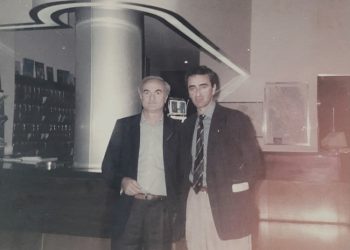
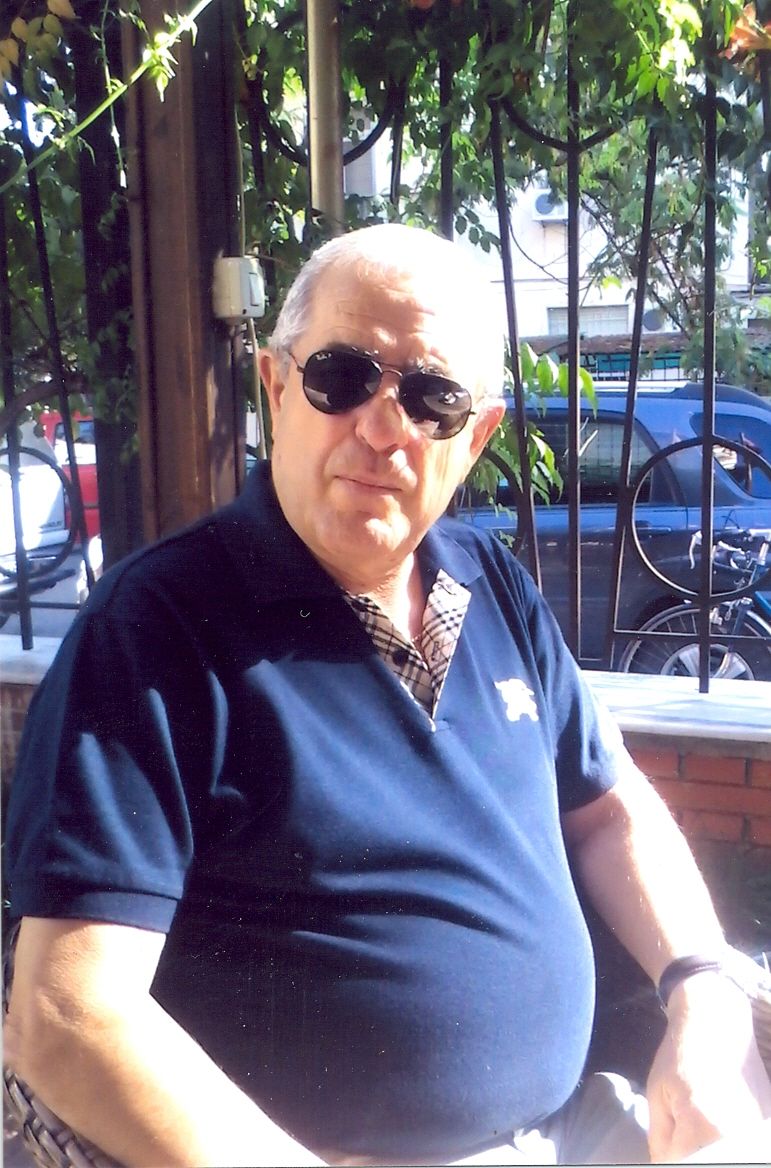
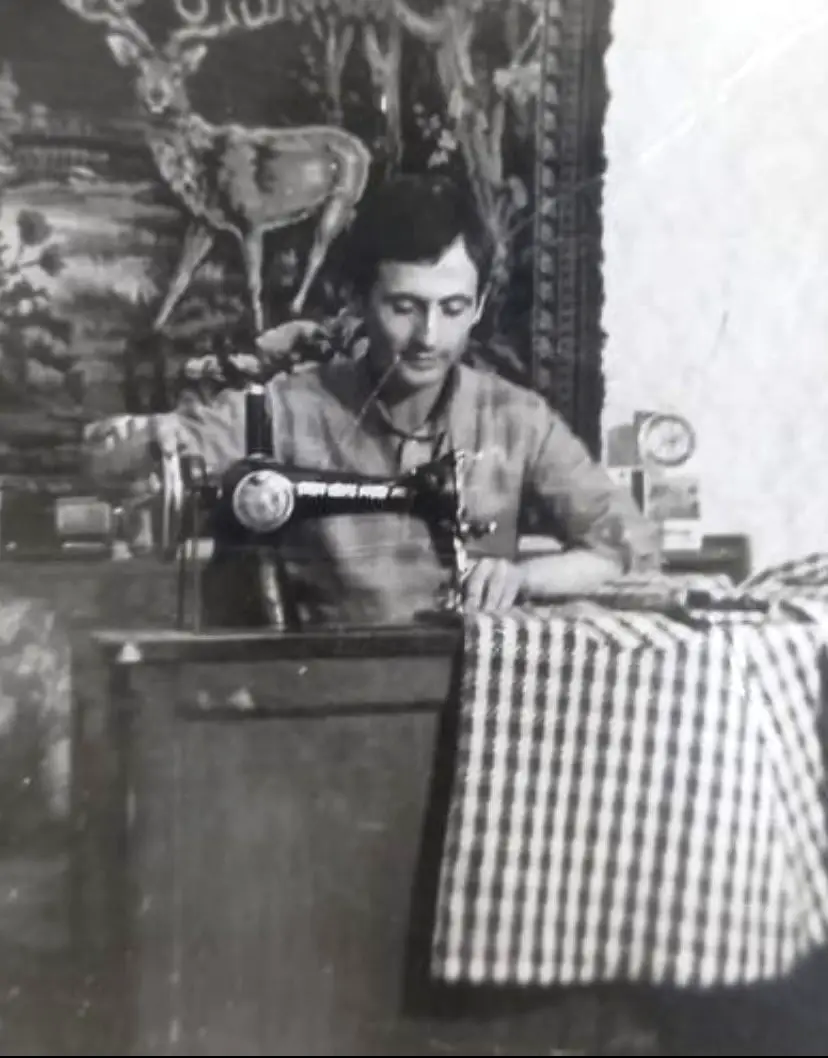
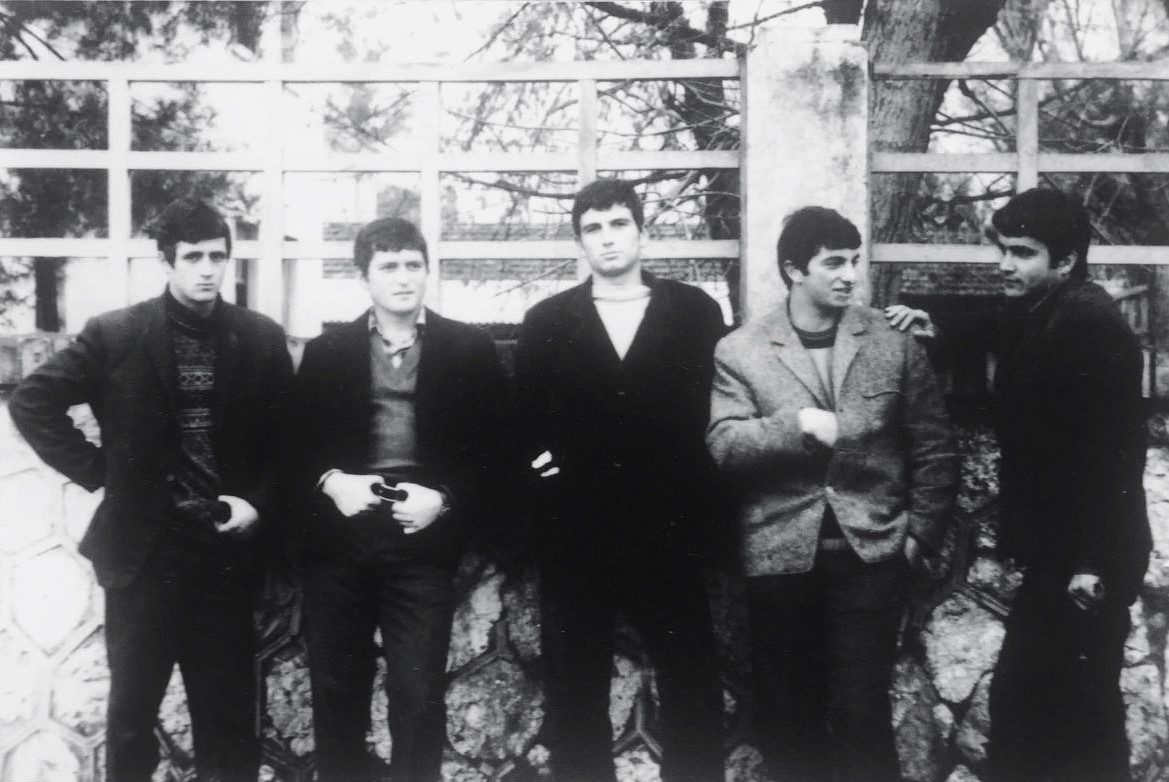
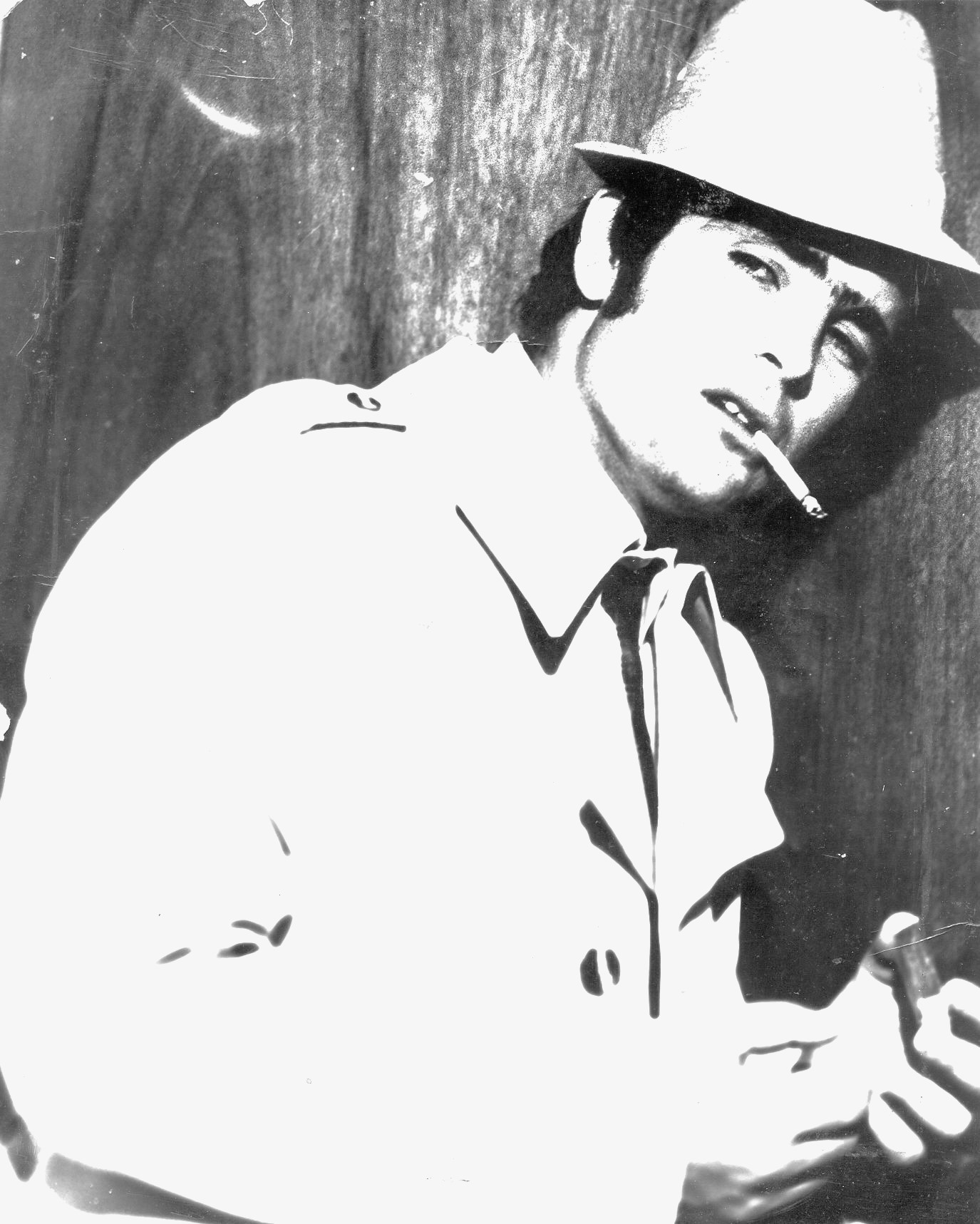
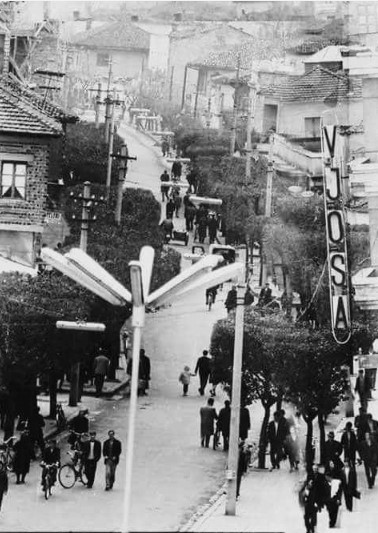
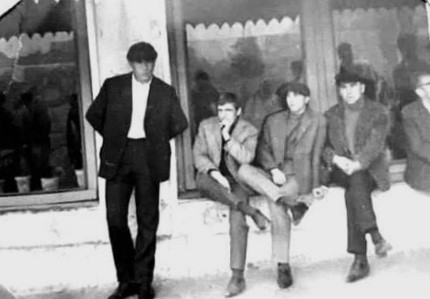
Memorie.al / Anyone who sees his youth photographs today finds it impossible to believe that he was an Albanian boy of the ’60s–’70s! It is easier to believe that he is a film actor. A physical education teacher by profession, Beb Daliu was among the charming boys of Tirana, one of those who brought fame to that street. A unique character, with a beautiful, elegant physique, he stood out for the trendy clothing of the time – a true “playboy.” An admirer of Alain Delon and passionate about motorcycles, Beb Daliu would also become a reason why young people began frequenting that street. Today, many years later, Bebi goes back in time, showing us the “secrets” of the Albanian “Broadway.” Regarding these and more, he introduces us to his exclusive interview, which we are publishing below in this article.
Mr. Daliu, how did you become connected to that street?
The beginnings go back to the early ’60s, quite by chance, when someone brought a photograph of “Broadway” in New York. We had just started frequenting “Dibra Street,” as it was a central road with movement, shops, and lights that gave it vitality, usually in the evening until the intersection with “Barricades Street.” There were no famous theaters, but the presence of the Opera Theater and the Folk Song and Dance Ensemble seemed to bring us a bit closer to the history of the American street.
Who were its frequenters?
There were several friends, such as: V. Rusi, H. Shehu, G. Galanxhi, A. Golemi, M. Oseku, B. Dedja, F. Rroku, the Xhilaga brothers, L. Radovicka, M. Konomi, L. Bungo, B. Tabaku, etc., who started meeting there every evening. Among them was also Dylber Vrioni, a well-known intellectual. I also remember Dash Shehi, Spartak Ngjela, and Bamir Topi, who, although younger, stayed with us. All were university students or graduates.
What was discussed, how did “Broadway” convey events?
Going out, standing there, and the conversations on “Broadway” were linked to the desire and preferences for openness, connection with the West in fashion, music, sports – everything. Every event, both within Albania and abroad, was experienced on “Broadway.” Information received from “Voice of America,” foreign radios, or the few television sets that existed before the ’70s, spread very quickly in the evening, being commented on in detail.
The assassination of Kennedy in November ’63 is remembered, the famous Kissinger-Mao Zedong meeting in October ’71, and Nixon’s trip to China. But we also followed the launch of the spacecraft “Apollo 11” on “Rai,” the moment when Armstrong first stepped on the moon. It was July of ’69, wasn’t it? Then the events of Albanian politics, such as the tense situations after the events in Prague in ’68, the ’70s when an opening was thought of and hoped for, and then the disappointment, isolation, and the point of no return.
What about artistic events?
I remember when Otis Redding and Louis Armstrong died. In fact, a kind of silence was even held on “Broadway” for the latter, and for this event, Tuç Zyma comes to mind – the doctor’s son, very passionate, extraordinary. Likewise, the breakup of “The Beatles,” or when Celentano won “Sanremo” with “Chi non lavora, non fa l’amore” in ’71, which was discussed not only on “Broadway” but also in Albanian political-artistic circles after an article in “Zëri i Popullit.” Naturally, every musical trend of the time and the singers were commented on at “Broadway.”
From Modugno, Don Backy, Charles Aznavour, “The Rolling Stones,” to the Americans Elvis Presley, Tom Jones, etc. There was no lack of preference for the great actors of the time: S. McQueen, Sophia Loren, Claudia Cardinale, Steve Reeves, Marlon Brando, Marcello Mastroianni, Jean-Paul Belmondo, Jean Marais. After the screening of the film “Last Tango in Paris” by director Bertolucci, with Brando and Maria Schneider, the comments on “Broadway” were endless.
We saw it late on a Yugoslav television channel. But Alain Delon was the favorite of all the boys and girls of “Broadway.” We waited for and followed his films with passion, such as “Rocco and His Brothers,” etc.; we even liked to imitate him.
Were there girls who went out to “Broadway”?
Those from elite families, mainly high school and university students, began to frequent the outings to “Broadway,” and in the evening they would pass through there, but without staying. Such were I. Zyma, I. Herri, L. Preza, L. Këllezi, H. Këllezi…! They were modern, beautiful, and intelligent girls. Over the years, the frequenting increased; in winter, during bad weather, rain, and cold, or on summer evenings, passing once through “Broadway” turned into a preferential ritual. We all knew each other. But that beautiful blue-eyed salesgirl at the flower shop—I would consider her one of the first “Broadway girls.”
Was it frequented by artists and athletes?
Being in the center, the street offered contact with artists and athletes, and the main events of those years were quickly conveyed to “Broadway.” Certainly, the soloists of the Opera Theater and the dancers of the Ensemble could be found there after the shows. Even the festivals, the singers, and their composers – Agim Krajka, Sherif Merdani – were part of the street. But the choreographer, the well-known master Panajot Kanaçi, was one of its unique characters. A speaker of five languages, he had great culture and was an admirer of “Broadway.”
Then others: Bujar Kapexhiu, Saimir Kumbaro, Lionel Konomi, as well as well-known athletes like Skënder Hyka, footballer for “17 Nëntori,” Gavrosh Lëvonja, Piro Koleka, Ardian Fullani. Their contact with the world and then coming to “Broadway” gave a different atmosphere and a Western hope to the street. I remember George Best, who was held at Rinas to have his hair cut; the arrival of West Germany with Beckenbauer, Overath, Müller; Oransoda with two Americans; and the Dutch of Ajax with a style of dress and appearance just as we preferred.
On “Broadway,” Serie A was followed – Inter, Mazzola, Boninsegna, or Rivera’s Milan (of which I am a fan) – and the English league. But what I do not forget are the boxing challenges Benvenuti-Monzon and Clay-Foreman. Especially the latter… It was October 30, 1974, a Tuesday, at 04:00 in the morning; we watched it on Italian television. The next evening, everyone was on “Broadway” to comment on it. We were fans of Clay; he won in the eighth round…
Kadare lived nearby; did he often come out that way?
The literature of the time, favorite books and authors, but also forbidden ones, circulated secretly; these are even the years when an opening was thought of and hope was high, which we felt during our frequenting of the long-awaited evenings on “Broadway.” A big signal was given to us by the publication of the book “The Winter of Great Solitude” in 1972, where Kadare talks about the Albanian “Broadway,” giving the sign of the beginning of a liberalism and freedom of thought, although it was later given for republication for changes – but Kadare did not touch the “Broadway” part.
Having his house there, he along with Elena passed by almost every evening. But the film “Silent Duel” was also a message of hope for everyone. The fact that they showed the film, as well as the acting of Ndrek Luca, Reshat Arbana, or Bujar Kapexhiu in the attempt to cross to the West, immensely provoked the imagination and the dream.
Could it be called a “romantic” street?
“Broadway” was frequented by select elite of Tirana, a group of young people, boys and girls, who for the time reflected a progressive mentality. “Broadway” was very sentimental and romantic when, in the rain with an umbrella under a tree, or on a bright evening full of lights, you waited for someone or would find them there where looks would cross, after which some of the most sensational loves of Tirana erupted.
But also the singers Justina Aliaj, Ferdinand Radi, Vaçe Zela, Bashkim Alibali, Dorian Nini with their songs; “Sot jam 20 vjeç” (Today I am 20 years old), “Lemza” (The Hiccup), as well as the song “Rruga e Dibrës” that Sherif Merdani sang at the festival, brought enthusiasm. Then, the passion for motorcycles was great for us, as a means that gave you freedom. The catalyst was the film “The Great Escape” with actor Steve McQueen. Not only for me, but also for several friends like Tim Xhilaga, the brothers, and the sons of the well-known doctor, Nand and Tuç Zyma.
And was the center of fashion there too…?
Clothing and the latest news were demonstrated with pleasure, and the narrow street up to the Bonboneria served as a fashion parade. Some received them from abroad, someone bought them at the currency shop or the commission shop, as well as athletes and artists who had the opportunity to go abroad and bring clothing that was preferred for the time. On “Broadway,” “blue jeans” were seen for the first time, or cowboy pants – a model that came from “Western” films with actor Clint Eastwood.
In fact, Tim Xhilaga made a pair of those with gray duck cloth, quite extravagant: 24 cm narrow at the knee and more than 30 cm at the feet. Also, leaving long hair and thick sideburns were very much preferred. We imitated famous actors, especially Hollywood ones.
Did the “Bllok” children come to “Broadway”?
They were a great hope for us. They frequented it regularly, although they avoided staying, but they would pass there almost every evening. Being a child of the “Bllok” or the Politburo and simultaneously a “Broadwayer” was an important signal for us. I will remember Agim Myftiu, Spartak Ngjela, or some very modern girls from these families who passed through “Broadway.”
This showed that even though their parents and family members were officials, they were against that ideology, showing through their behavior that they liked us and gave us hope. Even Fatos Lubonja, a charming, modern boy, preferred moving through “Broadway” to go to “Flora.” Whereas for politicians of the time, there was no question of them coming out to “Broadway”…!
Why and how was this street “hit”?
After January of ’73, along with the hit taken by the 11th Radio-Television Festival and the tension of situations in art, “Broadway” was also “hit.” Not that they didn’t know that “Broadway” was a street of dissidence where young people with Western preferences stayed, but like others, the moment came to hit it as well. Staying there became difficult as youth groups appeared, stopping any young person who had fashion tendencies; lightning posters (fletë-rrufe) exploded in workplaces and schools, and “Broadway” began not to be frequented systematically.
You lived on Tirana’s “Broadway,” but have you seen the real one?
I have been to New York several times to follow my son Bruno, a student and basketball player when he played there. The first time I landed, I asked my friends: “Accompany me, I want to see Broadway.” I was amazed. This pushed me to name an activity of mine “Broadway” as well. Meanwhile, I no longer pass through the famous street [in Tirana]. Sadness overwhelms me, as I see it transformed, destroyed, and abandoned—that to which we gave everything from our youth. I keep the memories, the friends, and only nostalgia remains for me. / Memorie.al