By Bashkim Trenova
Part Three
NAZIBOLSHEVISM – LITERATURE AND THE ARTS
FOREWORD
Memorie.al / Historians, political philosophers, intellectuals from different schools or positions have dedicated thousands upon thousands of pages, entire volumes, studies, and articles to the comparison between Nazism and Communism. Generally, their publications and studies focus on the police control of society by these dictatorships, the role of the dictatorial state hierarchy and the head of state as suppressors of free thought, the omnipresence of official propaganda in society, mass massacres and the network of concentration camps, the activities of the police, the NKVD in the USSR (later the KGB) and the Gestapo in the Third Reich. In his book Le Passé d’une illusion (The Past of an Illusion), François Furet notes that Nazism and Communism share the same opposition to liberal democracy and to what they call “capitalist bourgeoisie.” Both ideologies claim to be socialist and use the image of socialism. Communist countries called themselves “socialist.” “Nazism” is an abbreviation of National Socialism.
Continued from the previous issue
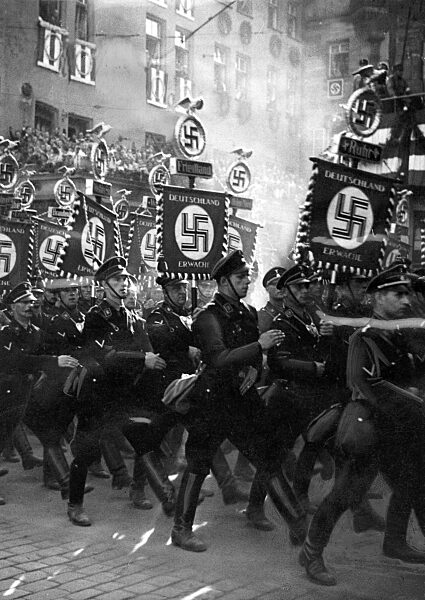
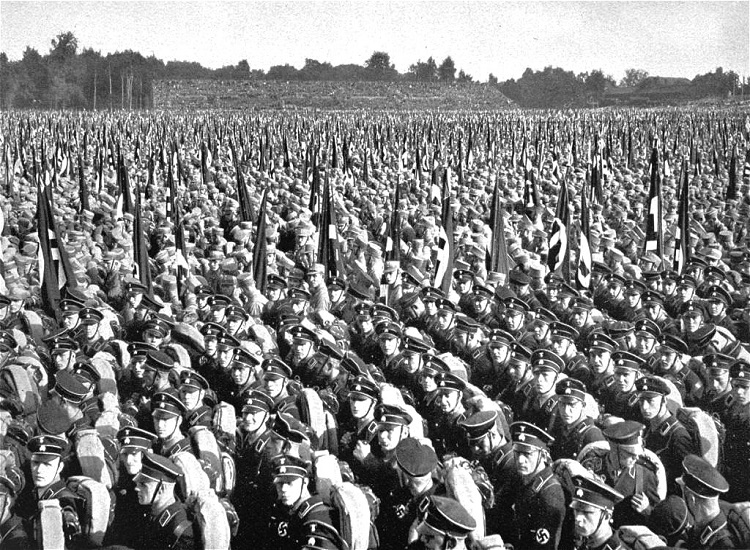
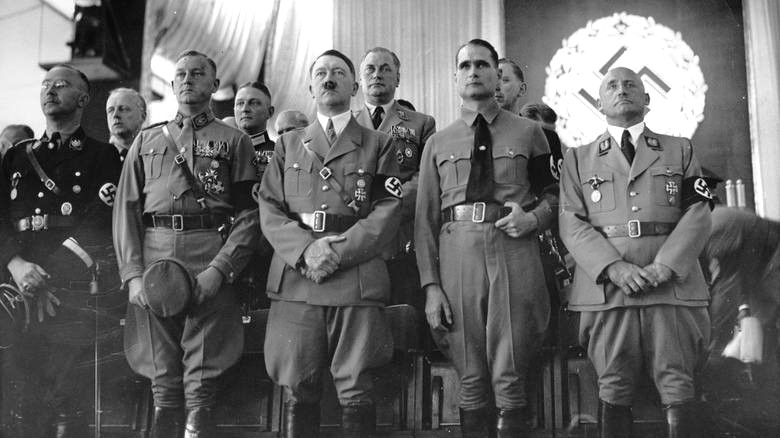
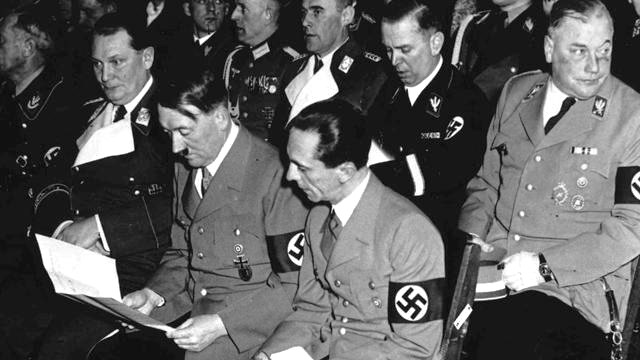
The Berliner Lokal-Anzeiger pays attention to Hitler’s presence at this ceremony and the opening of the session with the song Heroic Festival, part of the poetry collection by Gerhard Schuman. It emphasizes: “in honor of the war and the sacrifice of Adolf Hitler’s soldiers and their final victory.” The article further continues: “The flags have been unfurled, the victory of the Movement has been proclaimed. Right after the silence of the fanfares, Dr. Goebbels takes the floor. He speaks about the achievements of spiritual creators…! Adolf Hitler remains for another half hour at the opera, then, acclaimed by the crowd, he makes a triumphal march through the capital of National Socialist Germany.”
In German Nazi or pro-Nazi literature, Hitler is generally portrayed as the new Messiah, as the savior, as the Christ of our century, before whom everyone must kneel, obey blindly, entrusting him with their future, life, and death. The Nazi Party is like a new church, on whose altar stands Hitler, the undisputed savior of Germany, of the German people, their only hope, and their trampled dream! The entire existence of a nation, its destinies, are tied to him, represented, symbolized, embodied in him! The people, especially the youth, are required to practice a kind of “fides,” i.e., loyalty and submission to this new sovereign.
Thus, in her book Het verborgen licht in het leven van Jacob Boehme (The Hidden Light in the Life of Jacob Boehme), as well as in many of her stories, the author Edith Mikeleitis calls for total devotion to the Führer, following the example of Jacob Boehme’s devotion to God. Boehme is known as a medieval philosopher whose work lies between metaphysics, mysticism, and alchemy. This line permeates not only the German prose or poetry of the time, but also other publications of various kinds.
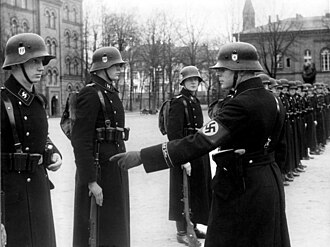
In a propaganda brochure from the “H. Hillger” Publishing House, from 1942, titled Dich ruft die SS (The SS Calls You), in the same spirit, on page 18, the reader is also given the oath of new recruits as follows: “You, Adolf Hitler, Führer and Chancellor of the Reich, I swear to be loyal and brave. I solemnly promise you and all those whom you appoint as my superiors, obedience unto death. May I be cursed if I break this oath?”
Besides the figure of Hitler, many German novelists, poets, ideologues, historians, etc., of the time dedicate their creativity to the National Socialist Party. They serve as its propagandists, as fanatical followers who, consciously or not, aim to instrumentalize the multi-million mass of readers, to mobilize this mass into the battalions, brigades, armies of the Nazi Wehrmacht, to shape it merely as a servile tool of power. These Arbeiter der Stirn (Workers of the Spirit) feed the reader with a non-existent world, a phantom world that must be accepted as real. They poison his thought and conscience, exercising a kind of ideological hypnosis, fanaticizing him.
Curt Rosten, highly prolific, published in 1933 Das ABC der Nationalsozialismus (The ABC of National Socialism), a ferociously anti-Jewish book that was reprinted twice more within a very short time. Also in 1933, he published Geschichte der nationalsozialistischen Revolution (History of the National Socialist Revolution). Then, a year later, by the same author, we have Und ihr habt doch gesiegt (And You Still Won), dedicated to Hitler’s failed military putsch in Bavaria in 1923. Werner von Langsdorff is another author who treads on this black asphalt. Starting from 1930, Langsdorff published novellas and novels under the pseudonym Thor Goote. He is known for a trilogy of autobiographical novels, among which Heb die Flagge! (Raise the Flag!), published in Berlin in 1933.
In this trilogy, he deals with one of the classic themes of Nazi literature: becoming a National Socialist. Goote, or Langsdorff, worships to the extreme the “spirit of the front” of World War I. In Heb die Flagge!, a novel of 417 pages, the novel’s hero, named Helmut, shows how National Socialism will lead Germany towards an unprecedented future. The central idea of the novel is expressed in a letter that Helmut receives from Conradi, a friend of his from the front of World War I.
In this letter, among other things, it is written: “Dear Helmut,… I have been a member of the German National Socialist Party for some time now, and I think you should join too, if you haven’t done so already. What the Party wants, you certainly know, and we need people who are ready to devote them wholeheartedly to our cause…! It is clear to me that you are not left-wing! Also, I don’t think you have let yourself fall into the comfort of the centrists! So you can be nothing other than a right-winger, joining a Party where we don’t always look nostalgically at the past without showing, in any case, the strength and courage to build a truly new Germany! So, you have no other choice but the German National Socialist Party.”
The third volume of the trilogy, Heb die Flagge, ends with Hitler at a Nazi rally in 1932 and with the thought that “seizure of power” is an urgent problem. Certainly, the hymns to Hitler and the Nazi Party do not end with the aforementioned authors and quotes from their output. To give a more general idea, we recall that in 1938, the services of Alfred Rosenberg, known as “Hitler’s chief ideologue,” published a bibliography titled Vierhundert Bücher für nationalsozialistiche Büchereien (Four Hundred Books for National Socialist Libraries). Regarding the role and services of Nazi literature, several members of the German Academy of Letters could also be mentioned. Among them, we can single out Werner Beumelburg, known as an author of historical and war novels, a fanatical partisan of the “national revolution.”
Likewise, we can single out another member of the German Academy of Letters: Hans Friedrich Blunck, president of the Reich Chamber of Literature from 1933 to 1945, the most prominent representative of the “Nordic rebirth.” In the period between 1933 and 1944, he published 97 books and 100 stories in the Völkischer Observer and the Krakauer Zeitung. For his devotion and services, Hitler placed Blunck on the list of important, great writers, the Gottbegnaden-Liste (God-gifted List). Furthermore, we can mention Hanns Johst, a high-ranking SS officer, writer, and playwright. His play Schlageter, dedicated to Adolf Hitler, completed on the anniversary of his birthday, is one of the cult pieces of the Third Reich. Schlageter was staged in theaters in over 1000 German cities.
Johst’s dedication: “To Adolf Hitler with manic adoration and unbreakable loyalty,” much like the content of his play, drew the attention of the head of German National Socialism, Hitler. Among the most prominent writers in Hitlerian Germany is Wilhelm Schäfer, author, among many others, of Dreizehn Bücher der deutschen Seele(Thirteen Books of the German Soul), published several times. Schäfer was one of the writers favored by Hitler and consequently, starting in 1944, he was part of the Gottbegnadeten-Liste (God-gifted List) of writers of the Third Reich. Also prominent at the time were Emil Strauss, Will Vesper, Adolf Bartels, the poet of Hitler Youth Hans Baumann, etc.
Nazi writers, playwrights, and poets, and those in the service of Nazism, wrote and published works which, in one way or another, center on the cult of the German or Nordic, Aryan race, war, the front, friendship or comradeship forged in the trenches, the extraordinary combat qualities of the German people, sacrifice and self-denial for German soil, the cult of the leader, and unquestioning obedience to him. Their goal stated or not, was to prepare the population for war.
Also mentioned in this vein is Albert Friehe, a racist political militant of the National Socialist Party and author of many books on racial hygiene. In 1934, he published the brochure Was muß der Nationalsozialist von der Vererbung wissen? Die Grundlagen der Vererbung und ihre Bedeutung für Mensch, Volk und Staat (What Must Every National Socialist Know About Heredity? The Basics of Heredity and Its Importance for Humans, People, and State). He is also known for the exhibition Erbgut und Rasse im deutschen Volk (Heredity and Race in the German People) opened in Bückeburg in 1936. The author strongly emphasizes the idea that some people have no value and, consequently, no reason to live. Thus, on page 45 of the aforementioned brochure, he calls for multiplying the sterilization of those he labels as abnormal, feeble-minded, insane, alcoholics, prostitutes, and those condemned once or several times by the courts.
At the same time, he presents as a necessity the increase of birth rates within the Germanic racial community, which, according to him, is linked to the improvement of the race, its heritage, the creation of famous, special, superior people in all fields, and thus also to the hegemony of the German race over other peoples.
According to the author, if Germans had limited themselves to two births per family, they would not have had Franz Schubert, the twelfth child of his family of fourteen children; they would not have had Johann Sebastian Bach, the eighth child in a family of twelve children; nor Richard Wagner, the last child of a family of nine children; nor the famous Prussian marshal and general, Gebhard Leberecht von Blücher, who defeated Bonaparte at the Battle of Waterloo and was the last child in his family of seven children. Likewise, he mentions Amadeus Mozart, the last child of a family of seven children; Bernd Heinrich Wilhelm von Kleist, or as he is known, Heinrich von Kleist, the genius of dramatic art, the most original of the German Romantic era, the last child of a family with five children.
Kleist is known, among other things, for the fact that in his final phase, his tragic output was directly related to the national awakening or revival and Germanic heroism. In parentheses, we might say that Nazi ideologues and, after them, some Nazi writers or those in the service of Nazism, paid special attention to the creation of large German families and the role of women in this process. Joseph Goebbels, for example, in his novel Michael, published 17 times, writes on pages 41-42: “A woman’s duty is to be beautiful and to have children…! I hate those quarrelsome females who meddle everywhere without understanding anything themselves. They, for the most part, do not know their primary duty: to raise children.” This was in the logic of preparing for war and then for war itself.
Numerous children, moulded with the racist ideology of “racial hygiene,” are bodies to be thrown to the front, to massacre and terrorize peoples deemed inferior in Europe, in the colonies, and elsewhere. Other authors of the time also focus on “racial hygiene,” explaining that a continuous racial mixture, a great neglect of the principles established by nature regarding racial purity, disrespect for the law of blood, and have caused the Germanic race, which once ruled part of the world, to head towards decline. According to them, it falls to the German people, the Teutonic race, through a purifying war, to restore lost qualities to the world, to lead Europe towards a joyful tomorrow, to “de-Judaize” it.
It can be said that the entire literary output of the National Socialist authors of the Third Reich has as its axis the belonging of the German people as a chosen people, called upon to save or revive not only Germany but all of humanity. It seeks to inculcate as natural the dangerous idea that the German people, as a pure race, consequently superior, is the obedient and invincible soldier of this sacred mission. Martin Staemmler, co-editor of the journal *Volk und Rasse* (People and Race), is among the most prolific in this field.
We can mention some of his publications, such as Grundtatsachen der Rassenkunde und Der Rassengedanke des Nationalsozialismus (Basic Facts of Racial Studies and the Racial Thought of National Socialism) 1936; Rassenpfleg und Schule (Race Protection and School) 1936; Die Auslese im Erbstrom des Volkes (Selection in the Hereditary Stream of the People) 1939; Rassenpflege im völkischen Staat (Race Protection in the National State) 1939; Deutsche Rassenpflege (German Race Care) 1942.
The author is concerned about the unfavorable condition in which the German people find themselves as a result of their lack of attention to the racial problem. He analyzes the laws of heredity, natural selection, to reach the conclusion of the necessity to annihilate inferior races and establish a racial legality. According to Staemmler, the state administration must ensure strict compliance with this, and its foundations must be taught from school benches. Only thus, Staemmler prophesies, will the “national revolution” be successful. Others like Hans Reyhing and Christian Jenssen, in their publication Die Deutsche Glocke (The German Bell), an anthology or collection of texts by classical and Nazi authors, exalt the “German racial-people’s spirit.”
Numerous publications during these years are dedicated to the roots of the homeland, the cult of ancestors, and the reconstruction of the past as a secure key to the future. Generally, they are permeated by a pseudo-romantic or regressive, non-rational romantic spirit, by mystery and populism, by Germanic vitalism through the centuries. German authors of the time, in active support of Nazi policy, racist, elitist ideas and practices, idealize and glorify the village and peasantry as guardians of race and popular traditions, faithful to the values of the German people. They treat the peasant as an “eternal hero.” Hans Reyhing published in this spirit the trilogy of 1,200 pages, Der Tausendjährige Acker (The Thousand-Year Field), dedicated to peasant life.
The author deifies the German roots deeply embedded in the German village. He sees modern civilization as pollution that endangers pure German blood. Through the characters of his trilogy, on page 605, Hans Reyhing states: “Even in the thousands of years to come… we will have, without any reserve, faith in our field… in this field that God has granted us as a shelter for our existence, as a tablet on which we write our name from generation to generation..! It is the frame and space where our destiny is realized. Only by starting from this concrete reality, from this defined space, will we find our way to the Racial Community, the Reich, and God.” / Memorie.al