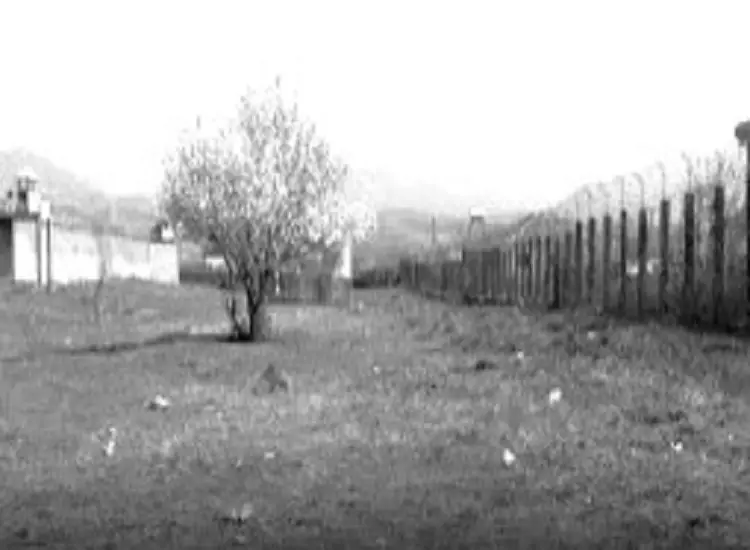

Memorie.al / Ali Kurti was the most infamous policeman of the Burrel prison. It is unknown how many political prisoners died or were tortured by his merciless hands and spirit. They even say that he was so trusted and supported by the Interior Minister of the dictatorship that, whatever Ali demanded or said in that prison, the commanders were forced to obey him. Indeed, whoever came and went as a high-ranking prison director stood at attention before Ali, who had served there since the very first day the prison was populated with opponents of communism – nationalists, clerics, and the cream of Albanian intelligence. I had heard about this monster from early prisoners when I found myself among the desolate mountains of the Spač prison, but only that much. No details, no other description of him.
Only as a man with a pitch-black soul, with a black face, as is usually the mental image of a killer who murders and tortures innocent people. I later heard that he was also one of the main characters in Arshi Pipa’s book (“The Prison Book”), published in the West, as soon as he had escaped from Albania.
His accounts had attracted the best Western directors, and the book was made into a film in record time. They said that this film had left a great reputation, revolting many citizens of the free world over the massacres of Albanian communists in Burrel prison. In the film, “Ali Kurti” had surpassed even the Nazi executioners in torture, so much so that a German officer emptied his pistol at the screen…!
When I myself ended up in Burrel Prison, immediately after receiving my second and severe sentence due to the uprising we political prisoners had staged in Spač prison, I saw and came to know the terrible Ali up close. Completely different from how I and many others like me had imagined him, based only on hearsay.
Thin, blond, with eyes as pale as whey just out of the cheese vat, he reminded you of a weasel scrambling up a tree to catch its prey, or of a fox which, unable to snatch a chicken that has perched in a tree, stares at it for a long time with its whey-like eyes until the chicken very strangely falls to the ground.
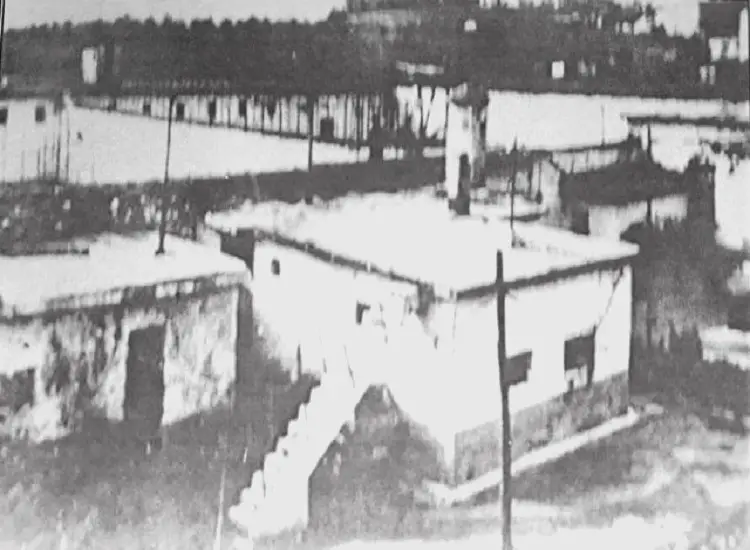
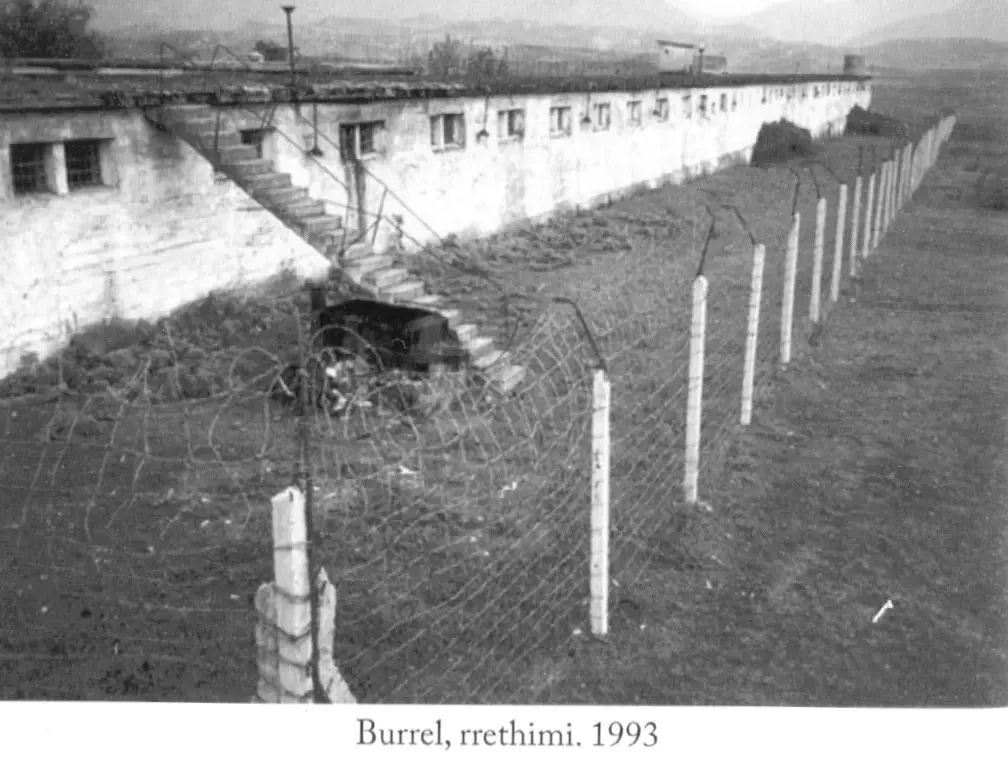
I saw this second strangeness with my own eyes on one of the occasions when a prisoner, a bold and defiant man like Adem Allçi – always hungry, whenever he got angry and revolted against the prison command – would climb onto the roof of the bathrooms in the middle of the courtyard, surrounded by a 2-meter-high wall topped with barbed wire from the Kavajë factory, and would not come down until his demands were met.
He would wrestle with the policemen, bleed with them, but he would not leave the roof. But when Ali Kurti approached, having ordered the other policemen to surprisingly withdraw from surrounding the roof, everyone was astonished at how the furious Ademi would calmly descend the stairs that Ali himself would have carried there, walking in front of this man who spoke to him in a low voice without threats, until he locked himself in his own cell, while the infamous one continued his duty as if nothing had happened…
I had heard that whenever the defiant Adem Allçi climbed onto the roof, if Ali Kurti was not on duty, they would send people to fetch him from his home…! On one occasion I was in the dungeon… I had been suffering from hunger and cold for fifteen days, in the unforgettable winter of 1975.
In the dungeon next to me, on the right, was Koço Tashko, the brother of the famous singer Tefta Tashko, one of the most important figures in the founding of the Communist Party in Albania in 1941, an elderly man who moaned from pain and cold, while on the other side I had Gjin Marku, one of the main generals of the National Liberation War, as the communists called it, who never stopped doing physical exercises while tirelessly singing their Internationale…!
Because of these two, Ali had chained me twice to the iron rings embedded in the wall, because I shouted about Koço being left to suffer in the dungeon from cold and hunger, while I loudly scolded the famous general to stop singing that damned song, which inspired the torturers to increase our sufferings even more…!
Although I had not yet been exhausted to the point of talking to myself, or seeing figures of dead people and ghosts on the dungeon walls – as usually happened to all political prisoners who served extra sentences in the icy dungeons of Burrel, as in my case, or in the cases of Koço Tashko and Gjin Marku – because the regulation for such punishments was merciless: they were given in the dead of winter to torture the enemies as much as possible in dungeons shaped like hexagons, with concrete and icy walls… with a narrow window above, where at night a lamp blackened by cigarette smoke and cobwebs glimmered – those were all that a man could possess in the “Siberia” created by one brother to torture his own brother…!
Each meal in the dungeons was waited impatiently, in order to gulp down the gruel brought by the command and a piece of dried-out or moldy bread. After this devouring, which never satisfied you, in the blink of an eye you would also take one of your own cigarettes, kept by the policeman outside the dungeon door. (From the outside, of course).
One day when Ali Kurti was on duty, for the morning meal, he had given me one cigarette paper and enough tobacco, as he thought sufficient for the capacity of the paper I would roll. He had also given me two matches, so that if one didn’t light, the other would serve me. Fortunately, I lit the cigarette with the first match. At lunch, according to the rules, Ali again gave me one cigarette paper and a pinch of tobacco as he thought necessary.
He also gave me two matches, because we kept the lighter with mercury inside the dungeon. I told him sincerely, without any ulterior motive, that I didn’t need two matches, since I had one left over from the morning. He looked at me attentively and, when he saw the matchstick I was holding in my hand, he bent down, took the bundle of leftover papers and a handful of tobacco, and gave me all of them, together with the spent matchsticks…! And he left.
I was surprised by his action; to tell the truth, it made me think, but I didn’t dwell on it too much, because instantly I remembered his case with Adem Allçi…! I said to myself: “No matter how much of a criminal a man may be, eventually a moment comes when he becomes… trustworthy. It seems that even he is conquered by truth and honesty…!”
What I have related above, I think, needs no oath as to whether it is true or not. There are many who lived through that time and that place, and even Adem Allçi himself, who is still alive, tells these things exactly as I tell them…!
It is not my intention to astonish the reader precisely with unheard stories. Nor to move the nostalgia of the “heroes” of the war for the victory of communism in Albania, as the narrator of “The Silent Heroes,” Mark Dodani, has told them and continues to tell them to this day…!
What makes my skin crawl is the behavior and manner in which today, in democracy, the sons and grandsons of the “Silent Heroes…” behave and speak toward the victims of communism, comparing their behavior – even with that of an ordinary, criminal policeman like Ali Kurti was in the dictatorship. / Memorie.al