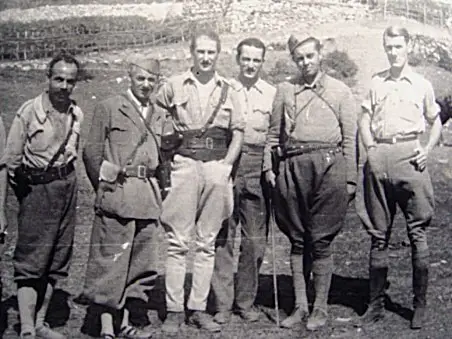
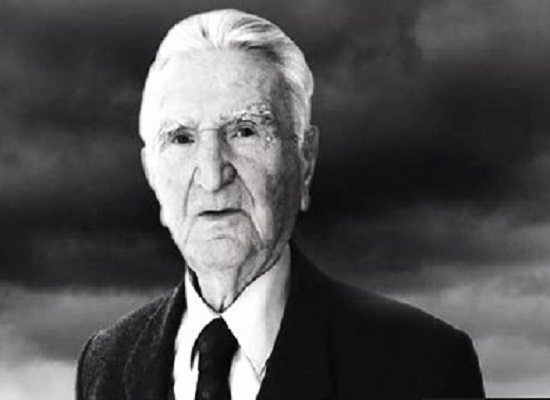

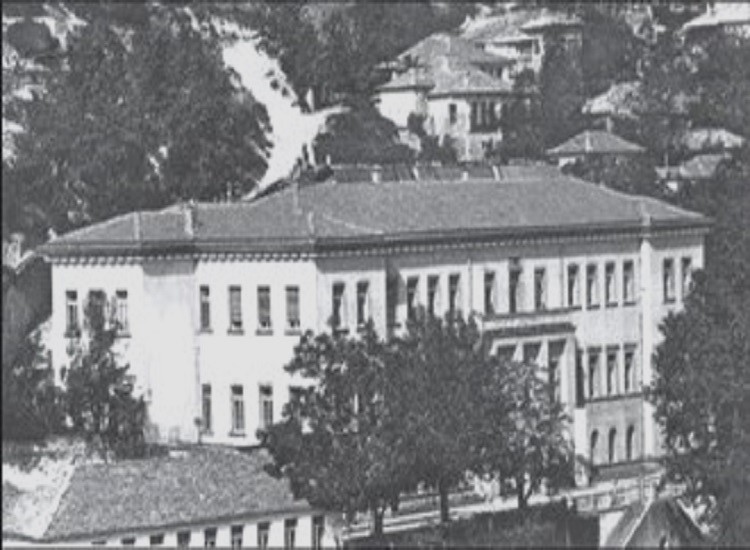
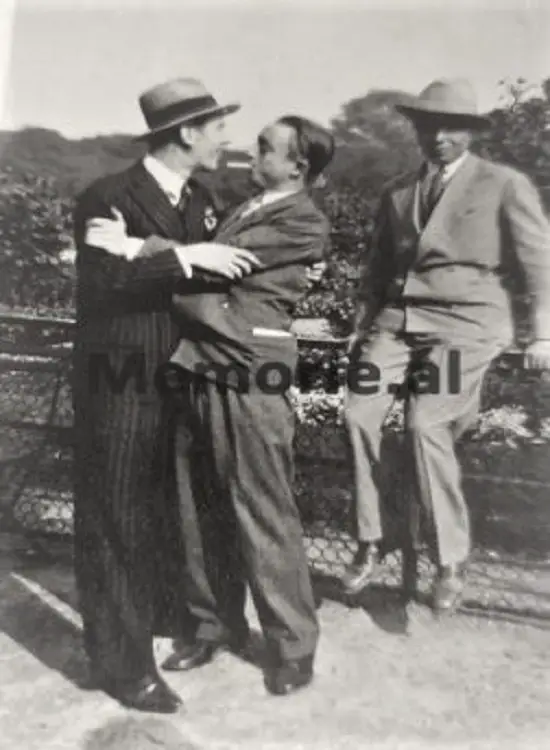


Memorie.al / “Life with Memories” is the title of the historian Arben Puto’s book, in which he recounts his childhood, youth, and then his career. It also includes his friends from different times, his studies in Gjirokastër, Korçë, and later in Italy and the Soviet Union. Today we excerpt from the book a part that recounts his youth, highlighting what the professor himself says: this is not history, these are memories (where Qazua is the father, Nefo is the sister).
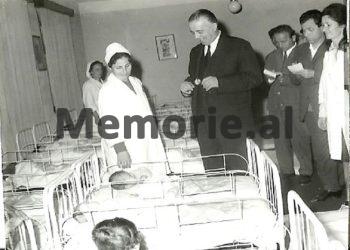
In the second grade (seventh grade), our teacher came as Enver Hoxha. It was the year 1937. He came from France. He spoke French well.
His appearance made an impression: tall, handsome, elegant. He was the youngest, 28-29 years old. From him we heard for the first time about events and names from French culture, literature, and history. His favorite topic was the French Revolution with its great principles Liberté, Egalité, Fraternité. When he spoke about the guillotine, he would add Robespierre’s words that revolutions are not made without severed heads.
Personally, I felt that he held a grudge against me in teaching; I didn’t get good grades, like those I was used to receiving. At the end of the year, he gave me the second prize (prix d’application). Much later I gave an explanation. In those years, Enver was in the Communist Group of Korçë. In class, he never spoke to us about ideology or politics. But he maintained an attitude. Enver knew the Gjirokastër families; he knew that I came from the wealthy Puto family. It was class struggle.
He encouraged students from modest family backgrounds. He treated us well; he was not gentle, but neither was he harsh, he did not punish, he did not hit. It may seem unbelievable, but it is a fact that he did not raise a hand. Many years later, in conversations within narrow circles, we, his classmates, would wonder at what was happening and say in a low voice: “Man, how is it possible, in class he never gave us a slap.”
The first two grades were preparatory, devoted mainly to French. The main subjects were taught from the third grade onward, almost all in French. Each subject had its own teacher. There were also French professors for some subjects, first and foremost for French, the history of France, but also in mathematics and physics. Even our teachers taught their subjects in French. I remember Abaz Ermenji, who taught the History of Albania, also in French.
Enver had the opportunity to show off his French with Morali. The only teacher who spoke Albanian was Stavro Skëndi, who taught the Albanian language. Historical events would show that they were three completely different figures: Enver, Abazi, and Stavro. The first in the Communist Group of Korçë, while the other two were members of the ‘Balli Kombëtar’ (National Front). The latter two went into exile: Abazi to France, Stavro to America.
Meeting with Enver Hoxha
In the autumn of 1939, I spent two or three months at the Gjirokastër High School. But my father, Qazua, wanted me to continue my studies at a French school. It was known that there was such a school in Rome. It was the Lyceum named after the great writer Chateaubriand. I came to Tirana to do the formalities. A particular encounter remains in my memory.
One day, while walking on “Rruga e Dibrës” (Dibra Street), on the sidewalk I saw my teacher, Enver Hoxha. He stopped me. He had found out and told me: “You are leaving, all of you are leaving.” In a word: “Zogu is gone, you leave too.” In fact, there were about seven or eight of us. Now he was engaged in the Resistance Movement. I didn’t understand anything.
Between Communists and Ballists – Face to Face
In September 1942, Bahri Omari arrived in Gjirokastër with some comrades. They came to organize the branch of Balli Kombëtar, the first anti-communist nationalist organization. The meeting was held at our house. Bahri was a close friend of Qazua. The house was divided into two camps. Even the family was split in two.
He called Bedriu, Nefo, and me, and told us to eavesdrop on what would be said at the meeting. We obeyed as children. I only remember Bahri speaking about the communist danger, but on the other hand, he sought reconciliation and a common front against the Italian occupation.
Qazua brought a proposal and it was decided to hold a joint meeting at the “Second Manalati”. They faced each other, Bahri with his men and Bedriu with rows of full (?) [Likely meaning their own people]. That dramatic moment is fixed in my memory: Qazua at Bahri’s side, me and Nefo at Bedri’s side. This was the first separation from our father. But Qazua did not make a fuss, did not get angry, and did not scold us. That was the way of uncles. There was no debate at the meeting; there was a clash.
Bedri used the occasion to show off his oratory. He made a pretense, similar to what would be done to Bahri at his trial in 1945. He spoke at length about the expansion of the Movement, about the actions of guerrilla units in the city, and about the actions of bands in the district. To the call for unity that Bahri pretended to plead, Bedri responded with the well-known argument: “You do not fight. You fight so that we unite.” In truth, they did not want rivals, and they showed that they would never become so. After the meeting at the “Second Manalati”, the parties fell into open conflict.
Reflection
I have had to judge myself more than once for our behavior. At this point, it is normal to ask: How is it explained that we, children of a wealthy family, raised with care and with all the good things of the time, took the side of a current that inspired deep mistrust in our parents, who saw it as a great danger to their wealth?
I pose the question all the more when I remember that my father, Qazua, sent me to Korçë and to Rome, took Nefo with him to Bari to treat a mild skin condition, and took my little sister Ado to Corfu and then to Athens for a tonsil operation.
The question arose not only for us, but for all those boys and girls from wealthy families throughout Albania who became committed militants, even giving their lives, disregarding their comforts and wealth.
The answer is the same for everyone. Almost all the youth were on this side. It was about communism. We knew nothing about it. We were hearing the name for the first time. We knew that the aim of the war was the liberation of Albania and a more just society, unlike that of the Zogist period.
Even as adolescents, we saw the condition in which the village, in particular, languished. Migjeni’s writing “The Legend of Corn” was passed from hand to hand in the dormitory, carefully so as not to catch the eye of Mr. Ahmet. It was an extremely attractive ideal for young people. And not only for young people.
Later, fascism, Nazism, and communism would be placed on the same plane, almost as synonyms. But it hasn’t always been that way. At the beginning of their emergence, communist ideas had a strong attractive power. There were illusions; it seemed like a great idea that would transform the world, would oppose the old political-social order, wild capitalism, and would establish social justice.
In fact, communist ideas were spread by high personalities after the October Revolution in Russia. They were scientists, like A. Einstein and P. Curie, writers and thinkers, etc. Contact with the reality of Soviet society marked the end of the illusions. After the visit he made to Moscow on the occasion of Maxim Gorky’s death in 1935, A. Gide distanced himself definitively.
Nevertheless, the idea of communism as a doctrine of progress and justice did not die out; it survived. Moreover, it had a wide reach during World War II, especially in the movements against the fascist powers in the Balkans. The idea has not died out even in our time. There is still a debate. So, the idea is discussed, but that does not mean there is a decisive argument for returning to the communist experience.
A French philosopher says that the communist hypothesis must be reactivated. It cannot be accepted that in the world, 10% of the population holds 80% of the resources. It was no accident that communist ideas won over wide circles of young people in Albania, who lined up on the side of the Communist Party.
So, the conversation about communism was open in our circles. I myself did not have the idea. In the years of transitioning from adolescence to maturity, I was away from the family. I had not even heard the name. At home, Qazua remained silent. But my second uncle, Hazbiu, was very worried. He considered the danger serious. He could not conceive of what was happening no further than his doorstep, especially as an American citizen.
It is understood that the word also reached the ear of my grandfather, Uncle Refat. One of those days, he called me and asked me for explanations. He said to me: “Hey Bene (my childhood name), what are they saying, they want to take our wealth”? I calmed him down, I told him that the goal is for the poor to also eat bread, for their children to be dressed and go to school. This could not be done in Zog’s time, or now in Italy’s time.
Again: “What are you saying that Asqua, Muhedini (the servants) will take my house and my estate?” He also asked for explanations from Nefo, when she gave him some gold. Nefo told him the same thing, that even the poor must live, even those of our neighborhood, whom even you have helped. But this time, the grandfather said: “Look, daughter, lest they become like us, and we become like them…”!
The Massacres in Tirana, February 1944
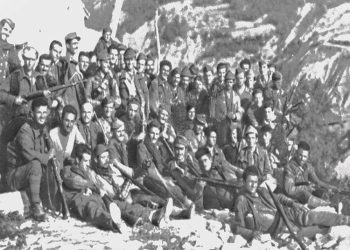
After Italy’s capitulation in September 1943, the fourteen months of German occupation would be the most difficult period. The National Liberation Movement would face a very severe test. During the two-three winter months, the Wehrmacht conducted a large-scale operation. The partisan forces suffered heavy losses.
The forces of the quisling government led by Xhafer Deva, a member of the government, also entered the operation. They undertook a terror action in Tirana. 84 residents were massacred in the streets, whoever they found in front of them.
That day I managed to get the newspaper “Bashkimi i Kombit” (Union of the Nation), which opened with the lead article “Blood demands blood”. It was the call for blood that incited Xhafer Deva to terror, as the only way to defeat the partisan movement. “Blood must flow like rivers in the streets of Tirana … one day of terror secure us ten years of peace.”
In Bed with Children
It wasn’t over. A state of siege was created. German soldiers began to pass from one neighborhood to another, from one street to another, stopping and capturing young boys, not for any concrete suspicion, but simply as potential activists. Alongside them were Xhafer Deva’s Kosovars. I myself miraculously escaped this sweep. A twenty-year-old boy. I found myself outside on the street in the “Shkolla e Kuqe” (Red School) neighborhood when the alarm was given that the Germans were coming, armed and with helmets.
They even entered houses. The neighbors saved me. The first floor of the house communicated with a staircase to the second floor. They took me and put me in a bed with small children who were sleeping. I still vividly remember the chilling noise of heavy boots at the door. The German went up to the second floor, saw the covered bed, and turned back. That night I spent it with the children.
‘Balli Kombëtar’ Enters the Government after the February 4 Massacre
‘Balli Kombëtar’ welcomed the arrival of the Wehrmacht as a chance for revenge. It immediately took the side of the new German occupation regime, especially since Albania was liberated from the Italian occupier. But it did not rush to participate in the government. After the Winter Operation, a turn is noted.
In all likelihood, the February 4 massacre gave the green light to ‘Balli’. It was the ‘coup de grâce’. They thought that the partisan movement was coming to an end. Then the leaders, above all Mit’hat Frashëri, decided to abandon their aloof stance, entering the government. They became party to the policy of terror that Xhafer Deva called the only salvation.
By Mit’hat’s decision, on February 8, only 4 days after the massacre, several key names of Balli entered the government: Bahri Omari, Foreign Minister; Koço Muka, Minister of Education; Kolë Tromara, Minister of Culture. All three were friends of my father, Qazua. When I told him, he said nothing. What could he say when that night I almost suffered the same fate, when the Germans appeared at our doorstep?
I have personal testimony from Seit, of the Selfo family, great merchants in Tirana. Bahri also had family ties with them. Before he took the step, Reis, Seit’s father, called him and together with others from the society, they told him not to accept. But Bahri said it was Mit’hat’s order. Reis cut him off: “Let Mit’hat himself go.” It happened as the elder said.
On Dajt with a Letter for Enver
Some evidence indicates that the high leadership of the Movement did not intend to liquidate Bahri. But neither Enver nor anyone else could do anything now. It would be left to the man of the Yugoslavs, the proletarian, Koçi Xoxe. Bahri committed an unworthy act, unlike his personality.
He entered the government alongside the terrorist Xhafer Deva. This sealed his fate. It was a matter of saving Bahri, who was still in Gjirokastër, hidden since the end of October 1943. The troubled Luan called on me for help, to take a letter to Enver at the General Staff on Dajt Mountain. It’s better to give it as Luan remembers it:
“At the end of October or the beginning of November 1943, I learned that partisans who had entered Gjirokastër after a temporary withdrawal of German forces killed several people who were members or supporters of ‘Balli Kombëtar’ and were looking to kill my father, who was hidden somewhere.
I became worried and after consulting with Arben, I wrote a letter to Enver, begging him to intervene to save my father. I had learned that the General Staff of the National Liberation Army was somewhere in the Dajt area. Arben took it upon himself to deliver the letter and set off, despite the opposition of his father, Qazua, who was afraid that something might happen to his son.
Arben met Nako (Spiro) in Priskë, who said that Enver together with the General Staff had left, but he would discuss it with another comrade, to whom he would also give the letter. Arben returned the next day.”
This case and the letter I sent to Dajt and handed to Nako Spiro shows that Enver himself, as well as his circle, were for saving Bahri. He managed to get out of Gjirokastër, but he would appear before a trial after the Liberation and be sentenced to death, for his participation in the quisling government as Foreign Minister. / Memorie.al