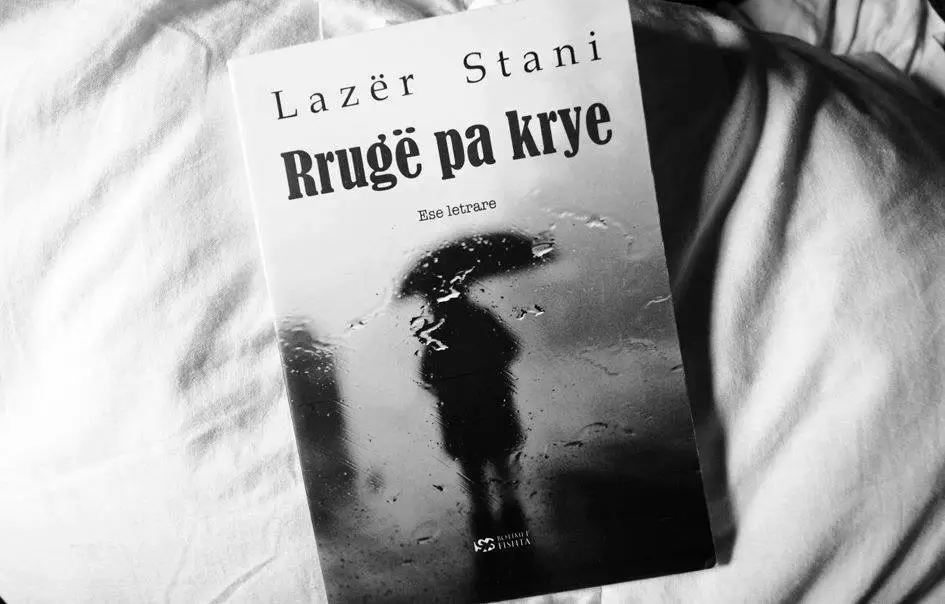

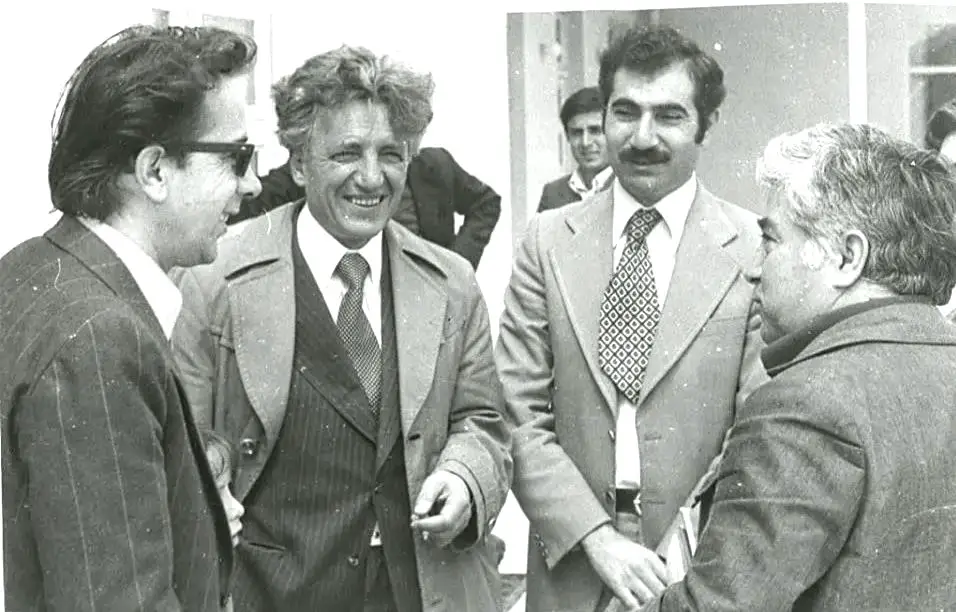
From Lazër Stani
Memorie.al / It is now a known fact that all Albanian literature published after the Second World War until the end of 1990, known by the official term “Literature of Socialist Realism”, is a missionary literature written for the purpose of the communist education of the masses, the creation of a new person, spiritually depersonalized and ideologically infected, or expressed in the terms of the time “kneaded with the teachings of the Party and comrade Enver”. This literature, written in conditions of absent freedom, was regulated as if by law, through the official method of Socialist Realism, and every artistic creation, before being published, was subjected to strict censorship, even though such a fact was never officially admitted. In the “Dictionary of the Modern Albanian Language”, compiled by the Academy of Sciences, from the first edition in 1980 to the latest edition in 2006, and also in the online edition of this dictionary by Shkenca.org, the word censorship is explained as follows:
CENSORSHIP f.
The examination and control of the content of various works, before they are published or shown, or the control of letters, telegrams, etc., before they are delivered, which is done (in capitalist and revisionist countries) by an official body or by a responsible person; the official body that does this work. Strict censorship. Military censorship. Fascist censorship. He imposed (established) censorship. He removed censorship. It escaped censorship. It receives the approval (authorization) of censorship. It passes through censorship. Censorship does not allow it. So, according to the explanation of this dictionary, compiled by academicians under dictatorship, and republished by the same academicians in post-dictatorship, censorship is a control exercised over various artistic works in bourgeois-revisionist countries, but not in a country with “people’s democracy”, such as dictatorial Albania. Even though the existence of censorship was not officially admitted, in practice censorship was sanctioned by a regulatory manual, called the “method of Socialist Realism”, which expressed the conditions, cunningly called principles, for a literary work, or any other artistic product in painting, cinematography, and music, to be acceptable.
Camouflaged censorship
After the Second World War, in the first steps of establishing the dictatorship, the new government took care to extend its control over all cultural institutions, newspapers, and radio broadcasts. All existing publishing houses were closed, as were newspapers and magazines. Magazines that had made a name in history, such as “Hylli i Dritës” or “Përpjekja Shqiptare”, were not only banned, but all existing copies were removed from circulation.
A militant literary commission, established within the newly created Writers’ Union, drafted a long list of pre-war Albanian books and authors who were strictly forbidden, and their works were removed from circulation. The list of the damned by the regime included the most famous names of Albanian culture, the author of the first Albanian novel, Ndoc Nikaj, the greatest Albanian poet, Father Gjergj Fishta, Faik Konica, Ernest Koliqi, Father Anton Harapi, Musine Kokalari, Ali Asllani, and almost all the authors who constituted the pre-war Albanian cultural elite.
Many of the authors who were alive were declared traitors, enemies, collaborators, arrested, imprisoned, executed. All books by foreign authors translated before the war was banned, with the exception of some translations of Greek classics and European classicism. In parallel, with this persecution and punishment of existing culture, new publishing structures were established which exercised strict control over everything that was published and allowed to circulate. The sole Publishing House was established, named after the Renaissance poet Naim Frashëri, through whose filter all publications would pass.
The Publishing House was structured with respective editorial departments for poetry, novels, short stories, children’s literature, drama, and translations. All editorial departments consisted of a head of department and editors. Their sole job was to read and evaluate creations in all literary genres and to allow the publication only of those works that conformed to the written norms of Socialist Realism, were permeated by partisanship, revolutionary spirit, the party line, the orders of the leader for literature and the arts.
Under the names of the editors and heads of editorial departments, the true names of the censors and chief censors were hidden. In support of this censorship apparatus, critics, militant writers, aestheticians, called reviewers, were also employed, who gave a written opinion on whether a work should be published or not. Each work was examined by two or three reviewers, and their opinion sealed the fate of the work. And above this entire camouflaged censorship apparatus stood an office within the Central Committee of the Party, called the Press and Propaganda Office. This office supervised the work of all publishing editorial departments, surveilled, investigated, and punished those editors or heads of editorial departments who, through carelessness, incompetence, or negligence, allowed a publication with ideological errors to slip through.
Punishment, in this case, was not limited to the censor editors, but extended also to the authors and the works, which were banned, removed from circulation, and pulped, while the authors were subjected to disciplinary measures; in the best case, they were dismissed from work and sent for revolutionary education in production enterprises, farms, or cooperatives, to become better acquainted with the revolutionary spirit of the working class, of the cooperative peasantry, with the sacrifices that simple people made for the construction of socialism, or in the worst case, their work was banned, their right to publish was removed, they were interned from the capital, or they could even end up facing criminal prosecution.
The writer facing censorship
After finishing his work, volumes of poetry, short stories, or a novel, the writer submitted it to the respective editorial department at the Publishing House. While he waited anxiously for the response from the editorial department as to whether his book would be published or not, the submitted work underwent a seemingly bureaucratic process, but which in fact involved its passage through the filters of censorship. It was given to two or three reviewers, who read the work with a magnifying glass, taking notes on everything that seemed to them not in line with the party line and the method of Socialist Realism. All these “ideo-aesthetic defects” were reflected in the form of conclusions at the end of the review, which ended with standard phrases; “I think it should be published”, “to be returned to the author for revision”, or “not to be published”.
After the reviews returned to the editorial department, the respective editor read the commissioned reviews, and if the book was to be published, he read it carefully letter by letter, deleting sentences, paragraphs, and whole chapters, replacing and changing sentences, to bring the literary text to the acceptable standards of him, the censor. In the end, he wrote a short report and presented it to the head of the editorial department, who was the person responsible for whether the book was published or not. Rarely did any book pass the first test. In most cases, they were returned for revision, review, even when we were dealing with well-known authors of Socialist Realist literature.
For example, for a volume of poetry returned for revision, the author was listed the poems that had passed the censorship test, he was asked to add some poems about the party, where the author with humility expressed his boundless love, poems about the homeland, poems about the working class and the peasantry, to better reflect the revolutionary momentum of the masses and the epochal transformations under the leadership of the party. Through revision, the book had to be freed from bourgeois intellectualism, sick sentimentalities, neo-Freudian, existentialist influences, or any conservative nuance carried over from the negative tradition of the overthrown society.
Before being sent for republication, the work was altered, disfigured, castrated by the author himself. Any author who refused to massacre his own work was left with the manuscript in his drawer, and was even listed among the suspects. So every literary work published under dictatorship was an abused work, first by the author himself and second by that monstrous apparatus of censorship. And when it happened that something undesirable and incompatible with the official standard was published, it awaited the vigilant eye of criticism, which massacred it with the greatest severity.
As an example to justify the massacre of the revision of works, the novel “The Young Guard” by the Soviet writer Alexander Fadeyev was used. Alexander Fadeyev, a communist writer, author of famous novels such as “The Rout” and “The Last of the Udege”, published in Albanian as far as I know in 1945, published the novel “The Young Guard” in 1945, a novel dedicated to the anti-fascist resistance of a Komsomol organization during the war years in the Ukrainian city of Krasnodon.
The novel was severely criticized after publication because it did not reflect the leading role of the party organization in the Great Patriotic War, as the Soviets called the Second World War. Faced with unimaginable pressures, the writer rewrote the novel and published it in 1951, now “improved”. In all Albanian schools, this example was taught of how the writer, with the help of the party, could be saved from his mistakes and writes a sound literary work.
However, the fact that the communist writer, insulted and humiliated by his own party, ended his life by suicide on May 13, 1956, in Moscow, was not taught in schools. The same filter was applied to translate books, especially books translated from Western literature. While books of Russian Socialist Realist literature were published in large quantities, as were some mainly French classics, such as Balzac, whom Engels had praised in his time, other books translated from Western authors were subjected to a brutal filter. The novel “El Señor Presidente” (The President) by Miguel Ángel Asturias had over thirty pages removed from the book to be published in Albanian. Almost all books were subjected to this fate, so much so that reading these books today becomes suspect, even though the translations were done by a galaxy of talented translators, most of them educated in the West.
Self-censorship as a lifeboat and success
All Albanian writers, whether educated in the Soviet Union, or in the countries included in the Socialist Camp, or educated in Albania, knew that the proclaimed “constitution” of literature and the arts was the Method of Socialist Realism, with rigid principles, written like articles, which determined not only the status of the writer as “a powerful weapon for the communist education of the masses”, but also the methodology of how this literature was written, where the first article was “Proletarian partisanship”.
If proletarian partisanship was lacking, the book you wrote would never see the light of publication, and you as an author would wither in the shadows, without enjoying the benefits that flowed from the status of a writer, such as a chosen job with a good salary, several months of creative leave, and even becoming a freelance professional, where you were paid a good salary just for writing works that would serve the communist education of the masses and the creation of the party’s new person.
All Socialist Realist writers, without exception, accepted this dictatorial method; otherwise they would neither have published nor existed as writers of that time. Here begins also the calvary of the violent alienation of the writer in his creative studio. The moment he sat down to write at his desk, he knew what was allowed and what was not, he knew more or less what themes he had to choose, how to develop the subject, and how to end it, who were the good and who were the bad, what message he had to convey through his literary work. From all the ideas and literary projects that could come to the writer’s mind, he had to focus on what was allowed and welcome, becoming his own guardian.
If during the creative process the writer’s mind was clouded by inspiration or internal creative energy, and he allowed himself verses, phrases, poems, or stories that deviated from the official method, then they would be massacred by reviewers and censors, literary critics, and party officials who would raise hell. To avoid the pressure of this self-censorship, some writers chose historical themes, but even history had to be interpreted according to Marxist-Leninist theory and the teachings of the leader, who had declared that “the Albanian people have cut their path through history with a sword in hand”. There was no question of writing a novel about the historical follies of Albanians, for example, their participation in the Battle of Çanakkale, known as the “Battle of Çanakkale”, where more than twenty-five thousand Albanian soldiers were killed fighting alongside the Turks, while Albanian lands were being burned and carved up by the chauvinist armies of neighboring countries.
Writers as censors of each other
I can never forget a testament of Dostoevsky, written in one of his notes: “When I die, do not bury me in the ‘Volkov’ cemetery, in the writers’ section. I do not want to be among enemies, even dead.” Knowing well this weakness of writers, the ambitions, jealousies, envy, and malice towards each other, the dictatorship pitted them against each other, incited them to attack one another with primitive savagery. In not a few cases, inspired also by the backstage of the State Security, they would raise hell against a colleague for a published book, at conferences of the Writers’ Union.
Meanwhile, many writers also did the work of direct censors, writing reviews for colleagues’ books in the publication process, or critical writings in the literary press of the Union, sometimes ordered from above, sometimes incited by envy and jealousy. The army of mediocrities, put at the service of the party, was ready to scrutinize every talent to pieces, not just for ideological deviations, but also because they felt threatened in their privileged status.
Personal experience
Even today, I remember with emotion the publication of my first story, in the newspaper “Zëri i rinisë”, in the summer of 1988. The story was titled; “Mara is not clear” and it was published as I had written it, without any censorship. It was about a girl who slept ten hours and never saw any dreams. She was in love with one of her colleagues, a young man in his mid-twenties. But he always avoided her, pretended not to understand. At the end of the story, when one of the women at the institution asked the boy why he didn’t get together with the girl, who was not only beautiful but had all those good qualities, he replied: “I can’t marry a girl who sleeps ten hours and never sees any dreams.”
Thus ended the story, which in fact had resonance in literary circles. Even more so because such a thing was not expected from a completely unknown name in literature. In the first days, the joy that the publication of this story brought me was extraordinary. However, the joy did not last long. Within a few days it faded, and sadness took its place. Within the story, one could feel the presence of Chekhov, a writer I loved very much at that time and had read everything from his twelve-volume work in the original language. I decided with myself that I would not publish any more stories unless I managed to free my prose from the shadow of the great writers I had read and loved. In literature, I had to be myself, otherwise what would be the point of writing. I punished this story by not including it in any of my books.
A few weeks later, perhaps after a month or two, I get a call from Vito Koçi, at that time prose editor for the literary newspaper “Drita”, a publication of the Writers’ Union. He ordered me to send him one of my stories to publish in the newspaper where he worked, since according to him, the story I had published was wonderful. Without thinking, I said yes. I browsed through my stories, which I kept in a folder, and chose “The End of Night Walks”, a story that, in any case, seemed more acceptable for publication, given the censorship at the time. I sent it to Vito at the editorial office. After two days, Vito called me and said that he wanted to have a coffee with me. I went the next day at ten o’clock, as we had agreed, and we sat together in the Writers’ Union café.
He had brought the manuscript of the story with him. I saw that he felt uncomfortable in front of me. His hands trembled as he raised the coffee cup to his lips. “Look,” he finally said to me. “The story is very beautiful, but we cannot publish it with that ending you have given it. It’s about the last two or three sentences. If you change them, or we change them together now, I will publish the story on Sunday. The story won’t be damaged, because on all its pages it presents the drama of an honest person in this society. But the ending must be changed, as I told you. You know that in our society, evil never wins, good wins. At least in literature, it cannot be written otherwise.”
I looked Vito in the eyes. At that moment, he seemed sad, powerless, as if he had just done a job that shamed him. After thinking for a moment, I said to Vito: “Let’s try not to change those last two or three sentences.” Vito handed me the story, avoiding my gaze. I found the last page of the typed story and saw that he had marked in red the last three sentences, the concluding sentences. “When we go up to your office, I’ll try to rewrite those three sentences as you tell me,” I said.
We went up together, and within five minutes, I rewrote the three sentences that Vito requested. Writing within the scheme was the simplest thing. Vito took the story, read the changed sentences, and said to me dryly: “Yes, now the story will be published in the Sunday issue.” The story was published and, despite the imposed ending, was very well received by readers and writers. The next summer, I made a third attempt to publish a story in the newspaper where I worked at that time. It is about the story “The Man of the File”. I have told the story of the publication of this story other times and I will not go on at length. But because of censorship, in agreement with the editor-in-chief, we published it under the label “Satirical Story”, when in fact it was one of the most serious stories I had written up to that point. The publication of the story had a great impact, but the threat was not long in coming.
A member of the Political Bureau of the PPSH had called my boss on the phone and told him: “Where did you find this Lazër Stani? We will show him the files properly” and hung up arrogantly. I knew that she was a born ignoramus, she did not understand literature, but someone, some evildoer, had certainly drafted a denunciatory report that had reached the offices of the Political Bureau. A journalist friend of mine, much older than me, invited me for coffee one day and told me in a low voice, as if afraid of being eavesdropped:
“Don’t publish any more stories, not for the time being. Let the waters cool a bit. Those who praise you today, tomorrow when you are condemned, will all be against you. They will deny you and attack you.”
I did not heed the friendly advice of my friend. I did exactly the opposite. I prepared a volume of stories and sent it to the “Naim Frashëri” Publishing House. I handed it to the head of the editorial department, Sami Çabej, for whom even today I keep a special respect, and I still do not understand how that knowledgeable man with such a good soul could do the job of chief censor of stories for many years at the Publishing House?! He received me very well and told me that he would start the publication procedures immediately. I waited more than three months, but no response came from the Publishing House. Finally, one day Sami called me and told me to come and see him. The next day I went and met him in his office. Sami handed me the folder with my book and said:
“Take the book. I have put in the folder the three reviews that were made for it. Read them and tear them up. If they ask me for them, I will say that I lost them in the editorial office, perhaps the cleaning lady threw them in the trash by accident. Otherwise, I would have to denounce you.” I took the book and left. I could hardly wait to read the reviews. Only Piro Misha, at that time a translator and head of the translations editorial department, had evaluated the book positively with the best words. The other two writer reviewers had buried it. One of them (for ethical reasons I will not mention his name) had listed in his review all the insults that the dictator had made over many years in his speeches against bourgeois revisionist literature.
More than a review, the text written by him resembled an indictment written by some prosecutor. The other writer, although in a more moderate language, still had not left me without faults in his criticism of modernism, hermeticism, pessimism, tendency to blacken reality, and who knows what else. My first attempt to publish a book under censorship conditions not only failed, but also turned out to be a dangerous test from which only Sami Çabej’s good-heartedness had saved me. My first book was published only four years later, after the dictatorship was overthrown.
The trauma of censorship in post-dictatorship
Albanians emerged from dictatorship not only as a wretched people, but also as a traumatized people, badly violated psychologically and spiritually. The basic values that make human beings human had been eroded during the long years of dictatorial rule, the spirit had been impoverished, the mind schematized. In this traumatic state, disoriented and lost, writers also found themselves on the day they were freed from the terrifying shackles of censorship. How could they write otherwise, without the advisory and guiding method of Socialist Realism? What would become of their published works? What future awaited them?
These were the questions that tormented many writers of Socialist Realism. These fears and insecurities made some writers break their pens, others more ambitious and infected with guilt feelings threw themselves at each other, accusing each other of a thousand and one evils. Since writers are public people and their accusations were published in the media, the false idea was created that writers were the architects of the installation of the dictatorship in Albania. As “engineers of souls”, as they were characterized under dictatorship, not that writers are without responsibility, not that they are not guilty of what happened during forty-five years. But the dictatorship was not their work.
Their responsibility and guilt cannot be compared with the criminal work of the political leaders of the dictatorship and its oppressive superstructure, composed of the secret police, investigators, prosecutors, judges. Not that there have not been among them specimens, spies, ordinary denouncers, evildoers. Writers are also people, like everyone else; they are not immunized against human weaknesses. Confronting the challenge of freedom itself was traumatizing for almost all writers of Socialist Realism. Only a few of them have succeeded in writing a successful book, reflecting a break in their creativity. The majority resigned themselves to their bad fate, nostalgically preserving the “golden age” of Socialist Realism, which set never to rise again. Memorie.al