From Don Albert Jakaj
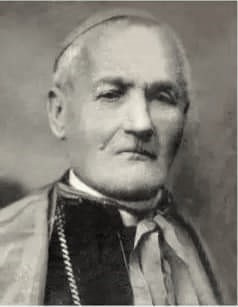
-Monsignor Trokthi from Delbnishti of Laç in Kurbin, representative of the cultural elite of the Albanian nation, alongside Fishta, Gurakuqi, Mjeda, Xhuvani, etc.-
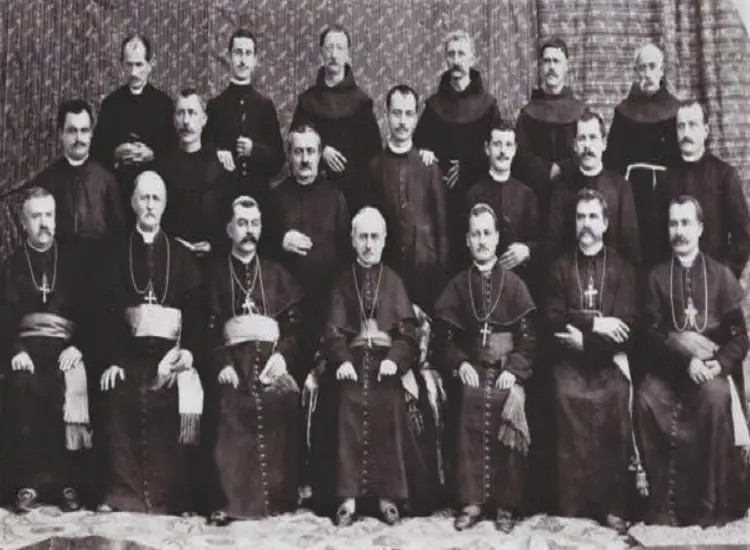
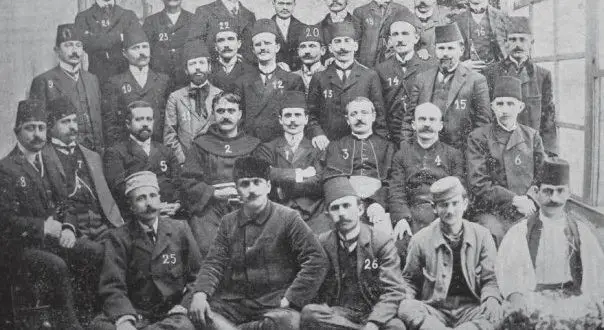
Memorie.al / The Catholic Hierarchy of Albania or, more clearly, the Cultural Elite of the Albanian Nation 127 years ago, photographed during the holding of the 3rd Albanian Council in Shkodra, from May 19 to June 23, 1895. The photograph is completed with the respective names, starting from the first row seated, from left to right: 1. Monsignor Gabriel Neviani, Bishop of Zadrima; 2. Monsignor Julian Marsili, Bishop of Antigone; 3. **Monsignor Pashk Trokthi**, Archbishop of Skopje; 4. Monsignor Pashk (Pasquale) Guerrini, Archbishop of Shkodra; 5. Monsignor Prenk Bardhi (Primo Bianchi), Archbishop of Durrës; 6. Monsignor Nikollë Markoni, Bishop of Pult; 7. Abbot Prend Doçi, Abbot of the Abbey of Sh’Lleshdrit (St. Alexander in Mirdita). The last two, in the second row, are respectively; Dom Lazer Mjeda and Dom Ndoc Mjeda. The third in the second row standing (always starting from the left) is Dom Nikollë Mazrreku, at that time delegate from Karadak (Letnica), Kosovo. While in the third row, the second standing is Dom Shtjefën Krasniqi, delegate from Prizren.
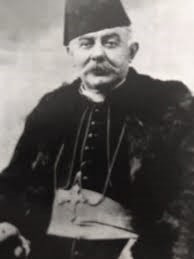
I began this summary article with this polyphoto; “The Cultural Elite of the Albanian Nation” with the aim that the reader, through it, may bring to light at least somewhat the values and extraordinary contribution of the Albanian Catholic Clergy, one of whom is Monsignor Pashk Trokshi. Outside state borders and in diplomatic circles, he is known as Mons. Pasquale Troksi (= Trokši, rarely Troxi, Trokshi, Trokthi…) or Paskal Troksha (used mainly by Slavic-speaking countries). In 1897, two years after its holding, the materials of this Council were published in Latin by the Printing Press of the Congregation de Propaganda Fide. From browsing these materials, a fairly clear picture emerges of the work and content of the decisions taken regarding the activity of the Church in the Albanian dioceses.
Monsignor Trokshi was born on January 2, 1850, in Delbnisht of Laç (at that time the Sanjak of Durrës), son of Jak Trokthi and Diella Vathi, a Catholic woman from Kurbin. He was orphaned at a young age, and together with his brother Hila, moved to his mother’s family (the Vathi family, Laç, Kurbin). Pashk’s uncles gave him a piece of land near Gurëz, at a corner of the village, close to the Church of St. Michael, where his descendants (the Trokthi family) still live today. As a child, he stood out for his skill, intelligence, and desire and will to follow the path of the priesthood. These qualities of his came more to the fore during Holy Mass (regular attendance at Mass and at cultural and church activities), where he very quickly gained the sympathy and respect of Monsignor Raffaele D’Ambrosio, who at that time was Archbishop of the Archdiocese of Durrës. Monsignor Raffaele, seeing these qualities and Pashk’s desire for the priesthood, and after consulting with and receiving the blessing of his mother, together with his uncle, Pjetër Vathi, began to encourage, educate, and support the young man on the path of the priesthood.
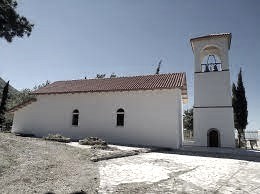
Pashk took his first studies in his birthplace, in Delbnisht of Laç, to continue them later in Shkodra, where he also completed his secondary studies at the Papal College in Shkodra. He completed his higher studies in philosophy and theology in Rome. He was ordained a priest in 1873 in Shkodra and was appointed to the Archdiocese of Durrës as secretary of Mons. Raffaele D’Ambrosio. Alongside his work as secretary, Monsignor Pashk occasionally held Mass at the Church “Zoja e Këshillit Të Mirë” (Our Lady of Good Counsel), Gurëz, Kurbin. This church was consecrated on April 25, 1881, by Monsignor Raffaele D’Ambrosio, and its first parish priest was precisely Dom Pashk Trokshi.
Given the situation and the need that the time required in Skopje and considering his abilities, the Archdiocese of Durrës proposed as a suitable candidate the priest of the Diocese of Durrës, Don Pashk Trokshi, to be proposed to the Holy See for the Metropolitan See of Skopje, as successor to Monsignor Andrea Logoreci. In the Archiepiscopal See of Skopje, bishops and archbishops of authority had served, such as: Monsignor Pjetër Mazreku, Monsignor Andrea Bogdani, Monsignor Gjon Nikollë Kazazi, Monsignor Mati Krasniqi, Monsignor Dario Bucciarelli, Monsignor Pjetër Bogdani, to be succeeded by Monsignor Lazër Mjeda, Monsignor Nikë Prela.
On December 22, 1892, Pope Leo XIII, according to the Official Acts of the Holy See: “Appointed Archbishop of the Bishopric of Skopje officially on January 10, 1893”.
According to the wish of Monsignor Pashk, the decision was announced in the presence of the Church Elite of the time, in the Chapel of the Papal Seminary in Shkodra, and a large festive ceremony was organized in his honor. On March 10, 1893, Monsignor Trokshi was consecrated Archbishop in the Church of the Jesuits in Shkodra by Monsignor Pasquale Guerini, in the presence of the Archbishop of Durrës, Raffaele D’Ambrosio, and the Abbot of Mirdita, Prenk Doçi (one of the most authoritative Albanians of that time). His qualities as a polyhedral figure: theologian, diplomat, philosopher, patriot, encourager and defender of education, customs, and the Albanian language, and of Christianity in Albania and in Albanian lands in Macedonia, Kosovo, Montenegro, Croatia, and beyond (as Archbishop of the Patriarchate of Constantinople, Turkey).
As an encourager and defender of education, Monsignor Pashk Trokshi is found in the writings of researcher Albert Ramaj, Vienna, August 2000, “Information and documentation according to Austrian Archives, especially the state archives in Vienna, on the place Stublla e Eperme and on the School of this place – its teacher Don Mikel Tarabulluzi”, where he emphasizes that: “It is interesting that Archbishop Monsignor Pashk Trokshi, as early as 1897, requests that 5 students from his diocese Skopje-Prizren, continue at the Seminary (High School) and study theology somewhere in Austria.” So important was the reopening of the School in Stubëll. This School had been opened in the 16th century (1584), as Dhimitër S. Shuteriqi writes, in the form of a College, of the rank of a higher institute, such as religious colleges of that time in Europe usually were, where besides theology, philosophy was taught and the classics were studied.
This tradition of Albanian schools, begun in 1584, would continue to be strengthened and enriched especially during the Albanian National Renaissance period, when in several well-known centers of Kosovo, such as in Prizren, Pejë, Gjakovë, Zym, Janjevë, and Stubëll, near Catholic Churches, Albanian schools would be opened and reopened, thus simultaneously becoming centers not only of education but also of our national movement. Even researcher Thomas Frasheri, in the magazine “Shqipëria e Shenjtë” (Holy Albania), highlights the strong connection of the Albanian Catholic Clergy with the West, where Monsignor Pashk Trokshi, metropolitan archbishop of Skopje-Prizren (1893-1906), supported the formation of Albanian youth in the Albanian language and greatly helped them to be educated at the best Austrian universities, for example; Refat Begolli, Dom Mikel Tarabulluzi, Dom Gjon Shllaku, Gasper Gashi, etc., … the great educational and patriotic value, without distinction of religion, region, or idea, of Monsignor Trokshi, comes to light through this support and help for education not only for Christians but also for Muslims (Refat Begolli), even though he was a cleric of the Catholic faith.
In the Letters of Father Gjeçovi, Pashk Trokshi is found lined up with personalities of the church hierarchy (Pal Dodaj, Ernest Koçi, etc.), with national historical figures (Ismail Qemali, Bajram Curri, Preng Bib Doda, Prend Doçi, Mit’hat Frashëri, Luigj Bumçi, Nikoll Kaçorri, Ahmet Dakli, etc.) and with distinguished figures of culture and art (Gjergj Fishta, Aleksandër Xhuvani, Zef Skiroi, Faik Konica, etc… and not by chance, the Holy See for bishops and archbishops of the Albanian Catholic Church, has always appointed highly educated Albanians with great authority, such as; Pjetër Mazreku, André and Pjetër Bogdani, Gjon Nikollë Kazazi, Mate Krasniqi, Pashk Trokshi, Lazër Mjeda, André Logoraci, etc. These Torchbearers of the Light of the Gospel, of national education and culture, even in difficult circumstances and among many dangers, have served, as F.S. Noli would put it, to connect Albanians, to unite them with the West, while for these figures Çabej would also say: -”.. For the time in which they lived, homeland, language, and faith were an inseparable trinom.” As a diplomat, Monsignor Trokshi is encountered in correspondence, cooperation, and endless efforts (of a distinguished patriot) with church personalities in the Balkans, Vienna, the Vatican, etc., as well as with the most prominent figures of the time, such as the Italian Ministry of Foreign Affairs, who later became the Italian President, Tommaso Tittoni; the Austro-Hungarian Emperor, Franz Joseph I, etc.
In the Co-Cathedral of Our Lady of Help in the city of Prizren, there is a plaque written in Albanian by the Emperor of Austria-Hungary, Franz Joseph. The plaque is placed on an organ, which this emperor donated (the gift was made in 1897, when the archbishop was the Albanian, Pashk Trokshi) to the Albanian Church, to accompany church songs…! The organ, on the lower part of the keyboard cover, bears the plaque, where the Emperor of Austria-Hungary, Franz Joseph, makes his dedication to the Cathedral Church of Prizren. The dedication is made in the Albanian language, on a bronze plaque, hand-engraved, in a text of nine lines, in capital letters of three sizes. The third line has larger letters, to highlight Franz Joseph, Emperor of Austria-Hungary, supporter of Albanian education and culture, protector of Christianity in Albania.
In the book “Kujtime të një jete së kalueme” (Memories of a Past Life) written by Dom Ndoc Nika, we find reflected his great participation and contribution to the creation of the Latin alphabet of the Albanian Language…! “In the meetings of Bashkimi, the main work was the creation of a general alphabet, so that every writer would have a mirror to harmonize with others. The purely Latin alphabet was taken as a principle, with Latin letters, and since the Albanian language has some special sounds that cannot be expressed with those letters, it was decided to double the most suitable letters that would approach the required sound. The alphabet used by the patriot Faik Konitza, in his periodical ‘Albania’ of Brussels, was taken as a basis, and a few changes were made that seemed more appropriate.
After it was accepted in the general meeting and everyone remained satisfied, for the conclusion reached on that occasion, for the main work, several works were assigned, to each of the members, to be prepared for print. The primer, the reader, the catechism, the numerary, the dictionary, which were the most necessary for schools, all in one alphabet. I had the notebook with which I made the greatest advertisement for that alphabet. Among the members, one was more hardworking, one lazier, and some did not write at all. The greatest and hardest work was the dictionary. Dom Dodë Koleci took it upon himself, together with me and Dom Mark Shllaku. Although I had other writings in hand, I supported Dom Dodë Koleci a lot, but he did the greatest part of the dictionary. I did one third and Dom Mark Shllaku about four or five letters. Our writings at that point were to ease Dom Dodës effort. Therefore, we sent him the papers which he arranged for print…!”
The Latin alphabet was the main goal
“The goal and program of the Society ‘Bashkimi’ (The Union) was the spread of the written language, strengthened with numerous publications. Improvements, purifications, perfections, and decorations would come later, when cultured people of the respective branch would have sufficient material, left by the forefathers, to examine, grow, and give appropriate and suitable forms. In Shkodra gathered the Archbishop of Prizren, Pashko Trokshi; the Archbishop of Durrës, Prend Bianchi; the Bishop of Zadrima, Lazër Mjeda; the Bishop of Pult, Nikollë Markoni; the Archbishop of Shkodra, Pashko Guerini, and, naturally, the Abbot of Mirdita, Prend Doçi, with the society ‘Bashkimi’. Why? To tackle the work of the alphabet, almost as if it were a matter of faith!…
… Explanations were sought, and, first of all, the Society ‘Bashkimi’ explained that the alphabet was not a local or regional thing; it was a general thing of all Albania and of all Albanians. Second, the Society ‘Bashkimi’ fought for the Latin alphabet, the purely Latin alphabet, and therefore on its part it was not concerned with joining two letters, whether one or the other was suitable. If the Society’s principle was accepted, it agreed on other matters. No agreement was reached. It was a foregone thing…! With that, the Society ‘Bashkimi’ continued its writings and publications…! I have lingered long in recounting these events, because they are things I participated in, and also for the impressions they left on me. I had written the history of these events in detail, after the bishops’ meetings, and intended to publish it, but Monsignor Abbot Doçi stopped me…!
The Society ‘Bashkimi’ had no other benefit than the spread of publications in the Albanian language, and since it was a patriotic literary society, in a meeting it decided to prepare writings inspired by the patriotic spirit, waiting for one of the alphabets followed by writers of the time to gain general acceptance. There was the old alphabet of Shkodra, the alphabet of Naim Frashëri, the alphabet of Istanbul, the alphabet of Faik Konica, the alphabet of ‘Bashkimi’, and that of Agimi…! I went myself to the Congress of Manastir on behalf of ‘Bashkimi’. There, various alphabets were presented. The Latin alphabet was taken as a principle; for the letters needed for Albanian expressions, doubling of letters was accepted, as the alphabet of Bashkimi and that of Faik Konica had, making some changes as in ç and ë. With that Congress, the Albanian alphabet received a general acceptance, and the members of the Society ‘Bashkimi’ continued to use it in their publications…!”
During the period (1899-1900), Bishop Trokshi had some disagreements with the Austrian government, which caused the Congregation of Propaganda to remove him from there, first to Vienna and then to Rome, while the faithful refused to participate in Mass because of his absence, that is, until the Archbishop (Monsignor Trokshi) returned. Faik Konica’s magazine “Albania” in Brussels, in a short article in Albanian and a longer one in French, likely written by Faik Konica himself in 1898, defends Monsignor Trokshi from some criticisms made in the Italo-Albanian newspaper of the Arbëreshë “La Nazione Albanese” (Year II/1897, no.20, pp.2-5), published in Naples, regarding some disputes that had arisen for Archbishop Troksi in Prizren.
Here is what Konica writes: “The so-called Albanian newspapers of Italy have begun to curse Monsignor Troksi, Archbishop of Prizren, saying as if His Eminence has quarreled with all the priests of the area, for trifles; and those newspapers praise Monsignor Troksi excessively for this quarrel. But who does not understand that these praises of enemies are curses? The aim of the Italian journalists is to destroy among us the little unity we have. We hope that His Eminence, the Archbishop, will silence the Italians, as he has no need to be defended by Italian Freemasons, since there are thousands of other places where he can say what he wants to say.” See: “Monsignor Troksi and the Italian Freemasons in Albania”.
The contribution to the region of Kurbin for the period 1903-1912 (the uprising of Kurbin) and not only, of Monsignor Pashk Trokshi, is found in the archives of the Vatican, Istanbul, and Vienna…! “Paskal Troksha, Archbishop of Skopje in the vilayet of Kosovo, through two letters sent to him by Dom Nikollë Kaçorri at that time, received detailed information about the violent actions undertaken by Shefqet Beu, commander of the Ottoman forces. Archbishop Trokshi reacted with harsh tones to the Austro-Hungarian Consulate of Prizren, where through a letter dated January 5, 1907, he wrote: “Now, these days I have received two letters from my homeland, telling me all the events that have happened in Kurbin, as all the European embassies are aware.
The first letter was sent from Durrës, on December 10, 1906, by Monsignor Kaçorri (through the apostolic notary), who tells me that in your house; soldiers have wreaked havoc on everything. The other letter, dated November 11, 1906, which was sent to me by a special man (Father Gjini), on New Year’s Day wrote to me that Shefqet Beu, with his savage traitors, besides destroying and plundering, stole the furniture, and even the cheese and butter. In your houses, only the four walls remain”! Two letters received from Prof. Aurel Plasari, on the day (November 19, 2012) of the arrival of Skanderbeg’s sword and helmet (the originals) in Albania on the occasion of the 100th anniversary of Independence…!
The first Albanian schools in Kosovo
In the writings of researchers Gazmend Shpuza and Engjëll Koliqi; “Today, 428 years ago, the first Albanian schools were opened in Kosovo”, the patriotic activity and great contribution of Monsignor Pashk Trokshi, in the Battle of Kaçanik and the League of Prizren and later in the declaration of Independence, are also reflected. Koliqi in his writing in “Lecco, May 17, 2005”, among other things, writes: “Stublla of Karadak this year celebrates a great jubilee, the 100th anniversary of the foundation of the Parish and of the legalization of the First Albanian School in Kosovo. Dom Mikel Tarabulluzi, a patriot from Prizren, had just received the Holy Orders, was appointed parish priest of Letnica, which in church circles was known as the parish of the Black Mountain of Skopje (Montenegro di Scopia).
Since Dom Mikeli immediately became connected with the leaders of the National Movement for Liberation from the Ottoman invaders, and because in Letnica elements from the invading hordes arrived more easily and more often, He stayed more in Stubëll (in the parish of Letnica at that time were also the villages: Stubëll, Binçë, Shashar, Vërnakollë, Terziaj, and Dunav). In agreement also with the leaders of the nation in the region, especially with Idriz Seferi, Dom Mikeli was stationed in Stubëll, finally in 1896, when the people of Stubëll donated the land at the foot of Stubllavaqa and built the church, where he simultaneously conducted religious ceremonies and classes at the school, which he immediately opened in the church premises.
All this he had done with the permission of the bishop and all church circles, down to the Vatican. Seeing the dangers threatening Dom Mikel and the church in Stubëll, the Vatican set in motion the diplomatic circles of the great powers of the time (France, Italy, and Austria-Hungary), which imposed upon the Sublime Porte in Istanbul to recognize the Church of Stublla and the Albanian School operating in its language as legal. Thus, on the eve of the spring of 1905, the bishop of Skopje, Monsignor Pashk Trokshi, signed the Decree for the establishment of the Parish of Stublla and for the appointment of Dom Mikel Tarabulluzi (1868-1933) as parish priest.” Dom Mikel Tarabulluzi opened the first legal Albanian school in Stubëll, being himself its teacher, a school officially recognized by the Austro-Hungarian Empire. This had an influential effect; in fact, at this time other Albanian schools were opened, such as in Gjakova, Peja, Ferizaj, and Zllakuqan. Monsignor Pashk Trokshi also gave a great indirect contribution to the Albanian patriotic movement on the eve of the declaration of Independence. His personality and figure come to light best through his correspondence with Father Shtjefën Gjeçovi, Father Pal Dodaj, Father Gjergj Fishta, Father Ernesto Cozzi, Ismail Qemali, Bajram Curri, Preng Bib Doda, Prend Doçi, Mit’hat Frashëri, Luigj Bumçi, Dom Nikollë Kaçorri, Ahmet Dakli, Aleksandër Xhuvani, Zef Skiroi, Faik Konica, etc.
The parish office in Stubëll was initially almost the headquarters and base of the leaders of the National Movement for liberation from the occupiers. There, the patriots of Karadak were daily visitors: Idriz Seferi, Munish Vërnakolla, Maliq Vërnakolla, Jak Munishi, Perë Simani, Engjëll Koliqi, Jozë Ballabani, Gjon Koliqi, Gjon Andrea (Ramaj), and many others. There was also prepared the plan of the Battle of Kaçanik, a battle that led the Nationwide Movement, and which immediately spread to the Highlands of Shkodra, and throughout Albania, down to Vlorë, where finally, on November 28, 1912, the Flag of Liberty was raised and the Independence of Albania was declared. Until April 29, 1908, he served as Archbishop of the Diocese of Skopje-Prizren, and for his abilities and great contribution to education and culture; he quickly climbed the ranks of the religious hierarchy, where by Decision of the Congregation of Propaganda, he was appointed Archbishop of the Diocese of Nakoleas (Patriarchate of Constantinople), Turkey. He served in this post until July 29, 1917 (date of death). As a personality of the church hierarchy, his bones rest in the Cemetery of St. Peter’s Church in the Vatican, Italy. Memorie.al
Poem to Pashk Trokshi, titled: “Forgive him, Lord Jesus Christ”
Forgive him, Lord “Jesus Christ”
(Song dedicated to Monsignor Pashk Trokshi)
In the Sanjak of Durrës, in Delbnisht
Forgive him, Lord “Jesus Christ”
A skillful and thoughtful boy
He heads to school, to become a priest
The priest of Durrës rises high
Archbishop, Skopje wants him
Monsignor Trokshi in Skopje-Prizren
For education his eye does not sleep
Five Albanians he sent to Austria
To study theology,
He chose them with strong dedication
For Homeland, Language, and Faith
Gjeçovi speaks and Ismail Qemali
Theofan Noli and the Vatican
How he spread among Albanians
That golden proud trinom
The Archbishop that holy word
Spread it quickly
Language, faith, and homeland first
Is the trinom of every Albanian?
Says “Albania” in Brussels
Who does not open the Church’s door?
Who waits for the word for priests?
Have left God without believers
Monsignor Trokshi son of Kurbin
Had a heart of gold
He had a legacy from the Forefathers
To open the Bible before the eyes of Albanians
In Skopje-Prizren, a Catholic church
In Stubëll he spurred the Albanian school
In Kaçanik, Idriz Seferi
Takes his hand as a brother in honor
As a blood brother, the Skopjan welcomes him
His voice has gone out among Albanians
-Above religion there is a love
Whose name is Albanian?
Monsignor Trokshi ends his life
A patriot who does not break his Oath
In Kurbin the ridges raise him
In the Vatican his bones rest
(Gjokë Beci, March 2013)