By AGRON TUFA and ÇELO HOXHA
Memorie.al / In the resolution of the Council of Europe (CE), adopted on 25.01.2006, on “Crimes of Communist Totalitarian Regimes,” the following are classified as crimes: individual and collective killings, executions, deaths in internment camps, starvation, deportation, torture, slave labor, and other massive forms of physical terror. In fact, everything had begun earlier, in 2003, with the proposal of the then President of the Parliamentary Assembly of the Council of Europe, Rene Van der Linden, who delivered a speech “On the necessity of condemning totalitarian regimes.” After a heated debate, it was decided to divide the topic into two sub-topics: the inadmissibility of the heroization of Nazism and the necessity of condemning the crimes of communism. The resolution drafted and adopted by the CE Presidency on January 25, 2006, states, among other things, that; “the fall of totalitarian regimes in Central and Eastern Europe did not attract the attention of international investigations into the crimes committed by these regimes, which exceed twice the number of victims caused by Nazism.
As a result, the societies of these countries and the societies of Western Europe have not been made aware of the crimes committed by communist totalitarian regimes in their own countries. Communist parties, or those that have followed the legacy of communism, exist on a legal basis in some of these countries, without even distancing themselves from the massive crimes of communism committed in the past.” In relation to this issue, the CE Presidency, in its resolution, calls for the implementation of a series of measures for the official condemnation of the crimes of communism. The CE resolution was sent to all parliaments of member states, and, among them, naturally, also to the Albanian Parliament.
I
In 2010, when the EU Commission for Justice Affairs in Brussels was involved in the analysis of the so-called “Prague Declaration,” drafted by six foreign ministers of former communist EU countries, the advocates of the dictatorship appeared in our press. The essence of the “Prague Declaration” was formulated by the president of the State Institute for the Investigation of Communist Crimes, the Romanian writer Marius Oprea. Here is what the Romanian writer sets forth in this declaration, which encompassed the stance of the six ministers of former communist countries: “We demand that communist crimes be treated the same as the Holocaust, which means that crimes from the time of the communist regime must be brought before justice in the same way. Their acts must not be declared time-barred; this is a problem we all face in former communist countries. We seek legal justice, not just moral compensation. Those who have committed murder and genocide in the name of communism must be punished.”
Immediately after the CE resolution, in all parliaments of former communist countries, on the one hand, a special law called the “Lustration Law” was adopted, and, on the other hand, special research institutes were rapidly established to study the crimes and consequences caused by communist totalitarian regimes. In Albania, as we know, such a lustration law was passed in Parliament but was struck down by the Constitutional Court at the end of 2009. Albania is the only former communist country that has not adopted this law. On the contrary, it has continued to further fill the courts, especially the Constitutional Court, with judges who come directly from the bloody experiences of the communist regime.
But it must be said that the Albanian Parliament approved the establishment of an Institute for Studies on the Crimes and Consequences of Communism, an independent and state institution, with its own law and budget, which was embodied by the executive power (the prime minister’s office) with a very small staff that, in reality, never supported its research and evidentiary activities, while also ignoring the obligation assigned by the law, although this institute found some support for its research, evidentiary, and publishing output on its own through collaborations with foreign foundations.
II
In Albania, there are terrible problems with the legacy of communism. All public, institutional, and educational spaces remain polluted with its mentality, actions, and symbols. Our society continues to resemble a restoration of communism in all its spheres. The political class shows neither awareness nor will to condemn the past or the totalitarian recidivism of the past, giving rise to an epidemic, society-wide filth regarding the democratic values of freedom. On the contrary, the bloody past that caused our tragedy is supported in every way, rehabilitated, glorified, and officially honored by institutions of culture, science, education, media, and even at the highest levels of the state. Provocations have become commonplace, and it seems that our intellectual elite has finally lost its moral nerve.
In post-communist powers, there is a devilish legality: what is subjected to constant changes is neither the present nor the future, but only the past is incessantly altered. The latest official recidivist pathos was demonstrated on the occasion of November 29th, the communist official myth of Liberation Day, where, with a demonstrative performance during the homage at the National Martyrs’ Cemetery, communist symbols and a large format portrait of the dictator Enver Hoxha were waved. Paradoxical, to think, that Albania, which solemnly raises portraits of Enver Hoxha, organizes commemorative sessions at the Academy of Sciences for his family, is precisely in the days of waiting for approval as an EU candidate country!
I don’t know which mentor has filled their heads that the doors of the EU should be peered at with portraits of the dictator! But what was the reason that the “Liberation” jubilee was honored with communist symbols and the waving portrait of the dictator? The advocates of Evil say that “Enver Hoxha was a war hero”; that his role during the National Liberation War was decisive, etc., etc. Let those who deal with the study of archival documents listen to us, but this beloved Enver of theirs turns out to be nothing but a criminal. A criminal who marked a painful rift in the life of the nation, who incited a fratricidal war, who approved and aided the calculated massacre of the Kosovo partisans of Shaban Polluzha and participated in the calvary of death of three echelons of Kosovo partisans along the itinerary Prizren-Shkodër-Tivar-Dubrovnik, where the terrible Serbo-Montenegrin massacre of four thousand two hundred young Kosovars awaited them.
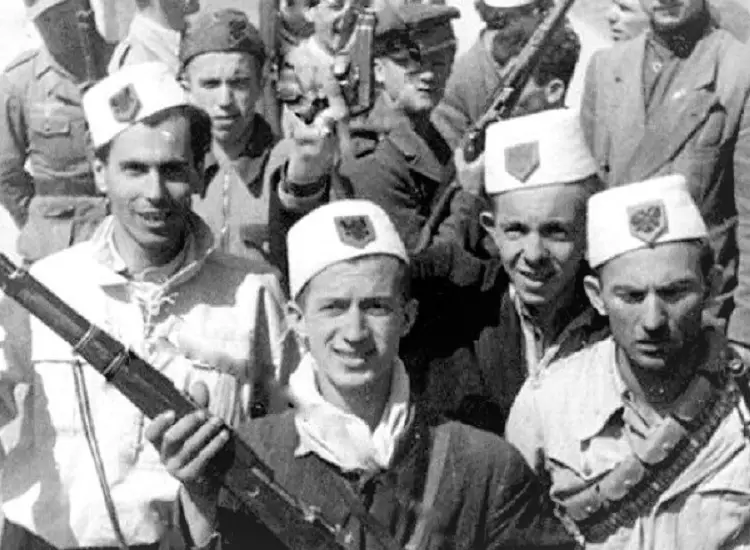
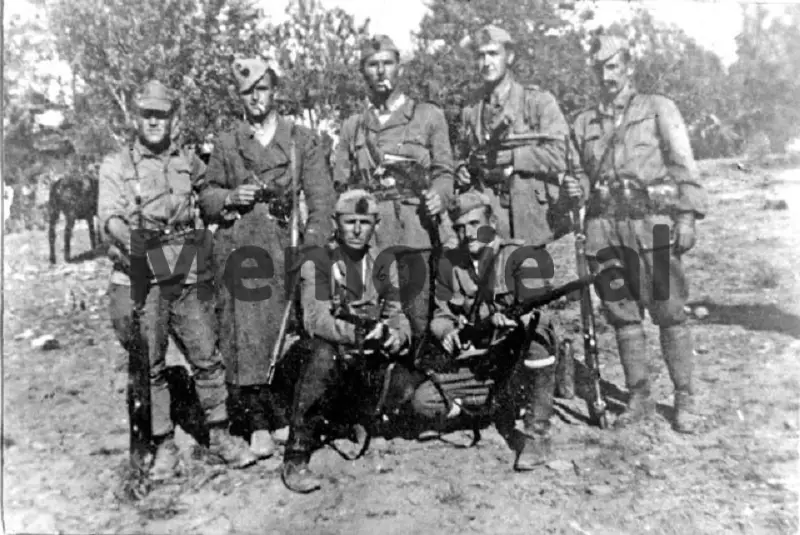
We understand very well that the establishment of communist historians, who obtained their ranks through militant service to the dictatorship, continues on the same isochronous line, especially in conditions of a lack of courage in political gesture. But we think we are not wrong to document for them that the portrait of their leader was not at all a hero’s portrait, but the portrait of a bloody criminal. And judging solely on his merits from the time of the war (which was not at all “anti-fascist” and especially not “liberating”), we list below, concerning this period, a brief overview of the visible, documentable part of Enver Hoxha’s crimes during this war.
III
War is a criminal activity, no matter how you turn it, but human society has never been able to avoid it and does not seem likely to avoid it in the future either. However, even in its barbarism, certain principles, norms, customs, and later laws, have always operated. Some activities, within the great slaughterhouse, are prohibited because, ironically, they are considered crimes. At the end of World War II, there were also trials in Albania that condemned (or pretended to condemn) war crimes. The misfortune was that the trials were organized by the victors, and they condemned political opponents, not the real criminals. We are first providing the definition of war criminals, according to the law created by the communists, and the reader, after reading the facts, can compare them with the law and reach their own conclusions.
The Law of January 23, 1945, upon which all communist military courts acted, Article 14, defines war crime as follows: “As war criminals, whether Albanian or foreign, are considered: Those who have inspired, organized, ordered, executed, or assisted in criminal acts, such as murder, torture, rape of women, forced displacement of populations, sending to concentration camps, sending populations to forced labor, robbery, arson, theft, destruction, looting of state and private property; those who have been collaborators or aides of the terrorist apparatus and terrorist formations of the occupier; those who have ordered and assisted the mobilization of the Albanian people for the enemy army” (Official Gazette, No. 3-bis, January 23, 1945).
The facts regarding Enver Hoxha’s activity are listed below:
- Enver Hoxha was responsible, as a member of the Provisional Central Committee of the Communist Party of Albania (CPA), for the terrorist acts committed by the communists of Gjirokastra, as a result of which 11 people were killed and 5 others were wounded. The PCC was informed of these crimes, which were presented to it as successes, on November 14, 1942.
- Enver Hoxha was responsible for the EXECUTION BY FIRING SQUAD of six gendarmes taken prisoner by the 1st Brigade at the Varri i Bamit post-command in Tirana. He was informed by Gogo Nushi in October 1943 about the murder of the gendarmes, and within that same month, he replied that their killing was a directive of the CPA. Nushi had spoken out against this act (The gendarmes were Albanians, law enforcement forces, plus, after being captured, they should have been treated as prisoners of war).
- As a member of the General Staff, Enver Hoxha was responsible for the EXECUTION BY FIRING SQUAD of 130 Italian prisoners (they killed them to take their clothes) in Orenjë, in October 1943, and 63 Ballist prisoners in Matjan, Lushnjë. For these crimes, the General Staff was informed by the main perpetrators of this act: Mehmet Shehu and Tuk Jakova, the commander and commissar of the 1st Brigade, on October 29, 1943. In his correspondence with Shehu, Enver Hoxha does not mention the massacred Italians again, although killing prisoners was a war crime.
- Regarding the Myzeqe peasants, he warns Mehmet Shehu in his letter of November 5, 1943, but treats the issue as a political problem and not as a crime. According to him, the peasants should not be killed because that sows hatred among the people towards the partisan army, not because their killing was a war crime. No one was punished for these crimes, thus incriminating the entire General Staff, of which Enver Hoxha was a member and commissar.
- Enver Hoxha was the orderer of the killing of partisan Tele Baçi, part of the “Reshit Çollaku” battalion. On March 24, 1944, he wrote to Tuk Jaka: “You must arrest Tele Baçin, put him on trial, and execute him by firing squad.” And so it happened.
- Enver Hoxha is responsible for the robbery (see the law on robbery and looting of property) of 400-500 head of livestock in the village of Bozhigrad, Korçë, by the “Fuat Babani” battalion, in April 1944. He later ordered that this livestock be returned, for political reasons, but the crime was not punished, and in the same letter, May 3, 1944, Hoxha advised robbing only the livestock of “some enemy of the people.” He had no legal authority to determine who was an enemy of the people and who was not.
- Enver Hoxha issued an order on June 1, 1944, for the purge of the areas of Çermenika, Zaranika, Tirana, and Dibra, from political opponents, which was accompanied by loss of life, both among residents of these areas and partisans, and the destruction of property.
- Enver Hoxha ordered the killing of Abaz Kupi on June 1, 1944.
- As a member of the General Staff, which he mostly was himself, he is responsible for the order, on June 1, 1944, to burn the houses of political opponents, classified as “traitors” or “reactionaries.” The Staff had no legitimacy or legal authority; it itself was an illegal body just like its own political opponents.
- As a member of the General Staff and a member of the Central Committee of the CPA, Enver Hoxha was responsible for the forced mobilization of the population into the ranks of the partisan army. This is evidenced by the letter from Liri Gega to the General Staff, June 16, 1944; from the reports of the 8th Brigade to the CC of the CPA, July 7, 1944, July 10, 1944, and July 17, 1944; from the report of Sami Gjebero, a member of the political sector in the 7th Brigade, July 25, 1944.
- As a member of the General Staff, Enver Hoxha is responsible for the following criminal acts committed by the 2nd Brigade, in the Dangëllia area, reported to the Staff by letter of June 2, 1944, from Beqir Balluku and Vasil Konomi. In Frashër, Përmet: a) seizure of property and occupation of part of the house (by partisans) of Mazllëm Skënderi, a deserted partisan; b) seizure of the property of Hodo Skënderi, because he was an “aspirant in the ranks of Legality”; c) seizure of the house of Seid Skënderi, chairman of the National Liberation Council who had gone over to the Balli Kombëtar.
In Zavalan, Kolonjë: a) burning of the house of Izet Hysniu and seizure of his grain; b) seizure of part of the movable property of Halit Kamberi, accused as a Ballist and participant in house burnings.
In Piskal: a) Sabri Nuredini, a Ballist accused of participating in house burnings, had his property seized, his house was not burned because it had been burned by the Germans (this is specified in the document by Beqir Balluku and Vasil Konomi); b) Shaqir Mysliu, a deserter partisan, “his five shops were seized.”
- In Bablaz: Qazim Goblara had his property seized, his house was burned, and his son Xhevir Goblara was taken hostage, with the condition that he would be released when his father and two other brothers abandoned the Balli Kombëtar.
In Radovickë: Avni Radovicka, a Ballist, had part of his property seized; his house was not burned because the families of his two partisan brothers lived there (the document specifies: “as he is not accused of serious guilt”).
In Miçan: Nexhip Mustafai and Fadil Abdurramani had their property seized, and if they did not abandon the Balli Kombëtar within 15 days, their grain would also be seized.
- As Commander-in-Chief of the Army, Enver Hoxha was responsible, informed by Beqir Balluku and Vasil Konomi, he was aware of these crimes in the Kolonjë area, and since he took no action against the criminals, he approved them: a) for “the internment of some fathers or brothers of elements tainted by involvement with the Balli Kombëtar,” internment is, in fact, hostage-taking, because it is done until “their brothers or sons surrender to our forces”; b) for the burning of five houses in the village of Qafëzez, which belonged to persons accused by Beqir Balluku and Vasil Konomi as harboring Ballists and informers for the Balli Kombëtar; c) for the execution in front of the people, with the aim of spreading terror, of Dalip Çaushi, accused as a harborer of Ballists.
- As a member of the Central Committee of the CPA, Enver Hoxha was responsible because he approved the crimes of the 5th Brigade, about which he was informed by Manush Myftiu, deputy commissar of the Brigade, in his report of August 5, 1944: a) the EXECUTION BY FIRING SQUAD of 15 innocent people, individuals they took into houses or encountered on the road, in Kurdari, Kukës; b) the burning of the village of Sinë in Dibër, “for no reason, only for revenge of fallen comrades” (after burning the houses, writes Myftiu, the partisans also destroyed everything that had escaped the fire).
- As commander of the National Liberation Army, Enver Hoxha was responsible for the killing of the partisan Neki (surname missing) and he punished the killer, Nuri Huta. The measure he took, in a document written by Hoxha himself, was to reprimand Nuri Huta (August 20, 1944) and advise him not to provoke such incidents anymore (so the killer was also the provocateur). The incident occurred in the 2nd Brigade. (General Staff document, no. 10/reserve). Beqir Balluku and Vasil Konomi are also responsible for this crime.
- As a member of the Central Committee of the CPA, Enver Hoxha was responsible for the killing of Dr. Rasha, who was killed solely because Kristo Themelko, commissar of the Peza Company, author of the report to the Central Committee (September 8, 1944), thought he was a “Gestapo agent and dangerous.” Myslim Peza, the company commander, was against it.
- As a member of the General Staff and its commissar, Enver Hoxha is responsible for the burning of the entire village of Starovë, with the exception of a few houses “that behaved well,” by the 1st and 4th Brigades in the Pogradec district, April 1944.
IV
The list of crimes for which Enver Hoxha had direct or indirect responsibility, as one of the main leaders of the NLA, is long, but even these are enough for any court, composed of jurists naturally, to declare him a war criminal, alive or posthumously, based solely on the military law of the NLA itself, dated January 23, 1945, which we cited at the beginning of the article. To better understand the criminal personality of Enver Hoxha, it is enough to cite him himself, from a letter he writes to Gogo Nushi regarding the cooperation of the Berat partisans (led by Gjin Marku) with the Germans:
“Regarding the Berat issue, you would do well not to write us anything, because the Berat organization or, rather, the leaders of Berat are all rebels. They have cut all ties with us and the Staff, and when we tie these pens again, we will smear some of them with blood.” This citation shows the real (macabre, in quality) dimension of Enver Hoxha’s criminal nature. In the 15 historical arguments above, it should be borne in mind that, when Ballists accused of burning houses or other crimes are mentioned, the accusations are made by their opponents, and they did not accompany the accusations with evidence. Furthermore, even if we take the accusations as true, the Ballists and partisans had the same legal authority or, in other words, neither party had the legal warrant for such actions.
Secondly, the word seizure is often mentioned in the text, because this word is used in the original documents, but in reality, seizure, requisition, and confiscation are euphemisms for robbery. Any thief can claim that he is not stealing but seizing; nevertheless, the prosecution would not take this justification into account. As the leader of the CPA, Enver Hoxha was responsible for many crimes, but we have focused on war crimes, and even among these, only where he has direct responsibility. From these facts, he turns out to have been a war criminal, and a war criminal cannot be honored. Not only that, a war directed by a war criminal, who had other criminals under his command, has nothing to be proud of. / Memorie.al