

By SAMI REPISHTI
Part Twenty-Five
Sami Repishti: – In Albania, the communist crimes of the past have not been documented or punished; the “spiritual cleansing,” the conscious confession, and the denunciation of ordinary communist criminals have not occurred! –
‘In the Shadow of Rozafa’
Memorie.al / During the 1930s and 40s of the last century, with the descent of the unstoppable Fascist and Communist storms over Europe, and sooner or later over the entire world, “fate” took the Albanian nation by the throat as well. Like all young people, I found myself at a crossroads where a stand had to be taken, even at the risk of my life. At that time, I said “no” to the dictatorship and took the road that had no end—a sailor in a vast sea without shores. The act of rebellion that almost killed me simultaneously liberated me. I am an eyewitness to life in the Fascist and Communist hell in Albania, not as a “politician” or a “personality” of Albanian macropolitics, but as a student, as a youth who became aware of my role in that time and place out of love for my country and a desire for freedom; simply as a young man with heightened sensibility, loyal to himself and to a life of dignity.
Continued from the previous issue...
XXIV
On a morning like any other, the selection of workers for a new camp began among the labor ranks. Nearly eight hundred names were read, mostly young men who were physically still capable. We did not go out to work. As the others left, we gathered our “rags” and prepared for the journey. No one knew the new location. When the trucks arrived, we were loaded again, bound with ropes and chains, and began the journey that ended before a large field near the city of Berat. It was Ura Vajgurore. This time, the barracks were prepared, and after being divided into five brigades, the first meeting was held in the camp courtyard.
A group of Sigurimi (Secret Police) officers entered the camp with a military stride. We understood nothing. A few minutes later, the camp director introduced himself, the political commissar, and the two officers who would handle our labor. “I am Major Xhelua,” he told us. “Remember this name well… does not forget it… then… you will understand who I am. Do you understand?” He looked around to see if anyone would speak, move, or answer. Nothing! Complete silence! He explained that an important military objective would be built there. “Do you understand?! I say, military,” he repeated, reminding us that any disobedience or poor work would be viewed as an act of sabotage and punished as such. He continued with the official propaganda of the “imperialist encirclement” and the great danger threatening Albania from predatory neighbors – expressions we had been fed for years.
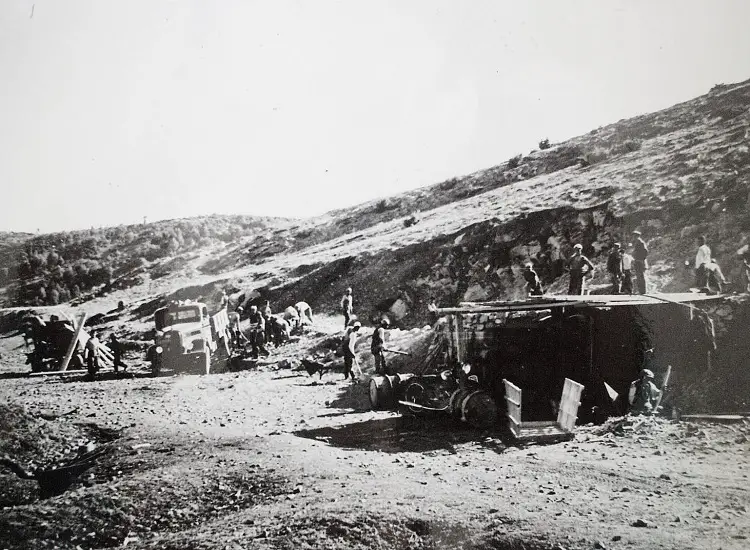
The next day, we went to work. We began by clearing the terrain, marking the runway, planting the surface, and removing debris outside the work perimeter. A few days later, five concrete stations were established, and the laying of rails for the transport wagons began. It was a true construction site. Military personnel came and went all day. Occasionally, they encouraged us. Most of the time, they gave us kicks and filthy insults.
But we were used to this way of life. What surprised us was a kind word – rare, but always refreshing – like that of Sergeant Jonuz from Berat! The chief engineer of the works was “Soviet.” He observed the behavior of the Albanian military and was clearly disturbed. He spoke very little. He never insulted us, nor did he demand more work and effort, unlike the Albanian “comrades” whom he held in contempt!
March 1953. Morning! We woke up as usual, but the silent stance of the camp guards was unusual. Within a few minutes, the news of the death of the “immortal Stalin” spread. The Great Satan had closed his eyes once and for all. He who had held half the world under his bloody heel and the other half under the nightmare of atomic war was no more. Unbelievable! In our great misery, his death was received with boundless, and sometimes uncontrollable, joy. Shkodran humor erupted.
“He forgot to breathe!” we repeated. We began congratulating one another. Work stopped for two days. In that sudden break, we found the opportunity to speak extensively about the “carcass” and his monstrous crimes, the effect within the Soviet Union and the outside world, and especially the consequences for our country following his departure from the stage. Some of us, incorrigible optimists, expected great and immediate changes.
Others, sworn pessimists, had no hope for improvement. Others believed our country had a brilliant opportunity to leave the “socialist camp” and take an independent path, perhaps like Tito. The lack of information from the outside world and our political immaturity due to age and lack of experience did not allow us to conduct deep analyses based on reliable data. Everything was conjecture; everything was speculation.
We all agreed that the death of the tyrant, the greatest Asiatic satrap of the 20th century, would have repercussions in Albania. Albania’s geographical position, separated from the “Socialist Bloc,” made us hope our country would develop according to its own dynamic, which, in our opinion, should not continue its ties with the “East.” In such an event, Albania would be forced to move closer to the “West.” Then, our reasoning continued, a change could be expected – if not of the regime, at least of its dictatorial methods.
One of the first steps should be the release of political opponents from prison. Regardless of the validity of our reasoning, the death of the Soviet dictator marked a turning point. A political development outside the framework of the Albanian communist leadership created the possibility of a political evolution that would change what seemed to be an unbreakable political rigidity. For the first time, the “monolithic rock” of socialism was put to a test, and no one knew how it would react; the coming reaction was pregnant with the unexpected. It was these unexpected events that promised changes after long decades of uniformity and rule with an iron fist.
Among us, we also had the “erring” former communists – an amorphous group, but one that nevertheless knew the state structure and the mentality of the communist leadership far better than we, the first anti-communist prisoners. Assessing the situation, they saw in the death of “Great Stalin” the need for a new idol for the indoctrinated masses of our country – the need for a “new god,” infallible, untouchable, almost divine. Here, they saw the door open for the “criminal Enver Hoxha” and a new role for him. “God has died for the broad masses,” one of them told me.
“You do not understand what it means to be convinced that Stalin is infallible and that his strategy would ensure the victory of proletarian internationalism. The Eastern world is prepared for this victory. Now, with the death of the immortal, their horizon is closed, and they see themselves as orphaned children without a parent. They cannot live long in this vacuum created by this great loss; therefore, the vacuum must be filled! And this is the historical moment for Enver Hoxha, so to speak, and he will emerge with the slogan: Comrades! Continue on the path of Great Stalin, and I will lead you to final victory!
With Stalin’s name, he will keep their hope and enthusiasm alive, while acting as the unquestioned dictator in our country, always under the shadow of Stalin! Listen to me, Stalin’s death has opened the door for Enver’s entry onto the stage as an uncontested Stalinist leader, and he will play this card to the very end…” The reasoning of my former communist colleague was well-constructed upon a dialectic that was unknown to me. But in the framework of my own thoughts, Stalin’s death brought to mind the simple believers who need to be reassured that their “god” does not die, does not err, and is not replaced, because he is immortal.
For believers, the need for a cult of God is deep, necessary, existential; it allows them to lift their daily, concrete lives into the sphere of dreams created by the great abstract desire to escape the link of the ordinary, the “lie,” that which dies! Was this not the essence of monotheistic beliefs – the existence of a superhuman, divine “power” that leads us, protects us, and finally saves us, presenting itself as the “Endless Good” in our world full of sins?
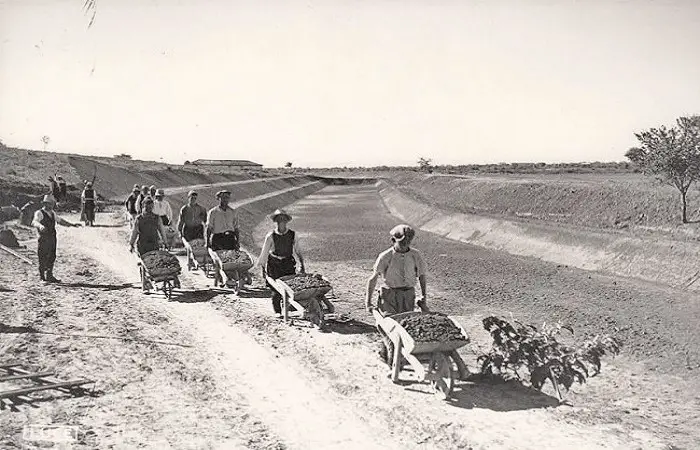
On the first day of work after this short but event-filled break, the guards were exceptionally fierce. It was clear that the instructions “from above” were to crush any attempt, however small, at revolt. In these heightened periods, there are always unfortunate souls who pay dearly and are made examples for others. With the setup of the concrete stations and the spreading of gravel over the runway – which lengthened every day and was compacted by rollers – the work became harder. The preparation, transport, and lying of concrete required efforts that exceeded our physical strength, weakened by scarce and poor food.
But there was no doubt that the quota had to be met, and any slowing down was severely punished. Organized into squads with specific functions, those who dealt with the gravel and crushed stones for the concrete reinforcement had the hardest job. Their hands were battered by shovels, and their knees bruised from the support of the shovel handle as they filled the measuring boxes for a mix. They carried them to the mixer, lifting and discharging the material with a set rhythm – neither earlier nor later – along with the sand, cement, and water. Mixed together for three minutes, they became a concrete dough emptied into wagons; pushed with the chest, they were directed toward the hexagonal molds where the dough was poured, leveled with vibrators to leave no empty spaces, and covered with mats until it hardened.
Then, the daily watering began to prevent premature drying. Concrete, concrete… everything else was secondary. Caught in a trap that they could neither open nor break, these small groups among the broad mass of prisoners became symbols of the heaviest suffering – the hell where the “disobedient” were sent. The conviction had formed that they were condemned to be the first victims of death from beatings and hard labor. This fear, which enveloped them relentlessly like the air around them, spurred the instinct of self-preservation and pushed the unfortunate ones to look at us with a kind of envy that I often did not understand – whether it showed their contempt for all of us who did not raise our voices to protect and save them from the position they had fallen into by volunteering to switch jobs, or the fear that they would not survive the suffering – a fear that killed even the hope that one day, perhaps, they would be free!
After a two-year gap, my brother visited me along with my mother. He had grown in stature, thin, a bit gaunt in the face, and with a sorrowful appearance. The sight of him and my mother, whose tears would not stop, touched my heart deeply but simultaneously gave me immense pleasure. The warmth of his lips, which he brought close through the barbed wire and which I felt after nearly seven years of separation, shook me. Then he began to shed tears, his voice trembled, and feeling that he was taking time away from the meeting, he said, “Speak to mother, for she has exhausted herself so much for you.” Then, mother approached, but the guard did not allow her to touch me. Exhausted from the long journey, she began to ask about my health. I smiled and assured her I was fine. But their tears and the expression of great pain on their faces shook me.
I was weak in health, and white hairs were visible on the head of the twenty-eight-year-old that I was at the time. They noticed them but did not speak. They looked on with the joy of the meeting and the pain of the parting. Mother would not leave. The camp guard grabbed her by the arm, pulled her away by force, and ordered me to go inside. After a twelve-hour journey from Shkodra, the visit lasted only one minute. In the barracks, alone on my bed, I began to think about the passage of long time and its effects on me and others. Mother had aged, my brother had grown, and I was entering maturity without ever having been young. In prison, forced into hard labor, I was rotting more every day. Only the hearts of my mother, my brother, and my three sisters beat for me. Only there, I thought, is found the warm nest that wraps me today from afar, and tomorrow, when I am released, from up close.
The concrete machines turned without stopping. The wagons passed over the train tracks – heavy, unlubricated, old. Everyone worked without rest, just as they were: exhausted and hungry. In torn clothes, because the camp command and the prisons never gave out clothing – most without shoes on their feet – more than eight hundred victims of the Red Dictatorship fought day and night with the work, the guards, themselves, and sometimes with each other. The struggle for survival took on a fundamental, urgent, and universal importance. “I will not die!” I said to myself, “I will not die! I am young, and I love life with all my soul, I will not die! I swear, I will not die!”
The airport grew every day, and every day our numbers decreased; every day the work took camp comrades with it, dead from exhaustion and hunger, incurable diseases, savage beatings, and despair. Outside the camp, the number of unmarked graves grew, covered in the trenches opened and closed by us. One day, one of the desperate tried to escape the camp. He was a villager from the outskirts of Tirana. The guards caught him immediately and brought him to the camp. An officer and two policemen began a savage beating. He stood on his feet, speechless, dazed, not knowing where to turn. The executioners struck him with sticks on the head, face, back, and arms; when they began hitting his knees, he collapsed – apparently from a broken leg – falling to the ground in a heap.
Then, with a kick received from the left side, he fell to the right, stretched on his back, hands and legs curled in the air like a horse giving up its spirit. His chest rose powerfully from fast, heavy, noisy breathing that resembled the exhaling of a suffering beast. Without speaking, without complaining, he followed with sighs that tore our souls every blow that, without a specific direction, mangled him even more. The sound of wood falling with force upon the victim’s thin body was drowned out by the filthy and continuous insults of the guard – a former partisan, his face flushed from a desire that seemed to satisfy an irrepressible need to insult, to torment, to destroy…!
That farmer giving up his soul to the uncarved wood could have been the father, the brother, perhaps the cousin of the executioner, but he was certainly a wretch, undoubtedly one who had suffered for centuries, generation after generation, as most villagers in my country have. And now, as his history came to an end – bones crushed, flesh torn, driven mad by torture – he is killed by the thick-skinned hand of another “victim,” a villager who does not see, does not hear, and does not know what he does! When he realizes that the victim is taking his last breath, the executioner – the other “victim” of the system – will raise his hand, numb from exhaustion, and his stick, half-broken by the hardness of the shattered bones, and will cry out with the raspy voice of an exalted madman: “This is the Dictatorship of the Proletariat!”
It was the terrible and inhuman formula, the principle that challenged the entire heritage of human civilization to a duel. I had heard it so many times in the communist interrogation offices; it symbolized for me, and for thousands of others, the call for the mass murder of the innocent, the call for the day of apocalypse without a tomorrow. It rang in my ears again, heavy and rhythmic, like a military funeral march: “This is the Dictatorship of the Proletariat! This is the Dictatorship of the Proletariat!” All around me, the shadow of death reigned over everyone and everything. No one moved. No voice, no sign of life! High above us, a black cloud ran like a mad thing and blocked the pine-sun that scorched our shaved heads – perhaps because it was free to do as it pleased, perhaps because it wished to hide from the light-giving source the witnesses of the crime, the madness of human darkness in this forgotten corner of the globe!
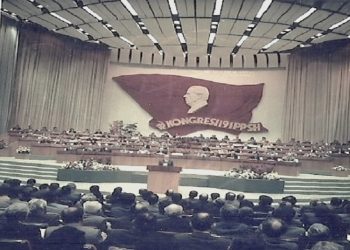
From the newspaper that entered the camp, we understood that the “Congress of the Democratic Front” was opening with a speech by “Comrade Enver.” His speech, stripped of the counting of achieved successes, resembled the piercing cry of a wounded bird. He called upon his “comrades” and the people to renew the enthusiasm of the National-Liberation War. Now, an extinguished fire, that enthusiasm had given way to a spiritual dryness and a void in the heart. The deafening noise of work and victories over dead matter had not been able to keep alive the inspiring atmosphere of effort and the necessary sacrifice for the building of the “new society,” the promising tomorrow…! Ten years of dictatorship had killed the hearts of the pioneers of the Movement and the fighters who sacrificed themselves for it.
“Comrade Enver” was the killer of nurtured ideals and the betrayer of cultivated hopes that thousands of young men and women had fed during the days of the heroic war and sacrifice. Now, ten years later, “Comrade Enver” called upon these murdered souls to resurrect the extinguished enthusiasm. This insincere appeal was the public confession of the failure of the new socialist society in Albania. If in the past there had been something inspiring, it was precisely the enthusiasm of the oppressed, impoverished, and forgotten masses to rise up in a common effort for a new, better, happier, more dignified life. Now, without enthusiasm, and enclosed in forced labor camps, violent cooperatives, and fruitless work centers, the workers had turned into modern slaves of a heartless system. An order to enter the barracks.
A delegation of high officials came from Tirana for inspection. They walked the entire length of the runway, got into cars, and left. The next day, the guards and officers were happy. Our work had been liked by the slave-owning master. As a reward, this “leadership,” which planned to build a second airfield near Tirana, decided that our group – now experts in the work – should be tasked with completing the new project. For me, the building of a camp near Tirana was good news. From Shkodra, my family would have the possibility to visit me more often. Memorie.al