

From SAMI REPISHTI
Part Twenty‑Two
Sami Repishti: – “In Albania, the communist crime of the past has not been documented and punished; no ‘spiritual cleansing’ has been carried out, no conscious confession and denunciation of ordinary communist criminals!” –
Under the Shadow of Rozafa’
Memorie.al / During the 1930s and 1940s of the last century, as the unstoppable torrent of fascism and communism descended upon Europe, first and later upon the entire world, “fate” also seized the Albanian nation by the throat. Like all young people, I too found myself at a crossroads where a stance had to be taken, even at the risk of my life. Then I said “no” to dictatorship, and took the path that had no end, a sailor on a wide sea without shores. The rebellious act that almost killed me simultaneously set me free. I am an eyewitness to life in the fascist and communist hell in Albania, not as a “politician” or a “personality” of Albanian macro‑politics, but as a student, as a young man who became aware of my role, in that time and in that place, out of love for my homeland and the desire for freedom; simply, as a young man with a pronounced sensibility, loyal to myself, to a life of dignity.
Continues from the previous issue
In such an environment, the spirits of the young were molded – those who would be the representatives of tomorrow, the temperers of the future, for a nation and a country that had never ceased to suffer, where hunger and fear had been daily bread. In this abyss that shattered bodies and crushed the spirit, the generation that would build a new society had to be formed, where the new man would be born among free people, conscious of their dignity, where every person was more than a worker, a peasant, a clerk or a soldier, where man was a human being like me, and a brother to me!
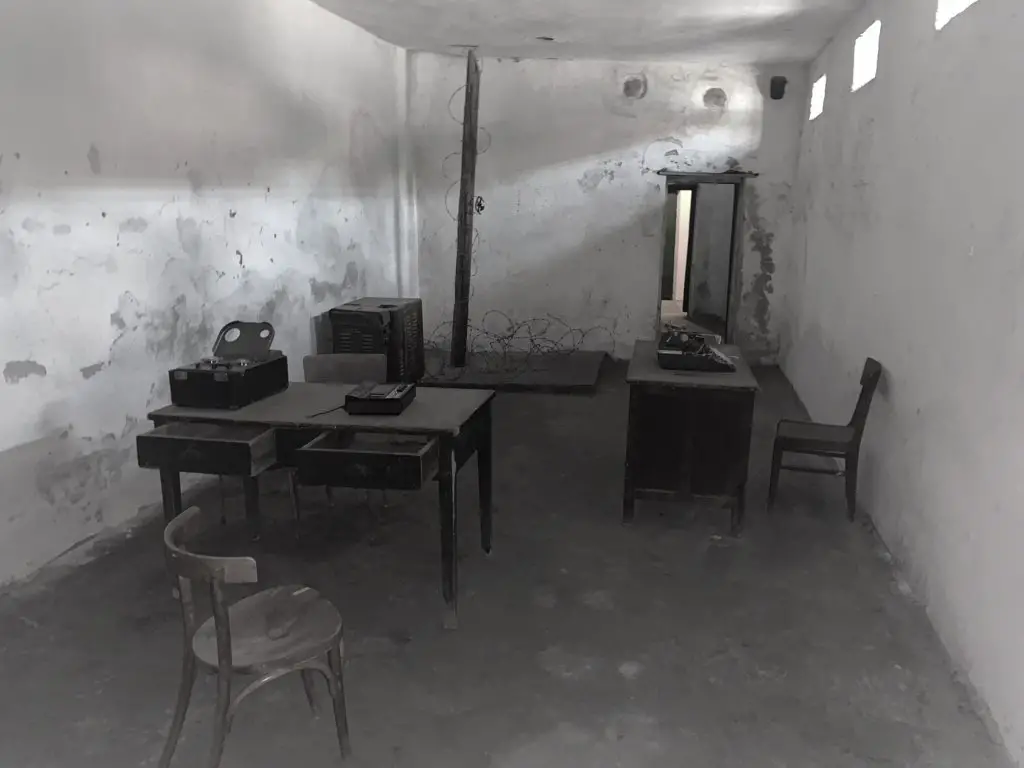
In this prison with its thick medieval walls, the outside world that surrounded me was so small, as small as the cell itself, the prison room, and the labor camp within the police cordon and barbed wire. But thought is not limited by walls and chains. In this narrow prison, thought found a wide and free field. My inner world began to develop, to expand, to take first place, and by constant repetition, to dominate my activities, my attitudes, and my ways of thinking. I came to know myself, more and more each day! Amid the sublime and the banal, life in prison remained monotonous, except when interrupted by moments of Shkodran humor.
Nevertheless, there were situations where even the comical was left speechless by the baseness of the policeman’s act at our expense. One day the officer ordered the seventy‑year‑old Imam’s white beard to be shaved off; the whole prison fell into a grave silence. The old Imam did not speak. Tears flowed down the hollows of his withered cheeks.
But when the officer mockingly said to him: “Hoxha, hey, how do you feel now, do you feel good?” the old hoxha replied simply, in a voice trembling with despair and physical exhaustion: “Are you not ashamed of my old age?!” The officer left without a word, but with that reply the Imam gave us a great moral victory. The victim rose above his torturer as the winner of an uncompromising duel.
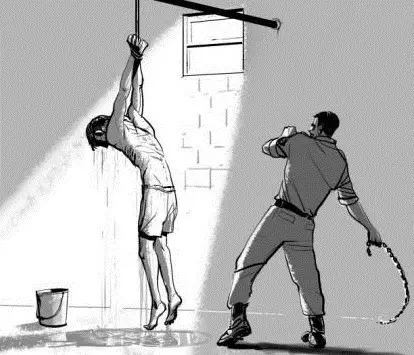
A noise broke the pregnant silence of the prison. It was night! A group of prison guards entered the courtyard, headed toward the isolation cell, and tried to stifle the screams and curses of an arrestee who had lost control of himself. The beatings continued with kicks and clubs, and with each blow he answered with a curse. It seemed they ordered him to strip naked. He refused.
They beat him mercilessly and threw buckets of cold water over his body. The victim screamed. The guards laughed. We were stunned by the brutality we witnessed. No one spoke anymore! A few minutes later, the prison guards dragged him out of the cell with clubs. The old man quickened his pace and began running around the inner courtyard, cursing. The guards laughed, as if this criminal mockery was done solely for their entertainment.
Finally, the victim fell to his knees, hands still chained, cursed again, until countless clubs threw him to the ground, lying motionless, without a voice. The guards laughed. All night, hundreds of prisoners could not sleep, because of the heart‑rending impression left by the last groans of the old man as he gave up his spirit.
The next day we learned that a policeman had seized the old man’s daughter from Oblika at home, and two days later he had attempted unsuccessfully to kill the policeman and the daughter. Arrested, he was locked in our prison, where he died from the beatings on the first night.
XIX
Suffering without purpose makes no sense; it is an absurdity. But causing suffering for the purpose of entertainment is more than absurdity; it is an unforgivable criminal act. The behavior of the prison guards that night strengthened even more my conviction of the complete dehumanization that the communist regime had brought among its own supporters and the servants who carried out the acts of tyranny.
Faced with such a situation, the will to resist the personified evil in the activity of the regime’s servants grew stronger. The methods used were undoubtedly the best way to create enemies and to arm the resistance with new revolutionary blood.
Clearly, the most dangerous enemy of the existing power was power itself and its emissaries, who implemented directives with criminal inclination, without thinking, without hesitation. The division between the world of crime and that of the victims was complete and irremediably directed toward a mortal confrontation.
But now brute force was with the communists, dominant over the life of the country and of the citizens condemned to live in that place we called “Mother Albania”! How would all this undeserved suffering end, where would the boundless hatred that filled our hearts in those days end?! The question found no answer, but it certainly frightened me greatly.
It seemed to me that the whole world was immersed in a pool of evil, of wickedness, of the inhuman. For me, the dilemma of opposing it, although it grew every day because of the spread and deepening of crime still did not make the problem easier. Should this evil that had covered our country be accepted as inevitable, with full awareness that nothing could change it, a “religious” fatalism typical of believers who have the courage to cast themselves into the “unknown” that only the Creator knows?
I needed help! The next day, with the Franciscan friar beside me, I began incessant questions about our daily struggle against the presence of “evil” in the world. I had my doubts about the Creator, and I reacted. We are not only reason. Because the Creator has also endowed me with a heart that feels for those who suffer, and with a voice of conscience that disturbs me when I err. The idea of sacrifice, of giving one’s life for the suffering, presented itself to me.
And, naturally, the heavier the evil, the greater the idea of sacrifice. The frightening loneliness of the victim seemed to call me to draw near, to become a brother to him. People suffer less when they are not alone. The friar listened and said to me: “Christ with me, and I with those who are unable to ask for His help as they should.” – ‘And for those who do not deserve it?’ I asked, in an attempt to defend my position.
“Only the Blessed Lord judges that. Only He can deny His unmerited grace. I am only a simple servant of the Great Lord. I only serve and am satisfied with only that.”
And turning his eyes toward me, with a smile that revealed his inner feeling: “My son,” he said, “do not forget that each one of us has something, however little, that is of a human nature. Even the enemy has a corner of his heart where mercy crouches, ready to show it.” And in a low voice, tracing the floor with his pointing finger, he added: “There where you least expect it!”
“Meanwhile, we are to wait to die under torture and in prisons… or starve in camps, to be torn apart and humiliated.” – Better say crucified, rather. Crucified, because it gives us hope for resurrection. Do not forget! Crucifixion, when it is done for the salvation of humanity, is like an act of God!”
The next day I turned again to Donat Kurti, the humble friar, and began the litany of my complaints about everything. – “Patience, my son, patience! The Blessed Lord advises us patience. Little by little, everything will be set right, we will be released. We will live free…! Patience, we must learn to endure…”! – The Blessed Lord does not die, I said to him. – Father, He is immortal, is He not?! – “Yes! One of the…”! – And He has plenty of time to wait, to be patient, and to act, – I interrupted. “I am a temporary man in this world, Father; I can die at any moment…! Time passes without any hope of return, and death awaits me…! I cannot endure. I cannot be satisfied with the hope of a future I do not know – especially since it does not depend on me.”
“The will of the Great Lord must be accepted, my son”! I did not know if my brother saw my sufferings as a spontaneous revolt of a young man living with the fear of death in prison! Or, in his intellectual space, he saw a young man, like all others, who resisted the divine message given by the clerics, the servants of God. But his insistence on submission did not help me. – Father – I replied, – you ask me for submission. If I accept, what is left for me?
“Not submission – he interrupted me – humility. And do not forget! There is also the blessedness of heaven.” And raising his index finger as a sign pointing to the divine, he continued in a half‑extinguished voice – “Here we are temporary. Yes, temporary, we say.” In the half‑lit room, the usual silence continued today, just like yesterday, like the day before, like the past months and years that had passed without leaving a trace. Around me, the prisoners busied themselves with fruitless, meaningless, aimless activities. Outside, the regular rhythm of the red military boot making the daily rounds in the inner courtyard could be heard.
– Father! – I said, looking him straight in the eye, – how do you explain the life of a young man who is tortured for many years and dies a few days before release, or immediately after being released from prison?!
– “The will of the Creator.” – And lowering his head so as not to meet my eyes directly, in a voice that seemed to me to tremble, unable to control it, he added: “Accept the will of the Creator!”
– And how is this suffering justified, Father, that seems to me to bring no benefit?! The outside world does not even know that we suffer the blackest misery. Suffering that dies with me, that is extinguished with the victim, that is neither avenged nor resurrected… and we young men here do not even have the satisfaction of the missionary. I meant to say; ‘like you.’ He smiled.
– “Listen! God sent His Son and promised Him the cross. Do not forget”! –
And resting his hand on my shoulder, he continued in a trembling voice: “Whenever the weight of suffering falls upon the innocent, a conflict arises in me. My life as a Christian cleric is a daily struggle to resolve this conflict. It is not easy for me…! But I believe in eternal life, and in my faith I base my explanations, which lighten the heavy burden of the conflict that torments me. I advise you to have faith, my son, but I cannot help more…! It is not an example I wish to set for you; it is a need that you yourself must feel with such strength, with enough power that you come to my state and humility is eased”!
And as if he did not know how to continue his suggestion, he ended with a question: – “In this rebellious state of yours, it seems to me I see a kind of visible pride, do I not?! Do not forget! Humility, humility is our part in this life.” – “Father! Do not indulge my weak side. Humility is perhaps easier than this pride of mine that troubles you, that you see, and that you think is the source of my suffering…! But allow me to say, with an open heart, that this spirit of revolt against every form of submission inspires me, keeps me alive, and, so to speak…!
– “It eases your suffering, as well”? – he interrupted me. – I think so. At least it does not call on me to accept evil with closed mouth, and in most cases it mobilizes me to fight strongly. Father! I want to take a stance, to act, not to fold my arms before evil… or wash my hands! On the poor friar’s face, the wrinkles of suffering deepened even more.
With knitted eyebrows, he looked around the whole room, at the mass of innocent prisoners, stripped of everything, insulted in their dignity by every means every hour, every day, every time a hand was stretched out for a piece of bread, as if he wanted to confirm, once again, the proportions of the misery that surrounded him. Then, turning his eyes again toward me, and with a voice whose resonance told me more than the spoken word, he replied:
– “I will pray for you… I will pray, my son, that one day you may hear more clearly in your heart the Word of Unfinished Good! The idea of God, as the only possibility to hope for a more worthy future, for the qualities that equip man, as the only ‘physician’ who understands and heals spirits worn out on the roads, hearts burned by passion, minds searching for truth, for a truth that satisfies and justifies every demand, attracted me. But it’s very ease in solving the problem of existence did not satisfy me. The friar interrupted the flow of my thoughts:
– “Why do you speak so timidly, as if you are afraid of disturbing the harmony of my thoughts?” – Yes, I am afraid…! – “Why are you afraid?! If they fall because of your criticisms, then they do not have that divine value I believe they have.” – Father! What frightens me is that I have nothing else to replace it with. It is this void within me that frightens me… and I wish to fill it with action!
Every morning, the friar and I would see the haggard faces of the young people in prison, as if they had been puffed up with air, rising from heavy sleep in rooms that stank from the breath of gas and more than a hundred prisoners, half of whom suffered from known and unknown but dangerous illnesses. Every morning, the friar and I could clearly see the obvious daily change from youthful freshness to the tired, withered, lifeless appearance of an army of young people, like wilted leaves in early autumn.
As days, months, and years passed, time did its work; it robbed the prisoners of youth and energy and replaced them with a feeling of discouragement, with a spirit of indifference that was noticeable especially among the “veterans” who had lost hope of release. The friar and I lived in the same world, but we saw it with different eyes. It was not that the friar lacked a conscious awareness, perhaps even an impulse toward revolt that he suppressed; on the contrary, resistance against “evil”, against the red tyranny, was deeply embedded in his mind and heart.
But he placed this resistance within the sphere of his religious conviction and endured, endured. For me, such an attitude, justified by the will of the Creator, was not enough. For me, active resistance was necessary, so that the easier path of surrender before “evil” would not be allowed, the inevitable end of which was moral corruption and its logical conclusion: complete failure. For me, it was a dilemma; “here and now”, which had to be solved in this world, before I was seized by the hand of death, the irreparable annihilation of life on earth.
The other life, of the other world? It did not matter. It was this fear that increased the urgency of action, even by force, when it came to breaking the chains that held us nailed in place. My brother tried not only to explain this pessimistic spirit, but also to present the causes, the effects, the objectives of an itinerary begun on the wrong foot, and finally, – oh, what magical power the story of resurrection had! – The possibility of salvation, the hope for a personal corner in this infinite universe, a warm hearth for a spirit frozen during the long journey in the darkness of solitude! /Memorie.al