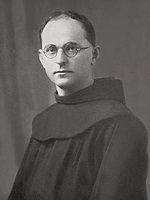
“Suffering, O son, makes victory more noble” – At Çiprijan Nikaj
European Day of Remembrance for Victims of Totalitarian Regimes, 2023 commemorated in the former internment camp of Tepelena
Memorie.al / Every year, August 23rd marks the European Day of Remembrance for Victims of Stalinism and Nazism, two barbaric, destructive ideologies of the 20th century, two criminal regimes that caused the death of millions of people, innocent victims of totalitarianism. It is a day which is marked, in memory of the victims of communism and Nazism, in the countries of the European continent, but also in the United States of America and Canada. Also known as the “Black Ribbon Day,” since 2008, the European Parliament has designated this day of remembrance for the victims of communism-Nazism, and since then it has been officially marked in the member countries of the European Union.
The date of August 23rd was officially established as a day of remembrance for the victims of communism-Nazism, because historically, it coincides with the day when the infamous Russo-Nazi “Molotov-Ribbentrop” pact was signed, between the communist Soviet Union and Nazi Germany, on August 23, 1939, by the foreign ministers of the two countries, on the basis of which Moscow and Berlin had agreed to divide Eastern Europe between themselves.
As is known, besides other tragedies, the signing of the communist-Nazi “Molotov-Ribbentrop” pact was the beginning of crimes and all the dark events throughout the old continent, and consequently, after the victory against Nazism, a large part of Europe and its bloody history was taken over and controlled by communism – Russo-Soviet Stalinism, for almost 50 years, including Albania and the Albanian territories under former Yugoslavia. All across Europe, the United States, and Canada, this day was marked today with pain and respect for the millions of innocent victims of communism and Nazism.
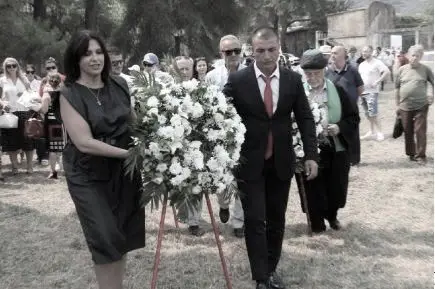
In Albania as well, the Authority for Information on Former State Security Documents (AIDSSH) announces on its portal that in Tepelena, on August 23, 2023, a remembrance ceremony was held at the former internment camp of Tepelena, within the framework of the European Day of Remembrance for Victims of Totalitarian Regimes. It is stated that representatives of the Authority for Information on Former State Security Documents and survivors and family members of victims in the internment camp from 1949-1953, as well as family members of those missing from communism in the Tepelena area, participated.
They honored the suffering of innocent minors, women, and the elderly, who were interned in Tepelena and remembered the victims of the barbaric Enverist, Slavic-Asian communism, placing wreaths and flowers near the informational exhibition at the former camp set up by AIDSSH.
The commemoration of this pan-European day, dedicated to the victims of communism and Nazism, including the ceremony held in Tepelena, in memory of the innocent victims; women, the elderly, and children, victims of the barbaric communist regime of Enver Hoxha, despite the absence of high authorities from official Tirana at such commemorations, makes us believe that evil, the crimes, and barbarisms of the communist regime in Albania, against humanity, never have the last word.
In the meantime, and within the framework of this European day in remembrance of the victims of communism, a few days ago, I came across a notice published by the advisor of the Shkodër Municipality, Eliona Kodra Shkreli, which spread the good news that; “On September 26, 2023, in Breglum, Shalë, Shkodër, the memorial of the Martyrs of the Albanian Catholic Church, originating from Dukagjin, will be placed,” adding that details of the ceremony will be announced later.
“The 20th century presents in Albania a brutal panorama that will be remembered in history as the darkest period of martyrdom,” states the announcement signed by a responsible commission for organizing the inauguration ceremony of the Memorial, dedicated to the martyred Catholic clerics from the Dukagjin area.
The Memorial in Shalë is dedicated to 8 men killed by communism and declared “beatified” by the Universal Catholic Church: At Çiprijan Nika, O.F.M., At Bernardin Palaj, O.F.M., At Gjon Shllaku, O.F.M., At Gaspër Suma, O.F.M., Dom Dedë Plani, Dom Mark Xhani, Dom Lazer Shantoja, and Gjelosh Lulashi, lay martyr.
The announcement from the organizing group for the erection of the Memorial states that the life and history of these martyrs show that faith is not something abstract, but an extraordinary force of connection with God, with the highest social and human virtues, is inspiration and courage, even unto sublime sacrifice.”
The erection of this Memorial, a private initiative (according to this announcement) is a long-standing idea and desire that today is becoming a reality by two respected families: the family of Gjin Markaj and the family of Dedë Prendaj, two respected families from Shala of Dukagjin. This memorial is a reflection for every person from Dukagjin and every Albanian, to remember the examples and messages that the martyrs gave until the last minutes of their lives, the announcement states.
These 8 men of Dukagjin, hailing from the noble and martyred Albanian land, during a harsh half-century winter under the atheist regime of Slavic-Asian communism, gave the Universal Church, society, and the Arbëresh Nation, testimony and example, dying for their faith in God, for human, national, intellectual, and spiritual values, values that never fade away.
The erection of the Memorial dedicated to the clerics of Dukagjin, next month, will also be considered a day that God gave us, as Pope John Paul II expressed when describing his visit to Albania in 1993, as a sign that the evil and half-century tragedy, called communism, would not last forever. That freedom would triumph and, sooner or later, the truth would manifest itself, forever!
The apostolic visit of Pope John Paul II to Albania in 1993 was a testimony to this truth, a special manifestation for Albania, although it had been proclaimed as the world’s first atheist state against God and the Albanian nation. On that occasion, John Paul II told the truth, to the world and to Albanians, about the historical role of the Catholic community martyred by the communist regime, particularly the clerics of the Catholic Church, in defense of the centuries-old national values and historical identity of Albanians.
“To you, O noble Albanian people, I extend my warm and affectionate greeting…! During such a harsh and weary winter of suffering and trials, the heroic Church in Albania, shaken by severe and prolonged persecution, but enriched by the testimony of its martyrs, has shared to the very end, the pains and hopes of the Nation, keeping alive through the personal sacrifice of its many members, the ancient Christian tradition, with the conviction that it represents an enduring value of the authentic Albanian identity,” expressed Pope John Paul II, on April 25, 1993, in Albania. And then the fatherly encouragement of St. John Paul II, for the present of Albanians: “Albania, rise to the height of the duties that await you”!
But also the call for perpetual memory: “The past must not be forgotten, but the future must be looked to and built with courage.” The Memorial that will be erected, next month, in Shalë of Dukagjin dedicated to the martyred clerics of that area, symbolically, will do precisely that: It will help ensure that the painful past is not forgotten. At the same time, this is also the message of the European Day of Remembrance for Victims of Communist-Nazi Totalitarian Regimes, August 23, 2023.
The truth, finally, triumphs, while evil never has the last word.
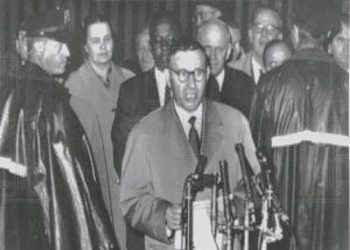
“At Çiprijan Nika, former Provincial of the Franciscan Order in Shkodër, was arrested in November 1946, on the absurd charge of hiding weapons in the Franciscan Convent in Shkodër. This comedy was invented and staged by the State Security Section, under the leadership of Major Zoi Themeli, and was spread by radio and press by the (communists) Albanians and later also by the Yugoslavs.
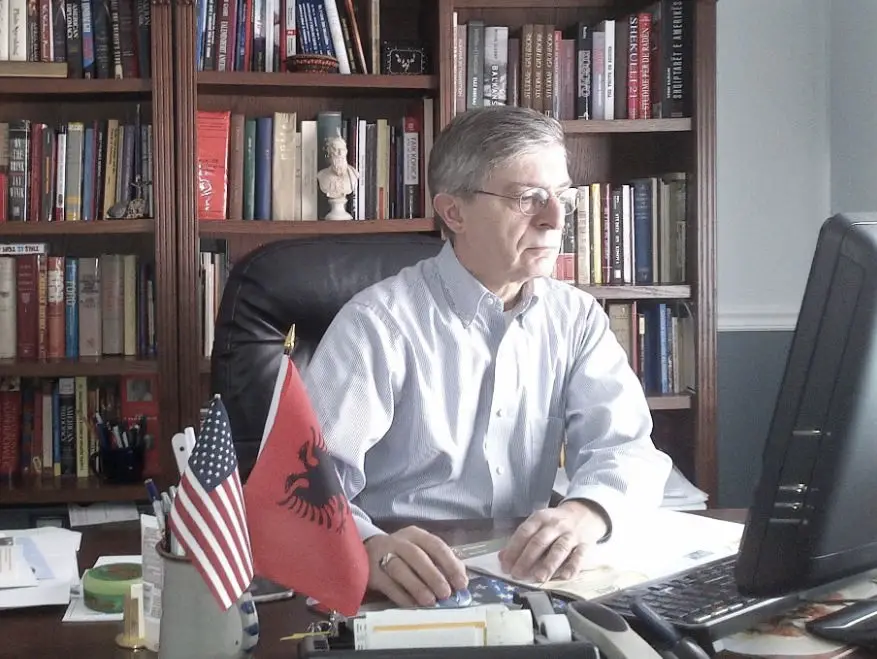
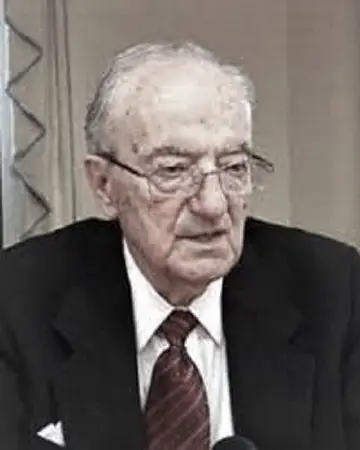
In March 1948, At Çiprijan Nika was executed by firing squad, while many other Albanian Franciscans suffered the same tragedy. The message of At Çiprijan Nikaj, to Sami Repishti, then 20 years old, a fellow sufferer in the same cell with him: “I leave it to you as a sacred trust, bring the truth to light.” “I give you my word,” replied the future professor, who was released 9 years later from the prisons of Enverist communism.
“For an endless and solemn minute, we remained silent in each other’s embrace, as if we wanted to ensure that the continuity of the truth, interrupted by the friar’s death, would survive in me and would vindicate the victim,” he wrote in the book: *Tears – Glory and Beatification*.
Dr. Gentiana Sula, head of the Authority, said among other things: “This day serves as a memory for the millions who suffered under these regimes, including those imprisoned in concentration camps, gulags, and prisons. We aim to honor the history of our people who were forced to live in these camps and to prevent their tragedy from being denied and forgotten.”
Simon Mirakaj, a child when his family, mother, and sisters were interned in Tepelena: “All this tragedy, upon completely innocent people, happened in peacetime. Our duty is to remember those we left behind and to encourage the Authority that in the light of new documents, this place, this history, be made known to the future.” /Memorie.al