• Rreth Nesh
  • Kontakt
  • Albanian
  • English
Wednesday, March 11, 2026
Memorie.al
No Result
View All Result
  • Home
  • Dossier
  • Interview
  • Personage
  • Documentary
  • Photo Gallery
  • Art & Culture
  • Sport
  • Historical calendar
  • Others
  • Home
  • Dossier
  • Interview
  • Personage
  • Documentary
  • Photo Gallery
  • Art & Culture
  • Sport
  • Historical calendar
  • Others
No Result
View All Result
Memorie.al
No Result
View All Result
Home Art & Culture

“Arifi went to Athens, where he was a shareholder of ‘DAG Film A.E.’, which was the first cinematographic company in Greece…”/ The unknown story of the two Albanian brothers Arif and Abedin Dino, in European papers

“Në ato kohë, Arifi dashurohej me një turke të bukur që quhej Guli, të cilën një mbrëmje vonë, në Jenikoi buzë Bosforit, ai…”/ Historia e dy vëllezërve shqiptarë Arif dhe Abedin Dino në letrat europiane
“Dinejtë e Çamërisë”: Historia e panjohur e familjes që shkriu pasurinë dhe talentin për pavarësinë e Shqipërisë
“Në ato kohë, Arifi dashurohej me një turke të bukur që quhej Guli, të cilën një mbrëmje vonë, në Jenikoi buzë Bosforit, ai…”/ Historia e dy vëllezërve shqiptarë Arif dhe Abedin Dino në letrat europiane
“Mes Sami Frashërit dhe aktores Mari Karyan, bukuroshes së famshme të Stambollit, kishte një histori dashurie që rezultoi tragjike, pasi ajo vdiq gjatë abortit…”/ Historia e panjohur e dijetarit të madh shqiptar
“Si mik me Konicën, i lindi kureshtja për të vizituar Shqipërinë dhe për të nxjerrë disa tipa shqiptarësh…”/ Historia tragjike e piktorit të famshëm Paul Nocquet, ku punët e tij si “Gratë e Sulit”, etj., janë në Luvër
“Faiku shton: por kur quajm vjershëtor të madh, Naim Frashërin, një bërës toto e tatatash, ç‘fjalë do të mbetet për një Gjergj Fishtë…”?! / Polemika e Nonda Bulkës me Faik Konicën, gusht 1937

Part Two

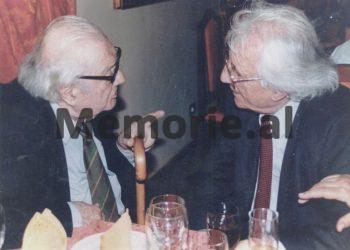
Memorie.al / In his dialogue with the great French poet Alain Bosquet, Jashar Qemali remembered in Paris his youth and his friendship with the two Albanian-Turkish brothers, Arif and Abedin Dino, grandsons of Abedin Pasha Dino, one of the prominent figures of the national movement at the time of the League of Prizren, and sons of Rasih Dino, one of the signatories of the Albanian Declaration of Independence, and also a loyal emissary whom Qemal bej Vlora sent to European chancelleries for the recognition of the new Albanian state…! Jashar Qemali described Arif as his spiritual inspiration, who, as he wrote; “through him I discovered the paths that lead to man. Even before the Dinos came to Adana, I knew their name and had heard about them. I had read Arif’s poems and seen Abedin’s drawings. I first met Arif and listened carefully to his advice. Arif was an admirer of Rimbaud, he even knew him by heart.”

                                              Continued from the previous issue

In Greece, the Greeks knew him as a great master of drawing, as they noticed in the paintings exhibited in Athens or even in the poster of the Delphi Festival painted by him, in May 1930. Arif also liked Apollinaire very much, the friend of the great Albanian Faik Konica. Even in Faik’s magazine *Albania*, he had published writings in defense of Albania. He wrote verses inspired by Apollinaire:

Gjithashtu mund të lexoni

“At that time, Arifi was in love with a beautiful Turkish woman named Guli, whom one late evening, in Yenikoy on the shores of the Bosphorus, he…”/ The story of two Albanian brothers Arif and Abedin Dino in European letters

“When Lefter Çipa heard the song and saw that his lyrics had been distorted into: ‘Boys and girls like butterflies / Raised by Mother Party…’, it felt to him like a betrayal of Petro Marko and…” / The rare testimony about the “Lasgush of the Coast.”

In the blue hour,

The sap rises from the branch

Towards the apple,

Eve bites it,

The sap leaps

enters and wets

*the lips of the fire,*

that are always thirsty”!

Here is another love poem, dedicated to “princess F.S.,” as he writes in French, titled *Lettre d’amour* (Love Letter):

“Your white hand

can save me

from the madness[3] of insanity.

If you are

the one I adore

Come.

Otherwise

wipe this letter,

bury this letter,

in the crypt

of your dead

loves”.

Often, his poetry is also enigmatic, as in the poem The Broken Glass, written in French with the title Verre brisé.

On the terrace with marble tiles,

twelve glasses were broken,

a cascade of crystalline laughter

into small… fine… shards…,

Evening of bloodied marble,

cemetery night

in the morning the broken glass,

regains its laughter of light”.

His poetry always inspired Jashar Qemali, as did the poetic line of his drawing. “On days I didn’t go to work, I stayed with Arif, from morning till evening. We talked about ancient theater, Homer, the Hittite epic of Kumarbi, Gilgamesh, and as always about painting. Arif Dino was a great painter. He did not exhibit and only showed his paintings to friends. He wrote poetry in Turkish and French.”

Undoubtedly, Dino was one of the most imaginative poets of Turkey at that time and one of the most modern, but who remained unknown, as he wrote little, unlike the long literary itinerary of Nazim Hikmet, an equally modern poet for the time. Arif wrote:

“Double vision.

What do you see

in my heart?

– I see

ruined stairs.

No actor.

No spectator.

And on the stage

of shadow,

silence that

moves to tears,

*eternal drama*

in an eternal heart!”

Through his poetry, Arif thus leads us to other worlds:


“Tired, the sun sets on a roof.

Desperate, the moon seized the lightning rod

and the beauty sang:

You love me because I leave

but I hide from myself

And the reawakened echo, recoiling, will murmur

Silence”.

Most of Arif’s poems, written directly in French, have been lost or torn up by him. The poem “Jewish Triptych” can be described as a high-level poem, of the same level as the great modern poets of that time, in the metropolises of Europe:

“From the most beautiful of the Shulamites

the flowers of the sacred tree of Judah,

from your perfume springs and is reborn

the temple, the spring, and the laurel

and from you to me awakens

the rhythm of the dance and your voluptuousness,

since your lip is a reflection

of the golden and

bloodied plate of Salome…”!

… Thus wrote the poet. In this poem is not only the power of word and image, but also his knowledge of biblical history and Judaism. The story of the severed head of Jean-Baptiste returns and settles in his poetry, between amorous exaltation and the bloodying of a golden plate.

When his mother dies, on November 27, 1930, Arif writes the poem, *De Profundis*:

“Laughter, joy

weeping, pain

and death that comes after

my mother is dead”.

Cinema was also one of his passions: the American Griffith, the Soviet Eisenstein, as well as the revolutionary German Piscator. As written by scholar Nikos Stillos, who has referred to the memoirs of Ilia Vasilas, a friend of Arif’s in Greece, “Arif moved to Athens, where he was a collaborator and shareholder of DAG Film A.E., which was the first cinematographic company in Greece, founded in 1920 by the Gaziadhi brothers, originally from Istanbul.

In Athens he worked as a painter, but also as an actor, and one of the best-known silent films to me, in which he acted, is: *Port of Tears*, by DAG Film, shot in 1928, starring Athanasia Mustaka and Emilio Veakis. After the first screening of this film, which took place in January 1929, he returned to Istanbul and began writing art criticism in the magazine Yeni Adam.

Upon his return to Istanbul in 1929, according to the writings of Osman Kurrizi, which are still unpublished in a book, he brought with him the musician from Preveza, the famous clarinetist Niko Xharas, to continue his studies further, which he arranged for him, also giving him a Turkish clarinet, which today is in the collection of Niko Xharas’s son, Dhimitri.

In the years 1939-1942, publishing poems in the progressive magazine *Yeniler*, he joined the movement against the fascist occupation and consequently was interned in the small town of Mecitozu in the Çorum region of Turkey, and later in Adana, together with his brother, Abedin. In 1951 he returned to Istanbul, to the small house he took in the “Kuzguncuk” neighborhood, in the Asian part of Uskudar of that city, where he lived alone in the last years of his life, as he was not married, and where he also died on March 30, 1957″.

Thus, in Arif, all three types of art converged: painting, poetry, and film. And each of his creations was an expression of his humanistic philosophy, a desire for the spiritual perfection of man.

“I would be God himself

if I were completely Human

free.

But God (if He exists)

is He truly

free?”

And in another poem he added:

“I don’t want to be zero

to add after one

its values.

I don’t want to be zero

before one to undo

its values.

I am equal to one”.

Entretiens avec Bosquet, “Gallimard” publications. / Memorie.al
ShareTweetPinSendShareSend
Previous Post

"Albanians, whether vagabonds out of work or outside Albania, or otherwise, we have seen more savagely and more gently, since the greatest danger to Albania is..."/ What did Father Gjergj Fishta say in 1921?

Next Post

“When the beautiful chief prosecutor asked him: ‘Defendant, be brief and precise, did you commit the assault and sexual relations with your student who is accusing you?’ he...” / The untold story of teacher Astrit Rizaj!

Artikuj të ngjashëm

“At that time, Arifi was in love with a beautiful Turkish woman named Guli, whom one late evening, in Yenikoy on the shores of the Bosphorus, he…”/ The story of two Albanian brothers Arif and Abedin Dino in European letters
Art & Culture

“At that time, Arifi was in love with a beautiful Turkish woman named Guli, whom one late evening, in Yenikoy on the shores of the Bosphorus, he…”/ The story of two Albanian brothers Arif and Abedin Dino in European letters

March 9, 2026
“When Lefter Çipa heard the song and saw that his lyrics had been distorted into: ‘Boys and girls like butterflies / Raised by Mother Party…’, it felt to him like a betrayal of Petro Marko and…” / The rare testimony about the “Lasgush of the Coast.”
Art & Culture

“When Lefter Çipa heard the song and saw that his lyrics had been distorted into: ‘Boys and girls like butterflies / Raised by Mother Party…’, it felt to him like a betrayal of Petro Marko and…” / The rare testimony about the “Lasgush of the Coast.”

March 8, 2026
“Kirov is murdered in Leningrad and shrouded in a veil of mystery, just as with Nako Spiru and others, all the way to Mehmet Shehu…” / Reflections of the writer on the book that draws parallels between the two dictatorships.
Art & Culture

“Kirov is murdered in Leningrad and shrouded in a veil of mystery, just as with Nako Spiru and others, all the way to Mehmet Shehu…” / Reflections of the writer on the book that draws parallels between the two dictatorships.

March 2, 2026
“When we went to meet Aleksandër Moisiu, along with the young German writer, Linke, as soon as he saw us, he invited us into his Chamber…” / The rare testimony of the Albanian journalist who met the famous actor.
Art & Culture

“When we went to meet Aleksandër Moisiu, along with the young German writer, Linke, as soon as he saw us, he invited us into his Chamber…” / The rare testimony of the Albanian journalist who met the famous actor.

February 24, 2026
Year 1994: “When the Assembly decided that June 27 be known as: ‘The day of genocide against the Albanians of Chameria by Greek chauvinism’ …” / Who took the initiative and the discussions of the deputies
Art & Culture

“Before returning to Memaliaj, where I was serving my sentence as a miner, I met Bashkim Shehu at ‘Peza’ [café], and when we spoke about Kadare, he told me…” / The unknown testimony of the writer and poet Sadik Bejko.

February 23, 2026
“In France, my parents did not want me to get involved in ballet, because they didn’t understand it; my mother in Albania had been a shepherdess with sheep, and…” / The unknown interview of Angjelin Preljocaj.
Art & Culture

“In France, my parents did not want me to get involved in ballet, because they didn’t understand it; my mother in Albania had been a shepherdess with sheep, and…” / The unknown interview of Angjelin Preljocaj.

February 18, 2026
Next Post
“He gave secret state information to Soviet Intelligence through agent Valentina Peza and the advisor to the Soviet embassy in Tirana…”! / The indictment that led to the death of the brother of Enver Hoxha’s secretary

“When the beautiful chief prosecutor asked him: ‘Defendant, be brief and precise, did you commit the assault and sexual relations with your student who is accusing you?’ he...” / The untold story of teacher Astrit Rizaj!

“Historia është versioni i ngjarjeve të kaluara për të cilat njerëzit kanë vendosur të bien dakord”
Napoleon Bonaparti

Publikimi ose shpërndarja e përmbajtjes së artikujve nga burime të tjera është e ndaluar reptësisht pa pëlqimin paraprak me shkrim nga Portali MEMORIE. Për të marrë dhe publikuar materialet e Portalit MEMORIE, dërgoni kërkesën tuaj tek [email protected]
NIPT: L92013011M

Na ndiqni

  • Rreth Nesh
  • Privacy

© Memorie.al 2024 • Ndalohet riprodhimi i paautorizuar i përmbajtjes së kësaj faqeje.

No Result
View All Result
  • Albanian
  • English
  • Home
  • Dossier
  • Interview
  • Personage
  • Documentary
  • Photo Gallery
  • Art & Culture
  • Sport
  • Historical calendar
  • Others