From Ali Buzra
Part Twenty-Four
– LIFE UNDER PRESSURE AND SUFFERING –
(ASSESSMENTS, COMMENTS, NARRATIVES)
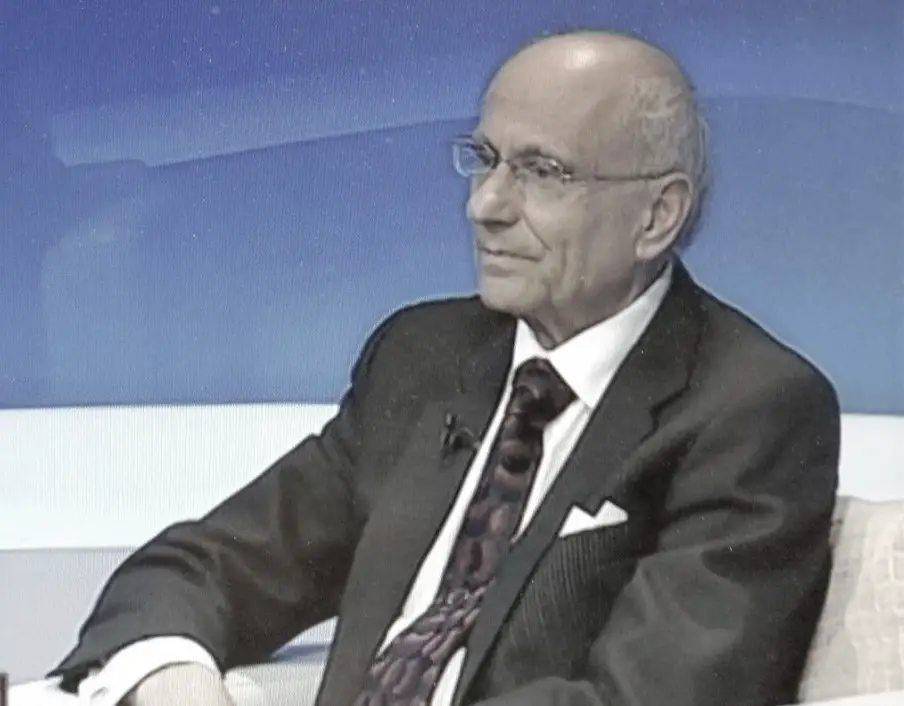
Memorie.al / At the request and wish of the author, Ali Buzra, as his first editor and reader, I will briefly share with you what I experienced in this encounter with this book, which is his second (after the book “Gizaveshi in the years”) and which naturally continues to develop his writing style. The sincerity and candor of the narrative, the simple and unmodified language, the accuracy and precision of the episodes, or the absence of a refining imagination, a deliberate subsequent one, or its non-utilization, I believe have served the author positively, who comes to the reader in his original form, inviting us to at least get to know unknown human fates and pains, whether by chance or not, leaving us to reflect as a starting point for awareness towards a catharsis so necessary for the conscience of Albanians.
Bedri Kaza
Continued from the previous issue
The communist state begins to arrest the men of the Biçaku family
This family, like many others in post-war Albania that were economically well-off, could not be overlooked by the new communist power that was being installed in Albania. The first measure, taken at the beginning of 1945, was the confiscation of the shop with all its goods in Librazhd, which at the time held a considerable value in gold francs. But the state of the time would not be satisfied with only that. This family would be an obstacle in the path of the absurd socialist reforms that would be undertaken.
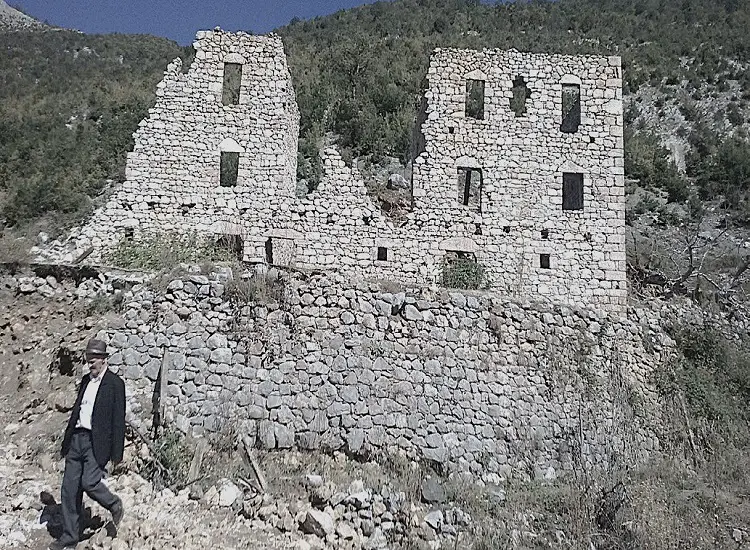
Around mid-1945, the house was surrounded by numerous Army forces. They arrested Emin, who was already elderly. They tied him up, placing him in front of the tower, by the bread oven. Meanwhile, they searched the house and took their goods and livestock, as well as a quantity of gold coins that were found there. Then they arrested his brother, Kapon. Through a staged trial, they were accused of having helped the armed group of Azis Biçak and Isak Alla, and of having sheltered Sadik Kaçi from Pajova. The latter was a friend of their family and had become a sworn brother (“vëlla”) with Kapon. He had escaped and was being pursued by the State Security forces. Emin was sentenced to 15 years in prison, while Kapo received 10 years. The two heads of the family, the oldest men of the family, served 7 and 6 years in prison respectively, in the prison camps of Elbasan, Maliq, and Libofshë. They were released in 1952 and 1953. Meanwhile, while the elders were in prison, in 1951, they arrested Nexhip, Emin’s son, but released him due to lack of evidence.
The dictatorship of the communist state did not give up again. After a few months, they arrested him again. He was also accused of maintaining ties with Azis Biçak and other fugitives. He was sentenced to 10 years in prison, with the banal motivation of the time, “For crimes against the state.” After a year, under suspicious and unknown circumstances, Nexhip died in prison 303 in Tirana, at the age of 36. He left behind his wife Fize, (the daughter of Liman Koxha from Gizaveshi), and 4 sons; Adil, 17 years old, Mevlut, 11 years old, Besim, 6 years old, and Agim, 2 years old. As with many other convicts of the dictatorship, there is no grave for Nexhip today.
We feel it necessary to comment on the fact that the Turks, Serbs, Italians, and Germans were indeed occupiers, committed numerous murders and crimes during wartime, but they did not deny family members the right to retrieve and bury the corpses. The example of the communist dictatorial state in Albania, established after the war, led by the radical communist Party, constitutes the most inhuman and unusual example of a Stalinist dictatorship.
In 1954, a year after his release from prison, Emin passed away. After him, the family was led by his brother Kapo, and then, since he was elderly, it was led by Veliu, Emin’s son, while Rrahimi, the older brother, moved to the “Qytezë” neighborhood. Despite the difficulties created by the state, their family was still doing well. As I also mentioned above, they were capable and hardworking people. This was not looked upon favorably. Apparently, the aim of the authorities at the time was the complete destruction of this family. Its men were surveilled day and night by the State Security and their servants. In 1960, they arrested the two brothers, Rrahim and Veliu. They were held in investigation for nearly 11 months, using the most inhuman tortures. As a result of their resistance and the lack of evidence found, they were released. In 1962, their family of 57 members separated to enable each to live independently, but they remained in the same dwelling. They had worked for this. They had gathered materials; stones and timber, and had burned a multi-ton lime kiln, to build other towers for each family. But the drama of the Biçaku family does not end here.
In July 1962, the house was surrounded again and Veliu, the pillar of the family who was now 47 years old, was arrested. He was the father of four children, two sons and two daughters. The oldest, a daughter named Hire, was 13 years old, the oldest son, Fatmir, was 8, Reif was 5, and the other daughter, Qamile, was 2 years old. In this case as well, the family had their goods and livestock taken, and their lime kiln was confiscated. They held him in investigation for two years, under the most inhuman tortures. In the dungeons, he recounted, mice often took their bread because they stayed with their hands tied.
He was initially sentenced to death, with the motivation; “for agitation and propaganda against the state and attempted escape.” He did not accept any of the charges brought against him. Regarding the attempted escape, he answered the judging panel: “If I had wanted to escape, no one could have stopped me. I could have escaped with my whole family, because I know the border like the back of my hand, but I never considered it.” After appeal, with another court decision, he was sentenced to 25 years in prison. Veliu was in good health. He had a strong body, in which the features of a brave and proud highlander were carved.
He served his sentence years in Elbasan, Ballsh, Spaç, Reps, and Laç, where he never submitted to threats and mistreatment in prison. He responded with contempt to the insults made by some prison staff to subdue him. However, his family, his wife and minor children, also suffered no less hardship and consequences. Meanwhile, under these conditions, the family trunk tries to survive by helping each other. Veliu’s wife, Hamide, a girl from Borova, together with her son Fatmir, and later when he grew up a bit, also Reif, would go to the prison to take him some food. In all cases, they were accompanied on the long and arduous road by her brothers-in-law, Shukri, Isa, and others. Several times, Nazim, Rrahim’s son, accompanied the poor mother with her sons. Regarding this, her son Fatmir expresses: “Nazimi was big-hearted. He was always ready to accompany us.” At that time, transportation was also a problem. With great pain, the brothers Fatmir and Reif narrate these comings and goings. – “We slept outside on many occasions, in Laç, in Spaç, and other places. Sleeping outside at night, the mosquitoes would eat us,” they recount.
They made the road from Tirana to Laç mostly on foot because cars wouldn’t pick them up. The poor children, together with their mother, endured the rain, cold, heat, sleeplessness, and fatigue on the long road to meet their father. Their memories are truly hair-raising. Walking along the road, exhausted from overexertion, they would beg their mother and uncle to rest a little. When they rested, they would immediately fall asleep, exhausted from fatigue. Their mother would call them with a torn heart, telling them they still had a long way to go. “Let us stay a little longer,” they would plead, but what could the poor mother do?
They painfully recall two instances when they couldn’t meet their father, once in Laç and another time in Spaç. After arriving at the prison, the guards told them they couldn’t see Veliu. He had “broken discipline” and his right to see his family was denied for some time. It was late in the afternoon. They waited in vain in Spaç, sleeping by a canal, the mother with her two sons, along with their uncle and Nazimi, hoping that the next day they would be allowed the meeting. In the morning, the officers of the prison command came. They pleaded with them, showing the small children, but it was not possible. The command’s order was final: “There will be no meeting for Veliu Biçaku until further notice.” They didn’t even accept the food. It was hot. The family members returned home in despair. The food obtained with difficulty had to be thrown away along the road because it started to spoil from the heat.
On another occasion, – their relatives recount, – during the journey on foot from Laç to Tirana, the rain did not stop the entire way. Night caught them on the road. They knocked on doors seeking shelter along the way, but no one opened their door. Near Tirana, an old woman who lived alone took them in, and they spent the night there. She was poor. The uncle who accompanied them gave her 50 lek.
Finding themselves under surveillance and at risk of arrest, some of the family men decide to escape
While Veliu was in prison, the family was constantly under surveillance. Its men were provoked to find some pretext. Other arrests were expected. Under these circumstances, Adil Biçaku, Nexhip’s son, escaped. Adil had been a weak spot for his uncle, Veliu. The latter loved him very much. Seeing in him special talents for learning, Veliu, before his arrest, sent his brother’s son to continue his 7-year education in Elbasan. After finishing compulsory education there, he arranged for him to have the right to study at the Pedagogical School as an external student. Veliu had friends everywhere. Adil was sheltered by a family friend in the city of Elbasan.
Adil finished the Pedagogical School for teaching with excellent results. Continuing with higher education was out of the question. His father Nexhip, as we mentioned above, was convicted and died in prison. The young man was considered a “son of an enemy of the people.” As soon as he finished pedagogical school, he hoped to start work in his village. But this was never made possible. And not only that. They assigned him as a teacher in Roskovec, Fier. This was a particular case for someone from Librazhd, because our district was in great need of teachers.
Local teachers in the 60s were very few. In many villages, local teachers with three-month courses, without Pedagogical education, were appointed. In schools, teachers from Elbasan, Korça, Saranda, Vlora, Gjirokastra, etc., taught. Adil was not only not assigned as a teacher in his village or district, but he was a teacher in internal exile. He was forbidden to go to Qarrishtë, even to visit his family. So, a teacher, an exemplary intellectual, was deprived of the right to join his family. He asked several times to go to Qarrishtë, to meet his mother and his younger brothers, but he was not allowed. He was surveilled and often provoked in various ways. Under these circumstances, and feeling the danger of a possible arrest, Adil decides to escape.
He secretly left Roskovec, together with Mustafa Leshanaku, whom he had as a friend and trusted. They came to Librazhd, traveling at night towards the border. They crossed it with great difficulty, arriving in Struga, where they stopped at some family friends. Unfortunately, the Macedonian police tracked them down and arrested them. A return to Albania would cost the young men their lives. As far as is known, at that time there was an agreement between the Albanian police and the Yugoslav one, and they exchanged fugitives from one side of the border to the other. Under unknown circumstances, about which I have no information, they escaped from prison and went to Greece.
In the Greek state, they surrendered and were sent to a refugee camp. Fortunately, a European woman from Human Rights was inspecting the camp. Adil, who knew a foreign language, contacted her. She gave him the opportunity to go to Sweden, while Mustafa Leshanaku went to America. After settling there, Adil enrolled and continued at the University of Stockholm, graduating with very good results. There, he met and married a Spanish student, starting a family. He started working in a prestigious Swedish company, on its management staff. Adil was and is a devout nationalist.
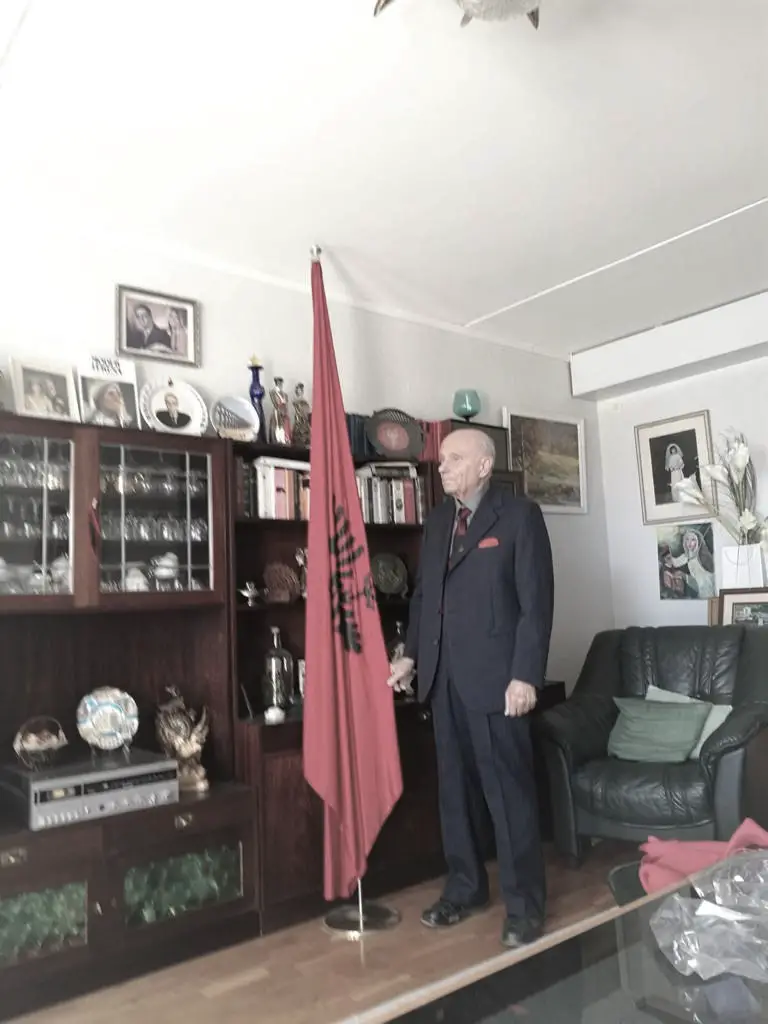
He served as a translator for Albanians in exile, following their problems and the court cases they had in process for regulating citizenship documents, etc. He was an admirer of the Albanian Royal Family, and was invited to the wedding of the heir of King Leka I. There in exile, Adil succeeded and built his life very well, but his heart remained distressed over the sufferings and vicissitudes of his family until the communist dictatorship was overthrown. After 1990, he came to Albania, reuniting with his mother and his brother Besim, while the other two brothers, Mevlut and Agim, had escaped in 1978, a case we will describe below.
Returning to the events of the family of Emin and Kapo Biçak, the reader will learn about its further vicissitudes and sufferings, which seem endless. While Veliu, the head of the family, was serving his sentence in prison, their tower was watched day and night by the command of the Border military forces and State Security officers. They would come during the day and tell them that “there is movement here at night,” and that “fugitives come,” making various pretexts; that “this stone or this branch has moved, noises were heard, dogs barked,” etc. Feeling the danger of arrest, in the spring of 1965, Kadriu, Veliu’s brother, escaped together with Ferit Dosku from Dorëzi.
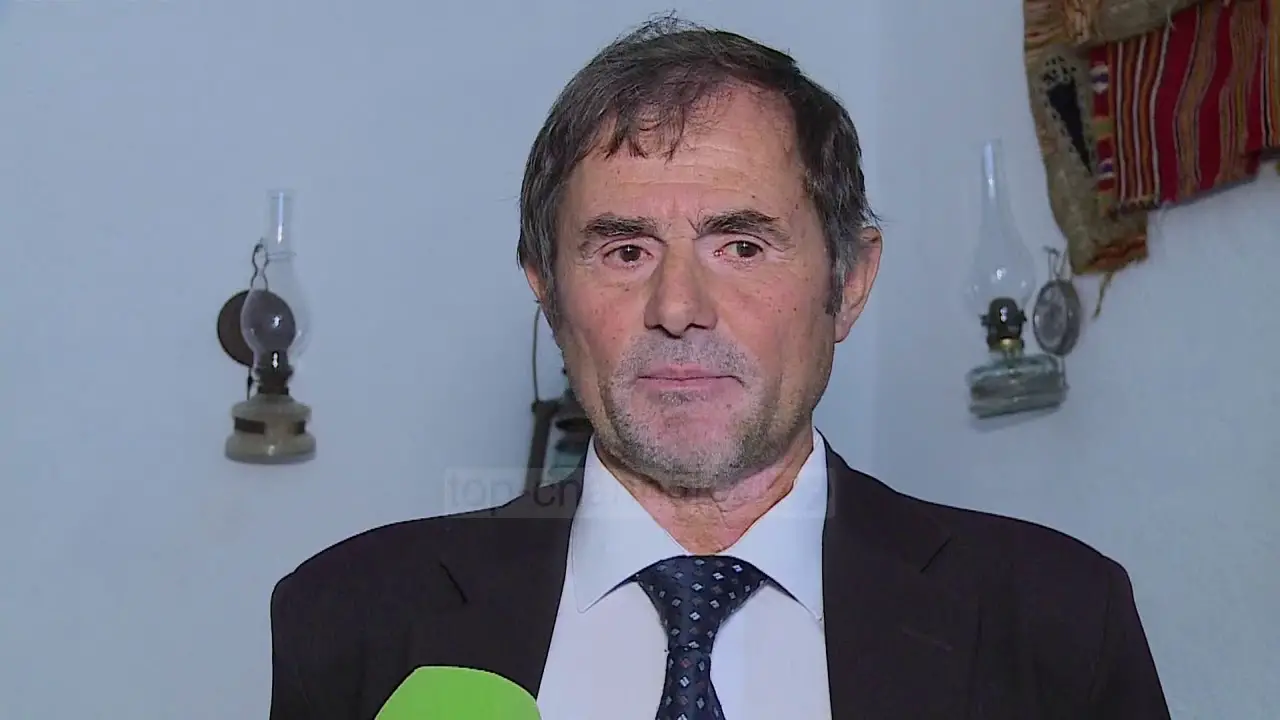
Ferit was related by marriage to the Biçaku family, as his brother Gani was married to their sister. From a contact with Kadri Biçak in September 2018, at his home in Elbasan, I learned about the motive and moments of his escape. In the spring of 1965, he was working in Gosë, Kavajë, with his brother Haki. Besides agricultural and livestock activities in the village, the men of the Biçaku family also worked seasonally as builders in various areas of the country, a profession they knew very well. He was 27 years old, married, and had a son, Ylli, two years old. A local resident came there and told him to go home to Qarrishtë because his family was asking for him. His brother stayed at work, while he set off for home.
That night he stayed in Elbasan. In the morning, with the first cars, he got off in Librazhd. There he met two residents of his village, and with one of them he set off for Qarrishtë. Along the way, he sensed that something was wrong, as his companion provoked him several times during the walk to the village regarding the families of Azis Biçak and Isak Alla. Kadriu was very intelligent. He did not fall into the trap that the State Security might have set for him. Very carefully, he avoided conversation with him, steering clear of the provocative questions. When he went home, they told him they hadn’t sent any notice for him to come. Meanwhile, he says, ten days earlier, his wife had given birth to a girl. They named her Sabire.
The next day he set off for Librazhd, and from there he would go to Gosë to finish the started work with his brother. Along the Qarrishtë-Librazhd road, which takes about four hours on foot, all sorts of thoughts ran through Kadri’s mind. One thing was clear to him: he was now being followed. And what was expected happened. When he arrived in Librazhd, near a bar where billiards was also played, the deputy head of the Internal Affairs Directorate touched him on the shoulder, calling him by name. He told him he had to report to the Directorate. He went upstairs to the office where were present: the Head of the Directorate, the deputy head, and two security officers. They asked him to work in the service of the State Security, promising him a house in Librazhd and other facilities for his family.
“This,” they told him, “is a service to the Party and the state,” and it would be good for him to accept it; otherwise, there could be consequences, – “since your brother, Veliu, is in prison,” – they reminded him. He felt much trapped and without a way out. He thought for a bit and answered that he would work, “but you must guide me,” he replied. Meanwhile, he told them he would come back in two days, as he needed to go to Peqin to secure grazing rights for the small livestock they had there, with the family of Tahir Rusi. They trusted him and couldn’t imagine he would escape, as the border above Qarrishtë had over two meters of snow.
It was March 11, 1965. At the mountain heights of 1,800 and 2,000 meters, in those years, snowfalls still occurred. “When I went out the door,” Kadriu recounts, “I was scared to death. Several officers who had come out there hugged me, telling me I had made powerful friends and that I had them for everything.” He set off for the bus agency, having already made his decision while inside the police offices. “What decision had you made?” I asked Kadriu during the conversation. – “I would not sell myself out. Better my children suffer, than for me to ruin other people’s children by becoming a spy,” he replied. He knew he was being followed.
He got on a flatbed truck and set off for Elbasan. There, by the castle, an old ragged man asked him for a tobacco cigarette. He gave him half the pack, along with papers. In the evening, there in Elbasan, he met Ferit Dosku. He trusted Ferit, not only because they were friends, but because they were from the same stratum of the persecuted. He told him about the decision he had made and asked if he could join him. Ferit was willing. They left Elbasan at night and got on a Czech “Skoda” for Librazhd. They got off before crossing the bridge. They crossed the bridge one by one, checking to see if they were being followed. They went under the bridge, down the steep slope, and took the road towards Xhamia e re, today’s Librazhd-Qendër. / Memorie.al