Part One
Memorie.al /In his dialogue with the great French poet Alain Bosquet, Yashar Kemal remembered in Paris his youth and his friendship with the two Albanian-Turkish brothers, Arif and Abedin Dino, the grandsons of Abedin Pasha Dino, one of the prominent figures of the national movement during the time of the League of Prizren, and the sons of Rasih Dino, one the signatories of the Albanian Declaration of Independence, but also a loyal emissary whom Qemal bey Vlora sent to European chanceries for the recognition of the new Albanian state…! Yashar Kemal described Arifin as his spiritual inspiration, who, as he wrote; “through him I discovered the paths that lead to man. Even before the Dinos came to Adana, I knew their name and had heard about them. I had read Arif’s poems and seen Abedin’s drawings. First I met Arif and listened a lot to his advice. Arifi was an admirer of Rimbaud, he even knew him by heart.
Together we spent hours translating Rimbaud’s poems and talking at length about them. That’s how we translated his poem ‘The Drunken Boat’ (Bateau Ivre). The first book that shook me was Don Quixote. I was seventeen when I read it. It was Arif who made me read that and the classics. When Arif Dino (1892-1957) sold some land, he gifted me about a hundred classic books. When I opened the boxes, I found three copies of Don Quixote. I went and told him he had mistakenly given me three copies, but he told me: No, I gave them to you to read for your whole life.”
And in other interviews in the French press, as well as in various conversations, Yashar Kemal never stopped talking about the Dino family, with whom he was linked by an almost mythical friendship. “Arif Dino was a great painter, as was his brother Abedin. But he didn’t want to exhibit his works. He painted for himself and was content to show them to close friends. The friendship with Arif continued for seventeen years, without any eclipse, discussing the novel, art, socialism. He also introduced me to Homer and the great tragedians. He wrote poems in French and Turkish. He even knew the Greek language well and adored Greek Antiquity. We talked together about literature and painting. I remember one day when Arif started explaining to us with conviction that the novelists of our time are afraid to create unique characters, that the literature of this century has come to an end and that no one had the grandeur of a Don Quixote. For him, the world novel should be of the Don Quixote kind…! His idols were also Molière and Charlie Chaplin. In May 1951, I started working at the newspaper “Cumhuriyet”, where I also wrote my first reportage on Anatolia. I passed through Ankara and visited Abedin. I was happy and informed him that I had started my new job. Arif was friends with the newspaper’s director and had written to him about this: “I am sending you a young man,’terracotta’, who has been through the fire twice.”
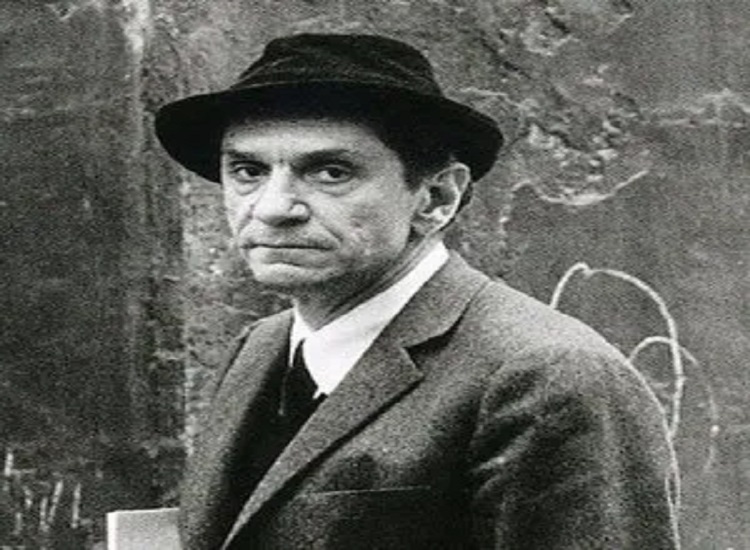
The portrait of Arif Dino has remained somewhat in the fog. Perhaps because he died early or perhaps because he was a man who always aimed for perfection. Therefore, he did not publish his wonderful poems. Some writings have remained, but they are very few, such as critical writings, for example, about the other painter of Albanian origin, Sabri Berkel, a disciple of Matisse, which was published in the magazine “Përpjekja shqiptare” (Albanian Endeavor) of the 1930s, published in Tirana, but also elsewhere. In the magazine La Turquie Kemaliste, emphasizing the modernity of the young painter influenced by the Italian Renaissance, he writes among other things that “From Giotto, Sabri Fetahu assimilated the qualities of volume and construction; from Masaccio he took the breath of freedom in art; from Fra Angelico he brought deep mystical visions.
Finally, from Andrea Del Castagno and Ghirlandaio he learned the technique, meaning all the nuances and difficulties of the art of the fresco…! Michelangelo had been and remained for him a divine source of eternal power and mastery, an unbroken ideal and a beautiful symbol of the eternity of art.” His critical sense was quite sharp and with great culture. However, he was one of those intellectuals who looked to the West and Western culture, and firstly to poetry, painting, and philosophy.
Arif often worked as a decorator, especially for the Izmir fairs, where he was invited every year. Then he spent his time writing and painting or reading the works of great authors, many of them French philosophers. “In the café he was always drawing,” recalls Guzinte, the wife of Abedin Dino, his brother, a painter who would be one of Turkey’s first avant-gardists in the field of painting and later would work in a studio with Picasso or Chagall (in “Madoura” in Vallauris). – “Back then he also taught Abedin boxing. They boxed together. Later, when showing his nose, Abedin would laugh and say that Arif smashed my nose with his fists. Arif loved his little brother very much. He even influenced his tastes and his development.”
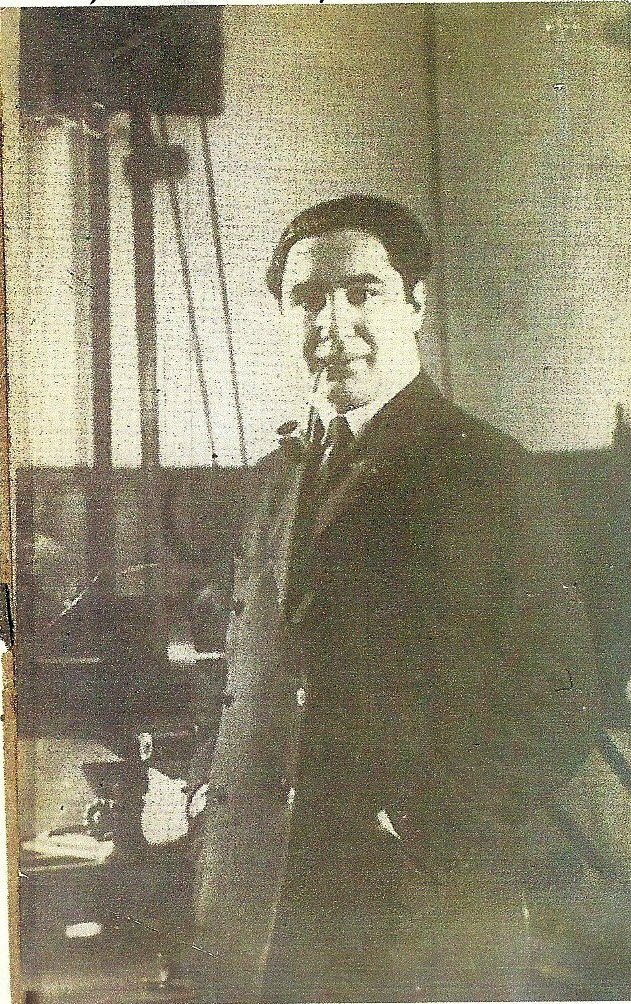
Arif was tall, 1.90 meters, and really liked boxing. He was healthy. As much of a gentleman as he was, he was equally simple, a proletarian at heart. He desired to eat well, but when he didn’t have [money], he didn’t complain and ate like a poor person. When he had money, he always bought a Dutch tobacco that he really liked; when he didn’t have money, then he was satisfied with the worst tobacco, 4-5 packs a day. He even wasn’t impressed by sleeping on the ground. He never wore a tie, although he had many of them. He was silent; he preferred to listen to others. What was the world around saying? He would draw with coffee grounds on cigarette pack lids or on small scraps of paper. Therefore, the drawings that remain from him are small-sized, drawn in cafes, but with great art.
He liked to be with crazy people, to know their world: were they crazy, what was the mechanism of their metaphysics? This had happened to him in Paris, Athens, or Istanbul. The world on the other threshold. “He was a philosopher,” recalled Abedin, in the book “Arif Dino”, “although he didn’t write a single line about philosophy. He wanted to experience art, to experience being an artist; the moment of creation mattered little. That is why he didn’t want to leave traces with his works. He spoke, others wrote about him. At the “Suleymaniye” mosque, near Beyazit Square, in the wooden café we called “Forum”, Arif often went.
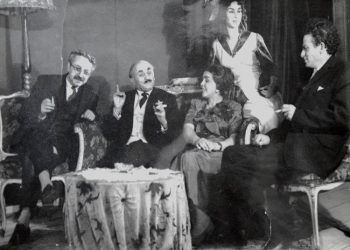
Many artists went there, among them Orhan Veli, Fikret Mualla, and Bedri Rahmi. All the artists had made it a habit to show their poems or drawings first to Arif, to hear his opinion… Arif was like the master of art. Everyone wanted to know if he liked it or not. The benchmark of perfection.” When Abedin sold his first painting and came home all cheerful, he yelled at him. According to him, one who made art to sell was committing a kind of prostitution. He saw art as something sacred: you could give it as a gift, but not sell it. Years later, when they were in Paris, whenever his paintings were sold, Abedin felt a kind of emptiness or guilt and always remembered his brother’s reaction in Adana.
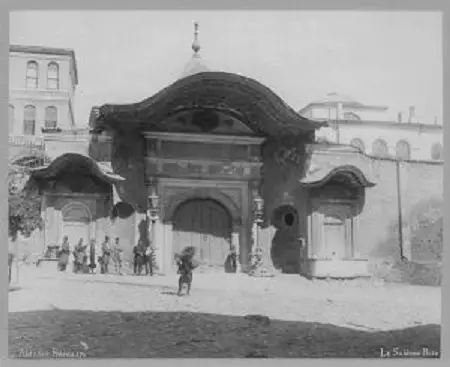
Arif was a man of high virtues, and the episode that Guzin would tell me about in Paris fully confirmed this. In Istanbul, when Arif lived near the famous “Suleymaniye” mosque, one of the largest and most beautiful in Istanbul and the entire Ottoman era, on the ground floor of his building lived a driver with his family. Arif was a simple and democratic man. Although a renowned intellectual, he was quite approachable also with simple people.
One day, the driver was pouring out his troubles and at one point had told him: “If something happens to me, who will take care of my poor family? My children will be left on the streets.” To calm him down, Arif had told him that he would take care of them and that he would not leave his family on the street. Strangely, the next day after that day, the driver had died. This death shocked Arif deeply, as he received this news as a divine message, sent by a supernatural power. And indeed he devoted himself to that family, so that it would not end up on the streets. This was Arif, with a big heart…!
When, together with Jusuf Vrioni, we met Abedin in Paris, speaking about Arif, he told us: “Arif was a great talent. I have some of his drawings at home. But he differed from me. He stayed in the shadows…”. Abedin had always adored his brother. Likewise his friend Yashar Kemal. In a writing of his in the magazine “Tarih ve Toplum” (History and Society) in 1994, Abedin’s contemporary and friend, Taha Toros, recalls how little Yashar approached their table and how he marveled at Arif’s words in the café in the city square. “When there was no room on a chair, he sat on the ground and listened to him.”
The Admirer of Rimbaud and Apollinaire
Years later, Yashar would not be separated from Arif. “Precisely, in a café corner, with Arif Dino we translated ‘The Drunken Boat’. We translated it thanks to his French and my Turkish…! We read ancient Greek writers and discussed Don Quixote, talked about Joyce, Kafka, and Faulkner…! We memorized folk poems: Yunus Emre, Karacaoğlan, the great rebellious poets, Pir Sultan and Dadaloğlu. We were not indifferent either to the greatest masters of Marxism, like Marx and Engels.” In a conversation with Alain Bosquet, remembering Arif, Kemal recounts: “I used to read then everything I could get my hands on about socialism. Soon, a group of socialist militants was formed. We got in touch with socialist workers and other intellectuals. Day and night we talked about socialism. The ‘Communist Manifesto’, copied and typed on a typewriter, circulated hand to hand…”!
In one issue of the famous French magazine Lire, in conversation with journalist Christian Guidicelli, Yashar Kemal recalled his time in Çukurova, when his life was inseparable from that of Arif. “He was my greatest friend. He knew ancient Greek very well. It was he who introduced me to the world of Homer and the great tragedians of Greek antiquity. He knew Rimbaud by heart. But I don’t forget Don Quixote. Arif used to say: the novel of the 20th century has come to an end because it is afraid of the unique hero, of the kind of Don Quixote…! Besides the ancient Greeks, his idols were Molière and Charlie Chaplin. Indeed, I inherited all his tastes…”.
In those times, Arif fell in love with a beautiful Turkish woman named Güli, whose portraits Arif has left us drawn with extraordinary sensitivity and sensuality. He was terribly in love with her and wrote poems for her. Arif was in fact a poet of love. Late one evening, in Yeniköy on the Bosphorus, where they lived, he wrote the poem dedicated to Güli. The figure of woman, of the beloved female, is often in his poems: she is enigmatic, sensual, lust-inducing, mother…!
“Your hair
your eyes
your lips
what a beautiful journey
of the wind
of the skies
of the seas
of the fruits
and then…”
In the other poem, Poem without a title, dedicated to Gül, as he writes, at 11 o’clock at night, Yeniköy, he writes:
“Invaded by emptiness,
despair.
Your griefs have no sound,
silence from you,
silence from me,
silence.”
His verses were lyrical and modern. Many of his poems seem to be influenced by Guillaume Apollinaire or Rimbaud. Particularly by Apollinaire’s “calligrammes”, where the verses create geometric or floral figures. However, after this series of poems, he writes an even more felt and modern type of poetry. When he was in Paris, he had also become acquainted with the poetry of his compatriot, Jean Moréas or otherwise Jani from the Morea, a scion of the Arvanite Tombazi family, which had greatly aided the Greek revolution for independence.
He adored the poems of this quite well-known symbolist of the era, who was a close friend of Verlaine and Mallarmé. Moréas was a poet of love. So was Arif. He had even had the luck to know Moréas personally, at the “Closerie de Lilas” bistro on the Boulevard du Montparnasse. What a strange man, what a great poet! From the meeting with him, Arif would sit down to write his poems…!
In Geneva, his closest friend was the writer Nurullah Ataç. They both spent nights talking about poetry and art. In 1926, Arif went to Athens, to his brother Ali, where he met many artistic personalities of that period. Among them, he had a close friendship with the actor Giorgos Papas, as well as with the son of a Mexican shipowner, a poet named Iturbi. “They were close friends,” Abedin recounted, “all three lived both in Athens and in Paris. All three knew French like their mother tongue. All three were crazy about Rimbaud. All three loved women very much…”. Arif even dedicated many poems to his Mexican friend, as he also testifies in the introduction to his cycle Oral Poems, where he writes: To my friend, the Mexican patron:
“…head of an Astec
eyes of a Muscovite
you dream nostalgically
even on the Acropolis
of the scents of passersby on the boulevards
of Paris …
For this
we are
Siamese twins”!/ Memorie.al