
Memorie.al /Almost 50 years ago, precisely on November 25, 1973, de facto, the right-wing Colonels’ Junta in Greece – which had come to power through a military coup on April 21, 1967, after overthrowing the democratic government of Panagiotis Kanellopoulos (1902–1996) – fell, although de jure it continued to exist for several more months, until July 24, 1974.
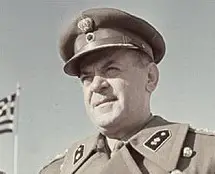
Its leader was Colonel Georgios Papadopoulos (1919–1999), together with his three close associates: Colonels Nikolaos Makarezos and Ioannis Ladas, and General Stylianos Pattakos (1912–2016). Part of the plot was also another personality, this time a civilian, Spyridon Markezinis, who became Prime Minister in 1973, when the dictatorship of the “Colonels’ Junta” was weakening and efforts were being made toward the democratization of Greece – a period known as “METAPOLITEFSI.”
In fact, the coup had been conceived by the last Greek King, Constantine II (1940–2023), and the Chief of the Greek Army General Staff, General Grigorios Spantidakis (1909–1996), who aimed to bring to power a government, led by the well-known politician and diplomat Panagiotis Pipinelis (1899–1970).
From November 25, 1973, Dimitrios Ioannidis (1923–2010), one of the colonels recently promoted to general, became Prime Minister. He was considered the shadow figure of the Junta – more precisely, a Greek “Richelieu” – and was shortly thereafter replaced by Spyridon Markezinis.
As soon as the Colonels’ Junta came to power, it began mass arrests (around 10,000 people), the exile of opposition figures, the abolition of freedoms and human rights, and the dissolution of political parties. From 1973, even the Royal Family of Constantine II was forced to seek asylum. Georgios Zoitakis became Regent, and later Papadopoulos himself declared himself President of the Hellenic Republic, before eventually being arrested.
There were many prominent dissidents against the Junta, but let us mention four of the most famous, who were forced to flee their homeland: Melina Mercouri (1920–1994), a great actress who later became Minister of Culture; Mikis Theodorakis (1925–2021), the renowned composer of “The Children of Piraeus”; Irene Papas (1929–2022), the legendary Arvanite actress; and Costa (Konstantinos) Gavras (born 1933), one of the greatest film directors of our time.
Besides Papadopoulos, other Prime Ministers during the dictatorial regime included: Phaedon Gizikis (1917–1999), Konstantinos Kollias (1901–1998), a well-known magistrate and Prosecutor General of Greece; Spyridon Markezinis (1909–2000); and Adamantios Androutsopoulos (1919–2000).
“METAPOLITEFSI,” in Modern Greek, means “change of regime.”
From the fall of the Junta until elections were held – in which opposition figures such as Panagiotis Kanellopoulos and Stefanos Stefanopoulos played a role – there was also the failed counter-coup attempt by Dimitrios Ioannidis, who sought unsuccessfully to stage a similar coup in Cyprus against Archbishop-President Makarios III (Mihail Christodoulou Mouskos, 1913 – 1977). Likewise, Nikos Sampson, a well-known journalist and politician, was among those who led but failed to carry out the coup in Cyprus, which paved the way for the Turkish invasion of the island in 1974, shortly after the fascist dictatorship of the Colonels had itself fallen.
All of them, after the overthrow of the regime, were tried and severely sentenced, even to death, for high treason. However, they were not executed; their death sentences were commuted to life imprisonment, where some of them died, including Papadopoulos, who categorically refused the amnesty granted to him.
Archbishop Makarios III fled to England but later returned and died of an acute myocardial infarction in Nicosia.
Post-war Greece, whether monarchist or republican, has been governed mainly by major and well-known political families such as the Venizelos, Karamanlis, Papandreou, Pangalos, and Mitsotakis families (the latter related by blood to the Venizelos family).
Kings Paul I and Constantine II (1940–2023) belonged to the Schleswig-Holstein-Sonderburg-Glücksburg dynasty. King Constantine II’s wife was Anne-Marie of Denmark, and their five children were Alexia, Pavlos, Nikolaos, Theodora, and Philippos.
From October 1940 to April 1941, from the territory of occupied Albania, Mussolini’s fascist Italian army declared war on Greece. Two Albanian battalions, “Tomori” and “Taraboshi,” were forcibly mobilized. Italy failed to conquer Greece, and since that time – in the height of political-diplomatic-military absurdity – Greece has formally (de jure) maintained in force for over 80 years the Law of War with Albania, even though in 1996 a Treaty of Friendship was signed between our two countries, which effectively – if not formally – nullified this paradoxical law.
The Greeks advanced as far as Korça and behaved as occupiers; indeed, had it not been for the Hitlerite divisions that forced them to withdraw, it is unclear how events might have unfolded.
During the Second World War, Greece was also engulfed in a fierce Civil War, with thousands of victims. The left was supported by Stalin, Tito, and Hoxha, while the right was supported by the Anglo-Americans. The conferences of the three Great Allies divided post-war Europe as they saw fit – a kind of bargaining over the fate and territories of smaller nations – and the Albanians not only gained nothing, but on the contrary were trampled upon, despite their contribution to the war against Nazism and Fascism alongside the Grand Coalition.
For decades there were no relations between the two countries, until suddenly, after secret Albania – Greece talks, diplomatic relations were restored on May 6, 1971, when Hoxha’s Stalinist regime in Albania and the extreme right-wing colonels’ regime in Greece were both at their peak – as if to prove that extremes often converge.
The first two Greek ambassadors were Denis Karajanis (Deputy Foreign Minister) and Dimitri Franghiskakis, a high-ranking official and Political Director at the Greek Ministry of Foreign Affairs. To reinforce the first ambassador, an important member of the Greek Secret Service (Asfalia) was assigned, hidden, as usual, behind the title of First Secretary – Ilias Papas, well acquainted with Albania, being a cousin of Nako Spiru, whom, like Mehmet Shehu, Enver Hoxha had “suicided” in November 1947.
In the years that followed, apart from the visit of Karolos Papoulias, relations extended to cultural exchanges, singers and artistic ensembles, as well as lemon imports. Marinella, Haris Alexiou, Yannis Parios, Mariza Koch, and Maria Farantouri were among the few famous singers.
Interestingly, as a peak of hypocrisy, was Enver Hoxha’s double-faced stance toward Marinella: in an internal bulletin he praised Party and Security comrades who abandoned her concert hall because she “twisted and swayed,” yet later in his book “Two Friendly Peoples” he harshly criticized those same “comrades” for forgetting how our own artists twist and sway, for example in the Tropoja dance.
With the collapse of the Hoxha – Alia totalitarian Stalinist regime, thanks to the December 1990 Student Movement led by the hero Azem Hajdari – inspired by the embassy events in July and by the shocking departure of our European and world literary genius Ismail Kadare on October 25, 1990, to France – Greece reacted immediately.
In the first days of January 1991, Greek Prime Minister Konstantinos Mitsotakis (1918–2017), father of current Prime Minister Kyriakos Mitsotakis and Dora Bakoyannis, paid a visit. The student movement turned into a popular hurricane, and the Democratic Party was founded (officially on December 19), joined and led by distinguished intellectuals such as Prof. Dr. Sali Berisha, Prof. Dr. Gramoz Pashko, Prof. Dr. Neritan Ceka, Prof. Dr. Meksi, Imami, Zogaj, and many others. These epochal developments marked the opening of Albania to the world.
Thus, over half a million Albanians found shelter and hospitality from the Greek people (and just as many from the Italian people), while making a significant contribution to the development of Greece’s economy in agriculture, livestock, tourism, and construction – including the construction of facilities for the 2004 Athens Olympic Games – amid mentalities and prejudices, especially from certain extremist politicians and, in particular, from unfriendly attitudes toward Albanians within the army, and to a lesser extent within the police, judiciary, and secret services.
For thousands of years we – Pelasgo-Illyrian-Arbërore (Albanians and Hellenes in the Balkans) – have been among the oldest peoples of the peninsula and the continent, contributing to world civilization. Never has any harm come from us to the Greek people or Greece; on the contrary, the contribution of the Arvanites – such as Kunduriotis, Kolokotronis, Karaiskakis, Bouboulina, Botsaris, Xhavella, Kryeziu, and others – in the Heterist Revolution and the proclamation of the modern independent Greek state has been and remains indisputable. The Hellenes gave civilization Homer, Herodotus, Hippocrates, Aeschylus, Sophocles, Euripides, Aristophanes, Aristotle, Plato (“Aristocles”), Pythagoras, Euclid, Pericles, Thucydides, Demosthenes, and many others.
Naturally, Albanians cannot forget – or worse, forgive – the genocide, crimes, and violent deportation of the Albanian population from their ancestral lands in Chameria, such as those committed by Napoleon Zervas (1891–1957) and his andartes, who from June 1944 began massacres, war crimes, and the forced expulsion of the indigenous Albanian population.
The toll of those crimes is difficult to calculate, and their variety remains almost unimaginable – a true horror that cannot and must not be forgiven.
[Organizational listings retained in translation…]
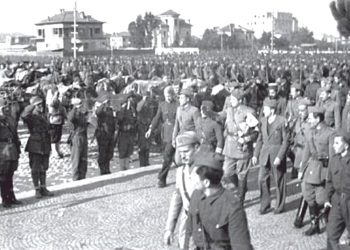
In 1949, the Greek monarcho-fascist army launched one of its heaviest attacks against Albania (the “August Provocations”), under the absurd pretext that we had sheltered thousands of Greek leftist fighters. They were repelled, leaving 300 dead, 500 wounded and 605 prisoners.
Our forces were commanded by General Petrit Dume (“Hero of the People”), later executed as a putschist by the paranoid dictator Enver Hoxha.
To this day, Greece’s main political forces are: New Democracy (currently re-elected), PASOK, SYRIZA, Golden Dawn, and the Communist Party of Greece (KKE).
Whichever political force the Greeks choose to govern them is the right of the neighboring people. For us Albanians, what remains constant is good neighborliness – without the absurd Law of War, whose abrogation strangely stretches into the “Greek Kalends” – a final solution in accordance with International Law, clear maritime borders, goodwill and justice regarding the Cham issue, the cessation of extremist chauvinist activities, Albanian-language schools for Albanians, and no forced change of names in exchange for documents or rights under UN conventions on migrants.
Since 1991, with Ramiz Alia’s approval, the head of the Autocephalous Orthodox Church of Albania has been the Greek Anastasios Yannoulatos – a complex personality, often debated.
Criminal events such as the Peshkëpia Massacre (April 10, 1994), or the killing of the young Albanian Gramoz Palushi on September 4, 2004, are strictly condemnable, just as border killings and abuses in police stations and prisons cannot be accepted.
We will always extend the hand of sincere friendship to our Greek neighbors and believe and hope that they will do the same./Memorie.al