
From Bashkim Trenova
Part Seventeen
Memorie.al/ publishes the memoirs of the journalist, publicist, translator, researcher, writer, playwright, and well-known diplomat, Bashkim Trenova. After graduating from the Faculty of History and Philology at the State University of Tirana in 1966, he was appointed a journalist at Radio Tirana in its Foreign Directorate, where he worked until 1975. He was then appointed journalist and head of the foreign desk at the newspaper ‘Zëri i popullit’ (The Voice of the People), the organ of the Central Committee of the Party of Labor of Albania. During the years 1984-1990, he served as head of the Publications Branch at the General Directorate of State Archives. After the first free elections in Albania, in March 1991, he was appointed to the newspaper ‘Rilindja Demokratike’ (Democratic Revival), initially as deputy editor-in-chief and then as editor-in-chief until 1994. That year, he was appointed to the Ministry of Foreign Affairs as Director of Press and spokesman for the ministry. In 1997, Trenova was appointed Ambassador of Albania to the Kingdom of Belgium and the Grand Duchy of Luxembourg. Mr. Trenova’s unknown memoirs, starting from the war period, his childhood, university years, professional career as a journalist and researcher at Radio Tirana, the newspaper ‘Zëri i popullit’, and the Central State Archive, where he served until the collapse of Enver Hoxha’s communist regime – a period during which he met many of his colleagues, scions of some of the ‘reactionary families,’ etc., in various circumstances – he has described with rare skill in a memoir book published in 2012, titled ‘Enemies of the People’ and now presents them to the readers of Memorie.al.
Continued from the previous issue
WITH THE “PEOPLE’S HEROES”
THE POLITICAL BUREAU AND THE PRESIDENCY
Nesti Nase offered me a job at the Ministry of Foreign Affairs, but…?!
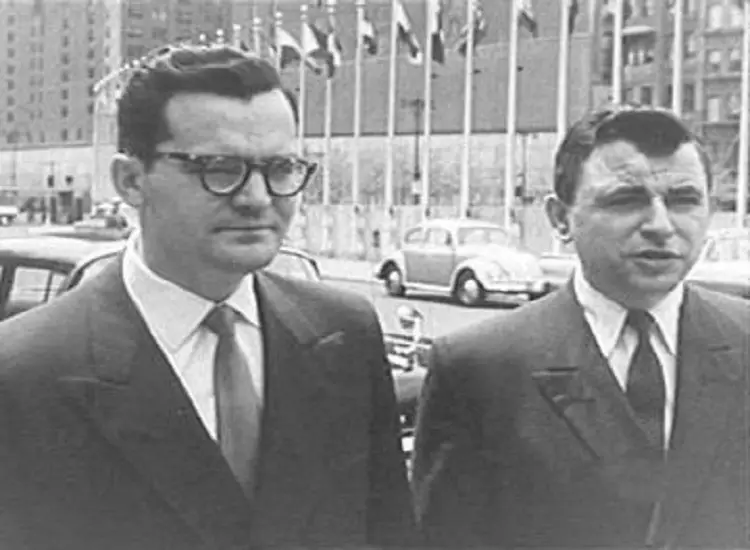
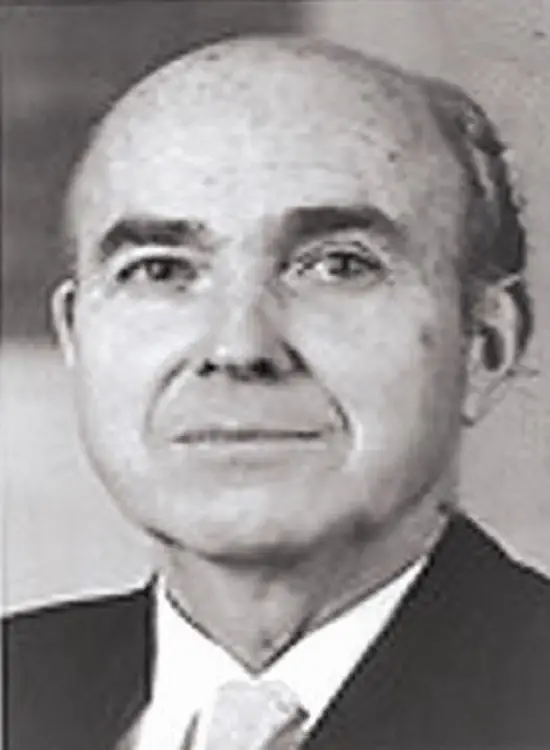
Besides Behar Shtylla, I also knew another member of the Central Committee of the Party of Labor, also a Foreign Minister, the late Nesti Nase. He replaced Behar Shtylla and held that post from 1970 until June 1982. My first meeting with Nesti Nase was at his request. He summoned me to his office at the Ministry of Foreign Affairs. It was my first time setting foot in that institution. Our conversation was conducted as it might be between two strangers who know each other from a distance. I knew him, just as I initially knew Behar Shtylla, from the “fiery” speeches delivered at various sessions of the United Nations General Assembly. He knew me through the equally “fiery” articles on international developments that I published in “Zëri i popullit.” In short, not to prolong, at this meeting Nesti Nase offered me a post at the Ministry of Foreign Affairs. He wanted to have my formal approval. He told me he had requested me before, but without result. Now, according to him, the place where decisions were made had given its consent. I also gave my consent to start work at the Ministry of Foreign Affairs. I parted with Nesti Nase, waiting for some time to be notified to start work at the institution he headed.
After a few weeks, I called Piro Koçi, the director of personnel at the Ministry of Foreign Affairs, to find out how the process of my appointment was going. Piro Koçi told me that I did not know a foreign language; therefore I would not be able to start work at that Ministry. I explained that I knew French, that I had even published many translations of well-known foreign poets and writers in “Drita,” the organ of the League of Writers and Artists of Albania. From the other end of the receiver, I heard the words: “Yes, but you don’t have an official document certifying that you know this language.” After hanging up, I went to the Faculty of History and Philology to inquire about the French exam session. It happened to be the time for these exams. I took the exam unprepared like that and obtained the official document proving proficiency in the French language. After this, I called Piro Koçi again and told him about the exam. From the other end of the receiver, complete silence. I understood that it wasn’t the foreign language, but something else that was hindering. I continued for several more years to work as head of the Foreign Sector at “Zëri i popullit.” However, from the first meeting with Nesti Nase, what remained in my memory was the care he showed in communicating with his interlocutor. I liked his direct, cultured, and at the same time delicate way of communicating. I saw in him a benevolent person.
The second meeting with the Minister of Foreign Affairs, Nesti Nase, in 1982
The second meeting with Nesti Nase was at my request several years later. It might have been 1982. An official delegation from the Islamic Republic of Iran had arrived in Albania. Atheistic, socialist Albania, totally self-isolated, with no opening either to the East or the West, had opened its doors to official representatives of those known as Islamic fundamentalists. Enver Hoxha, in one of his speeches to voters, emphasized that he would not allow “the pig and the sow” to enter Albania. The Islamists of Iran, they too, certainly excluded the pig and the sow. Nevertheless, this was not the cause or reason for common steps of rapprochement between Albania and Iran. “The pig and the sow,” in the sense Enver Hoxha used this phrase, were the United States of America with their allies, the Soviet Union with its allies, people of art, culture, and the press from the outside world. Albania’s official foreign policy was directed especially against the “two superpowers,” i.e., it attacked the hegemony of the two superpowers.
In its beginnings, Khomeini’s Islamic Revolution was also directed against the two superpowers, or as they said in Tehran, against the “two devils.” Here, perhaps, one can seek the common ground between Tirana and Tehran. Their international isolation was also common. Communist Albania had supported the Islamic revolution in Iran like perhaps no other country. In politics, I believe no service is done “for free.” The communist dictatorship of Tirana had done something similar when the black colonels, the putschists, came to power in Athens in 1967. The two regimes isolated in the world hastened to get closer to each other and establish diplomatic relations.
During the time the Iranian delegation was continuing its visit in Albania, Miti Tona, director of the Press Directorate at the Central Committee, called me and told me that the Iranians would hold a press conference at the Hotel Dajti. Miti told me to prepare some questions to be addressed to the head of the delegation. All the questions, Miti Tona said, must have an affirmative beginning. He also told me that after I formulated them, I should go and meet the Foreign Minister, Nesti Nase, to consult with him. Then, before the press conference, I should distribute the questions to some journalists who would participate in this conference.
I read all the questions I had thought might be asked to the Iranian delegation to Nesti Nase. He made no remarks, approved them quietly. It impressed me that he smoked a lot; as soon as he finished one cigarette, he lit another. He seemed tried to me, as if he wasn’t there, as if he was trying to appear as always while not being so. I don’t know why I said to him: “You smoke a lot, Comrade Minister!” I don’t remember his reaction after these words. I talked with my friends about the impressions I had from the meeting with Nesti Nase. It had been a few months since Mehmet Shehu, the Albanian Prime Minister, was killed or committed suicide. We were witnesses to the fact that he was taking with him many other leaders of the Party of Labor and the Albanian government, labeled as his collaborators. One couldn’t guess where Enver Hoxha’s beheading would stop. No one knew whose turn it was to go under the guillotine. We constantly talked about this state of terror and insecurity, even though it didn’t affect us directly. We constantly tried to find some word dropped casually, some seemingly insignificant gesture, to see or read what lay behind them. Nesti Nase’s heavy smoking did not seem like a good sign to us.
My mistake at the Iranian delegation’s press conference at the Hotel Dajti!
After I left the Ministry of Foreign Affairs and also informed Miti Tona about the meeting with Nesti Nase, I headed to the Hotel Dajti. There, at the entrance, I met some colleagues from the Telegraphic News Agency, Radio Television, and some press organs, to which I distributed the cards with the formulated questions to be asked to the Iranian delegation. In this distribution, I had made a mistake that I would understand later from the attitude of the head of the Iranian delegation. I had not noticed that the journalists who would ask questions were of Christian origin. For me, as for my entire generation, as for all my colleagues, religious affiliation not only had no importance but was also non-existent. So, one after another, Taqo Zoto, director of the Telegraphic Agency, Napolon Roshi, head of the Foreign Sector of the newspaper “Bashkimi” (The Union), etc., whose names I don’t remember, stood up and asked questions. From the Iranian side, the answers were correct, but curt. Finally, Shaban Murati, at that time a journalist in the Foreign Directorate of Radio Tirana, also stood up and asked a question. Before answering, the head of the Iranian delegation uttered the words: “Our brother Shaban.” Here I understood my “mistake,” but it was too late. The conference had come to an end.
The arrest of Nesti Nase by the State Security in the ministry building!
A few months later, on June 30, 1982, the end came for Nesti Nase as well. He was removed from the post of Foreign Minister. Formally, he was appointed “councilor” at the Institute for International Relations Studies attached to the Ministry of Foreign Affairs. I say formally, because no concrete task was assigned to him, because he practically had no one to advise, no one asked him for advice. He was isolated. Even when he went to the cafe, everyone hastened to leave. The quickest were those who had bowed and scraped to him, the flatterers and the servile, the careerists and the characterless people. At this Institute, in September 1982, three employees of the State Security put handcuffs on him, uttering the well-known formula: “In the name of the people, you are under arrest.” He was arrested as an accomplice of Mehmet Shehu in the non-existent plot to violently overthrow the dictatorship of the proletariat. At the moment of arrest, as Genc Mlloja, an employee of this Institute, has said in one of his interviews, only he, the deputy director of the Institute, Vladimir Prela, and a typist were present. All other employees of the Ministry of Foreign Affairs, which included the Institute, had been called to an improvised meeting. The State Security, apparently, preferred not to have more witnesses than necessary. Otherwise, there was no reason for Nesti Nase, Genc Mlloja, Vladimir Prela, and the typist not to be at the collective meeting, and no reason for only them not to be aware of it. They too were part of the collective.
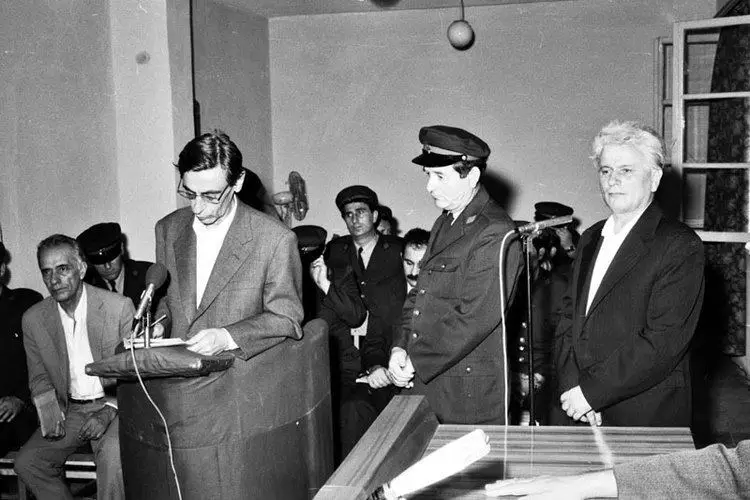
Before the judicial body, Nesti Nase was forced to testify as an indisputable truth a monstrous lie ordered by the dictator. He admitted that on two occasions Prime Minister Mehmet Shehu had told him that Enver Hoxha should be gotten rid of by force. Nesti Nase admitted that Mehmet Shehu was the head of a counter-revolutionary organization or band, of which, among others, he himself was a part, etc., etc. These admissions saved his life, while others who were next to him on the defendants’ bench were either executed or died in prisons. I, like everyone else, have become familiar with Nesti Nase’s testimony in the courtroom only in recent years, after the publication of the judicial minutes in the press.
I do not wish to judge Nesti Nase for the stance he took in the courtroom. Those accused there, even unjustly, were themselves the authors of countless injustices against their closest comrades. They bore on their conscience the imprisonments, killings, internments, disappearances of countless others, acting in the plenary halls of the Party Central Committee or behind the scenes, just like Nesti Nase in the courtroom. If asked to save their own heads, they would not have acted differently from Nesti Nase; they would have been ready to affirm that he was, in fact, even the main one, the number one among them. If they did not do this, it is only explained by the fact that the dictator had predetermined the fates and roles of everyone and that no one could deviate from the script. Seen in the course of time, however, one feels pity not for them, but for the fates of a country and a people, which for nearly half a century was ruled by a dictator who deformed everything in man, turning him into a robotic monster.
How was Nesti Nase’s wife found hanged in her home?!
Nesti Nase was released from prison in 1989. After the start of the Democratic Movement, I met him once by chance on the main boulevard in Tirana, somewhere near the Prime Minister’s building. I approached him and greeted him. He was alone. We talked, and I don’t know why we talked. We surely said general, trivial words. I don’t remember anything from this conversation. What I haven’t forgotten from this meeting is his solitude. He kept his head down, as if he didn’t want to see anyone, as if he was in a world where he knew no one. I had the impression that he felt that way. After Nesti Nase’s arrest, persecution extended to his entire circle. His nephew, Gjergji Cico, who was a journalist at the Albanian Telegraphic Agency, was dismissed from his job, expelled from Tirana, and sent as a teacher somewhere in a remote village in Korça. Much more severe, tragic, was what happened to his wife, Petrina. Two days after they arrested Nesti, his wife, Petrina, was found hanged at home.
More accurately, it should be said that the neighbors found her hanged, as her body had begun to decompose. The dictatorship hastened to say that she had hanged herself because she was an agent of the UDB, the Yugoslav secret service. Shouldn’t we first believe that she was hanged by agents of the Albanian Sigurimi?! Why? If only to put pressure on Nesti Nase, to crush him spiritually and manipulate him more easily afterwards.
Petrina had resisted death and escaped it in Mauthausen or some other concentration camp where she was interned during the War by the Nazis. (I am not sure of the name of the Nazi camp where she was interned.) The communist dictatorship broke her, snatched from her what she “owed” to Nazism. Not a single fact, even fabricated, was ever mentioned to prove her connections with the UDB. She was hanged; or rather they hanged her, solely because she was Nesti Nase’s wife. Nesti himself was conscious of this. He could not but suffer from the fact that his wife, his beloved, was an unintentional victim of him.
They had no children, they only had each other. Petrina had been sterilized by the Nazis in the concentration camps. Her departure was his complete solitude. Her departure was his endless pain. The overthrow of communism could not bring joy to the former Foreign Minister, Nesti Nase, could not bring back the one who had departed forever. You cannot rejoice alone in the world, even if you have escaped certain death. That is why Nesti Nase walked so aimlessly, so empty in spirit on the main boulevard of Tirana. We parted just as we had met. He, kind as always, as if parting from a friend he had just met and would never see again. I, undecided, truly happy to have met him, but not knowing why I met him, why I had to meet him. I could not help him. I believe no one could help him. /Memorie.al