

By Dashnor Kaloçi
Part Eighteen
Memorie.al / The history of parliamentary elections in our country, or more accurately, the attempts at elections, have its origins in the era of Ottoman rule when Albania was part of the Turkish Empire. One of the first Albanian deputies elected to the first Turkish Parliament, which opened its proceedings in December 1877, was Abdyl Frashëri. However, that parliament did not last long, as it was dissolved by the Sultan himself due to the outbreak of the Russo-Turkish War. Following the dissolution of Turkey’s first parliament, there were several other attempts at elections, but they all failed for various reasons. The first regular elections in Albania were held only in 1908, when the Young Turks came to power in Turkey. Those elections were not direct but were held through representation, otherwise known as the two-tier voting system (secondary electors).
The first Turkish Parliament opened on December 10, 1908, and out of 266 deputies, 27 were Albanians elected from the four vilayets of Albania. At that time, members of the “Committee of Union and Progress” in Turkey, which included many Albanians, split and grouped into three political factions. The first group was “Union and Progress” (the Turkish-Macedonian party) with 164 deputies, consisting of 130 Turks, 5 Arabs, 1 Greek, and 15 Albanians, led by Hasan Prishtina, a deputy from Kosovo.
The second group, called “Liberal Union” (the Greek-Albanian party), consisted of 45 deputies and included 12 Albanians led by Ismail Qemali. Among the other Albanian deputies in the Turkish Parliament at the time were Esad Pashë Toptani, Nexhip Draga, Rexhep Pashë Mati, etc. After 1908, there were several other elections where Albanians continued to vote for their representatives in the Turkish Parliament, a process that lasted until November 1912, when Independence was proclaimed and Ismail Qemali was elected head of the Government.
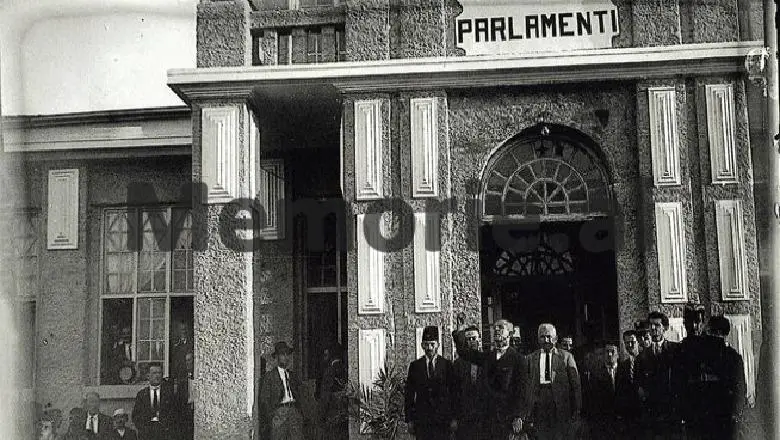
Meanwhile, the first parliamentary elections in Albania took place in the spring of 1921, as they had not been held until then due to World War I, in which Albania was also involved. The first Albanian Parliament opened on April 21 of that year; the first building of the Albanian Parliament was located where the Academy of Sciences stands today. In that parliament, 76 deputies participated, elected following a relatively regular process from the nine prefectures of the country: Berat, Durrës, Elbasan, Gjirokastra, Korça, Kosovo, Shkodra, Vlora, and the Albanian colony in the USA.
As in the past, those elections were conducted through a system of representation, or secondary electors, where based on territorial division, representatives of each province had the right to elect their deputy. The aforementioned, along with a brief history of parliamentary elections in Albania from that period until 1991, has been published by Memorie.al in previous issues. Here, we are publishing the complete Basic Statute of the Albanian Republic (the Constitution) of 1925, where a special place is held by the parliamentary election legislation of that time, as well as the Parliament’s regulations regarding the rights and duties of deputies, published by the “NIKAJ” Printing House in 1925.
Continued from the previous issue…
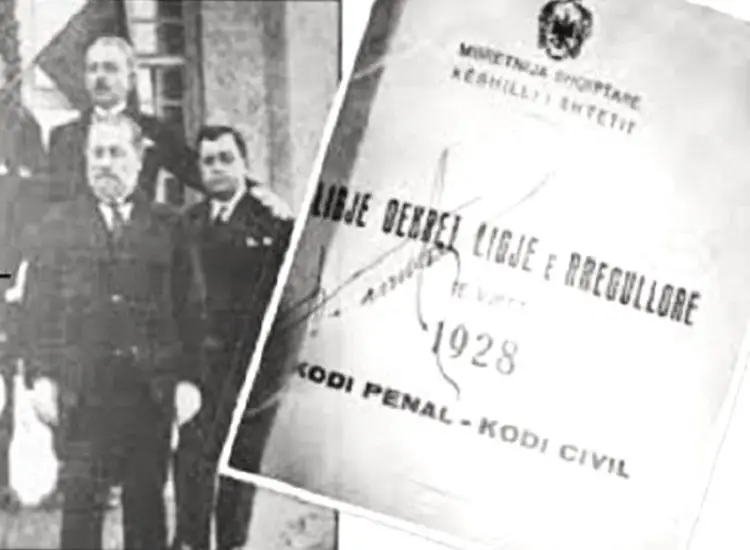
PENAL CODE 1928
SECOND BOOK
TITLE VII: Crimes Against Public Integrity
CHAPTER VI: Common Provisions for the Foregoing Chapters
ARTICLE 360. – Except for the cases provided for in Article 405, No. 4, and Article 413, if any of the offenses provided for in Articles 330 to 336, 338, 342, 343, and from 345 to 352, 356, 358, and 359 result in the death or bodily injury of any person, the punishments specified in those articles shall be doubled in the event of death. In the case of bodily injury, the punishment shall be increased by one-third to one-half; however, the term of heavy imprisonment cannot be less than five years in the first case (death) and no less than three months in the second (injury).
If the offense results in the death of two or more persons, or the death of one person and bodily injury to others, heavy imprisonment shall not be less than ten years and may be extended to the legal maximum of the punishment when that maximum is set at more than ten years.
If only bodily injury is caused to two or more persons, heavy imprisonment shall not be less than six months; where the punishment is already set at more than five years, it may be extended to fifteen years.
ARTICLE 361. – When any of the crimes provided for in the first two chapters of this Title are committed at night, or during a time of common danger, calamity, or public alarm, the punishment shall be increased by one-third.
ARTICLE 362. – When any of the crimes provided for in this Title are committed by a person charged with the service, processing, or guarding of the materials specified in this Title, the prescribed punishments shall be increased by one-sixth to one-third.
ARTICLE 363. – If, in the crimes provided for in the first two chapters of this Title, the danger caused by the offense is minimal, or if the offender has taken care and acted effectively to prevent or limit the consequences of that danger, the punishment may be reduced by one-third to two-thirds.
TITLE VIII: Crimes Against Good Morals and Family Order
CHAPTER I: Violation with Violence, Physical Demoralization of Minors, and Outrage to Public Decency (Outrage à la pudeur)
ARTICLE 364. – Whoever, by using violence or threats against a female or male person, violates their decency (e turpnon), shall be punished with heavy imprisonment from three to ten years.
The same punishment shall apply to whoever violates a female or male person who, at the time of the offense:
- Has not reached the age of fifteen;
- Has not reached the age of eighteen, if the offender is the ascendant, guardian, or teacher of the victim;
- Being detained or convicted, had been entrusted to the offender for transport or guarding;
- Due to mental or physical illness, or any other cause independent of the offender’s act, or due to the effect of deceptive means used by the offender, was unable to resist.
ARTICLE 365. – When any of the acts provided for in Paragraph I and in numbers 1 and 4 of the preceding article are committed by abusing authority, trust, or domestic relations, the offender shall be punished:
- In the case of the first paragraph, with heavy imprisonment from six to twelve years;
- In the other cases, with heavy imprisonment from eight to fifteen years.
ARTICLE 366. – Whoever, by using the means or taking advantage of the conditions and circumstances specified in Article 364, commits lustful acts (vepra luksuri) upon a female or male person that are not aimed at committing the crime provided for in that article, shall be punished with heavy imprisonment from one to seven years.
If the act is committed by abusing authority, trust, or domestic relations, the heavy imprisonment – if the act was committed through violence or intimidation – shall be from two to ten years; and in the cases provided for in numbers 1 and 4 of Article 364, from four to twelve years.
ARTICLE 367. – When any of the acts provided for in the preceding articles are committed with the simultaneous cooperation of two or more persons, the punishments specified in those articles shall be increased by one-third.
ARTICLE 368. – Whoever, through lustful acts, demoralizes (corrompe) a person under the age of sixteen, shall be punished with heavy imprisonment from one to thirty months and a heavy fine from 50 to 2,000 gold francs.
If the crime is committed through deception, or if the offender is the ascendant of the minor or was entrusted with their care, education, teaching, observation, or guarding, even temporarily, the punishment shall be heavy imprisonment from one to six years and a heavy fine from 100 to 3,000 gold francs.
ARTICLE 369. – The crimes provided for in the articles above, if committed against a female, shall be prosecuted only upon the request of the person entitled to file a civil suit; however, the request is admissible only within one year from the day the crime was committed or from the day the person entitled to sue on behalf of the victim became aware of it.
The withdrawal of the civil suit has no effect if it occurs after the trial has begun.
Prosecutions are conducted ex-officio (kryesisht) when the offense:
- Is committed against a male.
- Has caused the death of the offended person, or the crime was committed alongside another offense for which the punishment is no less than thirty months of imprisonment and is among those crimes prosecuted ex-officio.
- Is committed in a public place or a place open to the public.
- Is committed by abusing paternal power or the authority of guardianship.
ARTICLE 370. – Whoever is in a shameful relationship (relacione turpënore) with any of their parents or legitimate or natural descendants, or with a sister or brother (whether of the same parents or only one parent), or with any of the in-laws in a direct line, shall be punished with heavy imprisonment from eight months to three years.
If the offense is committed in a manner that causes a public scandal, heavy imprisonment shall be from two to five years. In both cases, a temporary ban from public office shall also be imposed.
ARTICLE 371. – Whoever, through persuasion, deprives a girl under the age of twenty of her virginity by promising to marry her, shall be punished – upon her request or the request of the person entitled to file a civil suit – with heavy imprisonment from three months to one year.
If he marries her, legal proceedings shall cease, and if a verdict has been rendered, the execution of the punishment and penal effects shall cease. However, if within five years from the day of the marriage, the offender divorces her without her giving a justified cause, the prosecution shall resume and other legal effects shall be applied.
ARTICLE 372. – Whoever, outside the cases mentioned in the preceding articles, outrages public decency (godit cipen publike) or good morals through acts committed in public places or places open to the public, shall be punished with heavy imprisonment from three to thirty months and a heavy fine from 50 to 500 gold francs.
ARTICLE 373. – Whoever outrages public decency through writings, drawings, or other obscene objects, which they distribute, expose, or sell, or through speeches, films, or plays in cinemas, theaters, or other places open to the public, or through gramophone records containing obscene songs or words, as well as those who manufacture, import from abroad, transport from one part of the Republic to another, or distribute and sell any of the aforementioned items, shall be punished with heavy imprisonment for up to one year and a heavy fine of up to 1,000 gold francs.
If these acts are committed for profit, heavy imprisonment shall be no less than one month and the heavy fine no less than 100 gold francs.
The objects containing such obscene imagery shall be confiscated and destroyed.
ARTICLE 374. – Whoever, for the purpose of profit in public places or places open to the public, engages çëngina (dancing girls) or other women to attract people and places them at the disposal of clients for shameful purposes or lust, as well as the women who engage in such acts, shall be punished with imprisonment from one to six months or internment from three to twelve months, and in every case, with a heavy fine of up to 1,000 gold francs.
ARTICLE 375. – Those that harass women or boys with words or deeds shall be punished with imprisonment for up to one month.
If this harassment was provoked by the offended party, the punishment shall be a heavy fine of up to 200 gold francs.
ARTICLE 376. – Those that enter a place reserved for women while wearing women’s clothing, where entry is prohibited, shall for this act alone be punished with imprisonment for up to one month.
CHAPTER II: Against Nature Violations
ARTICLE 377. – He who commits an act of violation against nature, if his offense does not carry a heavier punishment under the cases specified in Article 364, shall be punished with heavy imprisonment from three months to two years, or with internment from one to five years, and in both cases, the punishment shall include a heavy fine and a temporary ban from public office.
The same punishment applies to the person who undergoes such a violation, if they have reached the age of sixteen, respecting Articles 56 and 58.
ARTICLE 378. – If the offenders mentioned in the preceding article committed the act in a scandalous manner, the punishments shall be increased by one-third to one-half.
ARTICLE 379. – He who keeps in his residence, even temporarily, young boys who are not his close relatives and who have been previously convicted of pederasty, shall be punished with internment from three months to two years and a heavy fine of up to 500 gold francs.
If the offender keeps such boys in the residence where his wife also lives, the punishment shall be increased by half to double.
In all cases mentioned in this chapter, the punishment may also include special supervision by the Public Security Authority.
CHAPTER III: Abduction
ARTICLE 380. – Whoever, through violence, intimidation, or deception, removes or detains a woman over the age of 20 or an emancipated woman for the purpose of lust or marriage, shall be punished with heavy imprisonment from six months to five years.
ARTICLE 381. – Whoever, through violence, intimidation, or deception, removes or detains a married woman for the purpose of lust, shall be punished with heavy imprisonment from three to seven years.
If a minor is removed or detained without intimidation, violence, or deception, but with their own consent, the punishment shall be heavy imprisonment from six months to three years.
If the abducted person has not reached the age of fifteen, the offender shall be punished with heavy imprisonment from three to seven years, even if no violence, intimidation, or deception was used.
ARTICLE 382. – If the offender of any of the crimes provided for in the preceding articles, without having committed any lustful act, voluntarily releases the abducted person, returning them to the home from which they were taken, or to their family’s home, or by placing them in a safe place at the disposal of that family, the heavy imprisonment for the case in Article 380 shall be from one month to one year, and [otherwise] from one to five years.
ARTICLE 383. – If any of the offenses provided for in the preceding articles were committed solely for the purpose of marriage, simple imprisonment may be imposed instead of heavy imprisonment.
ARTICLE 384. – For the crimes provided for in the preceding articles, no prosecution shall be initiated except upon the request of the person entitled to file a civil suit; however, this request shall not be accepted after one year has passed from the day the crime was committed or from the day the person entitled to sue became aware of it.
The withdrawal [of the suit] has no effect once the trial of the case has begun. / Memorie.al