
Part Two
The well-known publicist’s reflections on Karl May’s legacy
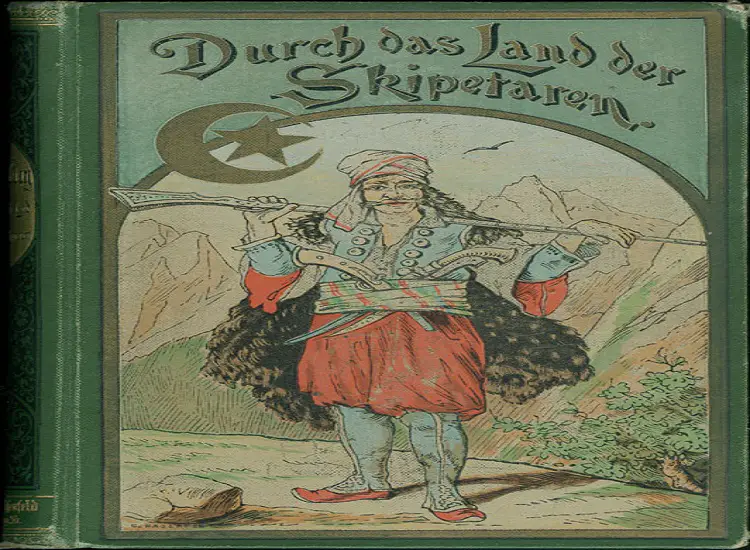
Memorie.al / Many people have heard of Karl May’s famous novel, “Journey to the Land of the Albanians,” and many others, even without knowing German, are very familiar with the title of his famous novel in German, “Durch das Land der Skipetaren.” As for this work (written in 1892), it is actually only one part of a cycle belonging to the so-called “Travel Tales.” But what interests us in this article is to bring up a very positive aspect, which is known as a special merit of Karl May.
Continued from the previous issue...
The Unfounded Attempt to Explain the Notion of “Schkypetaren”
The attempt, not well-based on science or the use of popular speech, to explain the notion of “Schkypetaren” solely with the Albanian tribes in the north of the country seems very peculiar. He describes Karl May’s book as the motivation for his interests about Albania and writes further:
“In my opinion, we should not underestimate the influence of Karl May, who transformed the name ‘Schkypetaren’ into a very popular notion- which he could not have invented himself – and that he was certainly the first to introduce it to Europe, and from there, it was later spread throughout the Anglo-Saxon literary world.”
The Cliches Conveyed by Karl May
The author of the study in question then invites us to delve deeper into the work of Karl May and discover a critical aspect of the image of Albania and Albanians conveyed by him. According to the author, this image has, in many cases, had a negative influence on the solidification of unrealistic cliches about our people.
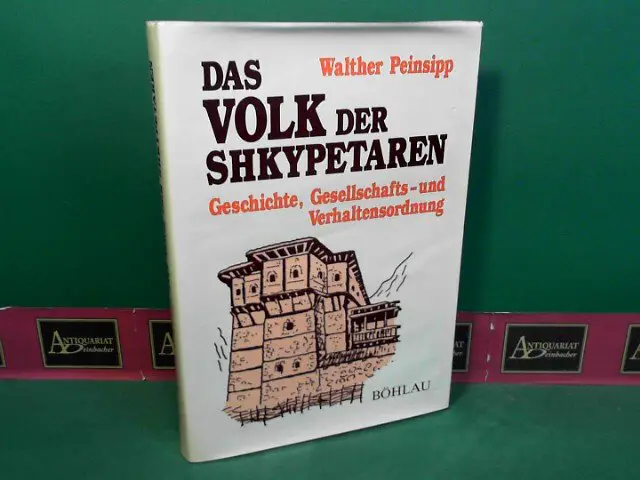
The German researcher emphasizes the ignorance noted regarding a rare phenomenon among Albanians, by the former German Wehrmacht officer, Valther Peinsipp, in a part of his monograph. “As for the abduction of brides,” writes the critic, “he doesn’t have much to say, as he claims he did not have the opportunity to be present there as often ‘as one gets the impression when reading the lines of Karl May’s novel.'”
This is extremely significant for a part of the conceptualization of May’s work: all the clichés that can be read somewhere, i.e., that can be encountered in the cinema or on TV, are inevitably and completely linked to May’s work. Because nowhere in May’s work is there ever a mention of the abduction of brides among Albanians.
Karl May’s “Skipetaren” Are Found Everywhere
Even in 1986 – albeit with some doubt – the preface to a tourist guide published by the Germany-Albania Friendship Association quotes: “Who doesn’t immediately think of Karl May when the topic of Albanians comes up?” Or in 1989, when a short article in a travel book, which briefly summarized the image of Albanians in the world, was titled: “And Again ‘In the Land of the Albanians’!”
In addition to what we mentioned above, in the mid-80s, a report was published in Austria titled “Reportage from the Land of the Albanians,” by Paul Lendvai, and an informational geographical book with illustrations by Norbert Stanek titled: “Albanien – Land der Skipetaren” (Albania – Land of the Albanians). Meanwhile, in Germany, a tourist book by Gerhard Gärsch was published, the title of which was, let’s say, a counterpoint to May’s work, as it highlighted modern means of transport: “Mit Bus und Bahn durchs Land der Skipetaren” (By Bus and Train through the Land of the Albanians).
Even art historians and archaeologists seem unable to do without relying on the already mythical designation, made more than a century ago by Karl May. For example, an exhibition opened in 1988, which for the first time showed in detail objects of rare Albanian archaeological treasures in Germany, was titled “Albanien – Schätze aus dem Land der Skipetaren” (or in Albanian: Albania – treasures from the land of the Albanians).
And the art historian Guntram Kochs presented at another exhibition with information about Albania, titling it “Art and Culture in the Land of the Albanians” (In German: Kunst und Kultur im Land der Skipetaren). And in this vein, we are not mentioning, says the author of the criticism in question, the countless articles in newspapers and magazines that quote parts or refer to the title of Karl May’s work.
Literature, May, and Albania
“But, of course, to a very large extent, it is precisely the field of literature that has been most affected by the definitions, descriptions, or names that Karl May once made when it comes to Albania and Albanians,” writes the German critic, who is also a very good connoisseur of Albanian history, culture, and mentality.
They (in most cases rightly) conclude that Karl May’s tales are the only book that the majority of German readers have had in their hands.
“Durch das Land der Skipetaren,” was written in 1892
The book’s content in the eyes of German publishers:
“Durch das Land der Skipetaren,” which Karl May wrote in 1892, is part of the six-volume “Orient Cycle” (more specifically, volume 5), written by him in the last two decades of the 19th century. Furthermore, this series also includes “Through the Desert” (Volume I), “In Wild Kurdistan” (Volume 2), “From Baghdad to Istanbul” (Volume 3), “In the Caves of the Balkans” (Volume 4), and “Shyti” (Volume 6).
Most of his scenes, therefore, are certainly set in the regions of Asia Minor and North Africa, while the Balkans or Southeast Europe (i.e., the European part of the former Ottoman Empire at the time) occupies a relatively smaller place.
Specifically, the fifth volume of this cycle of stories is the one dedicated exclusively to Albania and Albanians (but also the subsequent volume), although the author never set foot in those areas himself. This is precisely why many critics have rightly accused him of excessive fantasy far from reality.
In one of the explanations he gives for the content of Karl May’s work, “In the Land of the Albanians,” a German publisher says, among other things: In the land of the Albanians, the area that today belongs to Macedonia – the south of the former Yugoslavia and Albania – have to go through many dangers.
Kara Ben Nemsi, Hajj Halef Omar, and their companions pursue Shyti, the mystical leader of a band of Albanian outlaws, who has terrified the entire Balkans. Çurak, a confidant of Shyti, with the help of the twice-escaped Mubarek, lures Kara Ben Nemsi and his two companions, trapping them in a cave. He manages to free himself again, after which Çurak is killed and Mubarek is wounded.
But they are pursued by the Mirditors, members of one of the most famous and bravest tribes among the Arnauts, as Albanians in Turkey were called at the time. It is Çurak’s brother who then pursues Kara Ben Nemsi to avenge his murdered brother. But Kara Ben Nemsi defeats his opponent in a duel and then generously spares his life. As a sign that the blood feud between them must end, the Mirditor gives him the blood money.
Shortly after this, the reconciled parties fall into a new trap, created by one of Shyti’s spies, from which they manage to free themselves very cleverly. Not far from the mountainous region of Shar-Dag, where they believe Shyti is located, they manage to find out in detail about the life and deeds of this mystical outlaw leader, whom until then, no one had dared to see face to face.
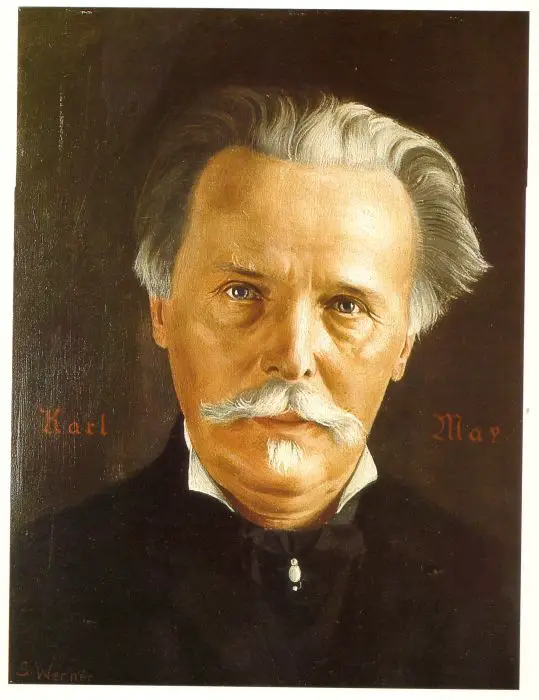
Who was Karl May?
He wrote to help oppressed peoples.
Karl May is undoubtedly the most-read travel novel writer in the German-speaking world, and his work is probably the most read after Martin Luther’s Bible. Although he wrote more than 150 years ago, his books continue to be very popular with the new generations. Many of his novels have also found their way to the screen and theater stage, attracting a lot of attention, especially during the 1950s and 1960s.
Karl May was born on February 25, 1842, as the fifth of 14 children of a very poor family, from an area near the city of Dresden in eastern Germany. He worked as a teacher from the age of 19, but lost his job again only a few weeks later. Due to life’s hardships, he had to serve eight years in prison, as a result of the wrong choices he made in those years, committing ordinary acts such as theft, assault, etc.
After being released from prison in 1874, May entered the profession of writer, after discovering that he had a talent for this work. At first, he wrote some short novels and then some anonymous novels. But his fame came when he wrote “Travel Tales,” which he first published in 1892. May, speaking in the first person, narrates the adventures and deeds of his hero in exotic places, first and foremost in the “Wild West” of North America and in the Orient.
He managed to convey these fictional reports (since he had never set foot in the places where the events of his work took place) in a very suggestive way to the readers, and the geographical regions where different peoples lived, appeared in the book full of fantasy with so many colors that the stories “Winnetou,” “Old Surehand,” “In the Desert”- although their literary values are debatable for many critics – are valued by today’s generations as very informative, interesting, and full of life.
Even the humane tendency in his books and the influence they had in helping the oppressed peoples at the time (such as the American Indians, especially, and the Kurds, for example) made him enjoy such epithets as “Shakespeare of the Youth” and a positive reputation among many readers over a time span that exceeds the era in which he wrote several times.
His works have also been adapted for the screen, starting as early as the 1920s and continuing until the 60s in the form of TV series or films for the cinema. He died in 1912, in Radebeul, near the city of Dresden. An association and a museum (established as early as 1927) have long borne his name, to honor the work he left behind. / Memorie.al