By Prof. Dr. Ardian Ndreca
Part Two
— The Historical Sentiment of Albanians —
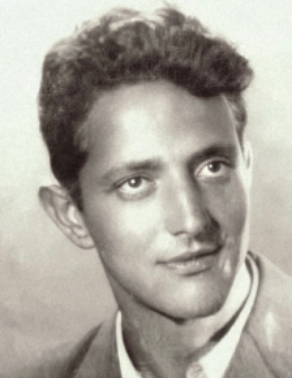
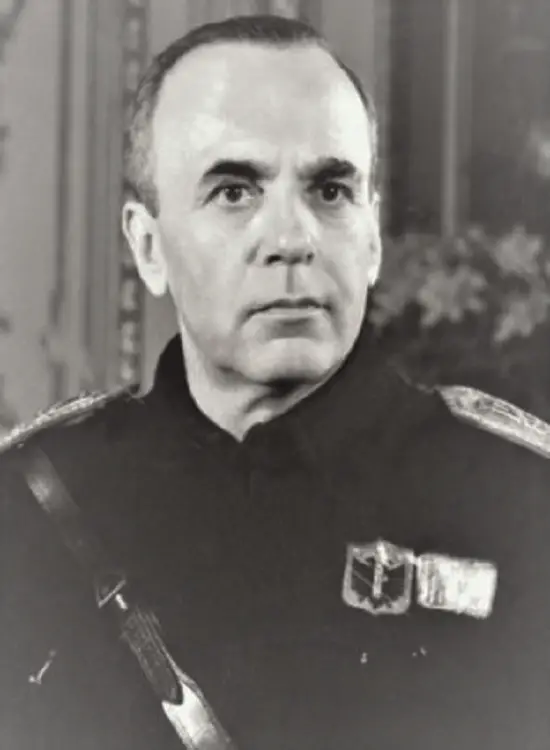
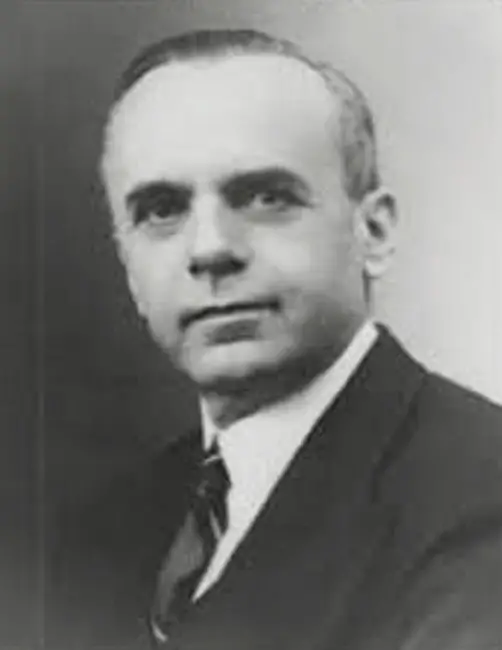
Memorie.al / It is not very easy today, when graves are being opened and memories are being buried in Albania, to present a figure as “controversial” as that of Mustafa Kruja. He belongs to that rank of men – such as Lef Nosi, Dom Lazër Shantoja, Kol Tromara, and Mark Gjomarkaj – of whom almost nothing is said, even though they occupy a place of honor on the altar of our nation. Today in Albania, the tendency to rehabilitate those figures that the communist regime had condemned until yesterday prevails. This is very just. However, the first to emerge as “persecuted patriots” are precisely those who were eliminated during the internal struggles between the communist factions in power. Today’s writers strive to arouse public sympathy by recounting the unjust fate that befell the likes of Koçi Xoxe and Mehmet Shehu, while intentionally silencing the fact that thousands upon thousands of graves of worthy and innocent people were sown in every corner of the country precisely by their hands.
Continued from the previous issue
Father Anton Harapi, in his speech on the occasion of his swearing-in as a member of the High Council, would express himself as follows: “I am under the impression that there is no son of an Albanian who thinks I took this burden for a seat, for interest, or for some intrigue. Someone might only fear that it was some mania of mine that pushed me this far. And I am confirming their words and telling them: yes, the mania for Albania – yes, it was that which presented me with the dilemma: either to be with the anarchists to shed blood, or to withdraw from the national cause. And since my soul did not tell me to do either one or the other, I was forced to choose one of two: either to commit’madness by accepting this office, or to show a weakness by walking away. I decided it was better to commit madness: or as those Albanians who wish to remain pure say – I chose to be compromised.”
The Fascist Hierarchy’s Opinion of Mustafa Kruja
The Germans, as has emerged from published documents (see the book by historian R. Morozzo della Rocca), considered Fr. Anton Harapi to be pro-British, while Lef Nosi was known for the idea of rapprochement with the United Kingdom. But what did they think of Mustafa at the Palazzo Venezia in Rome?
Firstly, it must be said that he was not a Fascist in the true sense of the term. It is historically known that Fascism was born from the womb of Socialism, to oppose individualistic liberalism and to prioritize the general interests of society over those of the individual. Mussolini himself in his youth was a militant socialist, and as such, he consistently strengthened the conviction that the State is the most important unit of social life, worthy of being placed above the values of freedom and democracy. In a 1932 interview given to his biographer, Emil Ludwig, for the periodical Candide, Benito Mussolini admitted that when he was young, he always carried a medallion with the image of Karl Marx as a talisman.
Now, Mustafa has nothing in common with socialist ideas; for him, the absolute value is not the State but the Fatherland, which includes: ethnicity, language, material and spiritual culture, and faith. In 1941, as a result of the German attack against the Soviet Union, the communists in Albania, inspired by foreigners, began to mobilize. All of this was done to create anarchy in the country.
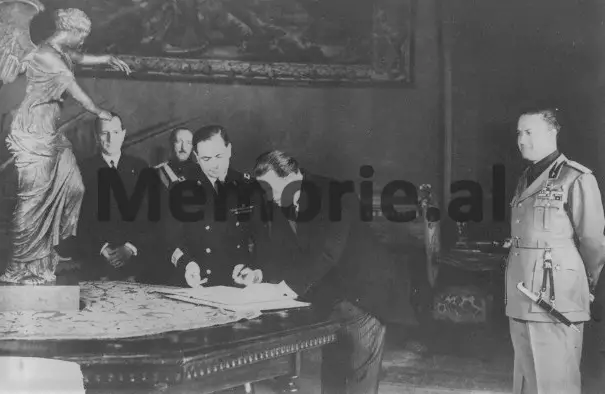
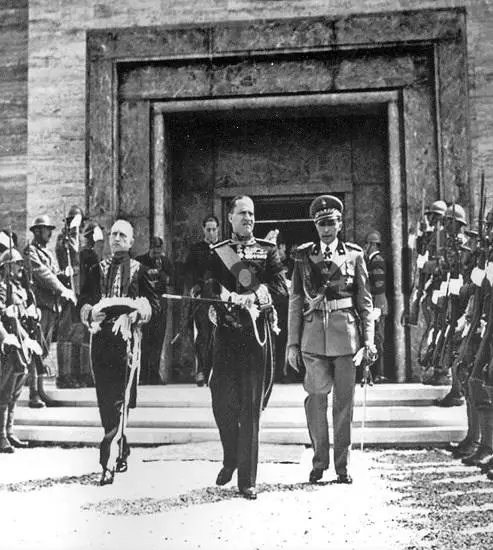
The government of Shefqet Vërlaci fell, and in December 1941, Mustafa Kruja was tasked with forming the new government. The Foreign Minister of Italy, Galeazzo Ciano, notes in his diary that: the appointment of Kruja to the post of Prime Minister “corresponds to a further concession to the extremists of Albanian nationalism.” Meanwhile, on December 23, Ciano writes that Vërlaci hates Kruja but has no strong arguments against him, limiting himself to saying that “the son of a servant cannot govern the country.”
From the very first time Mustafa came to Rome as Prime Minister in February 1942, as Ciano testifies in his Diary, he began asking the Italians for “minor border corrections toward Montenegro and a revision of the flag.” “They do not want,” continues Ciano, speaking of the nationalists in Tirana, “the Albanian eagle ‘imprisoned’ between the fasces and the Savoy knots. The matter is delicate and cannot be rejected a priori.” The appointment of Mustafa as Prime Minister, writes Count Ciano, caused a stir “among Italians because he is a staunch nationalist, and among Albanians because he hails from a humble family.”
Another hierarchy of Fascism, the King’s Lieutenant, F. Jacomoni, in his memoirs, analyzing Mustafa’s figure, observes: “A nationalist who did not yield an inch when it came to the interests of his own country, but whose open intelligence and sound Western culture made him appreciate, in all its fertility, the confederal idea which should preside over what was naturally called the Community of Rome.”
Another Italian journalist and writer, Indro Montanelli, in an article published in Corriere della Sera in 1942, wrote about the ministers of the Kruja government: “The Albanian ministers resemble one another. They are all young – not in years, but in experience. They all dress simply, are a bit harsh, but well-prepared theoretically. Their past is the same: they have suffered for their country. Their ideas are linked to several fundamental dogmas: the territorial unity of Albania, internal autonomy, the protection of the race and cultural heritage, and cooperation with Italy on the basis of mutual rights and obligations. They are honest and poor. They are men of action and not of bureaucracy.”
To speak plainly, these are words that any head of government would want to hear about his ministers, all the more so from a foreigner. As for Mustafa, Jacomoni says that, as the sincere man he was, he did not hesitate to express, when necessary, even the bitterest truths. But for Mustafa, despite many frustrations during his years of governance, successes were not lacking. Among these was the unification of Plav and Gucia with the motherland. These are moments that Nebil Çika, in one of his articles, describes as being lived with the enthusiasm of a worthy son of the National Renaissance, who finally experiences the quenching of a great historical injustice.
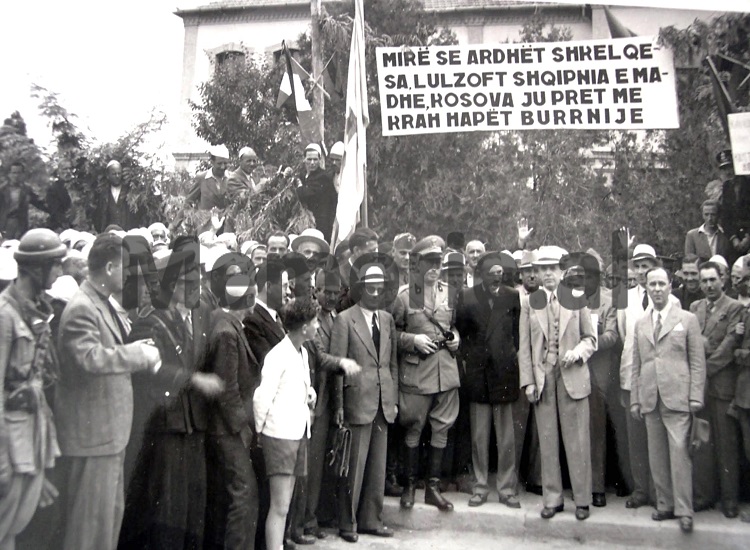
“On April 23, 1942,” Ciano notes in his Diary, “the Albanian flag was restored to its original form, thus without the Lictor’s fasces and without the Savoy coat of arms.” Meanwhile, Jacomoni testifies that Mussolini, when presented with the memorandum for this change, turning toward Ciano, said: “Who pushed me to make the mistake of changing the national symbol of Albania?” While Albanian nationalists celebrated their flag in the Lieutenant’s square, the Italians admitted the grave error they had made.
Another success of Albanian policy was the fact that the Italian racial laws, which directly affected the Jews, were not applied in Albania despite Rome’s persistence. This made it possible to shelter and equips many persecuted Jewish families with Albanian passports. Among other things, a plan was devised to secretly bring to Albania – by providing him with an Albanian passport – the famous Austrian albanologist of Jewish origin, Norbert Jokl, who unfortunately ended tragically without being able to benefit from the help of his Albanian friends.
“A testimony from Mustafa Kruja’s side,” writes Jacomoni in his memoirs, “of what was his ‘manliness’ (burrnía) – that is, the ability to face hardships with courage and magnanimity – I had shortly after he had taken over the Presidency of the Council of Ministers. The Consul General of Germany had gone to him and presented a verbal note with which the Nazi government demanded the handover of more than three hundred Jews who, having fled from Yugoslavia, had found refuge in Albania.
The German military command in Belgrade had provided precise information regarding the names and places where these people were sheltered in Albanian Kosovo. Mustafa Kruja came and asked me for permission to let them stay in peace in Albania. In Albania, there were no German troops who could identify the Jews. Regardless, it was decided that the Jewish refugees would be moved to the Gjirokastra zone, which bordered the Greek zone occupied by Italian troops.
They would be provided with Albanian passports under false names, and if need be, they would be assisted materially. These measures would make it possible for Mustafa Kruja to respond a few days later to the Consul General of Germany that all searches conducted in Kosovo regarding the persons in question had been unsuccessful.”
“Even those who did not like Mustafa,” writes Jacomoni, “considering first and foremost the Albanian feudals led by Shefqet Vërlaci, did not deny him two things: his love for the fatherland and his high moral values.” In an article published in Corriere della Sera, Indro Montanelli writes:
“I had not seen Merlika-Kruja for ten years, and I saw that he had changed very little. Success and honors have not been able to transform the nature and external behavior of this man. He is dressed more or less as he was dressed ten years ago, and he does not give himself importance with poses and big words. He continues to speak with measuredness and gives you the impression that he is telling the truth.”
Further on, the article writer notes that his life resembles that of Mazzini, and his program is this: “I want a united Albania within its natural borders. I want this united Albania to develop its life in the peace secured by Rome.”
Ernest Koliqi also compares Mustafa to Mazzini: “A brilliant ideologue, but a politician who did not succeed.” “Regardless,” writes the Shkodran writer, “it is a moment in which events became greater than men. It is not reasonable to attribute and charge the fault of the times to the men.”
And events did not follow as Mustafa and his comrades desired; the Italians were not of one mind in the war against terrorists – in fact, on their part, there were often sabotages in this direction. The impossibility of seeing his policy realized pushed Mustafa, as he himself testifies in his Exposé personnel published in Hylli i Dritës, to submit his resignation.
Dissatisfaction in Fascist circles had also been caused by his speech delivered on November 22, 1942, at the “Savoia” Theater in Rome. It is clearly understood from this speech that he is not a puppet in anyone’s hands. On that occasion, he underlines that Italy understands that only by respecting the full independence of Albania will it find in the Albanians its friend and brother for life and death; and, the orator adds, even Albania, a small state, must have its own secrets and its own general staff, which means a strong government.
What ultimately pushed Mustafa to resign was the assassination of Qazim Koculi, a high government authority in Vlora. It was an assassination of a political nature and at the same time an act of revenge. But primarily, Qazim – a patriot and activist of the War of Vlora, a political emigrant with Mustafa, and a man close to the latter’s popular policy – was a victim of the struggle that Mustafa had waged against both the policy of the Beys and against the anarchists and communists. The inability to react in the proper manner made Mustafa feel responsible for the murder of his friend.
Here is how Mustafa responds to the calls not to resign:
“Some Albanians are asking of me more than I can do; while others are hindering me. I do not have everything in my hands. On the other hand, I had sent Qazim Koculi to Vlora myself. And as long as my orders are not implemented for the capture and punishment of the perpetrators of Koculi’s murder, I must either admit that I killed him, or I must resign…! I cannot strip myself of my own being.”
In January 1943, Mustafa leaves the government in the hands of Ekrem Bey Libohova. Even though he returned to private life, working on his Dictionary, Mustafa remained a thorn in the side of Albania’s enemies. Thus, on October 12, 1943, in the middle of Tirana, he miraculously escaped, being slightly wounded, from a treacherous assassination attempt. These were the general rehearsals of the strategy of the Red Terror.
A year later, on April 15, 1944, in Florence, another assassination by communist groups would kill one of the greatest philosophers of the century, Giovanni Gentile. Another pillar of European philosophy and a convinced anti-fascist, Benedetto Croce, upon receiving the news of this hideous murder, would remark: “Now they are killing philosophers too.”
“How many writers,” asks Martin Camaj, “were executed or sentenced to life during the period of Koliqi as Minister of Education and Kruja as Prime Minister? Please tell us, because as a Kosovar, I have not read such a thing. And how many during the time of Enver, ‘the most beloved son of the Albanian people’? This is told and described to us more clearly than anything by the worthy emigrant teachers, the Pipa brothers, in the journal Shqiptari i Lirë in New York.”
The end of the war would show that the Red Terror could not endure true intellectuals – for them, there were only murders and imprisonments; the loyal intellectuals of the communist era would be formed with a new sense: the lack of character. / Memorie.al
To be continued in the next issue