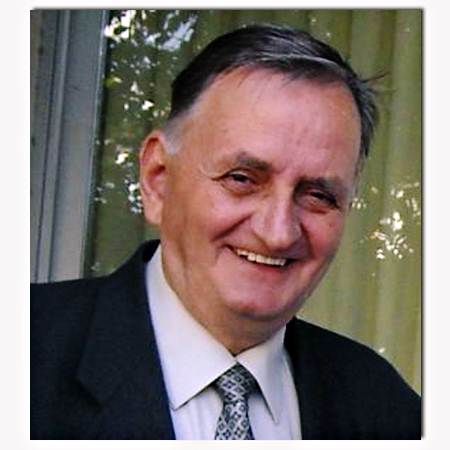
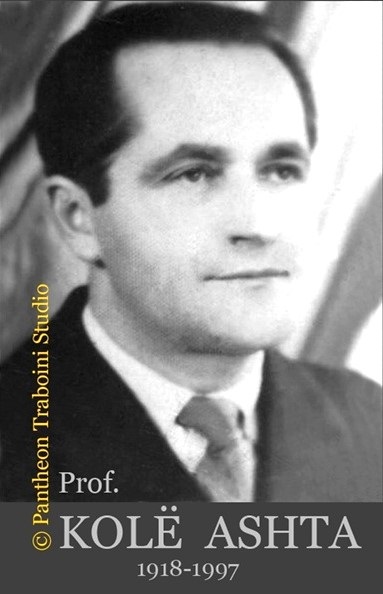
Memorie.al / It are a distinct honor and pleasure to speak about a revered teacher and man, a diligent researcher who, like few others, worked his entire life in two fields simultaneously: education and science. Which of these fields held more importance? Perhaps the professor himself could provide the best answer, but at least from the theme of today’s references – the evaluation of the social framework – the scale tips toward science. Yet, I somewhat disagree with this. For 30 years, he worked with passion in secondary and higher education: at the Berat Gymnasium, the “Normalja” of Elbasan, the Shkodër Gymnasium, and the Higher Pedagogical Institute. After completing his studies in Rome, he worked at the Institute of Albanian Studies alongside eminent intellectuals such as Çabej, Xhuvani, Dhimitër Berati, Eqerem Bej Vlora, Et’hem Haxhi Ademi, and others.
After the war, from a scientific researcher in the field of literary and linguistic studies, he was appointed as a teacher in Berat. It was a time of great upheaval, of a fierce war against the Albanian intelligentsia – of killings, imprisonments, and internments. The mourning of the class struggle had begun.
Professor Kola, who had defended his diploma thesis on Fishta’s Epics, still – forgive me – does not like to state the full title of his diploma today. This is because not only was Fishta pursued and locked behind a hundred locks, but those who had the honor of studying his works were also hounded and persecuted.
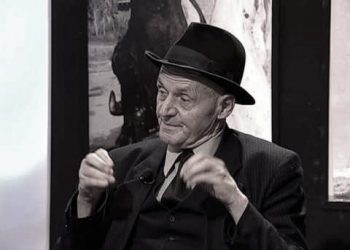
While this quiet and devoted man, with great politeness, still hesitates to say the full title of his dissertation, “The Epics of Gjergj Fishta,” he suddenly erupts, reciting the famous verses of ‘The Highland Lute’ (Lahuta e Malcis) in that room filled with light and shadow. In that moment, he is no longer the calm and silent man, but a youth full of vigor and severity, awakened by the epic verses of the Great Poet.
Unfortunately for us, the teacher did not have the opportunity to teach these verses of Fishta to the children, to recite them to his students, or to convey to them that great national message. Steeped in a broad literary and linguistic culture, due to truncated curricula increasingly filled with foreign Slavic or Asian literature, or the Albanian literature of Socialist Realism, he – like all other teachers – was forced to implement these programs.
However, all the generations who had the good fortune to be taught by Professor Kola remember well his preferences in handling the subject matter and his evaluation of various authors and works. They recall the depth of his analysis and the pleasure with which he treated Homer, Dante, Shakespeare, Goethe, or the old Northern authors, the prominent figures of the National Renaissance, or the Independence era. Even the students could sense his discomfort when he began teaching Russian literature or the Albanian Socialist Realist texts.
Many anecdotes are told by his students regarding this – which is not the place to recount here -but their message is clear: the teacher worked with reluctance because nothing there warmed his heart. Remember, this was the time of works such as ‘Zarika’, ‘The Liberators’, ‘The Swamp’, ‘Thus Myzeqe’, etc., where only we know what we endured, lying to ourselves and our students about their ideological and artistic values.
Precisely during these dark times for our country and culture, there in Berat or Elbasan, he began his scientific work. By then, his literary studies on the epic, on Fishta, and who knows how many other early youthful projects and ideas, had to be changed, tucked away in distant and dark corners.
While in Berat, he met Vexhi Buharaja, of whom Professor Kola speaks with great respect as a cultured man and diligent researcher of Oriental languages. He also became acquainted with the activity of Tahir Dizdari, and from there, his desire and passion to deal with the literature of the old authors were born. I would call this a great stroke of luck for our culture because the work Professor Kola did 45 years ago – drilling through stone like a drop of water – could not have been achieved by an entire research institute.
The work began in Elbasan, working at night by a kerosene lamp to research neologisms in the works of Kristoforidhi, and continued in Shkodër with Matranga, the Council of Arbër, Buzuku, Budi, Bogdani, and others. One might ask: what does this have to do with teaching?
Yes, Kolë Ashta was a teacher, but a teacher only in school; on Sundays, he prepared for the entire week; in the evenings, he prepared for the next day. During the day? No, during the day he had other tasks: he was tracking the works of the old authors. Imagine how much time was needed to decipher a single word, a line, or a page from Buzuku or Matranga on a microfilm under difficult technical conditions.
Although it is difficult to draw a word from Professor Kola – despite all efforts, he remains very silent and reserved – through personal acquaintance and conversations with his friends, colleagues, and students, we can present some moments of his work as a teacher.
The researcher, the teacher, and the man were fused into one. This was best seen in the 1960s and beyond, when his entire scientific and research caliber was placed at the service of raising the level of lectures in subjects like phonetics, lexicology, the history of language, and dialectology.
In this way, the scientist was directly and perfectly linked with the pedagogue. He became an example for many other colleagues who, unlike the subject they taught in higher schools, chose an entirely different field for their dissertation defense.
And Professor Kola was never heard boasting; he worked in silence, head down like a wheat stalk full of grain, without any pride, and drop by drop, he gathered material for teaching and scientific work. This was not an easy task; he not only lacked support and encouragement, but many obstacles were placed in his way.
Anyone might ask: having earned the title of Doctor how was it possible that this title was not recognized, or was the passing of four exams more important? Were those thousands of pages of genuine scientific work not enough?! How was it that the possibility of compiling and publishing his works was never found, not to speak of the obstacles in periodical publications?
Which of us would not withdraw when nothing was published in the journals of the Institute of Linguistics and Literature, except for one Matranga? It is the strength of a man’s character, his persistence, and his dedication that urged him to bear the heavy burden of the teacher and the hardships of the scientist.
How many teachers have complained about the work with children? Yet, nothing in this world is achieved without toil and sacrifice. Let us not forget that Professor Kola worked in an extremely difficult and, for many, tedious field.
Imagine what it takes to read a paragraph from Buzuku, transcribed and transliterated, let alone in the original or, even worse, on microfilm. This passion always elevated the figure of the teacher before his colleagues, students, and friends, but the censors, faithfully following the line of the class struggle, never gave him the proper recognition.
They only threw stones and weights. The greatest insult was dealt to him in March 1975, when, with two months of the school year still remaining, they forced him into retirement along with his friend, the equally diligent and silent researcher Fadil Podgorica.
Seventeen years have passed, and Prof. Kola still feels the sting of that insult. How was it possible not to allow this gentleman to complete the curriculum, to finish the year alongside his students? What pedagogy, besides a dictatorial bureaucracy, allows this? This was the strengthening of the ideological struggle against “foreign manifestations” that had begun in the famous plenum of 1974.
And Kolë Ashta, the researcher of Fishta in 1942, continued to deal with Buzuku, Budi, and Bogdani, instead of dealing with the lexicon in the work “The Anglo-American Danger”, which many other “linguists” began to study.
It is no surprise that criticisms were made that Kolë Ashta, Jup Kastrati, Fadil Podgorica, etc., were not dealing with current problems, while the past took up too much space. The meaning of this criticism made by the party’s basic organization of the Institute was clear.
Regardless of the fact that he prepared for scientific activity in the field of language and literature, and regardless of not receiving the necessary pedagogical training (Italian universities did not have this goal), he worked with great care to merge his scientific level with methodical treatment.
He learned from the experience of his colleagues. He remembers with pleasure the methodologist of the “Normalja” of Elbasan, Musa Tafa, while he does not say a single word about the director and methodologist of the Shkodër Practice School, Aneta Baba (Ashta).
His students remember his correctness, clarity, and the argument and logic of his literary and scientific treatment of the subject, accompanied by scientific and literary discussions that the professor allowed and opened freely, along with improvisations, dramatizations, gestures, and illustrations that left a lasting impression. These are still remembered today in conversations between students and colleagues.
They remember the scenes of Macbeth with a knife in hand, the dramatization of Kristoforidhi, the reprimand of a composition without a single punctuation mark, the grade of ten given to a student who had disturbed the peace, followed by a punishment for breaking discipline, and many others that need not be gossiped about here.
But I want to emphasize an event of my own. I was a young teacher at the “Xheladin Fishta” secondary school, conducting graduation exams for the first time with students I had guided for seven years and worked hard for. The next day, I went to the gymnasium and asked to read some compositions to compare them with my students’. I was disappointed.
Professor Kola’s students did not even compare to mine in terms of depth of thought and artistic presentation. I understood this well when I read his study on compositions in ‘Arsimi Popullor’. Since then, I looked from afar with great reverence at that silent man, who knew only how to work and not to raise dust like many others around him.
If in the field of science he worked tirelessly and has not yet been rewarded – because his works still await publication – in education, the honor has grown and expanded from generation to generation. Today, his students, now somewhat elderly, remember their teacher, the educator, the man – the good and honest one to the point of total devotion – a perfect embodiment of correctness, simplicity, love, and respect for colleagues and students.
Thank you for giving me the opportunity to express my respect for this learned man and highly honored teacher, Mr. Kolë Ashta. But I cannot fail to mention his wife and talented teacher, Mrs. Aneta Baba-Ashta, who for a long time created the necessary conditions for Mr. Kola to work in peace./Memorie.al