By Prof. Assoc. Dr. Thanas L. Gjika
Part two
(Portrait-biography dedicated to the distinguished activist, Professor Sami Repishti)
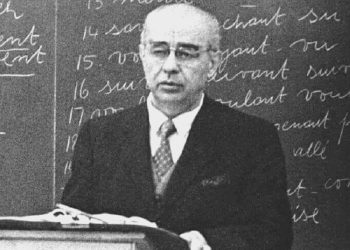
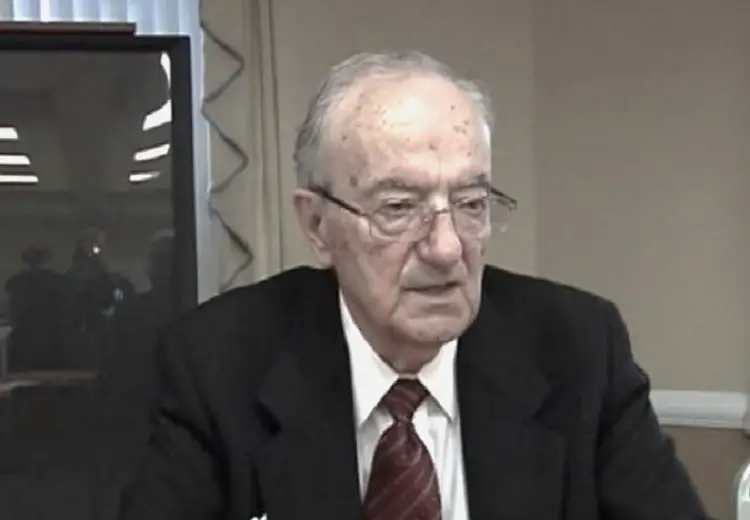
Memorie.al / Sami Repishti is one of those experienced individuals who, having endured torture during investigation, the suffering of prison, the risk of escape, and the persistent work to qualify and serve the homeland as anti-communists, deserve to be called, even while they are still alive, heroes of the Albanian world. He, along with Arshi Pipa and Martin Camaj, form an elite trio of Shkodra natives who, with their lives and work, carried forward the patriotic and intellectual mission of the National Renaissance and of the patriots of the Second World War and its aftermath. For more than half a century, Professor Repishti, with his multifaceted work in defense of the rights of Albanians wherever they live, with his memorandums, political articles, analyses, essays, literary creations, speeches at conferences, interviews on Radio “Voice of America” (VOA), with his work as a co-founder of several patriotic organizations and associations, as well as with his concrete actions in the homeland and in Kosovo to closely assist the processes of democratization and the creation of a rule-of-law state, deserves to be called an Independent Institution.
Continues from the previous issue
The Escape and the Hero of the Oath
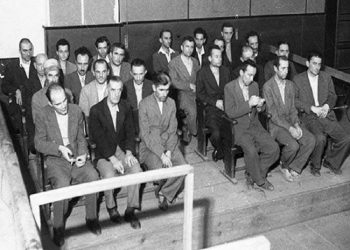
After Prof. Sami Repishti took a somewhat deep breath, he said, looking at John: “Before I talk about your father, the late Milto Lito, I want to tell you an episode about a hero, whose help and sacrifice I cannot forget as long as I live. After 10 years in prison, when my release time was approaching, my fellow inmate Muho Seit Toshi, from Vithgar in Ana e Malit, told me privately: ‘I will be released very soon too. If you want to cross the border to go abroad, come and meet me every market day at the Shkodra market.’
I did not take his proposal seriously, as we were not very close friends. However, after I got out of prison in July 1956, the situation of my family was miserable. My mother and sister were doing heavy manual labor. I was also given work digging canals, making mortar, and other poorly paid jobs. One day, a cousin of ours came to visit our house and told me: ‘I heard that the Security (Sigurimi) will arrest those who leave prison and do not get married immediately, because they suspect they want to escape, or engage in sabotage.’ These words brought Muho Toshi’s proposal to mind. I connected with him, and with his help, I was able to realize my escape.
However, in this story, there are two very touching moments that I cannot forget, and every time I recall them, my respect for that brave and trustworthy man, and also for our people who have produced such heroes, increases. When we went to the location near the Buna River, Muhua explained how we would meet the next day to carry out the escape. I asked him if he also had a revolver like me. When he said he did, I told him that I did not want to live through what I had endured in the investigation and in prison again, so I was determined not to fall alive into the hands of their guards. If the guards spot us, I will kill myself, but if my revolver doesn’t finish the job, you must kill me without fail. Swear it!
Muhua pondered a bit and, with his head bowed, solemnly said: ‘neither you nor I will surrender alive.’ And extending his hand to me, he added: ‘I give you my word (Besa)!’ I shook that hand that agreed to kill me to save me from the tortures I might suffer in investigation and prison… This solidarity of the oppressed people made me feel liberated. This solidarity seemed to me like the seal of the nobility of our nation…! The second moment occurred the next day after we crossed the border fence. Muhua told me: ‘Go now and surrender at the Yugoslav post, while I am returning because I need to settle things with my parents and some other matters. I will come to America too, but in two years.’
During those two years, Muho Toshi helped nine other Shkodra natives cross the border, but when he attempted to cross himself in 1961, the guards spotted and killed him. I can never forget this silent hero who risked his own life for me and nine other Shkodra natives. He left behind a wife and two orphans…! With a white handkerchief, he wiped his tears and, after taking a deep breath, somewhat relieved, began to speak about his fellow inmate, Milto Lito.”
The Testimony about Milto Lito
“He said that he had not gotten to know Milto during the investigation period because they had passed that period at different times. They had been together at the Maliq camp, where they worked on draining the swamp. He emphasized that Milto was a wise man (a quiet, thoughtful person). He minded his own business and did not approach people, never started a conversation. He did not ask for help either, he solved everything himself. Because of his reserved character, Sami said he had not had the opportunity to become friends with him.
Milto had chosen this way of life because he did not want to fall victim to informants, who would report what they heard to the command, and the command would increase the prisoners’ sentences. To mask the real reason, Milto used to say that he stayed away from people because he was severely myopic and would show his high-numbered glasses, saying: ‘If these break, I cannot work. People play various tricks, and my glasses are made of glass and can break.’
Then, the Professor recounted how, after his release from prison, he got to know Milto’s brother, Dr. Spiro Lito, the pneumologist specialist, whom he sought out to visit his brother-in-law, his older sister’s husband, who suffered from tuberculosis, a disease very widespread at the time due to poor nutrition. After the doctor gave me the time for the visit, – Sami added, – instead of a farewell, I told him: ‘Milto is fine.’ He opened his eyes and asked me: ‘How do you know?’ And I replied: ‘I just came out of that house a few days ago. Doesn’t worry, your brother is very careful and will not suffer any re-sentencing; he will be home soon.’
After he visited my brother-in-law and gave us advice on how to treat him, he told me he wanted to drink coffee with me and instructed me that whenever I saw him at the ‘Kafe e Madhe,’ I should go and sit at his table, without worrying about who would be with him. However, after a couple of days, when I was passing in front of the Kafe e Madhe, I saw Dr. Lito drinking coffee with the Head of the Internal Affairs Branch, General Hilmi Seiti. I lowered my head and left. The next day, the Doctor was with some other friends, and I went inside. As soon as he saw me, he waved, and I went and sat at his table. He asked me about my brother-in-law, whether there was any improvement, and then explained that the Head of the Internal Affairs Branch and other Security personnel were treating him to coffee because they needed him to treat their relatives. Apparently, he had seen me the previous day when I passed in front of the café and did not go in…!”
Family and Activities
Furthermore, John asked him about his family and children, and the Professor clarified that his family has two children: his son Daren Repishti, a physician specializing in radiology, today a pavilion chief at Norton Louisville KY hospital, and his daughter Ava Safir, a former lawyer in Major Giuliani’s administration, now qualified as a “nutritionist,” working to help patients with their diets. Both have grown children, some students and some in employment.
Daren has three children: his son Bryan, who graduated from Central College KY and works as a banker, his daughter Julia, who graduated from Kentucky University as an English language educator, and his second daughter Nicole, a third-year student at Ohio State University, studying history and international relations. His daughter Ava has two children: her daughter Audrey, a student at Laurenceville High School near Princeton University, and her son Alexander, a third-year student at Ridgefield Academy.
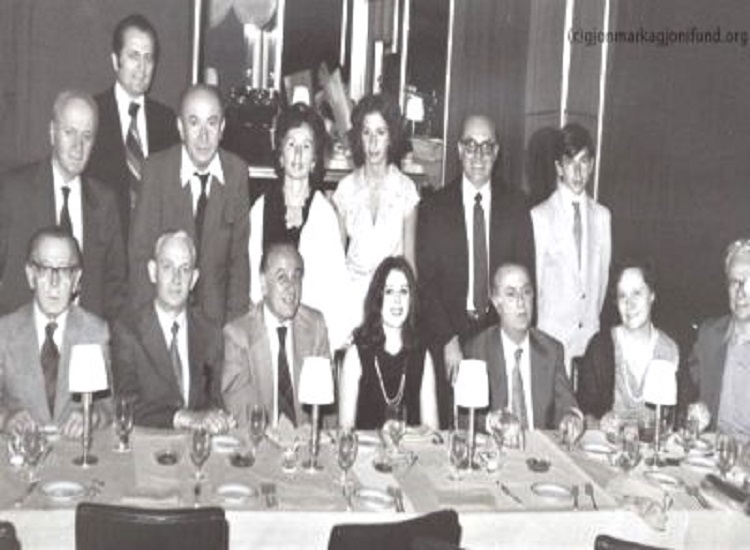
“We feel completely blessed,” the professor finally said and added, “This apartment where we have been living for ten years, close to our daughter, was a gift from our son.” He then briefly spoke about his passion and activity related to human rights protection, his creation and activity as a member of the society “Kosovo Albanian Youth in the Free World” (RShKBL); as co-founder and executive director (1986–1992) of the American Albanian Civic League (AACL) led by politician Joe Dio Guardi; as co-creator and first chairman (1996–1998) of the lobbying society National Albanian American Council (NAAC), etc., activities for which he also gave me some written materials. As the conversation was drawing to a close, the lady of the house, without making noise or drawing attention, had set the dining room table with cakes, fruits, and soft drinks, and invited us to move there. I took the opportunity to take some photos as a keepsake. At 4:00 PM, we parted with the wish to meet again next spring…!
Seeking Protection for Kosovo Albanians in the US Congress
In 1948, after J. B. Tito, the leader of the Socialist Federal Republic of Yugoslavia, had a falling out with J. V. Stalin, the leader of the Soviet Union, the US supported Yugoslavia as a preferred ally. Through American aid and that of other Western countries, the economic situation of this multi-ethnic state greatly improved. Likewise, relations between the Slavic peoples living there also improved.
However, the liberal policy of “Brotherhood and Unity” implemented among the Slavic peoples of this federation was applied at a very low level toward the Albanians who had been unjustly given to the Serbian and Montenegrin states since 1913. The Albanian people, within this federation, were now living administratively divided as a minority in the Republic of Serbia, Montenegro, and Macedonia.
An area called the Autonomous Province of Kosovo and Metohija had also been created, which constituted an administrative unit directly dependent on the Republic of Serbia. In this province, Albanians, making up the overwhelming majority, enjoyed somewhat more rights than Albanians living as minorities in Serbia, Montenegro, and Macedonia. In short, the Albanian people in Yugoslavia were viewed and treated as a second-class people, with fewer rights than the other peoples of the federation, even though they were an autochthonous population in their own lands since the time of ancient Dardania. They were called and treated as a people who had arrived from Albania, with the wicked ulterior motive that one day they would be expelled and returned to their place of origin…!
After arriving in the USA in April 1962, Sami Repishti began to learn English and pursue his university education. Even before becoming an American Citizen, he began to take an interest in the situation of the Albanian community, became a member of the “Vatra” Federation, and started to think about how to help improve the situation of the Albanian people living under the communist yoke in Albania and the rest of them who were treated as second-class people in Yugoslavia. In April 1965, the US Congress organized a hearing on the situation of peoples in the communist world. The US Congress Administration sent an invitation to the “Free Albania” Committee to send a person to testify about the situation of the Albanian people.
Prof. Nexhar Peshkëpia, a prepared political figure and serious person, proposed that Sami Repishti be sent for this issue, even though he was not a member of the “Free Albania” Committee, as he knew the situation of the Albanian people – where he had suffered in prison a few years prior – better than others. Sami accepted and spoke not only about the severe condition of the Albanian people under the communist yoke but also about the situation of the Albanian people in Yugoslavia, where they were treated as a second-class people and many of their rights were denied.
A hostile atmosphere was created against the speaker because he dared to criticize the internal politics of Yugoslavia, an allied state. The Chairman of the Commission, Congressman Lee Hamilton, as Sami himself clarified in an article, addressed him: “Mr. Repishti, Albania attacks us 7 days a week with radio and press. It is fortunate for us that we do not know Albanian to read and understand these daily insults. President Tito is our friend. You come here and ask us to take a stand against Tito, a friend, and support Albania’s requests. We cannot do this.” (Dielli Newspaper, N.Y, December 2018, p. 32)
Wounded in his pride, Sami replied that he did not want to engage in politics, but as a human rights activist, he sought the help of the American Congress to stop the oppression of the Albanian people in Albania and Kosovo. For this, he bravely said, I insist. This speech by Sami Repishti was the first articulation in the American Congress to defend the rights of the Albanian people of Kosovo, but the atmosphere of friendship between the US and the Yugoslav Federation did not allow the issue of the Albanian people’s situation in Yugoslavia to be taken seriously.
This situation began to improve from the early 1970s when the propaganda work of the society “Kosovo Albanian Youth in the Free World” (RShKBL) intensified, and especially after the signing of the Helsinki Final Act in 1975, for the protection of human rights, and after the creation of the American-Albanian Civic League (AACL) in 1986 by the politician of Arberesh origin, former Congressman Joseph Dio Guardi.
This organization raised this issue several times in the American Congress through Congressmen Tom Lantos, Eliot Engel, and Senator Robert (Bob) Dole – a presidential candidate – and the Senator. Sami Repishti served as the executive director of this political organization. In 1996, this activist founded the National Albanian American Council (NAAC) as a lobbying society in Washington D.C., primarily to defend the rights of the Albanian people of Kosovo from the oppression of Slobodan Milošević.
The Brain of the “Kosovo Albanian Youth in the Free World” Society
The Albanian nationalist, Tahir Curran Kernaja, who before coming to the USA (1962), had experienced prison and internment in Albania and inhumane torture in Yugoslavia, began to speak loudly among the Albanian emigrants in New York in the years 1963-1964 about the oppression of the Albanian people in Yugoslavia, especially in Kosovo.
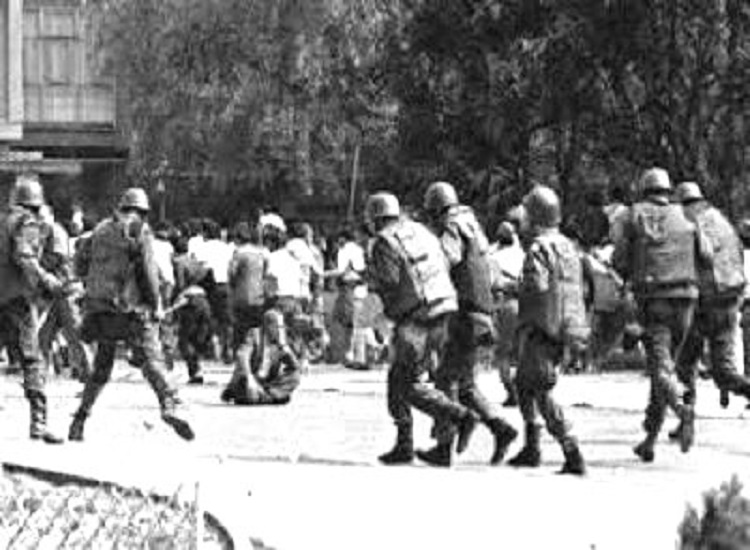
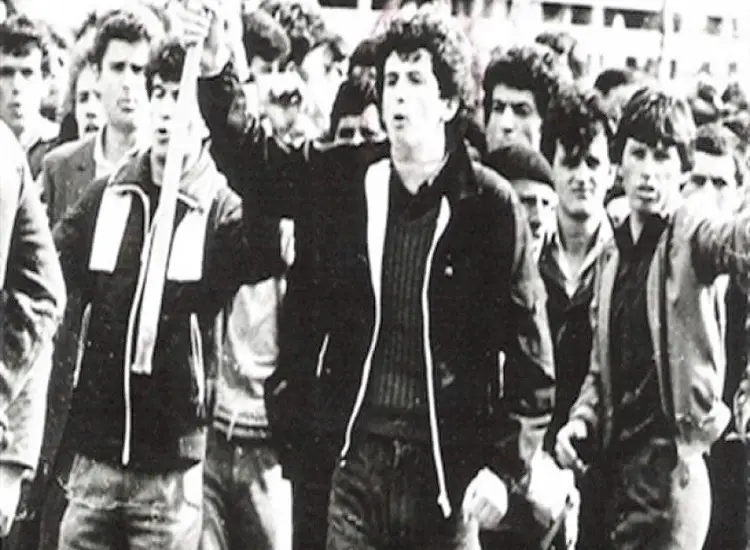
Following the demonstrations that erupted in various municipalities of Kosovo during November 1968, which peaked with the student demonstration on November 27 in Prishtina, Besianë, Ferizaj, and Gjilan, Tahir Kerrnaja met with his former cellmate from Shkodra prison, Sami Repishti, the brothers Sergio and John Bitici, and Prof. Rexhep Krasniqi, to create a core group of patriots with whom to begin the organized propaganda struggle in New York, to popularize the severe oppression inflicted upon the Albanian people in Kosovo and to demand the protection of their rights.
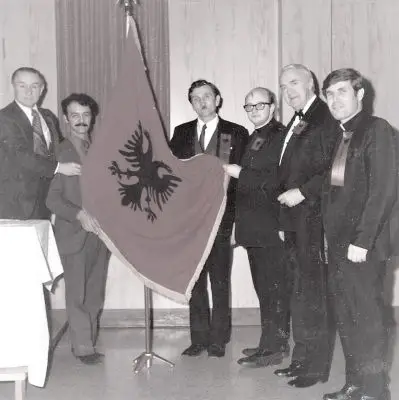
From the very beginning, upon the proposal of Rexhep Krasniqi, the group was named the “Kosovo Albanian Youth in the Free World” (RShKBL). It quickly expanded with the participation of Prof. Peter Prifti and Dr. Safete Juka, and later Maliq Arifaj joined, who was elected executive secretary. The organizational work, as well as the publishing and distribution of materials (articles, pamphlets, memorandums, news, etc.), was carried out by Tahir Curran Kernaja, Maliq Arifaj, Kujtim Zherka, Merxhan Hyseni, the brothers Sergio and John Bitici, etc.
Tahir’s residential address was used as the society’s address. Maliq Arifaj signed most of the writings, while the real authors did not sign their names at the end of the writings. The brothers Sergio and John Bitici, in addition to organizational work, covered the expenses of publishing the tracts and the costs of mailing them to various offices, embassies, and friends worldwide.
Tahir Kernaja and his two nephews, along with Sergio’s eldest daughter, distributed the tracts at the door of the UN building, handing them to those who entered and exited there – politicians and various officials – as well as in places where people gathered. Professor Sami Repishti, among the intellectual group consisting of himself, Prof. Peter Prifti, Dr. Safete Juka, and Prof. Rexhep Krasniqi, was the person who drafted almost 90% of all the writings, be they articles, memorandums, comments, etc. Precisely because he was the most prolific and highest-quality author of the writings, we dare to call him The Brain of the RShKBL Society.
By giving this activist this epithet, we do not underestimate the work of the other collaborators of this society, because the brain in an organism is indeed the most important organ, but it cannot function without the help it receives from other organs such as the heart, kidneys, lungs, stomach, etc. Even our popular expression, a good brave man has many friends, shows that an activist/fighter achieves results not alone, but by cooperating and fighting with many friends.
Looking at the progress of the efforts against the oppression of the rights of the Albanian people of Kosovo in American politics, from the long and continuous work of drafting, publishing, and distributing the tracts of the RShKBL society, to the creation and activity of the lobbying organizations American-Albanian Civic League (1986) and National Albanian American Council (1996), we must recognize that there is a link in this process, where the influence of this society’s work as the initiator cannot be overlooked.
Therefore, the RShKBL society, even though it was not officially registered as an organization—because that way it was protected from the Yugoslav and Albanian Intelligence that were present in New York—must be recognized for its merit as the initiator of this struggle and must be given the deserved appreciation. The effectiveness of this society’s activity against Yugoslav politics was acknowledged and noted by Sinan Hasani during the years 1984–1989 when he was elected President of the Yugoslav Presidency by rotation. / Memorie.al