



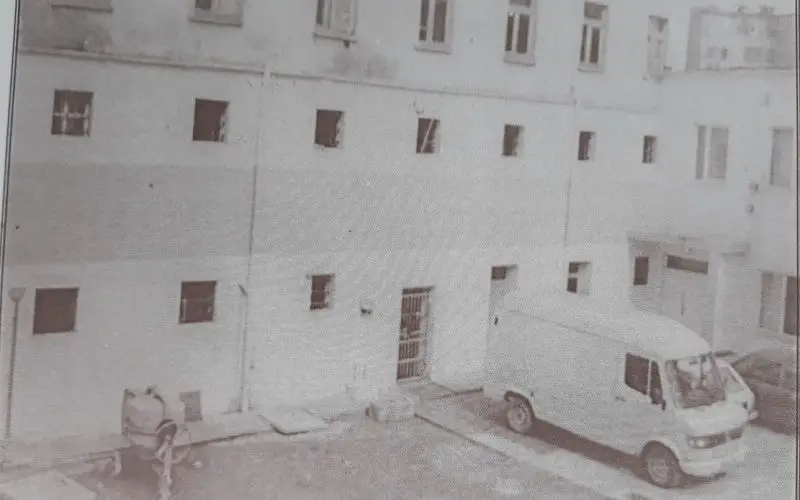
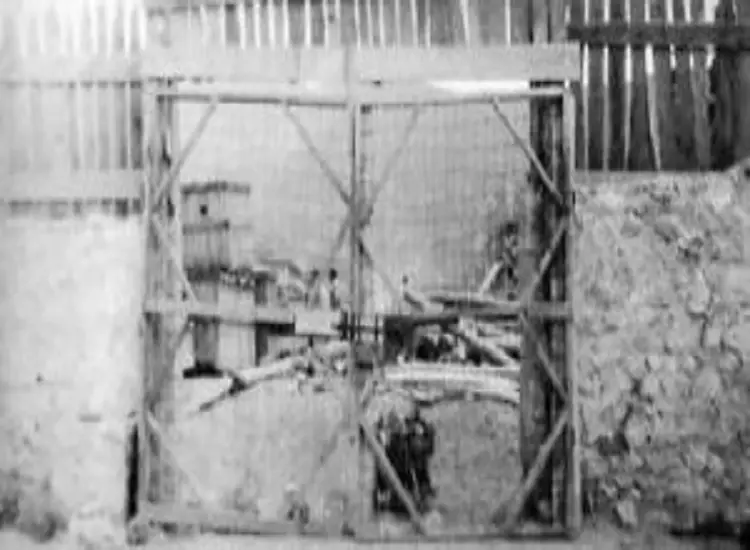
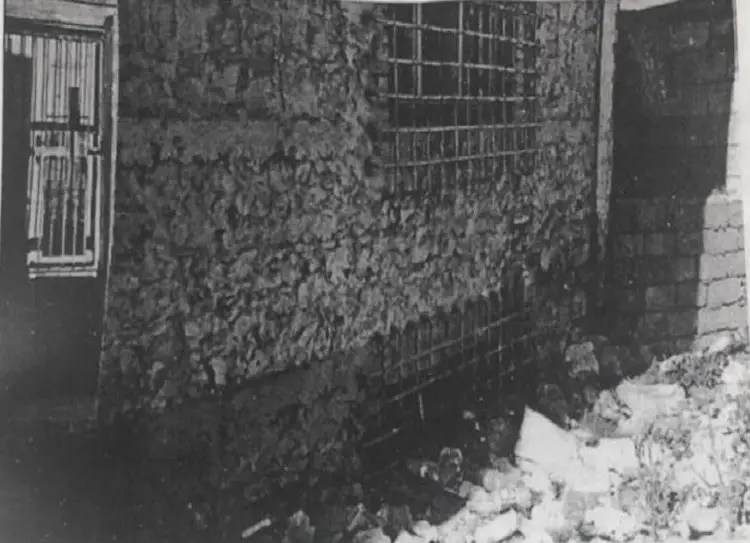
Memorie.al / “Tirana Prison serves as a transit point for convicts from other districts before they are sent to various prisons and re-education units. These convicts, waiting to be distributed, stay there for two, three, or more months, in addition to the time they have spent in the isolation cells of their districts of origin. Sick prisoners in Spaç, Qafë Bari, and Burrel were denied medical assistance for more than 9 months.” This is stated, among other things, in two report-information’s from the Prosecutor General of the Republic, sent to the Secretary of the Central Committee of the APL (PPSH), Haki Toska, and the Minister of Internal Affairs, Kadri Hazbiu, in April 1973. Many of them were in urgent need of intervention. However, the criminal communist regime had not reacted. This grave fact is found in an important official document of the General Prosecutor’s Office, signed by Prosecutor Dhori Panariti, who explains in detail, case by case, all the violations committed against the prisoners. Despite being held in isolation, in terrible living conditions and performing exhausting, life-threatening work in the mines, they were left to their fate even when they fell ill.
REPORT-INFORMATION OF THE GENERAL PROSECUTOR DHORI PANAROTI, SENT TO THE SECRETARY OF THE CENTRAL COMMITTEE OF THE ALP, HAKI TOSKA AND THE MINISTER OF INTERIOR KADRI HAZBIU, REGARDING THE PROBLEMS OF CONVICTS IN THE TIRANA PRISON
PEOPLE’S REPUBLIC OF ALBANIA
GENERAL PROSECUTOR’S OFFICE S E C R E T
(Directorate of Control of Investigative Actions)
No. 737/1 Tirana,
April 14, 1973
SECRETARY OF THE CENTRAL COMMITTEE OF THE ALPS
COMRADE HAKI TOSKA
TIRANA
Attached, we are sending you the report: “On several convicts in need of hospitalization for treatment.” We have also sent this report to comrade Kadri Hazbiu.
PROSECUTOR GENERAL
Dhori Panariti
INFORMATION
ON THE SITUATION IN THE PRISON AND PRE-DETENTION CELLS IN THE DISTRICT OF TIRANA
We have raised the issue of the undesirable situation in Tirana Prison and the pre-detention cells several times before; a situation which, although it changes in isolated cases, still sees many problems remaining without a definitive solution. Among the most primary are:
- Tirana Prison as a Transit Hub: It serves as a transit for convicts from other districts before they are sent to prisons and re-education units. These convicts stay there for two, three, or more months, in addition to the time spent in isolation in their home districts. Consequently, at various periods, they are gathered beyond the prison’s capacity, leading to severely overcrowded sleeping conditions. It should be noted that the vast majority of these are youth and minors. For example, there are currently 165 convicts in this prison, of whom 121 are youth and minors. Their long stay in Tirana Prison damages their health, this workforce is not utilized for labor, and simultaneously, their re-education becomes more difficult.
- Hygienic-Sanitary Conditions: The condition of these convicts is unsatisfactory. Since they are in transit, their bedding is worn out and insufficient. Likewise, because there are no facilities for hot water, they do not wash their personal clothing. We believe that in these circumstances, the conditions in the pre-detention cells of the Directorates of Internal Affairs in the districts should also be reviewed.
- Overcrowding Statistics: From the inspection carried out by us on April 10, 1973, in the pre-detention cells of Tirana Prison, it was found that in the 48 existing rooms, there are currently 151 persons, 18 of whom are women. According to the instructions on existing cubic capacity, there should be no more than 2 persons in these cells. In fact, in 20 rooms there are 3 persons, in 10 rooms there are 4, in 3 rooms there are 6, and in 1 room there are 7 persons. Thus, 34 rooms are over-occupied.
In several pre-detention cells, young individuals are kept together with adults, which contradicts point 32 of the instructions. Similar weaknesses exist in the isolation rooms of the Directorates of Internal Affairs in other districts, especially in Lushnjë, Kolonjë, Krujë, and Gjirokastër.
Tirana, April 14, 1973
PROSECUTOR GENERAL:
Dhori Panariti
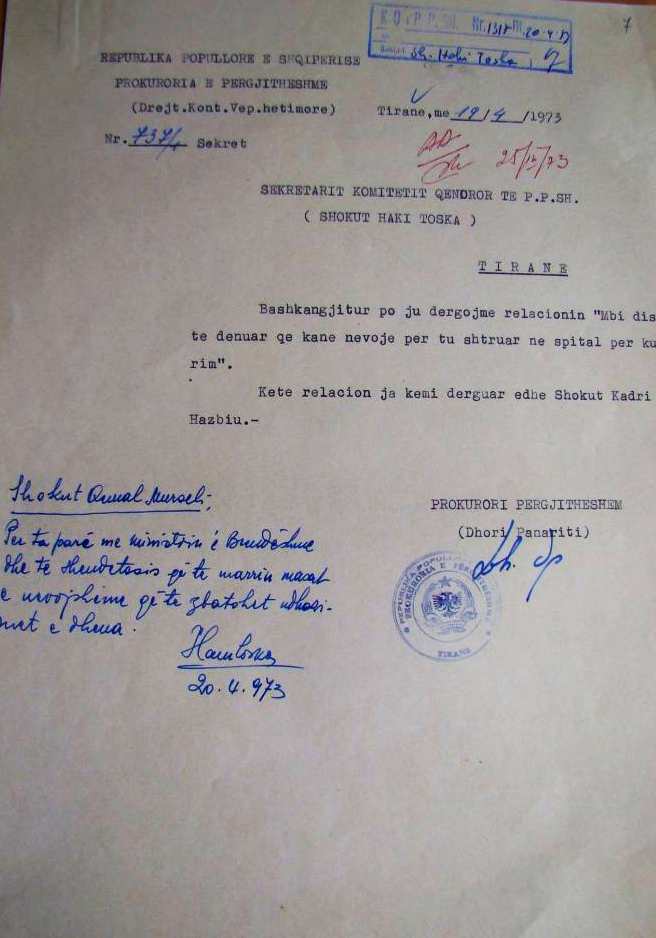
ARCHIVE DOCUMENT WITH THE REPORT-INFORMATION OF THE GENERAL PROSECUTOR DHORI PANAROTI, SENT TO THE SECRETARY OF THE CENTRAL COMMITTEE OF THE ALPSH, HAKI TOSKA, ON THE HEALTH PROBLEMS OF PRISONERS IN CAMPS AND PRISONS
PEOPLE’S REPUBLIC OF ALBANIA S E C R E T
GENERAL PROSECUTOR’S OFFICE
(Directorate of Investigation)
No. 737/1
Tirana, 19.04.1973
SECRETARY OF THE CENTRAL COMMITTEE OF THE PLA
COMRADE HAKI TOSKA
Tirana
Attached is the report “On some convicts who need to be hospitalized for treatment”.
We have also sent this report to comrade Kadri Hazbiu.
PROSECUTOR GENERAL
Dhori Panariti
Comrade Qemal Murseli:
To check with the Ministry of Interior and Health to take the necessary measures to implement the instructions given.
20.04.1973
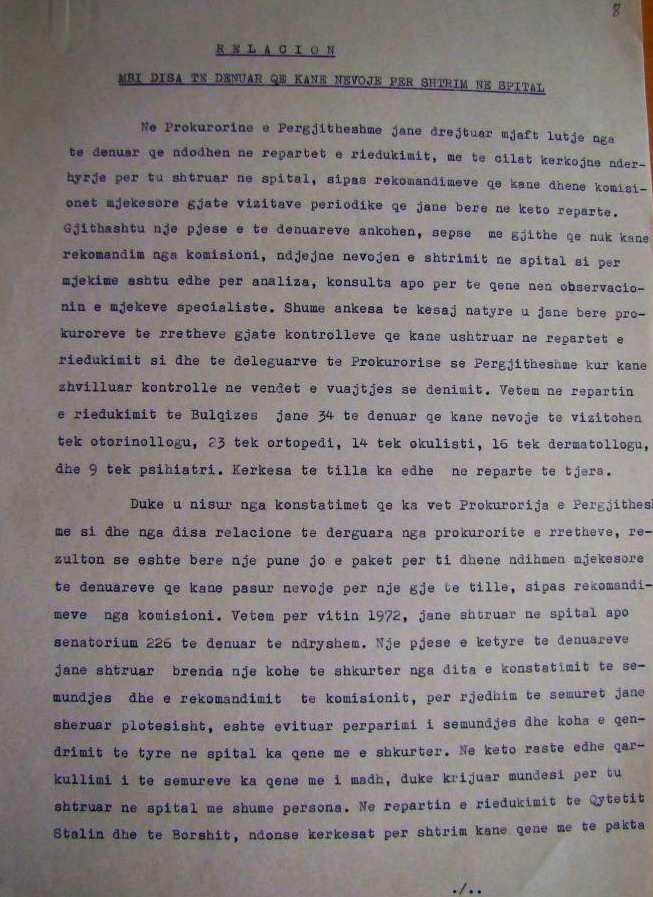
REPORT
ON SOME CONVICTS WHO NEED HOSPITALIZATION
The General Prosecutor’s Office has received requests from convicts in re-education wards, requesting intervention to be hospitalized, according to the recommendations given by the medical commissions during the periodic visits made to these wards. Also, some of the convicts complain because, although they do not have a recommendation from the commission, they feel the need to be hospitalized, both for treatment and for tests, consultations or to be under the observation of specialist doctors.
Many complaints of this nature have been made to district prosecutors during the inspections they have carried out in the re-education wards, as well as to the delegates of the General Prosecutor’s Office, when they have carried out inspections in the places of serving their sentence. In the Bulqiza re-education ward alone, there are 34 convicts who need to be visited by an otolaryngologist, 23 by an orthopedic surgeon, 14 by an ophthalmologist, 16 by a dermatologist and 9 by a psychiatrist. There are also such requests in other departments.
Based on the findings of the General Prosecutor’s Office itself and some reports sent by the district prosecutor’s offices, it turns out that a considerable amount of work has been done to provide medical assistance to convicts who have needed such assistance, according to the recommendations of the commission. In 1972 alone, 226 different convicts were hospitalized or hospitalized.
Some of these convicts were hospitalized within a short time from the day the illness was diagnosed and the commission’s recommendation, as a result, the sick have recovered completely, the progression of the disease has been avoided and the time they have spent in the hospital has been shorter. At these times, the circulation of the sick has also been greater, creating the opportunity for more people to be hospitalized.
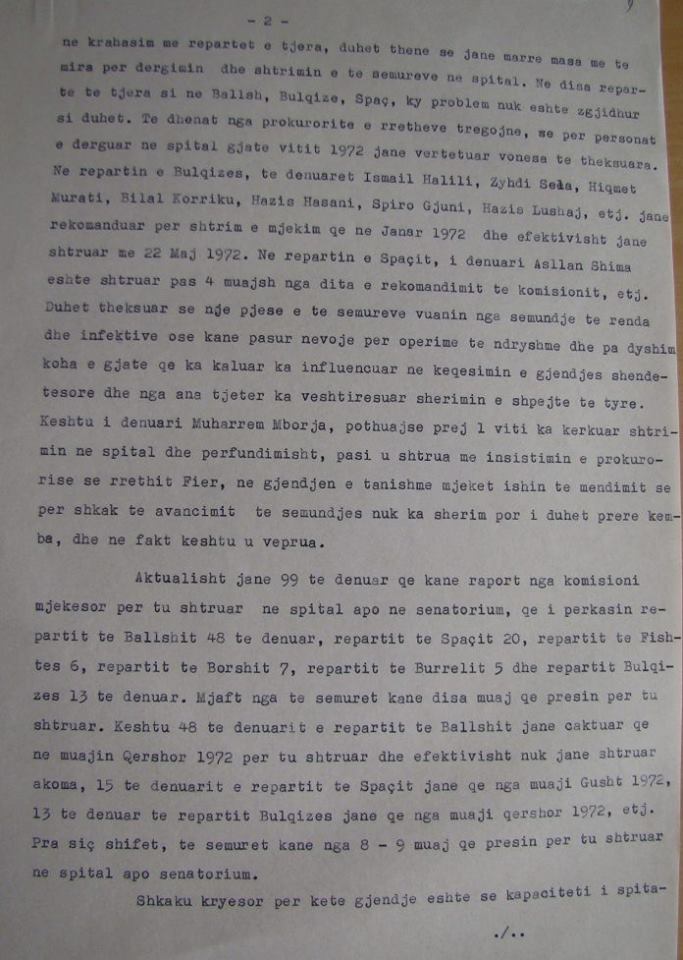
In the re-education ward of “Stalin City” and Borsh, although the requests for hospitalization have been fewer compared to other wards, it must be said that better measures have been taken for sending and hospitalization of the sick to the hospital. In some other wards such as Ballsh, Bulqizë, Spaç, this problem has not been solved properly. Data from the district prosecutors’ offices show that for the persons sent to the hospital during 1972, significant delays have been confirmed.
In the Bulqizë ward, the convicts Ismail Halili, Zyhdi Sela, Hiqmet Murati, Bilal Korriku, Hazis Hasani, Spiro Gjuni, Hazis Lushaj, etc., were recommended for hospitalization and treatment as early as January 1972 and were effectively hospitalized on May 22, 1972. In the Spaç ward, the convict Asllan Shima was hospitalized after 4 months from the date of the commission’s recommendation, etc.
It should be noted that some of the patients suffered from serious and infectious diseases or needed various surgeries and undoubtedly the long time that has passed has influenced the deterioration of their health condition and on the other hand has made it difficult for them to recover quickly.
Thus, the convict Muharrem Mborja, for almost 1 year, has requested hospitalization and finally, after being hospitalized at the insistence of the Fier district prosecutor’s office, in the current situation the doctors were of the opinion that due to the advancement of the disease there is no cure, but his leg should be amputated, and in fact this is what was done.
Currently, there are 99 convicts who have a report from the medical commission to be hospitalized in a hospital or sanatorium, belonging to the Ballsh ward 48 convicts, the Spaç ward 20, the Fishta ward 6, the Borsh ward 7, the Burrel ward 5 and the Bulqiza ward 13 convicts. Many of the sick have been waiting for months to be hospitalized.
Thus, 48 convicts of the Ballsh ward were scheduled to be hospitalized in June 1972 and have not yet been effectively hospitalized, 15 convicts of the Spaç ward have been since August 1972, 13 convicts of the Bulqiza ward have been since June 1972, etc.
So as can be seen, the sick have been waiting for 8-9 months to be hospitalized in a hospital or sanatorium. The main reason for this situation is that the capacity of the prison hospital is small and the measures that are planned to be taken do not definitively solve this problem. At the same time, a fair criterion for hospitalizations has not been followed.
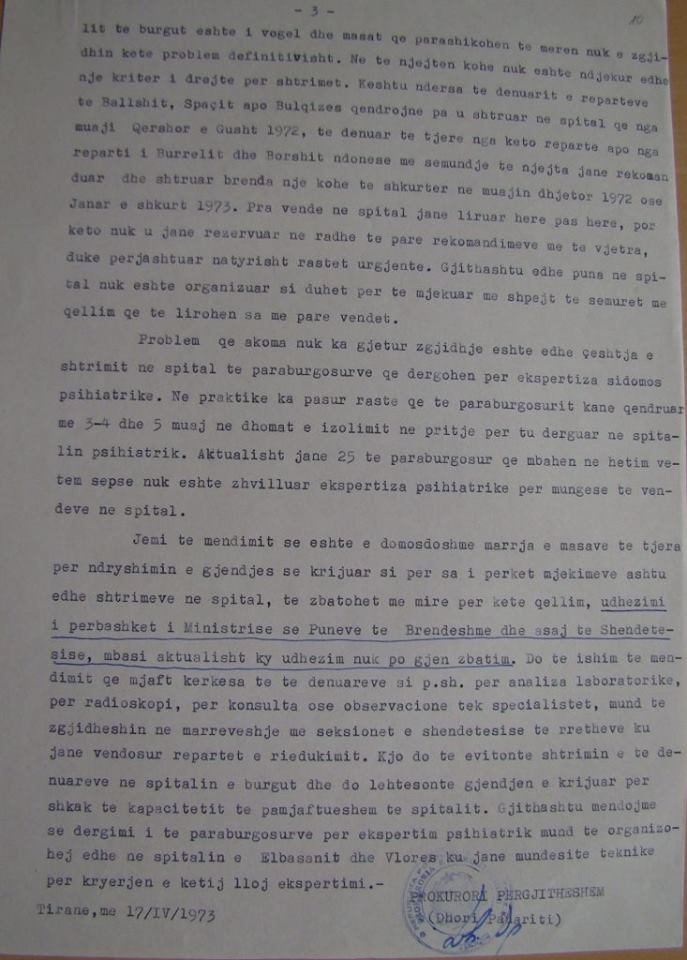
Thus, while the convicts of the Ballsh, Spaç or Bulqiza wards have remained without being hospitalized since June and August 1972, other convicts from these wards or from the Burrel and Borsh wards, although with the same illnesses, were recommended and hospitalized within a short time in December 1972 or January and February 1973.
So, hospital places have been freed up from time to time, but these have not been reserved in the first place for the oldest recommendations, excluding of course urgent cases. Also, the work in the hospital has not been properly organized to treat the sick as quickly as possible in order to free up the places as soon as possible.
A problem that has not yet been solved is the issue of hospitalization of detainees who are sent for expertise, especially psychiatric ones. In practice, there have been cases where detainees have stayed in isolation rooms for 3-4 and 5 months waiting to be sent to the psychiatric hospital. There are currently 25 detainees who are being held under investigation only because a psychiatric examination has not been conducted due to a lack of hospital beds.
We believe that it is necessary to take other measures to change the situation created both in terms of medication and hospitalization, to better implement for this purpose, the joint instruction of the Ministry of Internal Affairs and the Ministry of Health, since this instruction is currently not being implemented.
We would be of the opinion that many requests of convicts, such as for laboratory tests, for radiography, for consultations or observations by specialists, could be resolved in agreement with the health sections of the districts where the re-education wards are located.
This would avoid the hospitalization of convicts in the prison hospital and would alleviate the situation created due to the insufficient capacity of the hospital. We also think that sending pre-detainees for psychiatric expert examination could be organized in the hospitals of Elbasan and Vlora where there are technical possibilities for conducting this type of examination./ Memorie.al
Tirana, 17.04.1973
PROSECUTOR GENERAL
Dhori Panariti




![“Light imprisonment may be served in a workhouse or by performing labor for public benefit; and if the convict does not display [bad behavior/resistance]…” / What did the Penal Code of 1928 provide?](https://memorie.al/wp-content/uploads/2025/03/admin-ajax-1-75x75.jpg)
