
By Eugene Merlika
– A POWERFUL EVIDENCE –
The tragic story described by Lekë Tasi in the book “Robbery at the foot of the hills”
Memorie.al / When you finish reading Lekë Tasi’s book of memories, you get the impression that you have gone back in time and space, to environments and events lived or heard, in a world so small and miserable in events and actions, equally great and noble in the author’s reflections, expectations and explanations on them.
The book is written in the form of a diary, and this is one of the merits of the writer who had the courage, in times full of dangers in the environment where he lived, to put on paper the impressions of everyday life. Today, those notes, which at the time they were kept, had no hope of seeing the light of publication, completed and elaborated, give the Albanian reader a powerful work of its kind. It is a work that reflects with a shocking truth the reality of a country, in which the communist dictatorship was established in extreme forms, in terms of the ways and means of its exercise.
“Robber at the foot of the hills” is a book that attracts the reader. The variety of characters, mostly episodic, but all real, of themes, phenomena, environments, and analyzes make the work a kind of encyclopedia in miniature of the Albanian life of the last 15 years of the system, but thanks to the retrospectives or the author’s leaps, it gives us the complete framework of the previous years as well.
The work has as its central axis the life of the author and his family, along with which the lives of those who surround him, fellow sufferers, persons with party and state duties, their levers, ordinary people whose life relationships are revealed everyday they turn them into complementary parts of his being.
Lekë Tasi is an artist. As such, he perceives the environment in its entire extent and reflects it down to the smallest detail, with all the wealth of colors and sounds. The writer is very realistic. His pen is like a telecamera that films non-stop, continuously, but that occasionally stops filming, to give way to the voice of the speaker, who explains, interrupts, and philosophizes in the solitude of his thought.
The main feature of his writing style is truthfulness. The undersigned has lived for years in Grabiani at the foot of the hills, under the same conditions, and can assure you that everything described in the book, the episodes and characters are taken from real life and transplanted into his memories as they were, without resorting to fantasy for to change the qualities, traits or actions even a little.
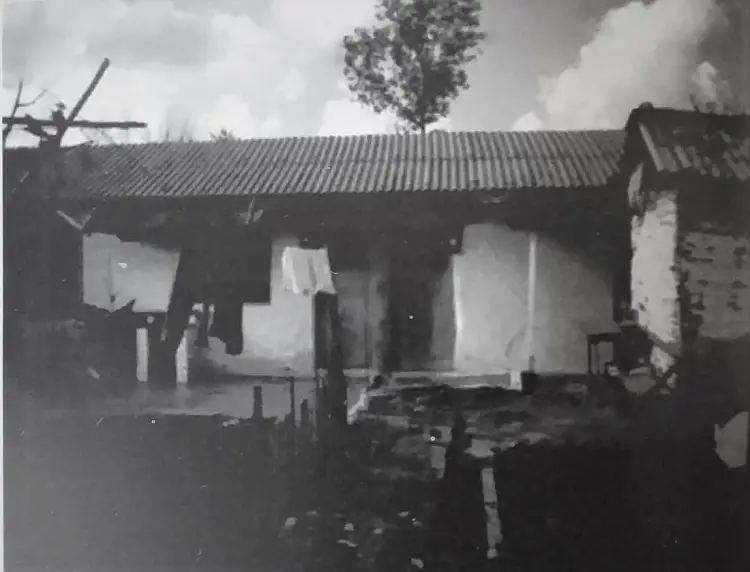
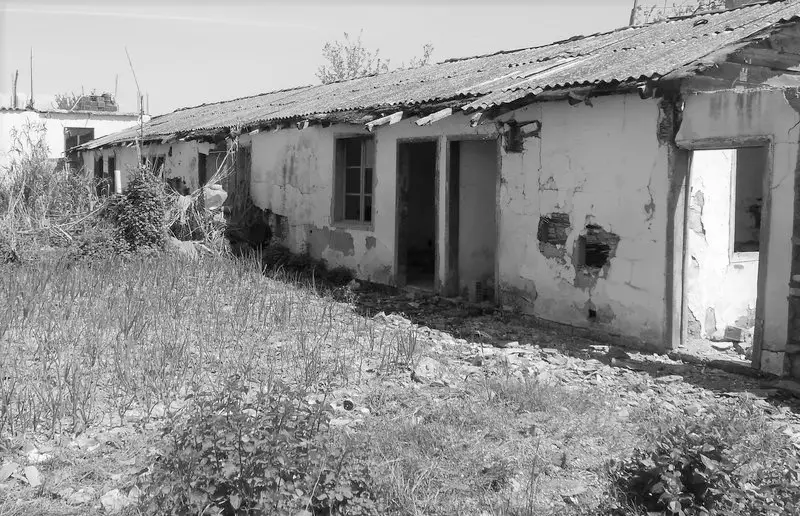
Grabiani was one of the eight internment centers in Myzeqena, chosen by the leadership as the most suitable place for the mass gathering of people unwanted by the regime after the demolition of the infamous Tepelena camp. They were mainly farm sectors, where these people were provided with continuous work in agriculture. They were also places of isolation for “class enemies”, who, being in the minority as a spirit in relation to the population, had become the rare species of a zoo where the native or voluntarily arrived population was daily trained to carried out a “witch hunt”, showing the party how capable it was of applying its “enlightened lessons” on the class struggle.
Episodes of arrests, “unmasking’s”, differentiations, from children in schools, to workers in the fields, to the sick who, even when dying, had to present themselves to the next policeman, to others who for months and years were forbidden to go to city also for health reasons, were an integral part of a strategy drawn up at the top of the State and implemented by loyal, spirited and small people, who found in it the magical field of unfolding creative “skills” in perfecting the war.
Lekë Tasi is a patriotic Albanian. All the criminal pressure, which was exerted on him in long years, failed to break the patriotic shield of his soul. In that small world, in which every day he had to fight for survival, where he was hated, despised, stoned, provoked, condemned, penalized in every way by many of his countrymen, without did not harm a fly, he preserved the nobility of the soul and the clarity of judgment. He doesn’t put everyone in one bag; he knows how to distinguish the differences between the people of the opposing field, to reflect the nuances of actions and behaviors towards him and his friends.
For some of them, he feels respect and consideration, expressing it. In this phenomenon, in a way, he sees the failure of the system that failed to turn all Albanians into criminals, but he also sees the power of the race’s endurance, which was put to an extremely difficult test. It is a great merit to love the Motherland even in the conditions described by the writer in his work, when he becomes worse than a stepfather, when he feels himself a stranger in your land. The chapter on Përmet, the city of origin, with childhood and youth memories, with its history and tradition, with the lyricism of the descriptions, is one of the most beautiful and inspired parts.
Attitude! This is one of the permeating motifs of the work, the resistance to evil raised in the system with the all-round mobilization of the individual who finds strength in himself, in inherited morality, in the positive family tradition, in faith in God. The symbol of endurance is the sister, Tefta, a truly rare woman, in terms of strength of character, foresight and the ability to penetrate into the essence of events, to see the light at the end of the tunnel, and then when it was completely dark.
The verbatim of her investigation is a manual of true dissidence, a principle without tricks, a mirror of extraordinary courage, evidence of values that time will know how to rise on a pedestal. She belongs to that group of Albanians who were not broken in any situation, in which he also introduces a tribal boy, Ded Gjomarkaj, graying in the dungeons of the Security since the age of 25. In it, the heroes of Spaçi, Xelal Koprencka, Vangjel Lezhon, Fadil Kokomanin, who sent letters from prison to the dictator, suing the great damage that he and the system established by him were bringing to the Motherland, paid for this with his head. . Next to them, less visible, were hundreds of others who agreed to go to prisons in order not to become gravediggers of their comrades.
This real dissidence, paid for with lost or mutilated lives, unfortunately, even after the collapse of the system, did not find the respect it deserved. The idea was cultivated that anti-communism flourished in the second half of the 1990s, when in some meeting of intellectuals some piloted change was demanded, or that it was the product of the student movement. Leaving the students and their real leaders in their rightful place, the indifference with actions towards non-passive anti-communism shows that our society and its political class find it very difficult to cut the umbilical cord that holds them together. with the mindset and tradition of communism.
This also justifies the fact that employees of the regime’s violence organs, who have committed heinous crimes against innocent citizens “in the name of the law”, today not only have not asked for forgiveness, but, in any case, see themselves as decorated and almost all of them hold important positions in the state administration.
The author painfully tells the fate of the Çeliku family, also known from other writings before this book: Mehdi, arrested on absurd charges, based on the fantastic guesses of the Security people, dies in the interrogator; the wife, Adelina, mother of six children, is forced, through diabolical investigative methods, to sign a false lawsuit against the husband, when she realizes the truth, she ends her life, the wonderful girl who is abandoned by her fiancé and relatives, the children who grow up as orphans in a friendly environment.
One of the many exterminated Albanian families, a story known as that of the poets of Vërshesta or the poet from Kukësi, facts that should have imposed the application of a universal law: that of the punishment of crime. After 64 years of the end of the Second World War and the breaking of the Nazi extermination strategy, the perpetrators of those crimes, even though 90 years may have passed, are pursued, caught and punished. Our criminals have eternal “immunity”, they are not unknown, they continue their careers peacefully, despite all the false processes they have invented and the lives of Albanians they have taken!
But the author will also find in their world of the color of blood, people in whom, however late, conscience raises its head over souls blackened by crimes and condemns them with self-judgment. It is not the usual, unfortunately it is the exception, but the author likes to point it out, maybe to catch some Tolstoyan illusion that repentance will be the hope of the future.
The book is a balanced analysis of the Albania system. The author’s ideas about the political developments during the war are very interesting, constructive and innovative. Addressing the figure of the father, the researchers of the well-known politician Koço Tasi make an objective and impartial analysis of the motives and political factors that brought about the loss of Albanian nationalism. With the same style, he also analyzes the regime in which he lives, “a general violence”, “a victory of enmity as a social factor”, a country condemned to loneliness, a system that was born for the will of two foreigners and that was inherited by a power freak who hated everything.
These were some of the impressions that evoke and the ideas that are awakened by reading the book I talked about, they are a small part of them because it is an inexhaustible well where the reader finds everything, above all, the true dimensions of an unparalleled dictatorship throughout Europe and the enormous damage it caused to the souls of Albanians. Lekë Tasi’s book is a powerful testimony of our recent past. It is added to the writings of Father Zef Pllumi, Makensen Bungo, Visar Zhiti, and other writers who describe in their artistic works the bitter experience of political prisoners in socialist Albania…!
Regrettably, I have to note that the help in fiction in that direction is still scarce, which makes “The Robber at the foot of the hills” a significant event for today’s Albanian literature. Congratulating Lekë Tas for the values of his work, I wish that his pen will continue to write for the benefit of Albanian culture. Memorie.al
August 2009