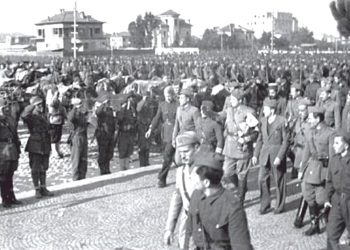
Memorie.al / I believe few have not seen one of the final audio-visual recordings of Albania’s former dictator, Enver Hoxha, where he appears to be deliriously mumbling figures and percentages of the production plan’s fulfillment, even comparing them to the production of 1938. Naturally, few took that final gasp of the dictator seriously. However, there is reason not to dismiss it entirely, for within the words exiting that aging body lies another truth: the systematic falsification of information during the socialist period in Albania. The dictator was simply practicing a vice he had never abandoned.
The end of the monist period brought to light that much was inflated and magnified by party propaganda instruments in service of the party-state. Yet, while we see information manipulated on an upward scale, we must also imagine and reconstruct the opposite of this phenomenon: the information that was withheld, censored, or classified as “secret,” as well as the accuracy of the information that was made public.
While the period of the dictatorship of the proletariat in Albania has been studied in its most inhumane aspects – death sentences, imprisonments, internments, and deportations – when the topic of censorship is touched upon, it is mostly limited to banned book titles and films, radio or television waves caught via makeshift antennas (“kanoçe”), or news that barely passed the vigilant eye of border guards or the State Security (Sigurimi).
Another less-touched field is censorship and the restriction of information through the archival institutions of socialist Albania, considering the development of these institutions over the decades. Despite their cultural character, archival institutions remain, in essence, political institutions. These institutions strictly determine what will be preserved, entering the gates of the “Palace of History,” and what will vanish, perhaps covered in eternal oblivion.
The archival institution takes on the same function under powers that limit human rights and freedoms: it determines what is allowed to be known and what must be kept hidden from public eyes. In this case, the archive has not only failed its duty but has acted entirely politically.
Therefore, as we see in critical studies on archives – be they colonial archives, archives of the former Eastern Bloc, or other dictatorial archives – they are not merely objects of censorship, but instruments of censorship (and in other cases, instruments of dictatorship, terror, etc., depending on the institution within which they operate).
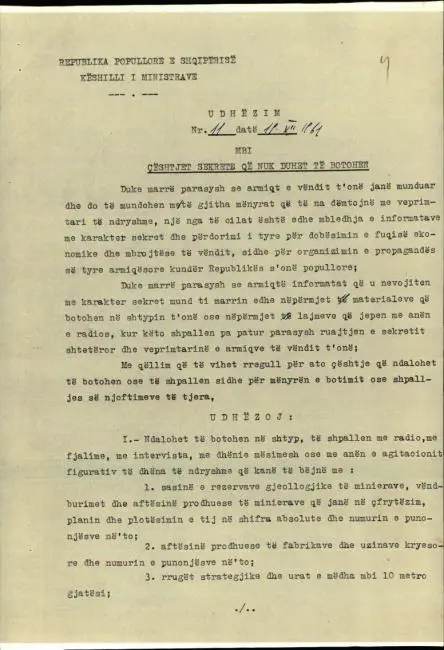
In this sense, the archival network in Albania from the end of World War II until the regime change must be examined through a critical lens. An illustration of this reality is the Instruction of the Council of Ministers, No. 11, dated 14/12/1961, on secret matters that must not be published. The Instruction itself was classified as “top secret” (now declassified).
The reader can see for themselves in the transcript provided here which matters must not be published, and the manner in which allowed topics may be treated. As the institution managing not only post-WWII documentation but also historical archival material collected before that date, the archives of Albania were the primary institutions forced to implement this Instruction.
Furthermore, through this writing, we wish to highlight another issue. Information made public during the socialist period in Albania must always be used with the aforementioned Instruction in mind. Since real figures, according to the Instruction, were not allowed to be published – only percentage comparisons – how reliable are the publications made during the dictatorship?
This applies from 1945, or at least from the effective date of this Instruction, until the end. This does not mean we should question the professionalism of the publishers, as they could not act otherwise. To gather information as close to the truth as possible, primary documentary sources produced by the country’s institutions themselves must be considered.
Meanwhile, as censorship and restrictions are not linked only to dictatorial systems but to any reality where the right to information is denied, let us reflect on those moments of the present when either political officials or institutions act (unconsciously) in accordance with the aforementioned Instruction. Because dictatorship on one hand, and censorship on the other, are not natural phenomena, but realities carried and constructed by the human mind and their objectives.
ARCHIVE DOCUMENT WITH THE INSTRUCTION OF THE COUNCIL OF MINISTERS OF 1961, FOR NOT PUBLISHING IN THE PRESS AND ON THE RADIO CERTAIN DATA THAT SHOULD BE CONSIDERED STATE SECRET
PEOPLE’S REPUBLIC OF ALBANIA
INSTRUCTION
No. 11 dated 19. 7. 1961
ON
SECRET ISSUES THAT SHOULD NOT BE PUBLISHED
Taking into account that the enemies of our country have tried and will try by all means to harm us in various activities, one of which is the collection of secret information and its use to weaken the economic and defensive power of the country, as well as for the organization of their hostile propaganda against our People’s Republic;
Taking into account that the enemies can obtain the secret information they need through materials published in our press, or through news broadcast on the radio, when these are announced without regard for the preservation of state secrets and the activities of our country’s enemies;
With the aim of establishing order regarding those matters prohibited from being published or announced, as well as the manner of publishing or announcing other notices:
I INSTRUCT:
It is prohibited to publish in the press, or to announce on the radio, in speeches, interviews, teaching, or via figurative agitation, various data relating to:
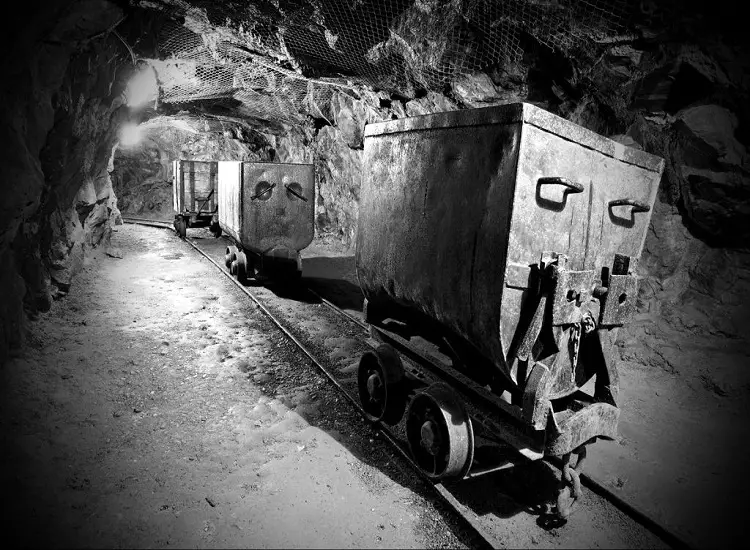
- The quantity of geological reserves in mines, the locations and production capacities of mines currently in operation, the plan and its fulfillment in absolute figures, and the number of employees working therein;
- The production capacity of main factories and plants and the number of employees therein;
- Strategic roads and bridges exceeding 10 meters in length./Memorie.al