
By Eugen SHEHU\*
Part One
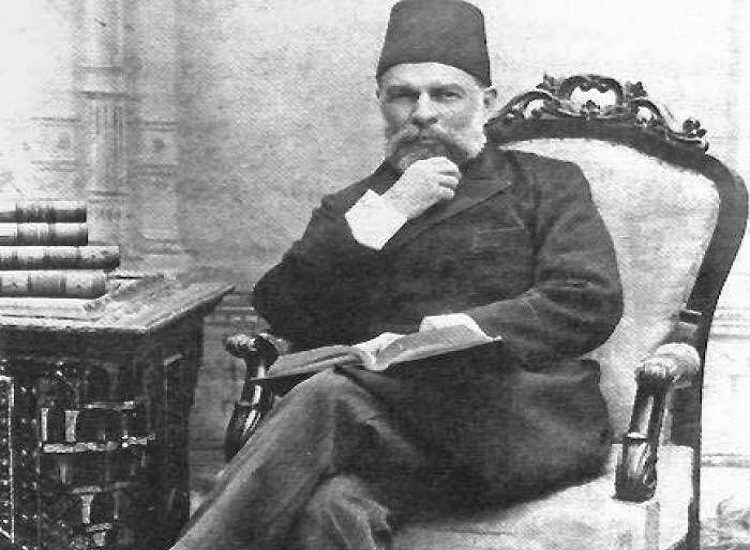
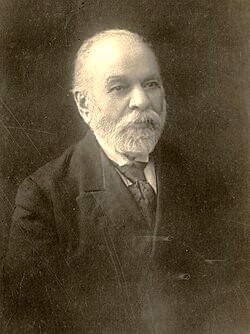
Memorie.al / In the pantheon of glory of our nation, Ismail Qemali undoubtedly holds the place of honor. The years of Albanian history bow with veneration before this man, just as entire generations of Albanians have bowed; these history years of the beginning of the century, in particular, have honored the brave man, for upon their shoulders the free wings of our two-headed eagle have beaten. Ismail Qemal Vlora was born in the city of Vlora, on January 24, 1844. In fact, Ismail’s origin flowed from the village of Kaninë, from that wonderful natural fortress, from that giant rock at whose foot lays the picturesque city of Vlora. In the Turkish registers, thousands of pages mention the bravery of Sinan Pasha, who was killed in Vlora in the distant year 1503, fighting against the crew of some Ragusan ships that wanted to capture the harbor. Sinan Pasha (among the ancestors of Ismail Qemali) was buried with honors in the courtyard of the Kaninë Tekke, since he had left his testament there.
From generation to generation, the love for Albania not only was not extinguished, but came growing and expanding just as the beds of Mountain Rivers grow and expand in April when the snows melt. This historical truth, among other things, is revealed by a simple statement of Ismail Qemali in his memoirs, much later, as he writes: “The truth is that our great-great-grandfather, Sinan Pasha, was one hundred percent Albanian, and for this we are proud.” (Ismail Qemali, Memoirs, Toronto, Canada, page 11).
Ismail’s father, Mahmud Bey Vlora, takes part in the fighting of Albanian outlaws who opposed the Turkish reforms of 1847. It is known that these popular uprisings had a short life, and therefore were quelled with violence by the Sublime Porte. But as if violence were not enough, the killings and taxes even heavier on the backs of Albanians, imprisonments and internments were also needed. Thus Mahmud Bey Vlora was interned in Konya of Asia Minor, while the family was sent to Thessaloniki.
The life of little Ismail suddenly took another course, but this seems not to have hindered the boy from Vlora at all from learning in a Turkish school of the city. He spends his free time especially with his mother Hedije Hanëm, who was the daughter of Tahir Bey Libohova, among the richest and most renowned families of Gjirokastra. However, far from their Vlora, mother and son as well as sister Bellkize would feel lonely. But there were some friends of the Vlora family who helped them.
Since Ismail Qemali was the nephew of Ibrahim Pasha Vlora and this one once had close friendship with the great Napoleon, they intervened at the French consulate of Thessaloniki. Certainly it was the influence of the French near the Sublime Porte that made Ismail with his mother and little sister return again to their birthplace. Naturally, his mother, Hedija, insistently sought that her son, Ismail, one day take the road again and find himself in the city of Ioannina.
There, according to the recommendations of some family friends, he enters to study at the “Zosimea” gymnasium, among the most distinguished of the time.
Among the first acquaintances there is Naim Frashëri, our great poet, and the two Bektashis from time to time, walking along the lake of the city, have certainly remembered the tekkes of Frashër and Kaninë, these hearths where the ember of Albanianism burned without ever being extinguished. After the brilliant completion of “Zosimea,” Ismail Qemali goes to Istanbul and pursues higher studies in the law branch. He is now a handsome young man.
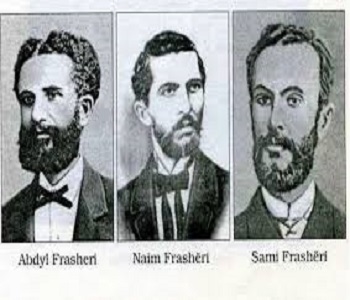
Through Naim he becomes acquainted with Abdyl and Sami, and in the company of the Frashër brothers he feels quite well. Undoubtedly, in contacts with them the first contours of ideas for Albanian independence were outlined, which could begin first with the spread of the light of knowledge. During the time he attended studies at the faculty of law, he went several times to Paris. It is interesting to know that, among other things, there Ismail Qemali became acquainted with the great French writer Victor Hugo. In conversations with him, the Albanian student would receive great knowledge on the plane of illuminist ideas.
After completing higher studies, Ismail Qemal Vlora, since he possessed great knowledge in the field of jurisprudence, as well as the Greek, Turkish, French and Italian languages, was called to work at the Ministry of Foreign Affairs of that time in Istanbul. In a few months of work, he stood out not only for his great work discipline but also for his dedication. He is chosen among many candidates to work as chief secretary of the Ministry of Foreign Affairs, and he was only 23 years old.
In the year 1870, the young man from Vlora, after the good results achieved at the Ministry of Foreign Affairs, is appointed governor in Varna of Bulgaria. Here, Ismail Qemali undertakes extremely liberal reforms, somehow constructing a new hope for the peoples living under the rule of the Sublime Porte. During his stay in Varna, among other things, Ismail Qemali would have the great pleasure of receiving Emperor Franz Josef.
Later in his memoirs, he would write about the impressions this visit left on him. Meanwhile, in his ideas, hopes are outlined for a different future for all peoples who were languishing in the Ottoman night. Among his inclinations, that of journalism now also appears. He worked for some time as a journalist at “Da nube” and later in 1867, as director of the newspaper “The Source of Thoughts.”
Notable in his writings is a clear thought for the autonomy of the vilayets. In fact, after this autonomy, Ismail Qemali foresaw the other part “of the iceberg,” the liberation wars that could flow as a result of this autonomy. Now his ideas and actions have been something more open and this could not pass unnoticed by the spies of the great Empire.
In the year 1900, the high authorities of the Porte appoint Ismail Qemali as Governor General of Tripolitania.
But from very secret sources, it is learned that exile awaits him, so friends notify him and he takes the road of illegality, renouncing without hesitation his diplomatic career. It is thought that the hostility of the Sublime Porte toward him may also have connections with Mid’hat Pasha. “When Mustafa Pasha was appointed prefect in Dobruja of Bulgaria, Ismail Bey had graduated and sought to be appointed an official near him. At that time the Governor of Philippopolis was Mid’hat Pasha, the famous freedom-loving prime minister, who was later killed by Sultan Hamid!
Mustafa Pasha advised him to take Ismail Qemali as advisor, since he knew French well. From this flowed the close friendship with Mid’hat Pasha, which remained until death. This cooperation made Ismail Bey known in intellectual circles and gave him fame. But at the same time it also aroused a shadow of suspicion in the Sultan.” (Safa Vlora, “Personal and family memories about Ismail Qemali,” Rome 1968).
After leaving Istanbul, Ismail Qemali goes to Athens. Naturally here he cannot find the patriotic environments of Istanbul, but his connections with Albanian patriots do not cease in all sorts of ways. In the first years of this century, Ismail Qemali cooperates closely with Abedin Pasha Dino, Shahin Kolonja, Dervish Hima, Hasan Prishtina, etc., striving in the creation of an ideal platform, which could spur those sparks of nationalism to unite and make the great fire of freedom.
This all-national platform, Ismail Bey Qemali could never achieve with two or three of his friends in Athens. Since he understands this, since he foresees the rapid fall of the Ottoman Empire, he now rushes to Europe. Some shops that his father had left him in Vlora enabled a kind of livelihood and what was left over he would use only in the interest and benefit of his own nation. Of these years are a series of activities of Ismail Qemali, who intuitively anticipated the danger of the nation and before it he could not remain silent.
Deep impressions left his sincerity and courage in the circles of Albanian patriots, as they took in hand the written call in which all those who loved Albania were invited to take part in the salvation of the homeland. In Egypt, Ismail Qemali meets Mehmet Ali Pasha, another Albanian in the high Turkish hierarchy, who gave him hope to help in the independence of the country. In Naples and Sicily, he was received quite well by the Arbëresh and conveyed to them the image of unity around a single national idea, that of the independence of the Albanian lands.
Arbëresh and Italian personalities of culture honored Ismail Qemali, supporting and backing in every case his thoughts on the autonomy of Albania. It is worth saying that when he went again to Rome in 1907, he was called to a special meeting by the Turkish minister in the Italian capital. The latter did not delay in giving him the Sultan’s message, to “not deal with politics.” But the soul of the young man from Vlora had been ignited by the ember of Albanianism and he could never be extinguished.
Geneva, Paris, London and Brussels would be the cities where the voice of Ismail Qemali would be heard powerfully in defense of the trampled interests of Albanians. This voice would remind the Young Turks, but also civilized Europe, that besides rare and precious virtues, Albanians kept in their soul, untouched, also the great feeling of freedom. Thus, he was honored and respected by the progressive circles of these countries, while in the eyes of Albanians his portrait was elevated from day to day.
In his writings, Ferid Vokopola, a former participant in the raising of the flag in Vlora, writes: “For the first time I had the fortune to meet him in Corfu, where we were on the road with my uncle, the late Hasan Kodra, and we had set out by sea to go to Ioannina. My uncle knew him very well…! It was an April day of 1908, when they introduced me to him. After a worshipful bow I kissed his hands and he ordered us to sit near.
When the conversation turned to the actions of the bands of the late Riza Vloçishti, Çerçiz Topulli and others, I saw tears come from his eyes, eyes shining like those of the mountain eagle, and he said: Freedom is taken and not given… its taking is not done through mercy, but unfortunately through blood. This the wretched Albanians have shed during centuries without sparing it at all, but until today they have gained nothing. We have fought and sacrificed for foreigners… Now the time is bringing it.” (Ferid Vokopola, magazine “Njeriu,” page 3, Tirana, February 1944).
It was the autumn of 1908, when some friends of Ismail Qemali in the city of Vlora learned that their son would arrive at the harbor on an Italian ship. The news spread everywhere within a few days and hundreds of Vlora citizens went every morning to the city harbor to ask. Now the name of Ismail Bey Qemali was conveyed with extraordinary respect, since his activity (at least 8 years) in Europe was known, when he raised his voice so that Albania would not be dismembered.
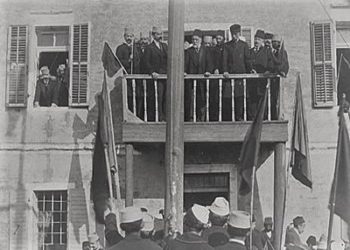
At noon on September 18, 1908, toward the city harbor appeared the vessel like a small white bird that brings good omens in its wings. Dozens of young men threw themselves into the sea and cut off the path of the vessel. They took the white-haired old man on their shoulders and brought him to shore while hundreds of others there loudly called the name of Ismail Qemali.
In honor of their son, that evening, Vlora seemed as if it were at a festival. The patriotic club “Labëria” on this occasion laid out a dinner, proposing to their son the high title of Honorary President. With tears in his eyes, moved by this almost family-like reception, Ismail Bey Qemali expressed himself: “No one can stop my life from serving for your sufferings and troubles.”
After a visit to the old house in Kaninë, he goes to the courtyard of the tekke where his ancestors rested. There the old man whispers some words that only he and his ancestors could understand. From Kaninë, this giant natural rock, he takes the road through the villages of the Vlora river. Many friendly friends await their son, recounting to him undoubtedly also the great troubles of that black life of oppression and misery.
Ismail Qemali’s visit coincides with the elections that would be held for deputy in the Turkish parliament, on which occasion the wise old man, with the message of many friends, decides his candidacy in the Sanjak of Berat. A month later, by election, Ismail Qemali managed to win, even though the Turkish propaganda for him had been extremely banal. Since they feared the democratic spirit and clever diplomacy of Ismail Qemali, the Young Turks and their tools also used bribes to bring down the wise old man.
But the Albanians, before giving their trust, had already forgiven their soul to this great man, this liberating giant. That great work, that priceless war in the service of the Albanian nation that driving force with which Ismail Qemali aimed to expand the sleepy Ottoman government, are undoubtedly the most precious chapters of his life. I underline this idea because, on the tribune of the Ottoman parliament of 1908, his voice was not only a cry against the fate of Albania, but also an awareness of what would happen in the troubled Balkans.
The Balkan ethnicities had begun to awaken and strengthen, foreseeing also blind attacks against each other. Therefore also the other deputies from the Balkan regions in the Ottoman parliament never cut off the old man’s word; on the contrary, they appreciated his sincerity and cleverness. Together with Nexhip Draga and Hasan Prishtina (also these deputies in the Ottoman parliament), Ismail Qemali did not spare his energies to seek the rights of Albanians.
These rights, he always saw connected with Balkan and European developments, since he had foreseen that on his own blessed land, the interests not only of neighbors but also of other great forces clashed ceaselessly. Naturally he sought the decentralization of the Ottoman Empire, but was too prudent in the “autonomy of other regions,” since within this political movement, the fate of his Albania was ceaselessly threatened.
According to the data of archival documents of Turkey, in the year 1909, Ismail Qemali was called by the Sultan and was proposed the task of Minister of the Interior of the Empire. We Albanians must not forget that, among other things, foreigners have always seen us as models of high character and deep honesty. This was perhaps the first impetus of the Sultan on this proposal and then naturally it could also remove him from his patriotic activity. But this function, the wise old man did not accept and this certainly also brought the anger of the Grand Vizier.
When also in the parliament a heavy situation was created, Ismail Qemali, also taking the opinion of his friends, in 1909, leaves the parliament definitively. From its tribune, Ismail Qemali had struck hard not only the dictatorship established by the Young Turks, but also the great social diseases that were rotting the great Empire.
Now he leaves Istanbul definitively, convinced that for the fate of his nation one should not think there, but elsewhere. As for the Young Turks, after these that a great mass of Albanians of that time went, in his memoirs, the old man of Vlora would write: “The Young Turks who call the Albanians simply a Muslim people, who had no political ideas of their own except the desire not to pay taxes…! With this hope, within less than two years, they launched against Albania four repressive military expeditions.
But the Albanians who during past centuries had withstood the power of so many empires, and had not fallen asleep even in the time of Abdyl Hamid, were not terrified by this effort. On the contrary, the attacking policy of the Young Turks was the spark that made our national feelings revive again and flourish with a new brilliance. The victories that the armies of Xhavid and Shefqet had here and there against the Albanians did nothing else but give flame to the covered ember of the uprising.” (Ismail Qemali, “Memoirs,” Toronto-Canada, page 248).
Meanwhile, as the old man of Vlora undertook travels throughout Europe, while his voice was heard powerfully in the deaf ear of Western chancelleries, in the eastern regions of Albania, violence had no end. The troops of Turgut Pasha had poured toward Kosovo and the killings, burnings and robberies were leading Albanians daily more and more into the great tragedy of their non-existence. Memorie.al
Continues in the next issue