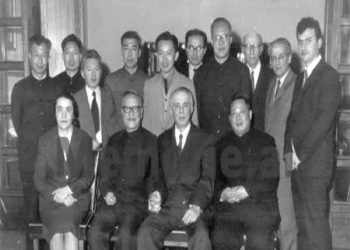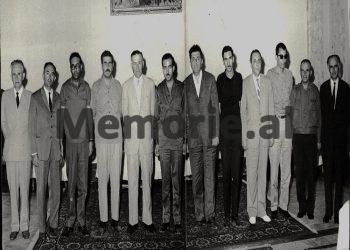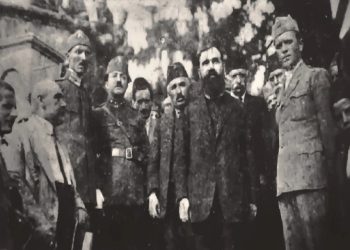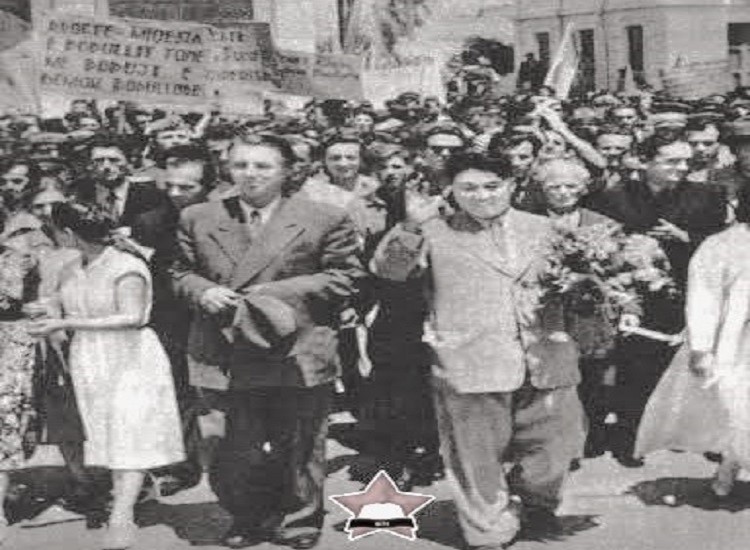
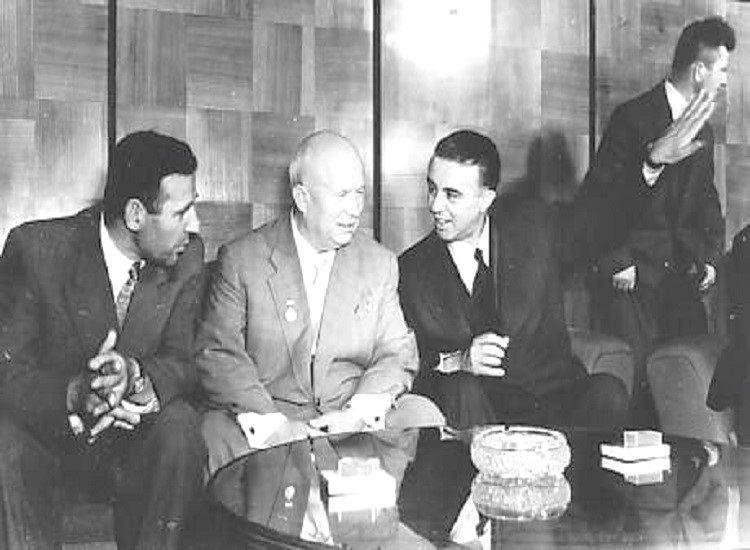

Memorie.al / After 1961, Communist Albania under Enver Hoxha, the People’s Republic of China led by Mao Zedong, and North Korea under Kim Il Sung openly aligned against the policies of Nikita Khrushchev’s Soviet Union. A document extracted from the Central State Archive (collection of the former Central Committee of the Party of Labor of Albania – PPSH), published here for the first time, reveals the impressions of an Albanian government delegation led by Todo Manço and Sul Baholli (deputies of the People’s Assembly and members of the Central Committee of the PPSH) during a visit to North Korea in 1964. It recounts how Moscow used neighboring countries against Albania, while North Korean officials spared no attacks against Nikita Khrushchev. For more on this and other details, see the document published below in this article.
September 1964
Informational Report on the Visit of the Albanian Delegation to North Korea Led by Todo Manço and Sul Baholli, August 17 – September 5, 1964
On August 10, our delegation departed for North Korea and arrived there on August 17. During our stopovers in Budapest, Moscow, and Beijing, we were welcomed by chargés d’affaires and embassy officials. All the embassy officials we met expressed their joy at our visit and their love for the Albanian people and leader Enver Hoxha, as well as appreciation for our struggle against imperialism and revisionism. The comrades of the Korean embassies in Budapest and Moscow organized a dinner in our honor.
The comrades of the Korean embassies in the countries where we stopped – and in particular the Korean Ambassador in Moscow and the Ambassador in Beijing – inquired about the health of Comrade Hoxha and other members of the leadership. We spoke at length with all the officials about the activities of the revisionists, and especially about Khrushchev’s group. In general, they expressed the view that the struggle against the revisionists must be strengthened further. During the dinner organized for us by the comrades of the embassy in Moscow, we discussed the economic difficulties and the shortage of food goods in Moscow and in the Soviet Union in general.
The Korean Embassy in Beijing paid for our plane tickets from Beijing to Pyongyang, even though we were supposed to have paid for them ourselves. On August 17, 1964, we arrived in Korea and stayed there until September 5. Throughout our stay, the Korean comrades looked after our comfort and were always ready to accompany us wherever we wished to go or suggested we visit. During the visit, we were accompanied by a foreign affairs instructor from the Central Committee, who spoke Albanian and also served as our interpreter. At several of the sites we visited, we were accompanied by leaders of the Korean party. They told us from time to time that they had received special instructions from the leadership to take great care of us, telling us: “With you, Albanian comrades, we have no secrets, as we might have with others.”
Details of the Visit
During our 18-day stay in Korea, across the 10 regions and cities we visited, we toured 10 industrial enterprises, 3 agricultural cooperatives, 2 large reservoirs with an irrigation capacity of 50,000 hectares, 2 irrigation pumping stations, 7 various cultural-historical centers, and an agricultural school. We also spoke with the chief engineer of the Sukcheon regional agricultural committee. In all the regions and cities we visited, we were hosted for dinner by the party chairmen (or their deputies, when they were out of town) of the respective regions or provinces.
At the production enterprises, we were accompanied by party leaders and welcomed by the heads of the production centers. Throughout all our visits, the officials expressed warm respect and love for our people and leader Enver Hoxha. They repeatedly stated that they were happy and proud to have such a strong and resolute friend as Albania and its party. During our talks, they expressed admiration for our struggle and the difficult conditions under which our people and party are fighting against imperialism, revisionism, and especially Khrushchev’s group.
On the day of our arrival in Pyongyang, we were greeted at the airport by the Director of the Central Committee Apparatus and the Deputy Director of Propaganda. On the day of our departure, we were seen off at the train station by the Director of Foreign Affairs and two members of the Central Committee for Foreign Affairs.
Meeting with Pak Kum Chol
On September 3, 1964, we were received by Comrade Pak Kum Chol, together with the Deputy Director of Foreign Affairs, Kim Hyo Sun. After inquiring about the health of leader Enver Hoxha, Comrade Pak Kum Chol said: “We well understand the struggle of the Albanian party and people against imperialism and revisionism. The international situation is very complex, and therefore at this stage the health of the senior members of the leadership is important. Great care must be taken for the health of the leaders, due to their role in the complex situation that has been created.
I was in your country during the 4th Congress of the Albanian party and left with the finest impressions of your party’s efforts for liberation and the building of socialism. I saw with my own eyes the unity that exists between the people and leader Enver Hoxha, as well as the attempts of revisionists like Barák or Andropov to sow division and plot against your leadership. They sent the head of the Mongolian delegation to invite me to attend a meeting at the Czechoslovak Embassy regarding the issue of the delegate from Greece, though their real intention was for me to join their protest.
I immediately opposed it and told him that they should not be doing such things at a time when we had come to celebrate your party’s congress. The Greek delegate sent a letter to our delegation and to the Vietnamese delegation, but we forwarded it to the Directorate of Foreign Affairs and never replied to it. During the congress, you fought very well against the revisionists and against Soviet and Czechoslovak activities. The struggle against revisionism is difficult, but the Communist Party of China, you, and other Marxist parties have fought resolutely and unmasked Khrushchev’s group.
I met with Comrade Hoxha and we spoke about the divisive activities of Ambassador Ivanov in Korea. When I was in Albania, I wanted to meet Ambassador Ivanov in person to give him a piece of my mind, but I never saw his face anywhere.” He then went on to speak about the building of socialism in Korea: “The Korean party is building socialism by relying on its own internal forces, and this aligns with the Marxist-Leninist line and proletarian internationalism, in contrast to the closed national economy preached by Khrushchev. He has always opposed our party’s course, claiming it is not in our interest.
He has also opposed the development of heavy industry, such as metallurgy and the production of heavy machinery like tractors and motor vehicles. He wants our country to be merely a base for supplying raw materials to the Soviet Union and a market for their industrial products. Yet thanks to our party’s correct course and policies, we have achieved successes in these fields and moved forward. Initially, the establishment of the international economic council in 1949 had good intentions, but when Khrushchev came to power, it changed and became an instrument of the USSR to usurp the economies of allied socialist countries.
Such was also the attempt to create intergovernmental economic zones, like that of the Danube. On the one hand, Khrushchev talks about the economic necessity of defeating capitalism, while on the other hand, he hinders the economic development of other socialist countries. He wants to lead the economic race all by himself, yet there are also contradictions between theory and practice. The policy of building the economy based on internal forces is also necessary for us because our country has been divided into two parts by American and Japanese imperialism.
The struggle we are waging serves not only the interests of our homeland, but also the interests of the international socialist camp, just as the struggle of the Vietnamese people serves all of socialism. All countries fighting against imperialism serve the socialist cause. Regarding the issue of Vietnam, the Soviet government has demanded that it be brought before the United Nations. This is unjust and harmful. China, Korea, and Vietnam form a common front against imperialism, and in the event of aggression, we will fight with all our might.
American imperialism is weak and cannot fight a war in this region, as its strength was put to the test and failed in Korea. The lesson the Vietnamese recently taught the imperialists is a good thing for us, yet considering the possibility that they may launch a war, we are taking all measures by strengthening our defense. We will increase the investments planned in the 7-Year Plan and we will strengthen our defense and military. In the struggle against revisionism, China, Korea, Vietnam, Indonesia, and other sound parties of Asia have achieved significant successes.
Your struggle, with Comrade Hoxha at the helm, is even more difficult due to your geographical encirclement by imperialism and revisionism, and this makes us admire you even more. We are certain that we will defeat the revisionists forever and preserve the purity of Marxism-Leninism. Regarding Khrushchev’s hasty call for a meeting of socialist parties, we have responded with a letter. Khrushchev is trying to tighten the noose around his own neck.
There is opposition to the meeting even from the revisionists themselves, such as the Italian Communist Party and others, who stand with us. I have fond memories of meeting Comrade Enver Hoxha, Mehmet Shehu, Hysni Kapo, Spiro Koleka, Rita Marko, and others. I had a long conversation with Comrade Hysni Kapo at the airport when we were departing.” At the end of the conversation, he expressed his pleasure at the visit and thanked us for the information about our country. In response to our remark that we had learned a great deal from what we had seen in Korea, he said: “You learn from us, and we learn from you.” This meeting lasted an hour and a half.
Certain Matters Regarding the Party and Civil and Military Organization in Korea
In the enterprises we visited, about 30% of the workforce was party members. For example, in the textile factory employing around 10,000 people, there were 2,600 party members, 45 party officials, 9 Trade Union representatives, 3 from the youth organizations, and 1 from the women’s organization. In the silk textile factory, 5,100 people worked, of whom about 1,500 were party members, 16 party officials, 6 Trade Union representatives, 5 from the youth organization, and 1 in the women’s organization.
In the metallurgical combine employing around 17,000 people, there were about 6,000 party members, 70 party officials, 8 Trade Union representatives, 7 from the youth organizations, and 1 from the women’s organization. In the agricultural cooperatives, about 20–25 percent of the workers were party members. Each cooperative had one party official, whereas mass organizations did not have dedicated full-time officials. In the grassroots party organizations of enterprises and cooperatives, there were 3 deputy chairmen in charge of organizational work, agitation and propaganda, and voluntary or military work.
In the regional party committees, one deputy chairman was responsible for military affairs (military readiness and training of civilians outside active military service). All civilians in villages and enterprises are organized into military units. Usually, agricultural cooperatives form infantry units according to their capacities, whereas economic enterprises form more specialized units.
In cases where a city has additional workers beyond the specialized weapons units, they form infantry units. Civilian military units are commanded directly by the party committees. The commanders of these units coordinate plans with military commanders whenever there are large-scale exercises or transfers from civilian areas.
The Party System in Cooperatives
In agricultural cooperatives, the chairman of the People’s Council is also the chairman of the cooperative, as this facilitates coordinating the cooperative’s economic activity with other matters, such as health, education, and so forth. In December 1961, an agricultural management committee was established in Sukchon at the proposal of the Comrade Premier. Upon the completion of collectivization, the executive committee could not adequately manage agriculture in areas such as technology, organization, etc.
The Sukchon region had been one of the most backward, and leader Kim Il Sung had visited it several times personally. The agricultural section had been unable to manage irrigation, machinery issues, etc., so the special committee began operating in early 1962. By 1963, production efficiency in this region had increased roughly 4.5-fold compared to 1945, which was a major achievement. Each peasant family received approximately 4 tons of rice per year. The agricultural committee had the finest specialists in grain, animal breeding, fruit and vegetable production, etc.
Each year, the cooperatives allocated a special budget for families who had lost members in the war, as well as for families of veteran revolutionaries or the disabled. Children in the cooperative kindergartens were clothed and fed free of charge. From kindergarten until the end of their schooling, the state had a special assistance program for children, providing, for example, one or two sets of clothes per year, one or two pairs of shoes, and a coat. Kindergarten staff received a daily wage from the cooperative, while school staff was paid by the state. In the cooperatives, the production quota was 4 quintals of rice per day.
Surpluses belonging to cooperative members were sold to the state and were not permitted to be sold on the free market. According to a party decision in early 1964, the construction of agricultural cooperatives is carried out free of charge by the state along with ancillary facilities, such as warehouses, kindergartens, cultural institutions, and workers’ housing. For example, 60 houses were built in the Lipsik cooperative and 42 houses in Lamangchili. Special cooperative workers maintain the houses free of charge. National roads connecting the cooperatives are maintained by them, and trees are also planted along their sides.
The cooperatives do not have dedicated land for producing animal feed, but after the rice harvest, they sow the land with secondary grains which they reap early, while still green. They also use rice or corn straw to supplement animal feed. Between fruit trees, they plant pumpkins and also utilize every available piece of land for planting, such as riverbanks, orchard terraces, etc.; even cleaned corn cobs are used in animal feed, primarily for pigs. It is considered the duty of all family members to go out into the fields or terraces during their free time to plant or work. In autumn, peasants are allotted a small plot of rice land to plant alfalfa, where their livestock can graze in the spring before rice planting begins.
Rice Production
Rice is planted in water, following the experience of the Lipsik cooperative. Immediately after the rice harvest, work begins to prepare the fields for spring. From January to March, organic fertilizer is spread on the fields. In spring, the land is plowed twice. Before planting, the land is irrigated with abundant water; then it is worked into double rows and planted with rice stalks. In rich soils, a single stalk is used, whereas in poorer soils, three stalks are planted. The rows of stalks are 18 cm apart, and the plants are spaced 10 cm from one another. / Memorie.al