

Part Six
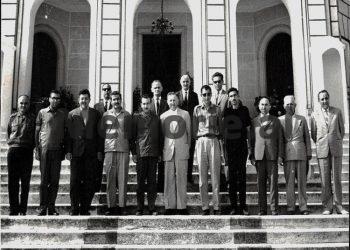
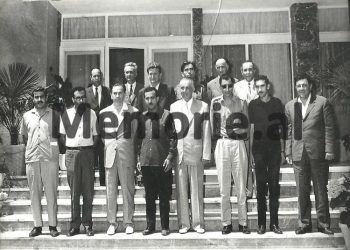
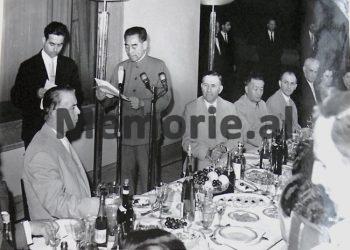
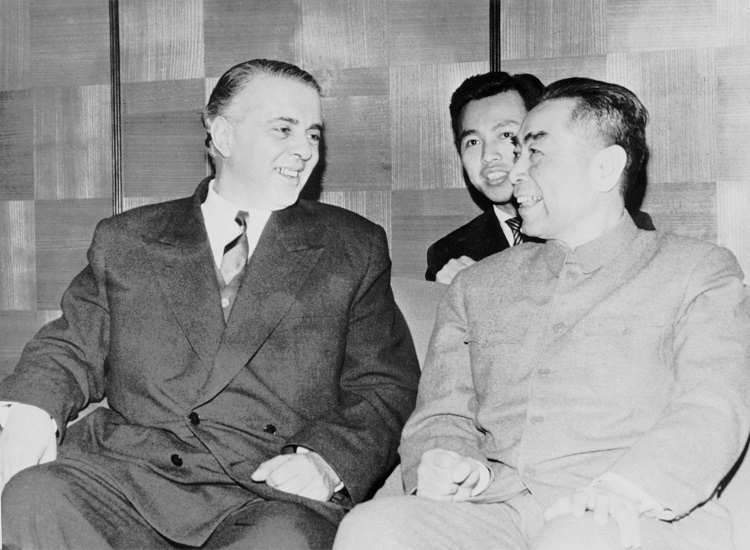
Memorie.al / In March 1965, a high-level Chinese delegation headed by Prime Minister Zhou Enlai arrived for an official visit to Albania. It was his second official visit to the small Balkan communist country and took place from March 27 to March 29, 1965, in Tirana, where he was welcomed by the top leaders of communist Albania, starting with Enver Hoxha, Mehmet Shehu, Beqir Balluku, Haxhi Lleshi, etc., who came out to welcome the Chinese guest right at Rinas Airport, to the sounds of the military band and honor guards. The official meetings were held at the headquarters of the Prime Minister’s Office, where, in addition to Enver Hoxha and Mehmet Shehu, other members of the Politburo and the Albanian government also took part, such as: Beqir Balluku, Hysni Kapo, Spiro Koleka, Adil Çarçani, Gogo Nushi, Haki Toska, Manush Myftiu, Ramiz Alia, Rita Marko, Spiro Koleka, Koço Theodhosi, Abdyl Këllezi, Behar Shtylla, and the Albanian ambassador to China, Nesti Nase, etc.
To be continued from the last issue
But what was discussed in the meetings with the Chinese prime minister, what were the priority requests made by the Albanian government for aid and loans from the People’s Republic of China, and what was Zhou Enlai’s response regarding what was requested of him? Archival documents containing the minutes of the meeting in question inform us about these matters and more, which have been extracted from the Central State Archive (the fund of the former Central Committee of the PLA), and which we are publishing with some abridgments.
March 1965
Minutes of the talk between Comrade Zhou Enlai and the leaders of the Albanian party and state, March 27–29, 1965.
Comrade Zhou Enlai and the other leaders of the Chinese Communist Party met with the Albanian leaders at the headquarters of the Prime Minister’s Office.
Albanian Side: Enver Hoxha, Mehmet Shehu, Adil Çarçani, Beqir Balluku, Gogo Nushi, Haki Toska, Hysni Kapo, Manush Myftiu, Ramiz Alia, Rita Marko, Spiro Koleka, Koço Theodhosi, Abdyl Këllezi, Behar Shtylla, and the ambassador to China, Nesti Nase
Chinese Side: Premier Zhou Enlai, Central Committee members Xie Fuzhi, Zhang Hanfu, Zhao Jimin, Zhou Jianguo, and Li Xiannian.
The first meeting began on March 27, 1965, at 16:30. All participants took their seats and Comrade Enver Hoxha asked Comrade Zhou Enlai to open the meeting according to the agenda of such meetings.
COMRADE ENVER HOXHA: Allow me, Chinese comrades, to thank Comrade Zhou Enlai for his wonderful presentation, which not only pleased us, but also increased our confidence and strength. Through his correct Marxist-Leninist analysis, Comrade Zhou Enlai shed light on many issues that concern us regarding the international situation, liberation wars, and the struggles of our Marxist-Leninist parties against imperialism and revisionism.
His presentation proves once again that our two countries are in complete union of thought and action on all issues. Comrade Zhou Enlai clarified very well the causes of the war in Indochina and the imperialist aggression with which the peoples of Asia are confronted. This analysis clarified many things for us, since our two peoples are bound by Marxism-Leninism. Be assured, Comrade Zhou Enlai, that our party will be a friend and ally of China, in good times and bad.
COMRADE ZHOU ENLAI: It is true; our two countries have a common view on the struggle against imperialism and revisionism, on supporting the liberation wars of peoples, and on strategies, tactics, and the general course of action. The meetings between our two sides help in increasing mutual understanding and the coordination of activities. We understand your opinion on the creation of South Vietnam, and the leaders of the southern defense forces have thought about this as well. But we think we must see how the Soviets will react to this test—will they truly support the liberation war of Vietnam, or do they defend it only to sell it out later?
COMRADE ENVER HOXHA: You have judged this issue correctly.
Closing session of the talks, March 29, 1965, 9:00 a.m.
COMRADE ENVER HOXHA: Before we begin, do you think we will come out with a joint statement, a communiqué, or neither?
COMRADE ZHOU ENLAI: It would be better if we came out with a joint statement, since the main issues will be included in our speeches.
COMRADE ENVER HOXHA: Very well then, the comrades of the Ministry of Foreign Affairs will begin work on preparing the statement, if you do not have one ready.
COMRADE ZHOU ENLAI: Yes, we can give you a copy for our foreign ministers, Comrade Behar and Comrade Hanfu, to decide on further. I think today we should also discuss our issues of economic cooperation, between Albania and China. I don’t know if you, Hoxha, and the Albanian comrades agree.
COMRADE ENVER HOXHA: We have no objection.
COMRADE ZHOU ENLAI: We are aware of the economic successes achieved by you, presented by Comrade Hoxha on the 20th anniversary of liberation. We feel happy for your successes since they are also our successes, just as China’s successes are also your successes. Regarding our economic cooperation, I want to clarify something: Before setting off for Albania, I read once again Comrade Shehu’s letter and the reply that we sent back to you.
We have not managed to make a full analysis, and when Comrade Spiro Koleka comes to Beijing, we will study it and take the necessary steps. More than two weeks have passed since the talks between the economic specialists of our two countries, and they have reached some conclusions. They have spoken twice with each other, yet there are still some problems that have not found a solution. I am referring to some issues, some of which they discussed with Comrade Mehmet Shehu and Beqir Balluku during my visit here last year. I apologize to you that I have not had time to look into them in detail since I have been very busy with the issues of the international situation.
COMRADE ENVER HOXHA: We understand that we have important problems on hand and we thank you for what you have done.
COMRADE ZHOU ENLAI: Therefore, I ask Comrades Shehu and Koleka to understand me. But this in any case does not mean that we do not attach importance to it, or that your requests for economic cooperation are of secondary importance. Over the past two days I have met twice with your specialists and we have talked about the problems. In any case, today I want to give some partial opinions of my own, which do not encompass the full scope of our stand.
First, we understand the wishes and demands of the Albanian people and party for accelerating the building of socialism in Albania. Comrade Hoxha was right in his view that Albania is an isolated socialist outpost far from the East and also the extreme southwestern point of the socialist camp, surrounded by enemies. Judging from this fact, you are justified in your desire to accelerate the building of socialism and the strengthening of the army.
We understand that Albania seeks to achieve the development of its economy by its own efforts, and China cannot remain indifferent to this. Currently you do not have the proper strength to fulfill your needs. Albania has some capabilities, but they are not sufficient, therefore we must certainly help, especially at a time when other socialist countries are refusing, or cannot give the aid that the Republic of China can give. With this aid Albania can become more powerful and play a larger role on the international arena.
We agree completely with what Comrade Hoxha mentioned. The base of the Albanian economy, just like ours, is agriculture, while industry is an auxiliary and reinforcing tool. Even we, when we began developing industry in China around 1959, had many shortcomings and made mistakes. One of them, for example, was generalizing our experiences. I want to tell you about the mistakes we encountered in our work, including those in the aid we gave to other countries. The comrades of the Committee for Economic Relations with Foreign Countries can tell you more in detail, but as far as I know, the main mistakes have been in four areas:
First, over the past six years, from the mid-[1950s] to 1963, we have not managed to gather accurate economic data for your country, for the surface and subsurface terrain. Studies have been conducted without relying sufficiently on the particular economic and political data of your country. One shortcoming, for example, is the small amount of arable land in Albania, which does not correspond to projects that require large agricultural output and consequently broad cultivable lands.
For this reason, the volume of work required for building the projects and the time for their completion have increased. Comrade Mehmet Shehu and Spiro Koleka have also mentioned these problems in their discussions. Another issue is that if something unexpected happens, such as the outbreak of a war, new facilities must be built in safe places, so that we are ready to confront the enemy. First, projects should not be built on good land and should take up as little cultivable land as possible.
In case of need, population displacement should be as small as possible, that is, we should not have massive displacement of the population. This means that projects should be built at the foot of mountains, and in any case not in a concentrated manner, but far from one another. Another factor is that projects should complement the population of the construction areas, and residents should be in favor of building the new facility. This is an aid that comes indirectly.
Our aim is that factories, mines, plants, and economic enterprises help the local population—for example, during agricultural campaigns, factories should help the local population with means of transport, or when the rural population is free, help with work in the factories. Recently we have worked according to this concept and the results have been good. We have organized national meetings on the issue of cotton production, since an airport was built in an area, taking up about one-third of the land of the local agricultural brigade.
The airport was truly necessary, but we managed to reduce the amount of land occupied by it by 20 hectares and also drafted directives so that the airport would come to the aid of the local community. We have more than 100 airports, but they take up a minimal amount of good land, with the aim of increasing agricultural production. We have more than 15 years with new construction projects, yet only in the last four years have we drafted the new land-saving directives. All of you have been to China and have seen that many of our plants and factories take up important land.
These projects were built in our first five-year plan and most of the design was done by the Soviets. By this I mean that such mistakes happen, but in the case of China or the Soviet Union, they are less significant, since these countries have a large territory. Whereas for Albania, besides the issue of space, you must keep in mind the possibility of a sudden war. Your important facilities must be built in secret locations, invisible to the naked eye, and if possible at the foot of mountains. This is in the interest of your people and is favored from a military standpoint.
Land in Albania is limited and cultivable land even more so. We have drawn up 29 projects for you, but they have not been adapted to the specific conditions of Albania. We, too, initially learned from the Soviet experience and are grateful for this. But after we carried out the “Great Leap Forward,” we launched a revolution in the field of construction, which was no longer copying from others. But in reality, even after 1959, we have not given the matter of construction due attention, and in some respects old practices can be seen that are used even today, in a form of generalizing the Soviet experience, even in cases where it is seen that the design does not suit China’s conditions.
This continues to happen in the construction of Chinese projects, despite all the guidelines we have drawn up for eliminating mistakes and paying attention to detail. Certainly such practices would not be useful to you either, since Albania has specialized conditions and an economy. Your mechanical industry has little capacity for coordinating activities among enterprises since, it must be emphasized, and your utilization of resources must be improved.
Lack of studies
But how can we solve in the future the problem of the lack of studying conditions? It must be emphasized that the revolution in the field of design is still in progress in our country, as Albanian Ambassador Nesti Nase may have informed you. We are continuously organizing broad conferences of our specialists to improve construction projects. For the construction of your industrial facilities, the matter of design must be taken into consideration. Chinese specialists must come here and see for themselves the terrain and conditions of Albania, in order to learn and help one another.
Another industrial reform in China is that of oil processing, where we have made great strides in the oil fields in northeastern China. The Romanian comrades know a lot about our oil there, where this year we expect to extract 10 million tons of crude oil. I believe your ambassador in China has followed in parliament that I have repeated that we must learn from the working spirit of the Daqing plant. But in any case technical difficulties remain, since our industrial equipment is relatively old, at a time when countries like Albania request to be equipped with advanced technical facilities.
It must be emphasized that over these last ten years, that is, after Khrushchev came to power, the USSR has not continued its previous assistance to China, such as in the field of design and in technical assistance, and this has had its effect. We have tried to raise our technical level by drawing from whatever experience, including that of Western countries. This means that when we build our sufficient technical base, we will create and advance our technology. As has happened in fact in our oil extraction industry, where we have had almost no aid and equipment from other countries.
But in the end we learned to extract and refine our oil. The Romanian comrades have also appreciated our advancement in this field. We admit that we have achieved some things, but we still have much to do, such as in the fields of chemicals or the production of synthetic fibers, where the Romanians are more advanced. I am mentioning these to you to show that the Chinese facilities built here with our aid are of a poor technical level, and not as advanced as they should be, therefore labor costs and the required workforce will be greater.
My visit to Africa last year left a strong impression on me. It is known that technology there is not advanced, yet there are some high-technology plants, such as refineries with a capacity of 1 million tons of oil per year in Ghana and Morocco, or the gas liquefaction plant and the automobile assembly plant in Algeria. They have an economic basis, because they save a lot of labor and are simple to operate. Certainly their construction has required foreign capital, but that is another matter. Such constructions would be favorable for your country.
According to our calculations, the planned facilities are expected to occupy an area of 660,000 square meters. Is it possible, then, to save more space? Certainly it is possible, but this requires an even more detailed study since we do not know well the terrain conditions where the facilities will be built. A more detailed study would save us land, workforce, construction volume, investments, etc. For the construction land, equipment, materials, and the entire activity, expenses are estimated at about 11,800 million lek, according to a general calculation that we have made.
COMRADE ENVER HOXHA: We have calculated the budget at 9,900 million lek.
COMRADE ZHOU ENLAI: Very well, this can be studied. I mentioned only a calculation of 37 facilities and the Planning Commission can work more accurately. From the information we have, it seems that by the end of 1964, a work volume of 2.5 billion lek has been achieved. This means that not even a quarter of the work has been done. At least one group of facilities must be built. I have divided them into four groups, but whether this is correct or not remains to be seen.
COMRADE ENVER HOXHA: According to our calculations, only 43 percent of the work will remain for the fourth five-year plan, that is, less than half.
COMRADE ZHOU ENLAI: Naturally, I mentioned those that were completed by the end of last year. Another issue is the supply of materials and equipment so that you can begin putting the facilities into operation. According to the idea we have about the construction and utilization of the facilities, a transport volume of about 100,000 tons per year will be required. Whereas after their completion, you will need a workforce of about 15,000 people. After the facilities are completed you will need to supply them with power, and during the drought season you cannot supply them. Certainly the construction of the thermal power plant in Fier, with a capacity of 74,000 kV, will help with this.
If this thermal power plant is completed quickly, you will have considerable power, even though most of it is calculated for the nitrogenous fertilizer factory. Another issue is transport, which will exist not only at the time of construction of the facilities, but also during their operation, since transport of raw materials and other materials will be necessary, such as imported ones and those coming from different areas of the country. The total needs of these 37 facilities require a volume of 66 million tons per year. Railways in Albania are insufficient; therefore this will bring a heavy burden on the infrastructure. / Memorie.al
To be continued in the next issue