
Part Two
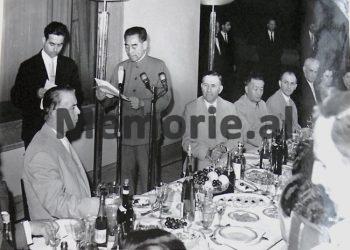
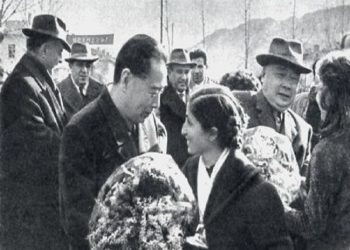
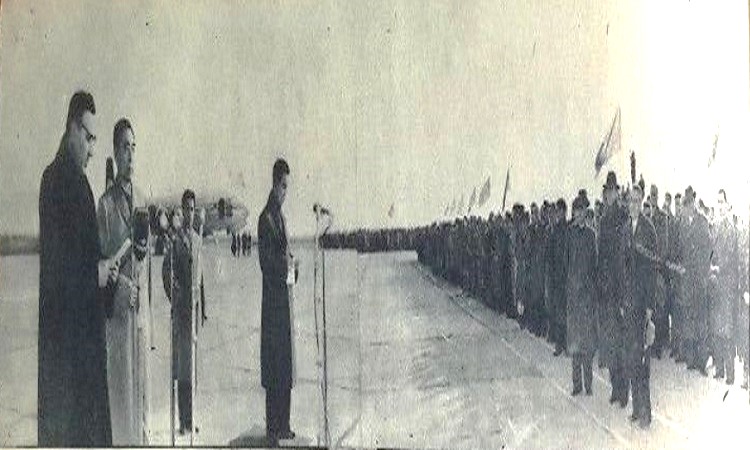
Memorie.al / In March 1965, a high-level Chinese delegation led by Premier Çu En Lai arrived for an official visit to Albania. It was his second official visit to the small Balkan communist country and took place from March 27 to March 29, 1965, in Tirana, where he was welcomed by the top leaders of communist Albania, starting with Enver Hoxha, Mehmet Shehu, Beqir Balluku, Haxhi Lleshi, etc., who came out to greet the Chinese guest right at Rinas Airport, to the sounds of the military band and honor guards. The official meetings were held at the headquarters of the Prime Minister’s Office, where, in addition to Enver Hoxha and Mehmet Shehu, other members of the Politburo and the Albanian government also participated, such as: Beqir Balluku, Hysni Kapo, Spiro Koleka, Adil Çarçani, Gogo Nushi, Haki Toska, Manush Mysfiu, Ramiz Alia, Rita Marko, Spiro Koleka, Koço Theodhosi, Abdyl Këllezi, Behar Shtylla, and the Albanian ambassador to China, Nesti Nase, etc.
But what was discussed in the meetings with the Chinese premier, what were the priority requests made by the Albanian government for aid and loans from the People’s Republic of China, and what was Çu En Lai’s response regarding what was requested of him? Concerning these matters and more, we are informed by the archival documents containing the minutes of the meeting in question, which have been extracted from the Central State Archive (the fund of the former Central Committee of the PPSh), which we are publishing with some abridgments.
Continued from the previous issue
March 1965
ÇU EN LAI: Naturally, I mentioned those that have been completed by the end of last year. Another issue is the supply of materials and equipment so that you can begin putting the facilities into operation. According to the idea we have regarding the construction and exploitation of the facilities, a transport volume of around 100,000 tons per year will be required. Meanwhile, after their construction is completed, you will need a workforce of around 15,000 people. After the completion of the facilities, you will need to supply them with power, and during the drought season, you cannot supply them.
Certainly, the construction of the thermal power plant in Fier with a capacity of 74,000 kV will help with this. If this thermal power plant is completed quickly, you will have considerable power, even though most of it is calculated for the nitrogenous fertilizer factory. Another issue is transport, which will exist not only during the construction of the facilities, but also during their operation, since transport of raw materials and other materials will be necessary, both imported ones and those coming from different areas of the country.
The total needs of these 37 facilities require a volume of 66 million tons per year. The railways in Albania are insufficient, so this will bring a heavy burden on the infrastructure. Regarding planning for the future, I think that for the fourth five-year plan, we must determine how many facilities will be built and whether or not these facilities are favorable for the building of socialism in Albania. Comrade Mehmet Shehu’s letter states clearly that you will try not to overburden the plan too much. It mentions the construction of 13 new facilities and the expansion of 15 existing units and facilities.
For eight facilities, studies will begin later since their construction will start in the fifth five-year plan. Meanwhile, from our side of the agreement, there are also problems that require analysis. There is no doubt that we will help you with the 37 facilities we have agreed to build, but expenses will exceed the budget and we will have to increase the loans. Specialists have told us that the facilities have not yet finished construction and the materials have not yet been sent.
From our calculations, it appears that construction, design, and the use of the facilities together with trade aid all reach the amount of 2 billion yuan. Compared to the aid we give to other countries in Asia and Africa, this amount is the second highest. Vietnam is in first place and Albania comes second. The assistance we give you is greater than that which we give to North Korea. Taking into account the work on the other facilities we are building, I think we should talk about the shortcomings I mentioned above, so that we plan every project rationally.
Last year when I came to Albania, I had the impression that the main focus of reconstruction would be agriculture and industry as an aid to it. Certainly, building along such a course is not simple. From what I have seen in your plan, the objective of securing bread in the country is moving at a slow pace, even though you have it as a primary objective of the plan. Wouldn’t it be better to produce bread on the lands you have planned for tobacco?
MEHMET SHEHU: We can plant grain on the tobacco lands, but the efficiency would be low. They would produce only four quintals of wheat or corn, since they are poor lands, whereas if we plant tobacco we get more and it is profitable for us.
ENVER HOXHA: We have encountered the problem regarding tobacco lands earlier with the experiments we have carried out; these poor lands do not produce much grain. We have carried out classifications of all our lands.
ÇU EN LAI: With the tobacco you plant, it seems you seek to meet export needs as well, and the types of tobacco you plant correspond to those of foreign demand. China, for example, does not use the tobacco you plant, so when we sell your tobacco on the market, we have to compensate the price ourselves. I was wondering whether you could plant more varied tobacco seeds on the tobacco lands.
ENVER HOXHA: Yes, we will try it; we can plant Chinese seeds.
ÇU EN LAI: My aim is for you to try all ways to secure your bread; it seems to me that this is a task that comes before all others. But of course you must keep in mind that there are also other food items you must produce, such as beans, meat, etc., so that if you cut off relations with the outside world you can rely on internal capacities. Just as an order of priorities is created in agriculture, one must also be created in industry, determining the facilities to be postponed for later.
Your main materials are oil, chrome, ferronickel, fertilizers, and the energy sector. Should you perhaps build thermal power plants and hydroelectric power plants first? This must be studied. We must certainly discover which approach is most advantageous, especially for the larger facilities. Our experience will be valuable for Albania. Cooperation among new enterprises is also important, but Albania has already created its mechanical base and can soon establish cooperation among industrial centers.
Therefore, the construction of facilities must be carried out in interconnection with one another. In China, we have large enterprises that combine their activity with other large enterprises. We also have medium and small enterprises that combine their activity with large enterprises. This is necessary to ensure supply with the material base. Another issue is the creation of cadres with specialists who must perfect the new technology of the facilities. Along with technical work, political work for the education of people must also continue.
We must also economize resources, which is a primary feature for building socialism both in China and in Albania. This issue must always be raised with the masses, and for Albania it takes on an even greater importance because of the weak economy. Regarding your five-year plan, I wanted to say that China is facing difficulties and cannot fulfill all your demands. We see that you ask to build many facilities, but we cannot fulfill all demands, whether in trade matters or loans.
There is no doubt that we will continue to assist in your economy, but you ask to make many investments, so we must hold concrete talks on our capacities and your demands. We can pledge only for what we can carry out, and for this we cannot give you a concrete answer at the moment. It is clear that many of the 37 facilities requested by you require imported materials. We will certainly provide them for you, but we must determine which ones you will get through exchanges and which ones through loans. As a result of imports, we also face the issue of their transport.
I also have a question: when do you think Comrade Spiro Koleka will come to China? So far, your group of specialists has held two rounds of talks with our specialists, but they are not prepared for all issues, so we ask for changes. We ask whether you can send a group of comrades to China who can make decisions on the problems and, if possible, stay there for a longer time, since it is difficult for us to come here with delegations of this rank. The countries receiving economic aid from our country are more than 30, so if we reduce the burden of some issues, it would work better.
Under these conditions, the head of our commission for external economic relations, Fang Ji, cannot leave China at the moment to hold discussions in other countries. We are preparing for the second conference of Asian and African countries, and among other things we will emphasize the need to increase economic cooperation with them, and we will put them into struggle against imperialism and modern revisionism. Regarding Albania’s fourth five-year plan, I think we will need more time to realize it.
As for the way of solving the problems, we ask Comrade Hoxha, Shehu, Koleka, and the other Albanian comrades to give us their opinion on the matter. I want to say once more that our viewpoints may not be the most advantageous for you, but mistakes can be corrected and those things that do not satisfy you we will discuss again, as Comrade Balluku knows well. That is all I had to say.
ENVER HOXHA: Let’s take a break.
ÇU EN LAI: I agree.
(After a short break, the talks of the final session were held, where the floor was taken mainly by Enver Hoxha. He thanked Comrade Çu En Lai for the broad and open discussion, but emphasized Albania’s need for Chinese investments in the construction of industrial facilities and military equipment, due to the danger from its imperialist and revisionist neighbors. The two sides agreed to further discussion of cooperation at the level of high-level Albanian delegations in China.) / Memorie.al
Continued in the next issue