
By Luan Shtëpani
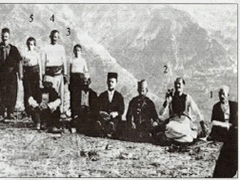
Memorie.al / The activity of this family are documented as far back as the State of Arbër. They appear very active also at the time of the Albanian League of Prizren. Participants in the great uprising against the Turkish occupier. Xhaferr Shtëpani, with initiative and financial contribution, helped also by family friends the patriots Murat and Abdi Toptani, made it possible for the first Albanian school in the district of Tirana to be opened in his home in Shëngjergj, which had its beginnings before the declaration of independence, and which became legal in 1913. While in 1917 he would be imprisoned and interned by Esat Pashë Toptani, in Italy. The loyalty of the Shtëpani family to the Government of Vlora, the support for Noli and the resistance against Zog.
The execution by firing squad of Xhelal Shtëpani in 1937 as a participant in the anti-Zogist uprising of Delvina. During the Anti-Fascist National Liberation War their home turned into a fortress of freedom and of the general staff. The declarations of the English mission about this family. After the liberation, together with the group of deputies, in 1947 Ali Shtëpani was imprisoned, who had been elected member of the General National Liberation Council at the Congress of Përmet. The trial against him, the bluff with the accusations, the conviction and the innocence. Here is what the great writer Dritëro Agolli writes about this family: “To speak of the Shtëpanis of Shëngjergj means to speak of an important part of Albanian history and resistance. The Shtëpani family through the stormy decades of the centuries left many memories and glorious pages through the generations and was distinguished for many beautiful human Albanian qualities.”
But the main quality that shines like a brilliant among brilliants is patriotism. This quality has been an innate attribute of the Shtëpani family and strengthened through generations. The Shtëpanis have not had their strength and vitality in the power of the next [ruler], but in justice and freedom, in the will of their hearts filled with love and gratitude for the birthplace. The activity of the Shtëpanis is documented as far back as the State of Arbër, where Andrea Shtëpani has an important position and contribution in that period. The Shtëpanis appear very active also at the time of the Albanian League of Prizren. Xhaferr Shtëpani, a descendant of this family, is described in war against the Turks in Shëngjergj.
His patriotism that of the family and of the population of Shëngjergj, had made an impression also in diplomatic circles. In one of the letters of 1902, which the Austro-Hungarian consul sent from Tirana to the Ministry of Foreign Affairs in Vienna about the uprising of the people of Shëngjergj, he writes: “Very honored Count. Due to the indecisive stance of the government, the situation in Shëngjergj and in the highlands, of which I had the honor to inform on July 20, in document no. 14, has since the 19th of this month worsened greatly. Kurt Begu did not implement the order to return the Matjans, but the highlanders are determined to remove them with their own forces. Until now, blood has not been spilled, but on the other hand, the insurgent forces continue to receive help from neighboring regions.”
The Shtëpanis of Shëngjergj realized their long-standing desire to write and read the Albanian language. Xhaferr Shtëpani, with initiative and financial contribution, helped also by family friends, the patriots Murat and Abdi Toptani (with books) made it possible for the first Albanian school in the district of Tirana to be opened in his home in Shëngjergj, which had its beginnings before the declaration of independence, and which became legal in 1913. In 1917 Xhaferr Shtëpani would be imprisoned and interned by Esat Pashë Toptani in Italy, where he also died. The government emerging from the Congress of Lushnja in 1920 with Prime Minister Sulejman Delvina, would appoint Islam Shtëpani commander of the gendarmerie of Shëngjergj and commander of the battalion of volunteers of the region of 24 villages, which realized the covenant of the people of the region of Shëngjergj, in support of the government of Lushnja.
The volunteer forces of the region led by Islam Shtëpani, together with the government forces fought against the Serbian forces in Bizë defeating them. Likewise these volunteer forces joined the forces led by Bajram Curri.
The Shtëpanis of Shëngjergj supported Noli, opposed Zog’s monarchy, culminating with the execution by firing squad of Lieutenant Xhelal Shtëpani in 1937. During the Anti-Fascist National Liberation War, the Shtëpani home turned into a fortress of freedom and of the leading staff of the national liberation army. From this family came seven partisans. Ali Shtëpani was elected member of the General National Liberation Council, Ramiz Ali Shtëpani was appointed commander of the Shëngjergj detachment, Reshit Ali Shtëpani, Ibrahim Islam Shtëpani, Petrit Ramazan Shtëpani, Eshref Ali Shtëpani and Isen Islam Shtëpani were partisans of the Shëngjergj detachment. At that time the British distinguished the Shtëpani family among the most important families of Central Albania.
The member of the English mission in Albania, David Smiley, writes: “… There are three families, musketeers of freedom that form a great triangle of the Albanian anti-fascist and freedom-loving spirit: And these are the Peza family, the Xhani family from Luzi i Madh of Kavaja, but who rightly took the surname Martaneshi, and the Shtëpani family from Shëngjergj…”. While “Dritëro Agolli about the Shtëpanis in the book ‘The Shtëpanis of Shëngjergj through the centuries’, while dwelling on ‘The home, the region, Albania’, has written: ‘… These three crowns constitute what we call patriotism or rather Albanianism, which is the greatest and holiest crown, which the Shtëpanis have kept through centuries undusted, have brought it as such at the end of the twentieth century and are carrying it also into the twenty-first century’.”
The contribution of this family together with others in Shëngjergj of Tirana has its beginnings in 1902, in the great uprising against the Turkish occupier. As a result of the great work done by the patriots, organized in the progressive clubs of the time, in the direction of encouraging and instigating hatred for the occupier and love for freedom, independence, language, culture and customs, the people of Shëngjergj become a fiery supporter throwing themselves with weapons in hand against the occupier and the traitors of the country.
According to documents taken from Vienna, the highlanders under the leadership of Xhafer Shtëpani and Islam Shtëpani, sought not to give on account of Turkey soldiers and taxes, opposed Ottoman rule, sought freedom and autonomy. Not by chance Vienna through its ambassador in Istanbul, several times had drawn the attention of the Sublime Porte to the dangerous consequences that the continuation of the arbitrary actions of Kurt Çela in the highlands of Tirana could bring. Thus after several days of stay in Shëngjergj, the Turkish army left with rifles lowered according to custom as a defeated force. Xhafer’s activity would be present also in other archival materials classified as “strictly confidential.”
Thus on p. 245 political matter no. 37 the vice-consul Krahus writes to Mr. Johan Marquis Palavicini – Istanbul, that, “as has been made known telegraphically, it is said that Xhelal Duka from Nivica (Sanjak of Gjirokastra), Vehib Aliko from Zhulat (Gjirokastra), Mahmut bey Pavrani from Frashër, Sulejman Tepelena (who is now an official in Preveza) and Mihal Grameno from Korça, all members of the committee ‘Besa-besë’, Elbasan were assigned by lot, each one with 120 men to go to the insurgent highlanders, the gathering of these chieftains of the detachments together with their men will take place after a notification that is still awaited in Shëngjergj of Tirana at Xhafer Aga Shtëpani’s.”
In this case the mentioned chieftains of the detachments would begin their activity themselves in central and southern Albania…!
The proposal for this action has apparently come indirectly here through an Albanian insurgent committee, perhaps from the “Black Society.” Among other things the vice-consul says that; the deputy from here Ismail Qemal Bey Vlora, it seems has not been insignificant for this unexpected turn. The same text I report once to Vienna with no. 4 and to Janina with no. 38. Strictly confidential – Signature Vlora.
The beginnings of the first Albanian school in the district of Tirana at the Shtëpanis in Shëngjergj
The echo of the Congress of Elbasan in 1909, the work of the patriots of the progressive clubs, created favorable conditions for the fulfillment of the centuries-old desire of the people of Shëngjergj to learn reading and writing in the Albanian language. According to the accounts given by the patriot Ali Shtëpani about whom we will speak below, around the years 1910 a student of the normal school of Elbasan was sheltered in the home of Xhafer and Islam Shtëpani in Shëngjergj, where upon arriving he supported Xhafer’s desire to illegally teach the Albanian language to the young and the adults. The books were secured by Murat and Abdi Toptani.
While in 1911 illegally the teaching of the Albanian language in Shëngjergj was continued by the Dibran Ramiz Hatibi, who in his memories says that he did the teaching in Xhafer’s home. In 1913, the teaching of the language began to be done legally. An important contribution has been given by the teacher Elmaz Shtëpani, Cen Bylyku, Ymer Distafa, Shaqir Duka, Mahmut Trimi, Shaqir Trimi, Shefki Keta etc., who radiated knowledge to the people of Shëngjergj, a tradition that was followed also by others who have been in the direction. The grateful Petraq Pepo, in Ramiz Hatibi’s memories published in the book “The Albanian National Endeavor 1878-1911”, writes that;
“Xhafer Shtëpani having the support of the patriots and of the families with whom he had friendship through a friend of his, entered into agreement with me and thus I became a teacher in Shëngjergj with 800 grosh salary and with food that Xhaferi gave me. Likewise he gave me a wooden room which I adapted for teaching. There have been quite a few villagers in Shëngjergj who believed that the Albanian school ruined religion, therefore I began the lesson with the reading of the Quran. After the Quran, with great pleasure we began the teaching of the mother tongue. The books especially the primers were given to us for free by the patriots of Tirana.”
In his memories Cen Bylyku says that a teacher before him in Shëngjergj was Ramiz Hatibi and that as books for learning Albanian he had used Naim Frashëri’s grammar and later other books published in Vienna, which as far as he remembered were printed by Simon Shuteriqi. Where I have been teaching in Shëngjergj I have ascertained that there the students had the desire to learn and there were also many persons and families who fought for the spread of the Albanian language like the Shtëpani family, that of Hoxhe Duka, etc. which I do not remember well.
The Shtëpani family has been a patriotic base and protected the patriots. Signature of the year 1980. Ilinden Spasse in the book “My father, Sterjo” quotes from his father; 20 III/ “Today we held the meeting in one of the rooms of the school for the new school building. There were 20 people, the whole notability of the village of Shëngjergj… Ali Shtëpani and others. After the debates it was decided that the schools are built by selling a piece of common land of the village, each piece amounted to almost 600-700 napoleons.
The conclusion pleased me very much.” Being a known fact that Shëngjergj was a region with open activity against the Turkish occupiers and their tools, the People’s Hero, Bajram Curri with highlanders from Tropoja and Kosovo in continuation of the journey to Vlora in November 1912, stays in Shëngjergj for two days. Under the care of the patriot Xhafer Shtëpani, for the itinerary of his movement and his security, Bajram Curri took with him the besa and the security of the people of the region towards the Government of Vlora.
The people of Shëngjergj respond to the government of Vlora to send volunteers against the Greek occupiers in the south of the country. A battalion of volunteers was formed under the command of Xhaferr Shtëpani, which on the way to Durrës where the center of the prefecture was, together with the battalion of Tirana fell into the ambush of numerous Esadist forces from where, after 3 hours of fighting, they are forced to retreat. Esat Pasha would take revenge and with cunning Xhaferr Shtëpani would be arrested and interned in Constanța of Italy, where even today it is not known where he is buried.
Due to the ever-increasing patriotic activity of the Shtëpani family, the Government of Lushnja in 1920 appoints with the rank of second lieutenant Islam Shtëpani, commander of the gendarmerie post in Shëngjergj of Tirana, signed by Prime Minister Sulejman Delvina. At the request of two of the members of the High Council, Aqif Pashë Elbasani and Abdi bey Toptani, in the guard of the High Council, are called as loyal to the government Osman Shtëpani, Ali Shtëpani, Dervish Pasha (Shtëpani) etc., people of Shëngjergj, who stayed voluntarily. The contribution of the Shtëpanis in the Covenant of the People of the region of Shëngjergj in support of the Government and National Salvation is known. In September 1920, the Yugoslavs in cooperation with Esat Pashë Toptani, are given an armed reception expelling them outside the zone.
The government addressed at the same time the great powers with a note requesting that the Yugoslav government recognize the territorial integrity of Albania. With the expulsion of the Yugoslav army and the Esadists, and the liberation of Vlora the complexity of factors make the government of Sulejman Delvina resign. According to documents during the governance of Sulejman Delvina, in the Port of Durrës a steamship was anchored, under the Turkish flag. In that port, Ramazan Shtëpani held the duty of commander of the Mole. Before him appeared two tourists, who stayed two nights there according to the order of Ibrahim Gjakova, commander of the district of Durrës and Tirana.
Also by his order, Ramazan together with Ali Kelmendi, accompany the tourists to Tirana and then Ramazan to Shëngjergj, where they are handed over to the gendarmerie commander Islam Shtëpani, who escorts them with high security measures to Skopje. After a few days comes the news that they were in Sofia of Bulgaria safe and sound. The news was given in the newspaper, while years later the Speaker of the Parliament of Bulgaria, has written in a magazine where he has quoted that one of them has been Beria himself, former Minister of Internal Affairs of the Soviet Union. The support for Noli, and the resistance against Zog.
The execution by firing squad of Xhelal Shtëpani participant in the anti-Zogist uprising of Delvina
The emergence on the scene of the “Republic of Mirdita”, would unite the forces of Shëngjergj headed with the government ones against it. Shëngjergj supported without reservations the democratic government of Fan S. Noli, denounced the coup d’état by Ahmet Zogu. Likewise it sabotaged his return from Dibra through Shëngjergj, where he was forced to change route thanks to the resistance of the region and of the Shtëpanis in particular. King Zog’s revenge would go very far for the Shtëpanis, who would be removed from their duties; likewise the culmination would reach with the execution by firing squad of Xhelal Shtëpani.
Initially Zog has been a friend of the Shtëpani family, where his mother also stayed for several days in their home. After the Congress of Lushnja everything changed. The disagreements deepened reaching open incompatibility. In the official documents of the Kingdom, which have conveyed the revolt of Delvina in 1937, it results that after Et’hem Toto, Xhelal Shtëpani has been characterized as the most dangerous for the regime in power. The days of the investigation were short, on the body of the imprisoned officer the most severe tortures were tried, and yet he declared “that my goal has been and remains the overthrow of Zog’s regime.
I for myself lived well, but this was not what I needed when hundreds and thousands of others suffered for the daily bread.”
The request for the pardon of his son and the submission of Ali Shtëpani was needed more by Zog. Ali, a rare man in wisdom, had two things entirely special in relations with others: he weighed the other by what he said, and by the things he did. Xhelal had faith that that manly resistance was seen by all the comrades of his ideal was seen also by his father and mother, with all the members of the family and of the clan. On July 12, 1937 in the prison of the castle of Gjirokastra, he was executed by firing squad together with a group of comrades.
Before the firing squad he shouted: “Youth will avenge us.” The ominous news about the execution of Xhelal reached Shëngjergj, the Shtëpanis were asked to limit the mourning and condolences, but it happened otherwise; thousands of people flooded for days on end to the great door. Simple, but with the weight of judgment and high understanding are the words of Ali Shtëpani in response to condolence: “From this killing nothing was gained… in our home the number of people remained as it was, mentioning the birth of another son in those days.
In a letter, Xhelal, after asking forgiveness for having brought troubles to the family and instructing that there be no cooperation with Zog, asks his father, Ali, that since his wife Sheja is young and without children, the Shtëpani family should marry her as their daughter. Ali continuously communicated this testament to Sheja, who continuously said: “I will preserve his orders and testament, but this not. He, what he did he did with reason. I leave from you only if you do not want me.” Here the word was cut, she became from bride to sister. She would contribute a lot to the war, although sick, she became an example of inspiration for all the Shtëpanis.
Freedom would be for the Shtëpanis a call to rise on their feet without distinction of religion, region or idea, in war against the fascist, nazi occupiers and traitors. Precisely in April of the year 1942, Ramadan Çitaku by order of the District Committee of Elbasan, meets in Shëngjergj with Ali Shtëpani, presenting to him the platform of the war. He was put at the service of the movement where, together with other patriots, they turned the mountains of Shëngjergj into invincible fortresses.
In these mountains, with determined people it became possible to sabotage the plans of the occupier to mobilize soldiers, militia and to collect grain, livestock, etc. The first National Liberation Council was formed in December of the year 1942 with Ali Shtëpani, chairman. Five debatikas of Tirana from the ranks of the Shtëpanis, Petriti, Fiqriu, Esherefi, Tefta and Shefikate. The efforts to create the partisan detachment had long since begun, but due to the sabotages that were made the decision for the creation of the detachment was taken on April 17, 1943, where Ramiz Shtëpani was appointed commander and Ali Zina deputy commander.
In the summer of the year 1943 Ali and Muharrem Lorja, participate in the Conference of Fushë-gurra, which would be a good test for those who would be loyal to the movement. The separation with Abaz Kupi takes place in Shëngjergj. The decision for the formation of the II Brigade came out from the General Staff on September 8, 1943, with Commander Beqir Balluku. The inauguration takes place in Shëngjergj on November 28.
In the great house of the Shtëpanis with 18 rooms, the General Staff of the NLA has worked and directed the war against nazi-fascism for hours and days on end.
There Enver Hoxha, Spiro Moisiu, Ramadan Çitaku, Baba Faja, Haxhi Lleshi, Omer Nishani etc., spent sleepless nights, awaited news from the battles of the war, sent orders and instructions. At that time Ali Shtëpani, member of the General National Liberation Council, elected at the Congress of Përmet, led all the people of the family in the war for freedom, defying his age. In the war participated men, women, children and 57 people from this family in the National Liberation Army?
The revenge of the occupiers and of their collaborators, would reach the culmination with the burning of the two-story house of the Shtëpanis. The men of this clan would build a new house, which would be open to all those who above everything have Albania. In this family have entered and exited also those who later would be characterized as enemies of the country. Today their descendants speak with superlatives about this great door. The Shtëpanis have now become with many houses, with many intellectuals of different fields, some with scientific degrees, as officers, doctors, teachers, historians, chemists, engineers, journalists, architects, athletes, artists.
Many males and females with higher education. The Shtëpanis produced also known intellectuals, from Mustafa Shtëpani who had finished higher education in Turkey; Elmaz Shtëpani who had finished the “Normal” school of Elbasan and was appointed teacher in Shëngjergj; Qazim Shtëpani and Xhelal Shtëpani who had finished military schools and came out officers with the rank of lieutenant; Ibrahim Shtëpani who had finished the semi-matura in Elbasan and the gymnasium in Tirana and had performed the duty of the regional head (head of the commune).
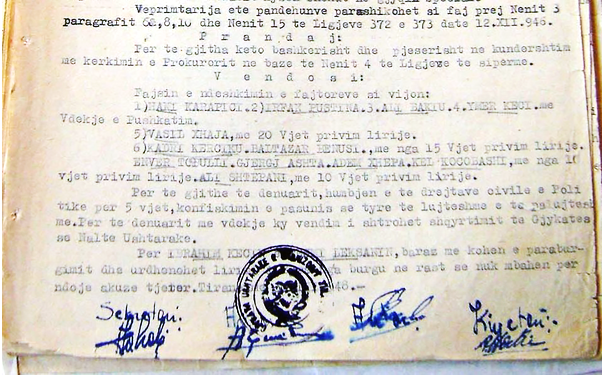
It is more than true that from such hearths are born and raised not only people of the rifle, but also of knowledge, which for this family has been nourished by the predecessors, who have known how to cultivate the love for the language and the country. But, regardless of the major contribution given over the years the beginnings of the liberation of the country would not be accompanied well for the Shtëpanis, who besides enthusiasm would experience a not at all pleasant event. On May 16, 1947, Ali Shtëpani would be arrested suddenly and explosively. The accusation against him would be very heavy.
The Military Prosecutor’s Office of the Garrison of Tirana accused him that; “in the position of vice-Chairman of the District Committee of the traitor deputies for Tirana, he has worked in his district against the people’s power. He has been in contact with the escaped war criminals, to which he has also given financial assistance on the part of the Committee.” This accusation, as would result later, was untrue, and malicious. No evidence, no document that would prove his guilt. He is sentenced to 10 years of imprisonment at a broken age.
After leaving prison as a result of the reduction of the sentence he asked that his case be reviewed once again by the court, or that they imprison him again. Because pardoned outside prison he could not accept it. The case was given to the High Court, which decided that Ali’s request for innocence was completely right. Regardless of this, the Shtëpanis would never bow their heads, would work with honesty and dedication. They remained always honored and respected both in work and society, without requesting in any case privileges or concessions for the contribution given. Never did they stop the contribution for their region, regardless of the fact that they concentrated in the capital. The first with name of this family organized and founded together with others the association “Gavril Dara i Riu” of Shëngjergj. The contribution continues./ Memorie.al