





By DASHNOR KALOÇI
Part Nine
Memorie.al / Even though he was the main leader of communist Albania for 40 consecutive years, governing his country with an iron fist from 1945 until he died on April 11, ’85, but also after his death, and until the collapse of the communist regime in early 1991, a complete official biography of Enver Hoxha was never published, although he himself left written a series of works of around 80 volumes. Even after the 1990s and to this day, a biography of the former communist dictator Enver Hoxha has not yet been published, one that would be based on archival documents shedding light on the early origins of the family, with its genealogical tree, as well as a life story of him, from the day he was born until he died…! This apparently also due to the fact that throughout his life, there were many light and shadows, indeed many dark stains, which made him himself never give approval for the publication of a biography of him in a separate book, even though such biographies have actually existed. Indeed three such biographies and with different authors, which are found even today in Enver Hoxha’s personal fund, at the Central State Archive in Tirana.
The first official biography of Enver Hoxha became public in 1946, within the framework of the “popularization” of his figure, as “the main leader and first secretary of the Communist Party of Albania, commander-in-chief of the National Liberation Army with the rank of colonel-general, chairman of the presidency of the Democratic Front of Albania, prime minister of the Albanian government, minister of People’s Defense and minister of Foreign Affairs”. As can be seen in the respective facsimiles attached to this article, this biography, which is a small booklet of 58 pages, published at the “Rinia” Printing House (former “Gutenberg” printing house) on the first page (after the dark maroon cover and the photo of Enver Hoxha in the military uniform of a general with medals on his chest), has written in capital letters: “ENVER HOXHA, A SHORT BIOGRAPHY”. That first official biography of Enver Hoxha was prepared for publication by the employees of the Agit-Prop (Agitation and Propaganda) sector at the apparatus of the Central Committee of the PPSh [Party of Labor of Albania], but in reality its compiler and author was the first captain, Ndreçi Plasari, whose name does not appear in the book in question, but is found written in his own handwriting on the first page of the typed material that was sent for printing.
The book, or more precisely the brochure “ENVER HOXHA, A SHORT BIOGRAPHY”, begins with a description of the city of Gjirokastra where Enver was born on October 16, 1908, and continues with several paragraphs on the history of the Hoxha family (which occupies only the first two pages), while the entire remaining part is dedicated to his role (Enver’s) during the period of the “Anti-Fascist National Liberation War” with some of its main events (the founding of the PKSH [Communist Party of Albania], the Peza Conference, the Labinot Meeting and the creation of the General Staff of the National Liberation Army on July 10, 1943, the Mukja Agreement, the Përmet Congress, etc.), concluding with January 11, 1946, with the event of the proclamation of the Republic. Even today it is not known with precision why that brochure with the first official biography of Enver Hoxha (where a life story of him for the period of Zog’s Monarchy is almost entirely missing), which glorifies his figure and role (or that of the Hoxha family), from the period of childhood up to the time it was published, was immediately withdrawn from circulation (it is said after two or three months) and was never again used even for references, in books, albums, or other works dedicated to his figure.
Because from that time onward, Enver Hoxha began the elimination of his close collaborators (members of the Politburo, ministers, deputies, etc.), by imprisoning, interning or executing them, and the book in question with his biography could no longer circulate with the names of “enemies of the people”. The second biography of Enver Hoxha was written in 1950 (15.VI.1950) and its author is Misto Treska, a close and highly trusted man of Enver Hoxha since the period of the French Lyceum of Korça and the Communist Group of that city where he was a member, who during the War period was political commissar of the partisan Battalion “Reshit Çollaku” and after 1944 was promoted to major, being appointed as prosecutor and member of the judging body in the Special Trial of 1945, which sentenced to death former prime minister Maliq Bushati and the members of the Regency, Lef Nosi and Father Anton Harapi..
Just like the biography written by Ndreçi Plasari in 1946, that of Misto Treska too, which has 238 pages of handwriting and the same title (“Enver Hoxha, a short biography”), glorifies beyond measure the figure and role of Enver Hoxha in all the time periods treated there. Perhaps this has also been the main reason why that biography written by Misto Treska for Enver Hoxha not only was never published, but was not even typewritten, like the 1946 biography of Ndreç Plasari, or the other that was written later. Likewise, it is not known with precision whether this “service” that Misto Treska did for the main leader of Albania, Enver Hoxha (with whom he had acquaintance also from the period of studies in France), influenced his later career, where he served as jurist, translator, book author, diplomat, ambassador of Albania to France, Belgium, etc., as well as chairman of the Committee for Friendly and Cultural Relations with the Outside World, where he also retired in 1981.
The same applies to professor Ndreçi Plasari, historian and researcher who during the communist regime held important academic and political posts, being for a long time also deputy director of the Institute of Marxist-Leninist Studies in Tirana, directed by Nexhmije Hoxha. In those duties, professor Plasari served until 1982, when he was struck by the Party, accused as “a man of Mehmet Shehu, who had been sent by him to the British archives to inflate his (Mehmet’s) cult and had hidden the documents proving that Mehmet Shehu had been an agent of the Intelligence Service”! The third biography of Enver Hoxha was written in 1969 and its author is Aqif Selfo, a close friend of childhood and youth with Enver and his neighbor in the city of Gjirokastra and, later, at the French Lyceum of Korça, where they studied together and Selfo served for some time also as a dormitory supervisor at that lyceum. On the first page of that biography, it is written: “Memories from the life of the Hoxha family, its origin and a life story of comrade Enver Hoxha, for the period 1908-1930 and 1931-1939, 6.1.1969, by Aqif Selfo”.
That biography, or more precisely a life story, as its author himself has titled it (it has 124 pages of handwriting, while 82 pages typewritten), just like those of Ndreçi Plasari and Misto Treska, from beginning to end glorifies the figure and role of Enver Hoxha, indeed with distortions and falsifications of historical events and facts. (For example, on p. 46 of his memoirs, Aqif Selfo among other things writes that: “Enver set off for Belgium, settled in Brussels and began the duty of secretary of the Consulate. He stayed here partly in 1934, all of 1935 and partly in 1936. Alongside the duty of secretary of the Albanian Consulate in Brussels, Enver continued his studies at the faculty of law and gave the exams of the second year”. While in another archival document found also in Enver Hoxha’s personal fund, the Albanian diplomat Nos Qosja who served at our embassy in Paris, among other things writes: “During my visit to Belgium with comrade Harrilla Kola, we went to the University of Brussels (Faculty of Law) and asked and established: Comrade Enver is registered at the Faculty of Law for the academic year 1934-1935. In the archive of that faculty, there exists a card with these data;
HOXHA Enver
Academic year 1934-1935
Date of birth; 3 October 1908 (Gjirokastër)
Register number; 2821
His address; “Legation d’Albania 155 Rue de la Loi, Brussels”.
The card is white; it does not appear that he has given any exam”.
Paris, 22 February 1969 Nos Qosja
From what is stated also in the archival document in question (which is contemporaneous with the period when the biography of Enver by Aqif Selfo was written), it results that Enver Hoxha did not give any exam at the Faculty of Law of Brussels, which refutes what Aqif Selfo writes, that “Enver gave the exams of the second year”! Perhaps this has also been the main reason why those “Memories” were never published as a book, since in the period they were written, many of Enver’s and Selfo’s comrades and peers were still alive (in political prisons or free), whether from the period of their childhood in the city of Gjirokastra, that of the Lyceum of Korça, or also studies in France. But even though those “Memories” never saw the light of publication, in all likelihood they served their author Aqif Selfo as a shield for a quiet life (he worked as a teacher in Tirana at the “Qemal Stafa” gymnasium until he retired), unlike his two cousins, Riza and Syrja Selfo, whom Enver arrested and executed, even though they and the entire Selfo family had helped him with money during the War period, 1939-1944.
On the basis of these three biographies, in 1978, a book was published or more precisely a brochure-type publication titled: “Enver Hoxha, beloved leader of the Albanian people” – (Material for conversations, on the occasion of the 70th anniversary of birth), where on the first page after the cover, it is written: “Prepared by the sector of Marxist-Leninist education, at the C.C. of the PPSh. – In aid of agitators and propagandists”. The book in question was published by the “8-Nëntori” Publishing House at the “Mihal Duri” Printing House in Tirana. The fact that these three biographies of Enver Hoxha are found in his personal fund, indeed even with interventions and corrections by other persons, if they were not made by his order, in all likelihood they were written with Enver’s approval. Nevertheless these remain within the framework of hypotheses where there is room for longer investigation, but in this article we are publishing first the biography of Enver Hoxha, which was written by Aqif Selfo, which is published for the first time and with the respective facsimiles in several issues, by Memorie.al.
Continues from the previous issue
ARCHIVAL DOCUMENT EXTRACTED FROM THE PERSONAL FUND OF ENVER HOXHA FOUND IN THE CENTRAL STATE ARCHIVE, WITH THE MEMOIRS WRITTEN BY AQIF SELFO, ON THE ORIGIN OF THE HOXHA FAMILY AND A LIFE STORY OF ENVER HOXHA
Memories from the life of the Hoxha family, its origin, and the life story of comrade Enver Hoxha for the period 1908–1930 and 1931 – 1939
By Aqif Selfo
6.1.1969
For the inauguration of the reconstruction of the grave of this veteran, on July 26, 1936, a ceremony was organized in which a large majority of the people took part, as well as a large number of young people from Gjirokastra with Enver at their head. In this ceremony, among those who held speeches, was also the twenty-eight-year-old youth, Enver Hoxha. Enver’s speech held, on this occasion, at the inauguration of the reconstruction of Bajo Topulli’s grave on July 26, 1936 – taken from the newspaper “Demokratia” No. 505, Saturday, August 1, 1936 – is: “The day before yesterday, Friday, it was exactly six years since you, O Bajo, departed from the bosom of Albanian society. Nevertheless, it seems to us as if it were yesterday, so alive is your memory in the spotless hearts of the youth who knew you and appreciated you from the lofty and patriotic deeds that you dedicated to this much-suffering land.
The Albanian youth, faithful to your principles, kneels before this modest grave and with admiration wonders how you, veterans, so few, have left so many deeds for the awakening of the national feeling, for the freedom of the entire nation and when? At a time when you were pursued without rest by the Asian hydra that oppressed and squeezed us for 500 consecutive years. The youth that is rising and that tomorrow or the day after will have the fortune to govern the Arbërian land, which you, martyrs of freedom, have stained with blood, will take its example from you and from the small circle of patriots that day by day are diminishing. The material for our work we will find only in your deeds and your life, your deeds will fill our hearts with honor and energy, for you have worked only for the ideal, you have been far from personal interests and ambitions, for you the most sacred thing was the Fatherland.
We who found this free Albania, this Albania that is prepared for us by you, with the blood of the heart, cannot feel proud if we do not bring an improvement to the Albanian Society that you loved so much. You did as much as you could, but we during these 25 years have not done as much as we should, but the youth that is rising pledges to you, upon this grave that is the most sacred shrine of every Albanian, that it will lack neither the will nor the courage when the time comes for us to prepare a happier Albania, a more prosperous Albania. We the young will not have the armchair as our ideal, but the well-being of the Fatherland, the true unity of the nation, a unity that will have its source in true Albanian hearts.
You, O Bajo, and you Çerçiz and you all the martyrs of the Fatherland who lie within and outside Albania, you who fought rigorously the imperialist and colonialist powers of Turkey, you workers of freedom, are for us the symbol of bravery and of self-sacrifice for the good of the Nation and as a sign of fidelity and infinite admiration that we nourish for you, I have the honor to place upon your grave a wreath that the youth dedicates to you, that youth in which you had hung all hope, that youth that to be worthy of you, is ready to sacrifice all the blood of the heart, for the well-being and progress of the Fatherland”.
Enver’s speech, held at Bajo Topulli’s grave, made a great impression on all those who had been present at this ceremony. It was for the first time that such a speech, with such a progressive content, was held in Albania governed by the Anatolian and enslaving methods and principles of Zog’s regime. The speech was an open unmasking against Zog’s regime when, addressing Bajo Topulli, the martyrs and other patriots, he says: “that you have worked only for the ideal, you have been far from personal interests and ambitions, for you the dearest thing was the Fatherland”. These words of the speech were foreign to Zog’s regime. For the ideal of this regime was only enrichment at the expense of the people, the continuous and cruel oppression and impoverishment and the selling of the country to foreigners for the prosperity and well-being of this clique.
The speech was at the same time a call and a work program, when in his speech Enver emphasizes…”but the youth that is rising pledges to you upon this grave that is the most sacred shrine of every Albanian, that it will lack neither the will nor the courage when the time comes for us to prepare a happier Albania, a more prosperous Albania. We the young will not have the armchair as our ideal but the well-being of the Fatherland, the true unity of the nation, a unity that will have its source in true Albanian hearts”. Enver concluded the speech:…”I have the honor to place upon your grave a wreath that the youth dedicates to you, that youth in which you had hung all hopes, that youth that to be worthy of you, is ready to sacrifice all the blood of the heart for the well-being and progress of the Fatherland”.
In this speech Enver showed that he was not only a very progressive young man, but also a talented orator. Those who heard this speech with their own ears wondered both at his courage and at his oratorical tone. One of those who took part in this ceremony was also Ibrahim Lelo, who had come temporarily to Albania from the United States of America. Ibrahim Lelo, after staying for several decades in emigration, has been back permanently in Albania for three-four years.
He, regarding the ceremony held at Bajo Topulli’s grave, says: “After the end of the ceremony, like everyone else, I too left and took the road home. On the way I meet Enver, since we both lived in the same neighborhood, in ‘Hazmurat’. On the way, in the course of conversation and bearing in mind the other speeches held at this ceremony, I said to him; ‘what are these scoundrels’, Enver immediately answered me, verbatim: ‘the time will come, when they will pay'”.
Also in the summer of 1936, Enver, being in Gjirokastra, had the opportunity to become acquainted also with the militant Ali Kelmendi. Ali Kelmendi, like many other participants in the democratic-bourgeois revolution of June 1924, after the return in December 1924 of Zog’s counter-revolutionary forces, was forced to take the road of emigration outside the country. He went to the Soviet Union, where he studied Marxism-Leninism. Here he stayed for several years, until 1930.
Also in 1930, Ali returned to Albania. In Albania Ali worked in very difficult conditions, with all his powers to spread communist ideas. At the beginning of 1932 he went abroad again and returned within that same year to Albania. At this time he did great work in many cities of Albania, especially with the Communist Group of Korça. But his activity caught the eye of the country’s authorities, for this reason he was interned in various cities and finally in Korça, where he stayed for more than two years. Ali, although he was interned, through his contacts that he had with the members of the Group of Korça, gave a great contribution to the raising of the communist consciousness of the group’s members.
Ali Kelmendi, at the end of 1935, after being released, conditionally from internment, went to Tirana, but here he was arrested and expelled from Tirana. He returned again to Korça, from here, by decision of the center of Korça, he went abroad, to Greece and Turkey. The purpose of this journey, to these two states, was to come into contact, in Greece, with the Greek Communist Party and in Turkey, with the Comintern. But both in Greece and in Turkey, Ali could not come into contact either with the Greek Communist Party or with the Comintern, therefore he returned again to Albania.
Ali Kelmendi must have returned to Albania at the end of June, or in the first days of July 1936. The authorities of Korça, according to a letter sent to the Ministry of Internal Affairs, notify that Ali Kelmendi was taken under observation on July 6, 1936 and that he was escorted, accompanied, to Gjirokastra on July 16, 1936. The escorting of Ali Kelmendi to Gjirokastra had been done on the basis of the decision of the Council of Ministers, according to which Ali was interned, for one year, in Gjirokastra as a dangerous propagandist to the detriment of the interests of the state.
Ali Kelmendi must have arrived in Gjirokastra around July 25. Skënder Topulli, regarding Ali’s arrival in Gjirokastra, says: “One morning, when I had just come out of the house, a driver, who was coming from Korça, handed me a letter, which a comrade in Korça had entrusted to him, to give to me. In this letter they notified me of the arrival of Ali Kelmendi as interned in Gjirokastra and asked me to notify his arrival, since we suspected lest they kill him on the road.
Days passed and Ali was not appearing in Gjirokastra. When one morning, around 10 o’clock, a group of students, among whom also comrade Enver, were chatting in the ‘Royal’ cafe, I see a tanned man coming down the stairs of the hotel, head bare and without jacket’ he was ‘Maloku’ (Ali Kelmendi). I had known Ali in Korça, before I went to France, in 1931, when he was interned for the first time in Korça. I get up and take him by the arm, greeted him and we continued down the road that led to Xhemali’s cafe”.
Skënderi after telling the conversation he had with Ali, about the delay of arrival in Gjirokastra, about his health, about the journey to Turkey and other things, continues: “Then Ali asked me about all those comrades who were in the cafe. I answered him that they are all well, partly they are students returned from abroad and partly they are teachers and internal students. Among them, I added to Ali, is also comrade Enver, a jewel of a boy and well prepared with progressive ideas and concepts, he enjoys the sympathy and authority of all those you see there, now that you are among us you will meet them all and so we parted.
In the afternoon I meet again with Ali in the cafe of Serjan, in the square of ‘Çerçiz’, where we used to meet in the evening with the comrades. At this time comrade Enver also comes and some of the other comrades. This was comrade Enver’s first meeting with Ali. There began an interesting conversation, but since many comrades gathered and the policemen and spies were coming around us, we got up and took a walk up to one of the hillsides of the city. There Ali spoke to me about the international situation, about Zog’s hated regime and spoke to us about the youth group of Korça and how one should work with the good element”.
During his short stay in Gjirokastra, Ali Kelmendi had many meetings with the young, with intellectuals and with workers, but all these were done, especially Ali’s meetings with workers, in a very secret manner, so as not to catch the eye. Nevertheless he was followed foot by foot by policemen, gendarmes and detectives. So that the authorities of Gjirokastra were afraid of Ali’s stay in Gjirokastra. For this reason the prefecture of Gjirokastra, in a confidential letter sent to the Ministry of Internal Affairs, with the proposal that Ali Kelmendi be sent as interned to Porto Palermo.
Regarding this matter Skënder Topulli says: “Two months had not passed, when one morning, as we were conversing with comrade Enver in the ‘Royal’ cafe, ‘Maloku’ comes to us as calm as his nature was and tells us that; today they notified me of an order from Tirana, where it is said that Ali Kelmendi, if he wishes to stay in Albania, must turn himself in to the castle prison, or otherwise be expelled from the country – and added that – after all, even in prison it is not bad, for there is plenty of people there and one must work with them’.
I told him that you should not enter prison, since your health does not allow it, but you should go abroad and later come again; also comrade Enver intervenes and says: that’s right Ali, Skënderi speaks well, you should not enter prison, for there your health is not promised, but you should go abroad, stabilize your health and return again. What do you say? Ali cut in, let’s both tell him. So it was decided that Ali should leave the country and return again, after improving his health”.
While the magazine “Agitatori” No. 5 October 1947, in the article “Enver Hoxha – short biography” – writes, regarding Enver’s meeting with Ali Kelmendi: “He had been seen in Gjirokastra, at the time of the vacations, when he had returned from France. They were the last days that Ali would live in Albania, for after a long time of internment in the castle of Gjirokastra, he had received an order of expulsion outside Albania, from the governmental organs of Zog. Enver remembers verbatim the last instruction that Ali gave him, when they were parting: Despite Zog’s oppression and terror, we must organize the struggle against the regime'”.
Ali Kelmendi acted thus. After being equipped with the respective documents he went abroad, to France. Ali’s departure from Albania must have been in the first days of September 1936. This is proven by the secret letter of the prefecture of Gjirokastra dated September 10, 1936, addressed to the Ministry of Internal Affairs, as a reply to the secret order dated August 3, 1936. In this letter it is said: “We have the honor to submit to you that Ali Sulejman Kelmendi, via Vlora, left outside the country”.
Regarding Enver’s meeting with Ali Kelmendi in Gjirokastra and Ali’s opinion of Enver, in the book “Ali Kelmendi”, publication of the Institute of Party History at the Central Committee of the PPSh – Tirana in 1960, on page 13, it is said: “Here Ali also had several meetings with comrade Enver Hoxha, in whom he saw a determined and mature Marxist-Leninist. He himself has declared to comrades in emigration that he had remained very pleased with the meetings with comrade Enver Hoxha”.
Ali Kelmendi even being in emigration, alongside the great work he had, did not interrupt relations with comrades. He through letters, within the possibilities he had, gave from time to time valuable information on some matters that greatly interested the communist movement in Albania. Regarding this matter Skënder Topulli says: “Around 1938, Ali Kelmendi sent me a long letter, where he signaled to us the deviation of Zoi Fundo and notified us that soon he was preparing to return to Korça and that we should be careful, that he not be allowed to come into contact with the comrades of the group, this letter I have given to comrade Enver.
A little time passed and we see that Zoi returned to Korça. Since the group of Korça was aware of his deviation, you would see Zoi accompanied by the Trotskyist Dhimitër Fallo and Faslli Frashëri (a reactionary from a family of beys of Korça). From what I remember comrade Enver, on the basis of the letter, did his utmost so that Zoi’s mask would be torn off and he would be known as a deviator”.
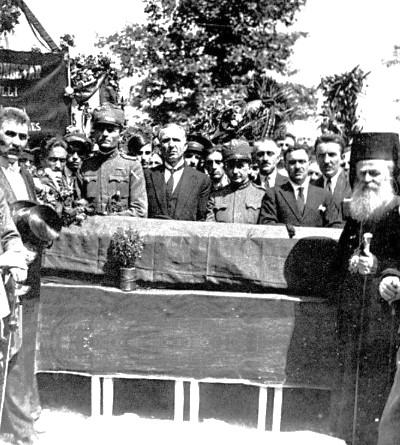
Also in this period the bones of Çerçiz Topulli and Muço Qulli, killed treacherously by the Montenegrins in 1915 in Shkodra, were also exhumed. For the retrieval of Çerçiz’s bones a commission was formed. In this commission took part, besides some of the city’s authorities, also Çerçiz’s brother Jonuz Topulli as well as Enver, who was in Tirana, where he took part in this commission, as representative of the youth of Gjirokastra. On September 14, 1936, the bones of the two martyrs were taken out from the place where they had been buried at the time of their killing, and were placed in coffins. The coffins with the bones of Çerçiz Topulli and Muço Qulli were taken to the Municipality of Shkodra where the occasion’s ceremony was held.
From the balcony of the city’s municipality speeches were held in the name of the municipality and in the name of the delegations that had gone from Gjirokastra and from Leskoviku to receive the bones of the martyrs. The speech in the name of the delegations was held by Enver. The newspaper “Arbënia”, year II No. 366 dated September 17, 1936, in its correspondence – Fighters of the Renaissance, with the title “Shkodra kneels before the bones of the two martyrs” – among other things writes: “It should be noted that when Ernest Koliqi had finished the speech, on the balcony of the Municipality, the young man from Gjirokastra Mr. Enver Hoxha, in the name of the delegations, thanked with emphatic words the authorities, the clergy and the people, for the honors that are being paid to the bones of the martyrs and to those as delegates, taking from Shkodra a memory that will never be forgotten”.
Regarding the impression that Enver’s speech made at this ceremony, Skënder Topulli says: “Finally greeted the coffin with Çerçiz’s bones also Father Andon Arapi, in the name of the people of Shkodra. Before the commission set off from Shkodra, Father Andoni says to Jonuzi about comrade Enver, that; ‘Gjirokastra will have an excellent orator'”, this impression the speech that comrade Enver held on the balcony of the Municipality of Shkodra left on the priest, on the occasion of the retrieval of Çerçiz’s bones from Shkodra.
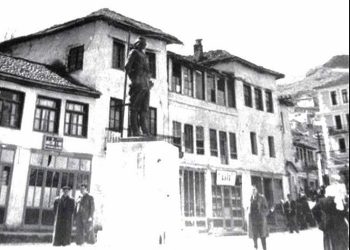
On September 15 the bones of the two martyrs, after passing through Berat, received and accompanied with respect by a large majority of the people and school pupils, arrived in Këlcyra. Here the bones of Muço Qulli set off for Leskovik and those of Çerçiz for Gjirokastra. The arrival of Çerçiz’s bones in Gjirokastra was received with magnificence. His coffin was placed in front of the monument erected in his honor in the square that bears his name and after the occasion’s speeches, the coffin was placed in one of the halls of the Municipality, after a time, the coffin, with Çerçiz’s bones was placed alongside his brother, Bajo Topulli, on the bank of Pllaka./ Memorie.al
Continues next issue