




By DASHNOR KALOÇI
Part One
Memorie.al / Even though he was the main leader of communist Albania for 40 consecutive years, governing his country with an iron hand from 1945 until he died on 11 April ’85, but also after his death and until the collapse of the communist regime at the beginning of 1991, a complete official biography of Enver Hoxha was never published, although he himself left written a series of works of about 80 volumes. Even after the 1990s and to this day, no biography has yet been published about the former communist dictator Enver Hoxha that is based on archival documents that would shed light on the early origin of the family, with its genealogical tree, as well as a biography of him, from the day he was born until he died…! This apparently also due to the fact that throughout his life there were many lights and shadows, indeed many dark spots, which made him never give approval for the publication of a biography of him in a separate book, even though such biographies have actually existed. Indeed three of them and with different authors, which are found even today in Enver Hoxha’s personal fund, in the Central State Archive in Tirana.
The first official biography of Enver Hoxha became public in 1946, within the framework of the “popularization” of his figure, as “the main leader and first secretary of the Communist Party of Albania, commander-in-chief of the National Liberation Army with the rank of general-colonel, chairman of the presidency of the Democratic Front of Albania, prime minister of the Albanian government, minister of People’s Defense and minister of Foreign Affairs.” As can be seen also in the respective facsimiles attached to this article, this biography, which is a small booklet of 58 pages, published at the “Rinia” Printing House (formerly the “Gutenberg” printing house), on the first page (after the dark maroon cover and the photo of Enver Hoxha in the military uniform of a general with medals on his chest), has written in capital letters: “ENVER HOXHA, A SHORT BIOGRAPHY.” That first official biography of Enver Hoxha was prepared for publication by the employees of the Agit-Prop sector (Agitation and Propaganda) at the apparatus of the Central Committee of the PPSh, but in reality its compiler and author was the first captain, Ndreçi Plasari, whose name does not appear in the said book, but is found written in his own handwriting on the first page of the typed material that was sent for printing.
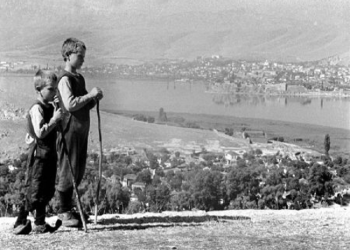
The book, or more precisely the brochure “ENVER HOXHA, A SHORT BIOGRAPHY,” begins with a description of the city of Gjirokastra where Enver was born on 16 October 1908 and continues with several paragraphs on the history of the Hoxha family (something which occupies only the first two pages), while the entire remaining part is devoted to his (Enver’s) role during the period of the “Anti-Fascist National Liberation War” with some of its main events (the founding of the PKSh, the Peza Conference, the Labinot Meeting and the creation of the General Staff of the National Liberation Army on 10 July 1943, the Mukja Agreement, the Përmet Congress, etc.), concluding with 11 January 1946, with the event of the proclamation of the Republic. To this day it is not known precisely why that brochure with the first official biography of Enver Hoxha (where a biography of him for the period of Zog’s Monarchy is almost entirely missing), which glorifies his figure and role (or that of the Hoxha family), from the period of childhood up to the time it was published, was immediately withdrawn from circulation (it is said after two or three months) and was never again used even for references, in books, albums, or other works dedicated to his figure.
Because from that time onward, Enver Hoxha began eliminating his close collaborators (members of the Politburo, ministers, deputies, etc.), by imprisoning, interning or executing them, and the said book with his biography could no longer circulate with the names of “enemies of the people.” The second biography of Enver Hoxha was written in 1950 (15.VI.1950) and its author is Misto Treska, a close and very trusted man of Enver Hoxha since the period of the French Lyceum of Korça and the Communist Group of that city where he was a member, who during the War period was political commissar of the partisan Battalion “Reshit Çollaku” and after 1944 was promoted to major, being appointed as prosecutor and member of the judging body in the Special Trial of 1945, which sentenced to death former prime minister Maliq Bushati and the members of the Regency, Lef Nosi and Father Anton Harapi.
Just like the biography written by Ndreçi Plasari in 1946, that of Misto Treska too, which has 238 pages of handwriting and the same title (“Enver Hoxha, a short biography”), glorifies beyond measure the figure and role of Enver Hoxha in all the time periods treated there. Perhaps this was also the main reason why that biography written by Misto Treska about Enver Hoxha was not only never published, but was not even typed on a typewriter, like the 1946 biography of Ndreç Plasari, or the other one written later. Likewise, it is not known precisely whether this “service” that Misto Treska did for the main leader of Albania, Enver Hoxha (with whom he had acquaintance also from the period of studies in France), influenced his later career, where he served as a jurist, translator, author of books, diplomat, ambassador of Albania to France, Belgium, etc., as well as chairman of the Committee for Friendly and Cultural Relations with the Outside World, where he retired in 1981.
The same is true also for Professor Ndreçi Plasari, a historian and researcher who during the communist regime held important academic and political posts, being for a long time also deputy director of the Institute of Marxist-Leninist Studies in Tirana, directed by Nexhmije Hoxha. In those duties, Professor Plasari served until 1982, when he was struck by the Party, accused as “a man of Mehmet Shehu, who had been sent by him to the British archives to inflate his (Mehmet’s) cult and had hidden the documents that proved that Mehmet Shehu had been an agent of the Intelligence Service”! The third biography of Enver Hoxha was written in 1969 and its author is Aqif Selfo, a close friend of childhood and youth with Enver and his neighbor in the city of Gjirokastra and, later, at the French Lyceum of Korça, where they studied together and Selfo served for some time also as a dormitory supervisor at that lyceum. On the first page of that biography, it is written: “Memories from the life of the Hoxha family, its origin and a biography of comrade Enver Hoxha, for the period 1908-1930 and 1931-1939, 6.1.1969, by Aqif Selfo.”
That biography, or more precisely a biography, as the author himself has titled it (it has 124 pages of handwriting, while 82 pages typed), just like those of Ndreçi Plasari and Misto Treska, from beginning to end, glorifies the figure and role of Enver Hoxha, indeed with distortions and falsifications of historical events and facts. (For example, on p. 46 of his memoirs, Aqif Selfo among other things writes that: “Enver set off for Belgium, settled in Brussels and began the duty of secretary of the Consulate. He stayed here partly in 1934, all of 1935 and partly in 1936. Alongside the duty of secretary of the Albanian Consulate in Brussels, Enver continued his studies at the faculty of law and gave the exams of the second year.” While in another archival document that is found in Enver Hoxha’s personal fund, the Albanian diplomat Nos Qosja who served in our embassy in Paris, among other things writes: “During my visit to Belgium with comrade Harrilla Kola, we went to the University of Brussels (Faculty of Law) and asked and established: Comrade Enver is registered in the Faculty of Law for the academic year 1934-1935. In the archive of that faculty, there exists a card with these data;
HOXHA Enver
Academic year 1934-1935
Date of birth; 3 October 1908 (Gjirokastra)
Register number; 2821
His address; “Legation d’Albania 155 Rue de la Loi, Brussels”.
The card is white, it does not appear that he has given any exam.”
Paris, 22 February 1969 — Nos Qosja
From what is said also in the said archival document (which coincides with the period when Enver’s biography was also written by Aqif Selfo), it results that Enver Hoxha did not give any exam at the Faculty of Law of Brussels, something which refutes what Aqif Selfo writes, that “Enver gave the exams of the second year”! Perhaps this was also the main reason why those “Memories” were never published as a book, since in the period they were written, many of Enver’s and Selfo’s friends and peers were still alive (in political prisons or free), both from the period of their childhood in the city of Gjirokastra, that of the Lyceum of Korça, or and of studies in France. But even though those “Memories” never saw the light of publication, in all likelihood they served their author Aqif Selfo as a shield for a quiet life (he worked as a teacher in Tirana at the “Qemal Stafa” gymnasium until he retired), unlike his two cousins, Riza and Syrja Selfo, whom Enver arrested and shot, even though they and the entire Selfo family had helped him with money during the War period, 1939-1944.
On the basis of these three biographies, in 1978, a book was published, or more precisely a kind of brochure with the title: “Enver Hoxha, beloved leader of the Albanian people” — (Material for conversations, on the occasion of the 70th anniversary of his birth), where on the first page after the cover, it is written: “Prepared by the sector of Marxist-Leninist education, at the C.C. of the PPSh. — In aid of agitators and propagandists.” The said book was published by the “8-Nëntori” Publishing House at the “Mihal Duri” Printing House in Tirana. The fact that these three biographies of Enver Hoxha are found in his personal fund, indeed with interventions and corrections by other persons, if they were not made by his order, in all likelihood they were written with Enver’s approval. Nevertheless these remain within the framework of hypotheses where there is room to investigate longer, but in this article we are publishing first the biography of Enver Hoxha, which was written by Aqif Selfo, which is published for the first time and with the respective facsimiles in several issues, by Memorie.al.
THE ARCHIVAL DOCUMENT EXTRACTED FROM THE PERSONAL FUND OF ENVER HOXHA THAT IS FOUND IN THE CENTRAL STATE ARCHIVE, WITH THE MEMORIES WRITTEN BY AQIF SELFO, ON THE ORIGIN OF THE HOXHA FAMILY AND A BIOGRAPHY OF ENVER HOXHA
Memories from the life of the Hoxha family, its origin, and the biography of comrade Enver Hoxha for the period 1908–1930 and 1931-1939
By Aqif Selfo
6.1.1969
Kol-Gjoni, Ali, Hëzër, Muhamet, Beqir, Isa, Hysen, Beqir, Nexhip, Hysen, Halil, Beqir, Enver, Ilir, Sokol.
The genealogical tree of the Hoxha family, following only the males, is as can be seen in the scheme attached here. In this genealogical scheme, what immediately catches the eye is the repetition of several names of the Hoxha family, such as the name Beqir which is repeated three times and the names Hysen and Halil, which are repeated twice. The Hoxha family in Gjirokastra is known not only as one of the oldest families of the city, but also as one of the most honest and most courteous families. This family in its good years was much honored, even though its economic condition was not in the ranks of many other families of the city, it was honored also when its economic condition had deteriorated excessively. About the distant members of the Hoxha family not many things are known, while about the closer members there is some data. Nexhip Hoxha, Enver’s grandfather, was a kadi and served in various places of the Turkish Empire, while his brother Beqir occupied himself more with the arrangement of the family economy in Gjirokastra. Nexhip had two sons: Hysen and Halil Hoxha, while Beqir had no children. The two brothers, Hysen and Halil, lived together, undivided, until 1916, when their house burned down. In this period they formed a single family with a common economy.
In this family the children of both brothers grew up together and, respecting age, both Hysen’s children and Halil’s called Hysen father, as he was the older brother, and Halil uncle, as he was the younger brother. In this period the Hoxha family was one of the few Gjirokastra families that played an important role in the national awakening, in the efforts to spread education in Gjirokastra and in the villages, in the anti-Turkish stance, in the support of the declaration of independence, in the anti-Greek stance and later in the support of the democratic movement. Also in this period the house of the Hoxha family was one of the important nests of various political and educational activities. In these activities Hysen Hoxha stands out. Hysen Hoxha died around 1935, at the age of 73. He had completed the higher medrese school which was a type of gymnasium. Hysen Hoxha was very devoted, as his close people tell, after historical studies, he read entire books and treatises that dealt with historical issues. From a young age, Hysen Hoxha connected with all those who had at heart the cause of shaking off Turkish slavery and cooperated actively with them.
Early he learned to read and write also the Albanian language, certainly this he must have learned from Koto Hoxhi from Qesarati (a village near Gjirokastra), who was a distinguished propagandist of the spread of national ideas and of the Albanian language. Koto Hoxhi, in the last years of his life — at the end of the 19th century, militated in the region of Gjirokastra. Hysen Hoxha introduced the Albanian language also into his home, teaching the members of the family to read and write it. Most of his grown daughters, as well as his eldest granddaughter and his eldest grandson, had Hysen Hoxha as their first teacher. While these in turn taught the Albanian language to the younger children and in the first place to their sisters and nieces, who not only had no schools to learn in, but even if there had been they could not go in that period. The activity of Hysen Hoxha can be divided into three periods: before the Turkish revolution of 1908; from the triumph of the 1908 revolution and the declaration of national independence in 1912, until the occupation of Gjirokastra by Greece in March 1913 and from the period under Greek occupation. At the beginning of the 20th century, the national movement was much enlivened throughout Albania, as also in Gjirokastra. In the years 1905-1908 it took great momentum.
Armed bands began to be organized and formed and from year to year they grew and expanded their activity, not only in the region of Gjirokastra, but also in other regions and especially in the region of Korça and in all of southwestern Albania and in the southeastern one. The insurgent band led by Çerçiz Topulli, with Mihal Grameno, Hajredin Tremishti and many other brave men, which at its formation around 1907, had shaken the Turkish authorities who pursued it relentlessly, but the insurgents who fought for freedom were protected, helped and sheltered by the people themselves of the regions where they went. Likewise Çerçiz’s band passed from pass to pass without being harmed. Protected in this way it operated in various regions such as in Korça, Leskovik, Përmet, Gjirokastra and in other places. In this period the house of the Hoxhas became one of the nests of great importance for the national movement. There gathered to talk and take the respective decisions many of the leaders and other patriots of the national movement such as Çerçiz Topulli, Duro Gurri, Idriz Gurri, etc.
This is emphasized also in the letter that comrade Enver wrote to the “Asim Zeneli” gymnasium in Gjirokastra, dated 22 September 1962, on the occasion of sending the wall clock as a gift to the gymnasium. In this letter comrade Enver’s mother, Gjulo Hoxha, telling the history of the clock, among other things, says: “This clock has seen the mullan (Hysen Hoxha) talk secretly with Çerçiz, with Duro Gurra and Idriz Gurra.” From this house were sent by Hysen Hoxha the letters and everything that had to do with the proper conduct of the movement in various places and especially in the direction of the insurgents. One of the couriers was also Hysen Hoxha’s cousin, Nexhmo (Nexhmudin) Hoxha. He, being young and agile, went wherever need demanded. The letters sent were well secured to escape anything unexpected. Therefore they were carefully sewn into the courier’s xhaqeta, between the fabric and the lining, usually in the back part, on the back.
Thus the courier after completing his mission returned to Gjirokastra. Regarding this matter one of Hysen Hoxha’s relatives tells that, after many years, while traveling from Gjirokastra to Vlora, Hysen Hoxha showed him, along the way and in its depth, the places that were their main points of meeting and support at the time of the efforts for freedom against the Turkish forces. The activity of Çerçiz’s band grew much in the first months of 1908. Also at this time an important role was played by the committee of patriots of Gjirokastra. Although I have not been able to find who participated in this committee, I think that one of its members must have been also Hysen Hoxha, as an active member of the national cause that he was and for the high office he had in the city: he was mayor.
So the committee of patriots of Gjirokastra informed Çerçiz’s band, which had just returned to the region of Gjirokastra, about the hostile acts of the Turkish authorities and in the first place of the Turkish bimbash (a rank in the Turkish army, major) and of the commander of the gendarmerie in Gjirokastra: The Bimbash had made many arrests in the ranks of the Gjirokastra patriots and had continuously terrorized the population of the city, as well as of the villages of Gjirokastra and Përmet. The band led by Çerçiz put into implementation, immediately, this notification of the committee: two members of the band entered the city and went straight to the neighborhood where the bimbash lived, in the Hozmurat neighborhood they kill the bimbash, join the other comrades who were waiting for them outside the city and leave without suffering any damage. The killing of the bimbash made the Turkish authorities of Gjirokastra multiply the pursuits against the insurgents.
Thus after three weeks from the killing of the bimbash, on 18 March 1908, a part of the band with Çerçiz at the head, with Mihal Grameno, with Hajredin Tremishti and others, is found in Mashkullorë (a village near Gjirokastra) and is treacherously surrounded by large Turkish forces. The band in this unequal battle fought for several hours in a row with unparalleled heroism and managed to break the siege having only one loss: the heroic fall of Hajredin Tremishti, who despite being unable, participated in the fighting. While on the enemy side 20 people remained killed. The victory reaped, in Mashkullorë, of Çerçiz’s small band, over the large Turkish forces, had a great echo throughout the country and especially in the region of Gjirokastra and that of Korça. After this victory the ranks of the insurgent bands were increased with new fighters. Alongside this also the pursuits of the Turkish army continued with more fury. Çerçiz’s band in this period was struck twice: the first time in June 1908 near Gjirokastra and the second time in July 1908, in the region of Korça. Also in this month the movement of the Young Turks had reached its climax.
Sultan Hamid, frightened by the created situation, proclaimed in Istanbul, on 24 July 1908, the constitution, the Hyriet and freedom. The proclamation of the constitution was an event of great importance for all the subjects of the Turkish empire including also the non-Turkish peoples and especially the Albanians. This act was received with joy also in Albania. The Albanians with the proclamation of the constitution thought that this was the first victory that gave opportunity for broader actions for political, social and educational rights. They hoped that these rights finally gained would lead to the achievement of the main goal which was the complete freedom and independence of Albania. Also in Gjirokastra, as everywhere in Albania, the proclamation of the constitution was received with joy and enthusiasm. The first days were always in celebration. Gjirokastra received with grandeur the fighters of freedom with Çerçiz Topulli at the head, which left the mountains and returned near their families to continue the war with other methods. The Gjirokastra patriots, immediately, set to work with great zeal for the creation of the club of Gjirokastra as a political and educational center. After great preparations, the general meeting was held. / Memorie.al
Continued in the next issue