

By Fred Brandt
Part Two
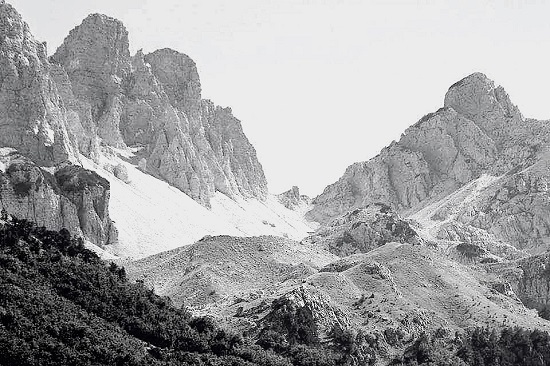
Memorie.al / My boss in Pec (Peja), the commander of the German troops, told me that he had received an order from the superior command in Belgrade that, in the Albanian Alps, west of Gjakova, we were to build a stronghold. One of the main purposes of the stronghold was, among other means of warfare, [to counter] the English officers of the Intelligence Service. The commander entrusted to me the raising and maintaining of this stronghold of the German army in the Albanian Alps, with some soldiers from Tajikistan. From Peja to the mountain range, behind which the stronghold would be raised, was a distance of 75 km, but the stronghold itself would be raised even deeper, beyond a mountain pass at an altitude of 1800 m. The road to the pass passed about 30 km away from Valbona and was heavily forested. We had to pass through that dense forest where, at best, only pack animals had passed.
Continued from the previous issue
After two days we dispersed. Major Neel and Nikë Sokoli turned westward, to meet the joyful Albanians, regarding the decisions taken. I continued northward, toward my people. The terrain was foreign to us and controlled by the fighters. An English major, stationed there, gave us escorts to the north of Bihaç (Bytyç).
We passed through Prizren and Gjakova, to reach Peja, so that I might inform the chief of the garrison of the German troops, on whom I also depended, of the decisions taken at the meeting. He agreed with my contacts and decisions and would make them known to the superior command in Belgrade. He would also discuss with them the reinforcement of the stronghold.
After a week, a colonel from Belgrade came to Peja. I informed him of the situation. He agreed with my thoughts, positions, and proposals. He gave me decision-making authority and 20 Tajik soldiers for the reinforcement of the stronghold in Nikaj. “The English are completely right,” he said. “With six men, no stronghold can be held.” His last word was: “Continue this way!”
At the end of June, a lieutenant from the Intelligence Service named Hibberdine, who spoke German well, came to Major Neel. He also brought a radio transmitter, which was connected directly to Bari. With the English wish and with the approval of my superior command, at the end of July, we joined the English at a joint encampment. Nikë Sokoli settled near us with some of his fighters. They were supplied with food and other means by the English.
Until that time, I had been supplied with food and other means by the Peja garrison, with great difficulty, by pack animals, but now the road was blocked by the partisans. It was impossible. From that moment on, we too were supplied by the English. Major Neel gave me 3 heavy machine guns, 2 grenade launchers, 25 automatic rifles, and a large quantity of ammunition, thus arming us for long battles against the bands and Albanian communist partisans.
Throughout August we stayed at that encampment. Then Major Neel received orders to position himself somewhere near Skutari (Shkodra). I declared my support with my soldiers during the march to the new encampment. “So safe and calm I have never felt in Albania as now, under the security of your soldiers,” he told me. For this, he had to accept my control over his activity and did not dare undertake combat operations against German troops for as long as we were together. Nikë Sokoli with his men also joined our march.
At the beginning of September, we raised our base at an altitude of 1600 m in the steep mountains of Shillak (Shllak), north of Shkodra. A few kilometers below stretched a plateau which served very well as a parachute drop zone. At this time, Major Neel received orders to blow up a fuel depot of the German troops and the bridge over the Drin River. He could carry out this order only with the help of the Albanians. But I had made it known to the English that if they did not abide by the conditions we had agreed upon, our relations would be severed. They could not decide for me. My Tajiks too opposed combat operations against German troops, although Lieutenant Hibberdine tried in every way to persuade them otherwise.
Increasingly, near our encampment, on the mountain plateau where there was also a wonderful water spring – a rare thing – leaders of the nationalist partisans appeared. Almost every day I went there, no longer as a supporter of Nikë Sokoli but as commander of the English base, and as a “Colonel,” a rank the English themselves had given me. I was treated as an equal among equals. I soon became acquainted with the sympathizers of a bajraktar, before whom Nikë Sokoli himself boasted of me as his friend.
On one thing, all Albanians were of one mind: a northern national army had to be created—against the communist partisans of the south. But where would the weapons and other materials for this army come from? For this I decided to discuss with the English. I had long been closely connected with the Albanians and shared my concern with them.
In the evening, during dinner at the table, I opened the topic with Major Neel and expressed my opinion openly: “After the departure of the German troops from Albania, let us create and support a nationalist government.” He was amazed by this idea and promised that he would immediately get in contact with Bari to obtain their approval. After two days, the answer came from Bari: Complete unanimity.
The northern Albanians would be supplied with all necessary materials, including weapons, and we were to make requests for the things needed. The next day, in the valley, I made known to the Albanians the decision taken by us and the English. The joy was great.
When the moment came to discuss the leader who would command the forces, the problem fell on me. I was impartial and agreeable to all parties. For the Muslims I was a believer in Allah, and in truth I was a friend of the English, of their commander, plus a “Colonel” on top of that.
In those days, the Albanians warned me of the danger: the SD (the security service for military leaders of the Abwehr) had placed a very large bounty on my head, dead or alive. This did not surprise me at all. Every day I heard on the radio of the pursuit and arrest of officers of the German Abwehr. If I was only a minor leader who for some months had been cooperating with the English, what proof did I have in hand that all I was doing was by order of my superior command?
I had nothing. And now that my chief had left Peja, I could not even imagine that the commander of the Abwehr in Belgrade might wish to remember me. For a week, the Albanians were seized by a great joy. From all regions of the country came various representatives, who showed their readiness to unite and fight with us. Combat units were also created. Nikë Sokoli, with his troops, positioned himself near Shkodra. Now there were 2,000 troops on our side. All were waiting for the supply of materials from England.
But nothing came except a radiogram from Bari, which said that Major Neel, together with me and the Albanian leaders should go to Alessio (Lezha), from where we would be transported by English warships to Bari for important talks. We were guaranteed physical safety. We were during the journey when another radiogram came: we had to change the course of movement, not via Lezha but via Montenegro, in the Berana area, where there was an English field airfield. From there we would fly to Italy.
All the Albanians hesitated to pass through Montenegro, through the Serbs, their old enemies unto death. So we marched – Major Neel, his Italian interpreter, and I with my three Tajikistanis. After several days of marching, we reached Guci. The airfield in Beran had been surrendered by the English due to the withdrawal of German troops. The situation there was so dangerous that we decided to return to Shkodra. According to the next radiogram, we were notified that all promises given to the northern Albanians were withdrawn. The English government would send neither weapons nor other materials for the Albanian nationalist army.
Everything came to an end. Major Neel received orders to leave Shkodra immediately and position himself on the Adriatic coast. I and my Tajikistanis were permitted to accompany him. If we did this, we would be guaranteed prisoner-of-war status. It was the beginning of October 1944. For the last time I descended to the valley to meet my Albanian friends, in order to inform them of the latest news. It was a difficult step for me and a difficult hour of farewell, the hour in which all our hopes were shattered. A farewell forever. Nothing remained for me but to accept the English offer.
I could not stay alone in this headless country, which would very soon be shaken by fierce fighting between internal forces. After several days we reached the coast, at the mouth of the Drin, in an impassable marsh and lagoon area. From there, two small warships took us. Two Albanian nationalist leaders came with us, in order to try once more to persuade the English for aid. But their mission too failed.
In conclusion: All the English abandoned Albania and the Albanians were left to themselves. I went out on the deck of the ship and was looking at the Albanian Alps, where I had stayed for eight months as a German soldier, as a “Brandenburger,” with the Albanian fighters, where I fulfilled my duty, assigned by my chief.
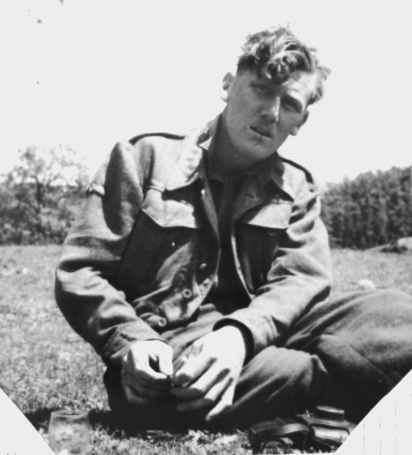
Who was Fred Brandt?
Dr. Fred Herman Brandt was born in Saint Petersburg and grew up in Latvia. During the Second World War, he was a member of the German Wehrmacht troops. As an entomologist (a studier and collector of insects), in 1937–1939 he went to Iran to study butterflies. During that period he wrote several scientific papers.
In 1939, Brandt was appointed commander of the Brandenburg battalion. He carried out his first service at the head of the battalion in Afghanistan. At the beginning of 1944, Brandt with his Tajikistanis, from the garrison in Belgrade, was commanded to the Albanian Alps, to Nikaj, to build a military stronghold. There, he surprisingly built friendly relations with the officers of the English secret service. At the beginning of October 1944, when he lost contact with his chief in Peja – a time when a campaign of arrests of German officers in the ranks of the army broke out – he surrendered to the English officers and was evacuated to southern Italy as a prisoner of war.
In 1957, the British newspaper “Sunday Pictorial” made known a piece of news about Brandt: The clever one, the colonel of butterflies, pretended to occupy himself with butterflies but in reality he was Colonel Brandt, a master spy who tried to build the death network for English agents. This madman was a seasoned agent of Nazism, one of the most dangerous agents and traitors of the time. In 1973, Brandt, the master spy, made this material known, about his stance and activity in Nikaj and Albania. / Memorie.al
Translated by Lekë Imeraj – writer and translator