
Part Thirty-Four
Memorie.al / The CIA have shown the great role that the Soviet Union played in communist Albania. In several “Top Secret” documents, declassified years ago, it is shown that the USSR built several important military bases, especially in the South of the country. There, the submarines that Moscow had on the island of Sazan and in the Bay of Vlora are shown in detail, as well as the air bases, such as that of Rinas, Kuçova, etc. Then a panorama of political developments is given, where the dismissal of Defense Minister Beqir Balluku in the summer of 1974 from all functions in the army and party is mentioned. Likewise, a special place in the documents that the CIA has declassified are also those that speak about Albanian political emigrants in Yugoslavia, who are included in the Committee of Prizren, initially led by Apostol Tanefi and under the pressures of the UDB, which recruits them with coercive measures, such as return to Albania, etc.
Continued from the previous issue
28 September 1954
Conclusions on Albania’s objectives and projects
Among the objectives currently pursued is the preservation of the hope of liberation through the Committee of Albanian leaders in emigration, which is loyal to the enslaved Albanian people and has the support of the countries of the free world. Some of the objectives in the national directives have been neglected, particularly those related to harassment of the regime and encouragement of passive resistance, which does not bring punishment or reprisals.
Regarding the objectives of strengthening our assets in the country and preparing the ground for resistance against the Soviets, it was accepted that progress was slow due to deficiencies in qualified agents. The branch believes it is desirable to create internal assets slowly and securely.
The role of the National Committee for “Free Albania”
It is accepted that the operation has created in the minds of Albanians the idea that the National Committee of “Free Albania” is the only group of leaders in emigration that is loyal and has the support of the Great Powers. Among the deficiencies we mention the lack of programs for encouraging passive resistance and harassment of the regime. There has been a measure of success in desertion programs, as a number of refugees who recently arrived in Greece were aware of them.
One explanation for the operation’s deficiencies is the lack of intelligence on conditions inside Albania. Considerable attention is being devoted to deficiencies, particularly regarding the encouragement of selective desertions, which are already the object of intensive propaganda from Athens. The encouragement of passive resistance has encountered problems regarding achieving results without causing consequences for anti-communist elements.
Leaflet drops
To reduce future deficiencies, the branch is expected to investigate the possibility of releasing false documents that give the finder special privileges, such as; food rations, vacations in coastal camps, etc. The branch will devote importance to the possibilities of harassment through the recent opening of postal channels in Albania from Eastern European countries.
Other aspects of the postal campaign will be considered, to make it as effective as possible as an instrument of harassment. The branch and staff will review the instructions of the harassment campaign to select the most suitable for Albania, and at the same time a better understanding of the possibilities of passive resistance, with the smallest possible consequences, will be encouraged.
Food supplies
Efforts will continue to secure food supplies to be distributed in the name of the committee both within Albania and for Albanian refugees in need outside it. After three years of broadcasting within the framework of operation OBTEST, we have only some scattered evidence of the hearing of messages in Albania and it has been agreed that the project should continue without a deadline.
The reasons for this are the fact that the jammers have recently been reduced in strength and the fact that refugees from different areas of Albania knew the programs. In addition, the cost of the project is small and the equipment is already installed.
Their staff is used at the same time for the brochure distribution program as well, and its cessation would indicate a decline of interest from the West both for the authorities and for the Albanian people. It is also believed that the operation has been successful in forming the Committee’s reputation in Albania.
Regarding the program of texts from the air, it was accepted that it was the reason for our success in creating the reputation of the emigration Committee in Albania. Among the problems discussed were the difficulties in creating other routes of delivery, some difficulties with the means of printing the texts, and reports that the brochures have not been released in highly populated areas, but none of these problems is insurmountable.
The deficiencies of field agents in completing the number of local agents were also mentioned. The release of goods was awaited mainly negatively, as in interviews with some refugees certain anger toward the Committee was described for giving goods to the communists. This contradicts our calculations, that the anger would be directed at the communists who confiscated the goods from the population.
But since no reaction has been observed since their resumption last year, it was thought to make an assessment of the initiative when the packages of goods in Athens were finished. In this regard, we will try to obtain monthly reports from the field.
Conclusions
In conclusion, the branch accepted that according to field recommendations, the annual program for 1955 should be prepared. Among the recommendations received was the continuation of efforts for the development of intelligence inside Albania, whose function is the provision of information for the support program from outside. The possibility of air release of falsified documents for the purpose of harassing the regime will be studied, which will be supported by the campaign of fake threatening mail.
The campaign of encouraging desertions will continue, accompanied by new suggestions for ways of encouraging passive resistance in the population. Clandestine radio broadcasts will also continue, accompanied by the supporting campaign of propaganda brochures.
November 1948
Army, armaments
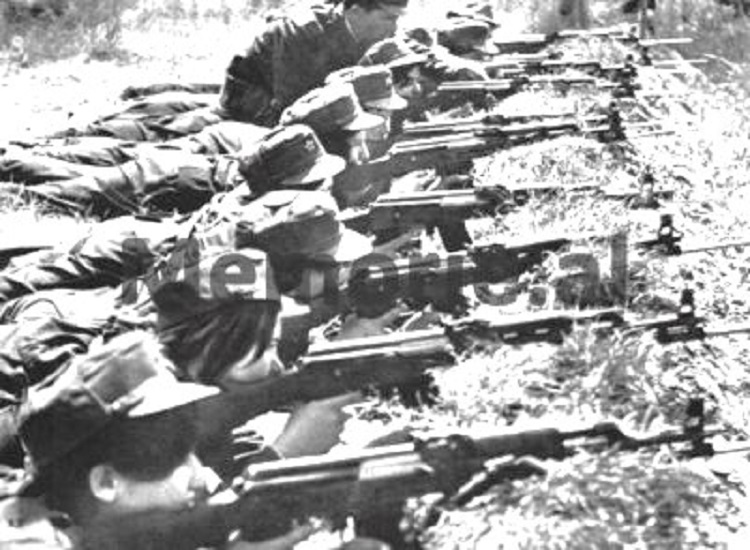
The Albanian army consists of squads, companies, battalions and regiments. Squads have 8-10 riflemen, 6 people for 82 mm mortars, 6 soldiers for “Max” machine guns weighing about 65 kg., with a total force of about 20-22 people.
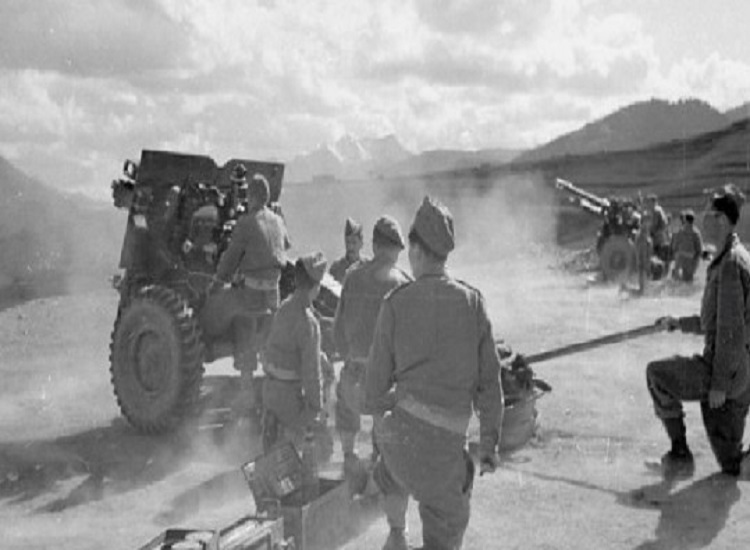
Companies consist of about 60 riflemen, 36 people for mortars and six “Max” machine guns. A battalion consists of three rifle companies, a mortar company, a machine gun company, an anti-tank squad and a transport squad. The regiment consists of three battalions and usually has about 100 other people operating 105 and 107 millimeter mortars, as well as heavy artillery.
The old armaments of the Albanian army had various origins, Italian, Greek, British or German. But recently they have been replaced with weapons of Russian production. The new armament has already been completed in the garrisons of the Elbasan district, which have also received mortars and artillery of Soviet production. The army’s rifles rust quickly and must be cleaned every five days with oil, due to oxidation.
According to the rule, a soldier must clean his rifle twice a day. The army has radio units in every battalion, while communications between smaller groups are carried out by courier. The army does not have a single uniform style. Most have Yugoslav uniforms of poor quality, while officers have good uniforms of one type. Even the shoes of Yugoslav production are outdated and repaired.
The food ration for soldiers is 700 grams of bread and 20 grams of meat per day. The bread is a mixture of wheat, corn, barley and potato flour, while the meat ration was set after the collectivization of livestock on 11 May 1948. Before the breakdown of relations between Tito and Hoxha, the ratio was 1000 grams of bread per day. Soldiers are increasingly dissatisfied, as officers eat much better.
About 10 percent of military personnel are communists, mainly officers. There are also low-ranking officers who are not members of the communist party. In border areas, the mixing of soldiers with local residents is not allowed. The army does not have its own vehicles but uses vehicles nationalized from private citizens, which are few and outdated.
The military division of Korçë consists of three infantry regiments and one artillery regiment. It is led by Commander Nezir Met’hasani, Commissar Eleftherios Kasnetsis, who is also the liaison of the Albanian government with the Greek communist guerrillas. The entire force of the Korçë division is concentrated in the border area from Leskovik to Lake Prespa. This came after the attacks of the Greek army against the communist guerrillas who are sheltered and aided by Albania.
An infantry regiment is positioned in the Sinitsa-Erseka sector, based in the village of Flioki. The division is led by Colonel Muharrem Prodani. Along the entire border with Greece, military fortifications are being erected, mainly trenches covered with tree trunks. In places where this activity can be seen by Greek border guards, the work is carried out during the night, while in places where it is not visible, the work is carried out during the day. Fortifications are also being erected at the Tsakoni pass.
Here the work is being carried out in “voluntary” form by the Northern Epirote residents of Korçë. The center of the fortification work in Tsakoni is the village of Zemblak. The ammunition depots are located at various points on the outskirts of Korçë, such as the church of Agios Athanasios, the church of Agios Petros in Dardhë, or in the military hospital of Korçë. The hospital was built by the Italians and was used by them during the war./ Memorie.al