





By DASHNOR KALOÇI
Part Fourteen
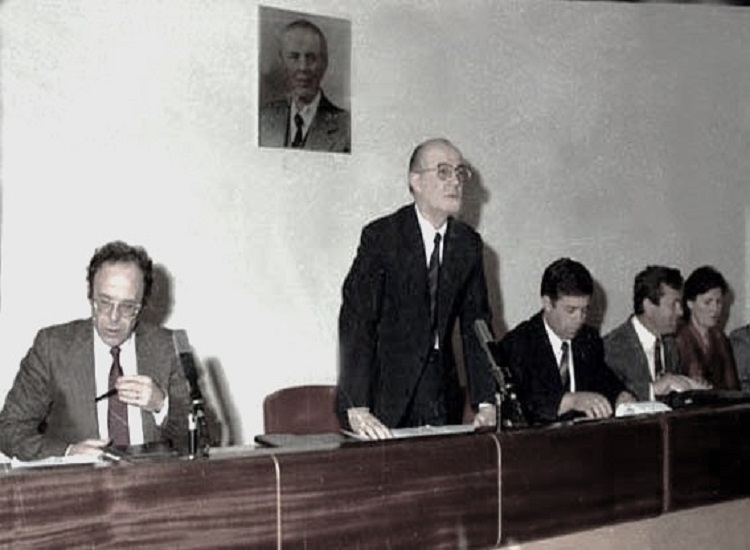
Memorie.al / When not even a week had passed since 2 July 1990, when thousands of Albanian citizens crossed the railings and walls of foreign embassies in Tirana and entered their premises with the aim of leaving Albania, the high leadership of the PPSh (Party of Labour of Albania), headed by General Secretary Ramiz Alia, held the 11th plenum of the Central Committee, which conducted its proceedings on 6 and 7 July. Although the agenda was predetermined in three main points, where the one on the development of education in Albania predominated, almost throughout the proceedings of that plenum (especially at point 4, “Miscellaneous”), the event of those days, otherwise known as “2 July of the embassies”, was discussed and debated. At that plenum, in which all members and candidates of the Central Committee of the PPSh participated, the first secretaries of the party committees of the districts, ministers, main cadres of the education, culture, science, economy sector, leaders of the organization of the Union of Working Youth of Albania, from the apparatus of the Central Committee of the PPSh, Radio-Television, ATSH, etc., absent were Nimet Cani, Ali Vukatana, Reiz Malile, Shpëtim Çaushi, Zylyftar Ramizi, Qemal Lame, Zef Loka, Pirro Kondi and Hekuran Isai, who for several days had been “in the field”, “managing” the embassy event.
After the opening of the meeting by Ramiz Alia, the floor was given to the Minister of Education, Skënder Gjinushi, who also held the relevant report (“On the perfection of the educational system and the further qualitative strengthening of the school”), the main topic of that plenum was the “embassy event”, discussing and analyzing in detail how and why it happened, (“the role of foreign agencies”), up to the tasks that emerged for managing that situation in those hot July days, when over five thousand Albanian citizens from all the districts of the country were located in the internal premises of some of the main embassies in Tirana, waiting to leave Albania.
In addition to this, throughout that meeting, but mainly at point no. 4 of the agenda, (which was discussed in the last session), several of the main events that had occurred in various districts of the country during that year were also taken into analysis, such as: the protests in Shkodra in January for the removal of Stalin’s bust; the events in the city of Kavaja where the people of that city clashed with police forces; mass escapes from the state borders with Yugoslavia and Greece, mass gatherings in holy religious places, such as the Church of Saint Ndou in Laç of Kurbin; the legal permission of religious beliefs and the opening of places of worship; or other problems that were raised for solution, such as: the talks of the international factor for the restoration of diplomatic relations with the USA, the Soviet Union, (the talks held with the Soviet Deputy Foreign Minister in Sofia by Sofokli Lazri); the Kosovo problem; international pressure for the opening of Albania to the world and its accession to several international conventions; the privileges of the high leadership of the PPSh and their families who lived mainly in the “Block”; the words circulating among the people about Enver Hoxha’s family and Ramiz’s relations with Nexhmije; the change of legislation and the penal code; the release of political prisoners; the stamping with passports of citizens who sought to leave as visitors to their relatives abroad; the new economic mechanism; the housing and employment of many additions in all districts of the country; the giving of land and livestock to the cooperative peasantry; up to the supply of the urban population with basic food products and various industrial goods.
As we will also see from archival documents belonging to the 11th plenum of the Central Committee of the PPSh, which we emphasize are published for the first time, in addition to the leadership and some of the high officials of that time, several other high figures who continued their political careers even after the 1990s also discussed or were mentioned at that meeting, such as: Skënder Gjinushi, Fatos Nano, Sali Berisha, Rexhep Mejdani, Gramoz Pashko, Spiro Dede, Dritëro Agolli, Ismail Kadare, Moikom Zeqo, Mehmet Elezi, Lisen Bashkurti, Koço Kokëdhima, Ylli Popa, Aleks Luarasi, etc.
Likewise, in the voluminous file of this plenum, of great interest are also those documents that belong to the secretaries of the Party Committees of the districts or the “Information Group” who went to all the districts of the country and documented all the main problems that emerged in the meetings of the base organizations of the party, where “On the letter of the Central Committee” was discussed, documents that constitute the largest and also the most important part of the file in question. In fact, it can be said to be among the most important of the entire period of the communist regime of Enver Hoxha and his successor Ramiz Alia, since that period of time with the events that unfolded also marked the prologue of the fall of that regime.
Likewise, of great interest are also the documents that belong to the last session of that meeting with point no. 4 of the agenda “Miscellaneous”, which constitutes the hottest point of the entire plenum, where it was discussed, even with harsh debates, the release from duties and retirement of three members of the Political Bureau (Rita Marko, Manush Myftiu and Prokop Murra), or the release from ministerial duties or other high functions that several other “leaders” had held for years, such as Simon Stefani, Pali Miska, Muho Asllani, Lenka Çuko, Vito Kapo, Pirro Kondi, Jovan Bardhi, etc., and the appointment of “new comrades” in the leadership of the high forums of the Party and State, such as: Xhelil Gjoni, Abdyl Backa, Niko Gjyzari, Kiço Mustaqi, etc. Regarding these etc., we are made known by the documents in question extracted from the Central State Archive (Fund of the former Central Committee of the PPSh), which are published for the first time and with the relevant facsimiles by Memorie.al
MINUTES OF THE MEETING OF THE 11TH PLENUM OF THE CENTRAL COMMITTEE OF THE PPSh, HELD ON 6 AND 7 JULY 1990
MISCELLANEOUS
Some issues of today’s situations and the political problems arising from them.
COMRADE THEMIJE THOMAI: We feel the responsibility for the remarks and criticism that You make, comrade Ramiz, not only as comrades elected to the Central Committee of the Party, but also as leaders of the Party’s work in the districts where we work. The situation is grave, but we must master it, especially now, which relates to the fates of the nation. We must be careful and not remain only in side problems, but grasp the main ones and not confuse what is party-related with what is not party-related. I have the impression that sometimes some shortcomings and weaknesses of the leadership of some, we are seeing as shortcomings of democracy and as errors in the Party’s line.
The people, the people who work in enterprises and cooperatives love the Party, and are fully in agreement with the measures it is taking for the deepening of democracy. It seems to me that it is others who are shifting attention from this essential issue by saying that “the workers and peasants have not correctly understood the measures being taken for the deepening of democracy”. It is the incapable ones who are interested in doing this to hide their own shortcomings. In this issue there is no place for speculation, but more accountability must be sought from the leaders, so that they work with a high sense of responsibility. Let us think better about how to increase the meetings so that this practice is something natural, since it is not always implemented.
Something else too. There is much talk about the new economic mechanism and it is said that efforts are being made for it to find implementation, but there are more words than concrete work. It is clear that there are difficulties of the material base etc., but these difficulties are not insurmountable. Only the difficulties must first be overcome by the communists and the cadres, who, not being they in order, confuse the work. There are all the possibilities that in Tirana, in Lushnja or Fier, in Durrës, or in Shkodra, everywhere the Party, the communists have the situation in hand. I wanted to emphasize that this so worrying situation and on such a scale is only in Tirana, while in the districts the situation is different, it is healthier.
COMRADE RAMIZ ALIA: Good. Is there any other comrade to discuss? Of interest to me would be some concrete issue, not general words.
COMRADE HALIL LEJLI: I am fully in agreement with the issues that You raised, comrade Ramiz. But I think that the organs of Internal Affairs should also increase their intelligence force, because after the decisions of the 10th Plenum of the Central Committee of the Party, some employees think that hostile activity has decreased and the class struggle has softened, and thus the work decreases. From such carelessness, unexpected situations may be created, like this present one; therefore these thoughts must be fought.
COMRADE RAMIZ ALIA: What is your conclusion?
COMRADE HALIL LEJLI: I think a stance should be taken for the people who make such mistakes and in this plenum some explanation should have been made, why the security organs allowed this situation.
COMRADE RAMIZ ALIA: Are you asking this answer from comrade Simon?
COMRADE HALIL LEJLI: I am asking the answer from comrade Simon and from the other comrades whom the Party has assigned to deal with these works and who have not known how to lead properly. Another issue I wanted to raise is that of the removal of the incapable from duty. People rightly say that “the incapable should be removed”, since it has been a while that the Party has raised this issue. The newspapers write about it every day. Since the 8th Plenum of the Central Committee of the Party, it was forcefully raised that the elderly should retire, but it seems to me that in the ministries and below, this work is not continuing. About the only one it is talked about and written in the newspaper.
I would say that comrade Marash Hajati is incapable of leading the newspaper “Zëri i popullit”. Even when he was general director of Radio-Television, there were remarks about him, that he created some unpleasant situation. He has influenced with his tastes, even as if he were the director of some programs that the people did not like and about these he has spoken openly. Nevertheless, even now that he went as editor-in-chief, he has influenced such problems to be created in the Party press, although the press is led by the Party. But the people and people from the base say that it is not only Marashi, as editor-in-chief, who creates these concerns. The writings that have to do with the Party’s line are approved from above, by the comrades of the apparatus of the Central Committee of the Party…
COMRADE RAMIZ ALIA: Don’t let them say they are approved also by comrade Ramiz?!
COMRADE HALIL LEJLI: To tell you the truth, some even think so; otherwise some of these writings should not have been allowed…! Nevertheless today people generally have ideological and cultural level and know how to distinguish the mistakes that the editor-in-chief or others may make from the true stance of the Party on certain issues. So, I emphasize once again that for comrade Marash a stance must be taken.
COMRADE RAMIZ ALIA: Good.
COMRADE SIMON STEFANI: Here quite a few problems were raised also for the Security Organs, which have their responsibility for all these events. But it is not true that the Security Organs have not provided data. They have informed about this data the Party and government Organs, from the base to the top, therefore the entire responsibility cannot fall on the State Security Organs. Also in accordance with the laws that were approved recently, we have discussed and changed all the orders. But those persons whom the law does not make an object of security, we cannot take as such.
There has been among our employees even some thought that “now our work has become easier”. These thoughts we have criticized, we have reported about them also to the Political Bureau and, rightly, comrade Ramiz has criticized this concept, for which we have also clarified our employees. There may still be individuals who have such thoughts, but the work of the Security Organs now is much more difficult than it was before the changes of some laws that were made recently. Before it was easier, since it was enough to say a word against the political line and the justice organs would judge for agitation and propaganda.
COMRADE ADIL ÇARÇANI: In this situation it is not only the work of the Security Organs that has become difficult, Simon.
COMRADE SIMON STEFANI: The entire work of the Party has also become difficult.
COMRADE ADIL ÇARÇANI: Therefore the Security, regardless of the difficulties, must also do its duty, for which it is responsible. In the moments we are going through, the work of the security organs must be more agile and more qualified.
COMRADE SIMON STEFANI: Comrade Adil, I said that it is difficult, in relation to the opinion that exists among some security workers that the work now has become easier…!
COMRADE HALIL LEJLI: On 2 July extraordinary events occurred and the Security knew nothing, although some time ago hooligans had prepared to carry out ugly acts in Tirana. These events were prevented by the Party, which took measures, as soon as it dictated the situation. Thus the hooligans and hostile elements did not dare to act. Whereas now I have the opinion that the Security not only has no data about the situation, but certain people may have even become spectators.
COMRADE SIMON STEFANI: No, even now the Security knew these problems. In Shkodra there were more tendencies for some commotion to be organized. Likewise in Kavaja it was known that something like this would be organized, comrade Halil. But these events cannot be faced only by the organs of the police and the Security; they must be faced by all of us. Nevertheless we cannot say that the Security Organs have no responsibility for this situation.
COMRADE RAMIZ ALIA: Do you accept that in this situation the Security organs were caught by surprise?
COMRADE SIMON STEFANI: We cannot fully accept it, comrade Ramiz, since we had some data that certain people would enter the embassies.
COMRADE RAMIZ ALIA: Here we are at the meeting of the Central Committee and the criticism must be accepted, let us not partially avoid it. Did the Security organs think that there would be such a flooding of people into the embassies?
COMRADE SIMON STEFANI: If we come to the issue of the flooding into the embassies, let us discuss it.
COMRADE RAMIZ ALIA: Since this discussion was opened, it must be taken to the end. If 6 workers of the Valias mine go and enter with a truck into the Italian embassy, they must have gathered, at least several times, to agree with each other, to study the place and agree. Does the State Security see these actions?! If it does not see them, what does it do, shake the chain?! Likewise into the German embassy 30 people go and enter with a truck at once, taking even the children with them. What do the Security organs do, when they do not see them and do not inform beforehand about their preparations?! Whereas we are told that it is even known what X or Y does at home.
COMRADE SIMON STEFANI: We have not said that…!
COMRADE RAMIZ ALIA: You have said it before, but now among the people the opinion has been created that “the security organs are sleeping”. Do you have this opinion, the comrades who are here? (The comrades approve and affirm that it is so). Each must bear his own responsibilities. It has been three months that I have gathered you, comrade Hekuran, comrade Prokop, comrade Adil and comrade Kiço and I have told you that you must prepare for new wars. The issue should not be seen simply, only in the prevention of a demonstration that was being prepared in Shkodra.
There will be other activities, therefore the situation must be studied well and a whole program must be drafted, where it is foreseen what the police organ will do, what the state security will do and what the Ministry of Defense will do. There it must also be foreseen in what case the police forces must enter into action, in what case the security forces must enter, in what case the army must enter. I have told you, categorically, that in no case should weapons be used, but the forces of the people should be used, starting from the working class, the communists and all the masses. The State Security has the responsibility that in this situation we found ourselves unprepared to take such measures.
COMRADE SIMON STEFANI: Naturally, there is responsibility…!
COMRADE RAMIZ ALIA: Precisely for this Halil is also referring, when he makes criticism about you. / Memorie.al
Continues in the next issue