By Uran Butka
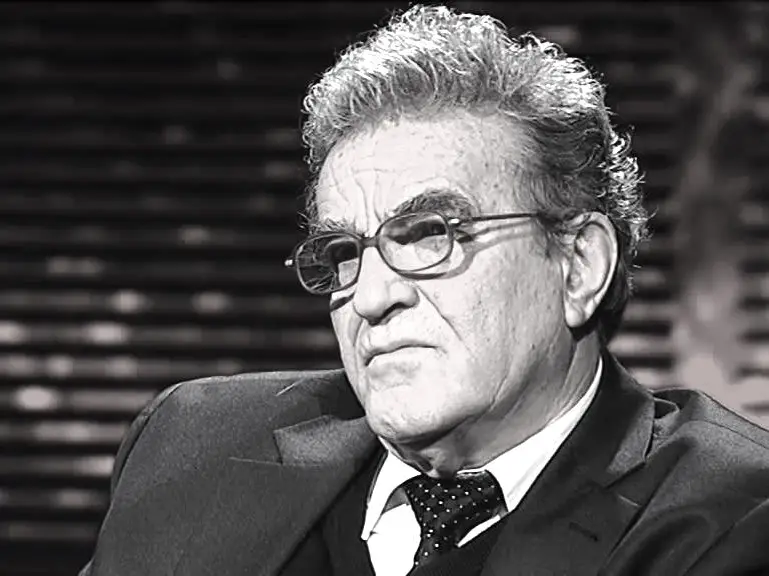
Memorie.al– In judging and evaluating a historical personality, one must take into account the time in which he acted, as well as his stance toward the major events in the life of his people and nation. Fadil Hoxha lived and acted in one of the most critical periods of our nation: World War II and the post-war era, which influenced and conditioned his formation and activity. In this writing, I will not lay out Fadil Hoxha’s complete activity, but will briefly pause on only a few of his stances, which contradict and refute the tendentious assessments of Rahman Perllaku and some other nostalgics in Albania and Kosovo who call Fadil Hoxha an outstanding figure of the Albanian nation, since these assessments are made public in the press and still today spread falsehoods, distort history, and wound the national sentiment. I will bring some documented facts; let the reader judge.
Immediately after the Italian occupation, it was the brothers Hasan, Gani, and Said Kryeziu who organized the anti-fascist resistance and later also the armed struggle against the German occupiers. The path chosen by the Kryezis was that of the liberation war against the occupiers, in cooperation with all anti-fascist factors, especially with the Western allies.
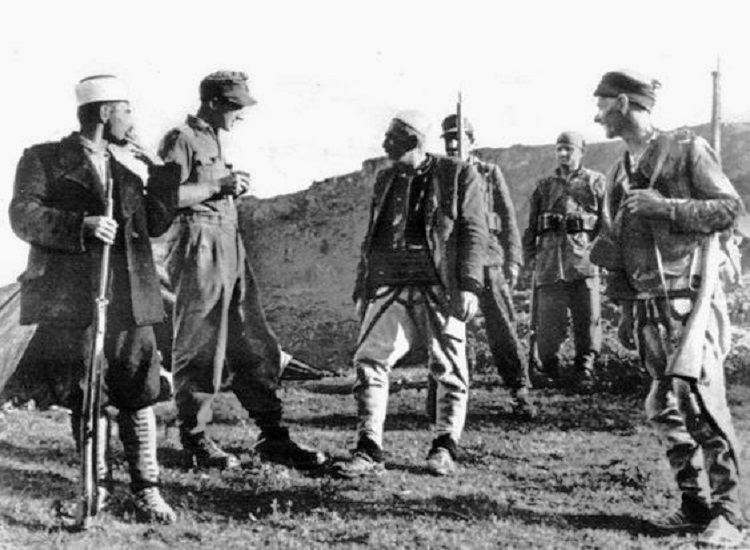
Precisely when the forces of the “Kryeziu” Movement – which included the fighters of Mehmet Ali Bajraktari, Mujë Rama, and Ymer Bardhosh, along with Llazar Fundo and the Briton Simcox – were fighting against the German occupiers in the battle for the liberation of Gjakova, September 10–15, 1944, they were treacherously attacked from both sides by the National Liberation forces of Yugoslavia commanded by Fadil Hoxha and the forces of the V Brigade of the National Liberation Army of Albania.
Enver Hoxha was rushing to be the first in this murderous holocaust. In a radiogram sent to Liri Gega dated August 8, 1944, Enver Hoxha instructed: “Near Kryeziu is Zai Fundo. A month ago, Fadil Hoxha spoke with the comrades from Kosovo. Dushani and Rade also know. I told Fadil to kill him (Zai Fundo), without regard for any circumstance.” (Central State Archive of Albania, F.41 D.158 v.1944)
The secretary of the committee of the Communist Party of Yugoslavia for Kosovo and a member of the operational staff of the Yugoslav National Liberation Army, Pavle Jovićević (“Rade”), instructed Fadil Hoxha to very secretly verify information on exactly where Gani Bey was, how many forces he had, where the battalions were located, whether the road was guarded, etc. “This is rigorously conspiratorial. Report at 5:30 and 10″ – Pavle.” (Documents of the Institute of History, Belgrade, 1949)
Furthermore, on September 21, 1944, Enver Hoxha sent a very conspiratorial radiogram to the First Corps – to Liri Gega, the all-powerful representative of the Central Committee of the Albanian Communist Party in the North: “Do not seek any longer for Gani to surrender, but at all costs and with severity he must be attacked and killed. You must act as soon as possible, because the Kosovars may come to his aid”! (AQSH, F.41 d.158 v.1944)
Fadil Hoxha sent full information to Liri Gega about the rout of Gani Kryeziu’s forces, the arrest of the Briton Simcox and Said Kryeziu, as well as the execution of Zai Fundo. (AQSH F.41 v.1944 D.158)
Llazar Fundo was arrested, beaten to death, and asked to answer the questions that Enver Hoxha had sent by radiogram: “Torture Zai Fundo to death and then execute him over there. He should be asked to give explanations to these questions: Why has he come to Kosovo, who sent him, and with what directives; what are Gani’s and the Englishmen’s aims; give explanations about his previous activity and his treason…! Kill Zai over there…”! (Radiogram from E. Hoxha, September 21, 1944) He was executed on September 23, 1944, after being tortured to death.
Shaban Polluzha has entered the history of Kosovo and the Albanian nation as a great fighter for the nation and as a martyr. This no one can deny. However, the order for the bloody suppression of his national resistance was given on February 5, 1945, by the commander of the Operational Staff of Kosmet, Fadil Hoxha, and the Serbian commissar Krsto Filipović. So how can both Shaban Polluzha (the victim) and the one who ordered his killing and that of hundreds of his patriotic fighters (Fadil Hoxha) be considered outstanding figures of the nation? Here is the document:
SECRET
No. 119, February 5, 1945
ORDER 50
Intelligence on the enemy: The forces of Adem Voçë, from the north of Mitrovica in Kosovo up to the southern slopes of Kopaonik, have been destroyed. The forces of Shaban Polluzha in Drenica have strength of 5,000 soldiers. They are putting up strong resistance. The encirclement is being tightened. One group, between Runik and Rakosh, has crossed toward Rogozna. Other forces tend in the same direction and toward Gjakova and Istog. Our forces have been reinforced with the 24th Division and the I Montenegrin Brigade of Boka and Kotor.
Task: To continue with the destruction, pursuit, and elimination of the enemy, and the disarmament of the population.
Commissar Krsto Filipović — Commander Fadil Hoxha
(Document: Archive of the National Liberation War of Yugoslavia, no. 9-4, box 1411, v.1945)
The military offensive against the forces of Shaban Polluzha and Mehmet Gradica began in early February and concluded most fiercely during the days of February 12–22, 1945. Shaban Polluzha, Mehmet Gradica, and the Albanian fighters fought heroically against vastly unequal forces in numbers and armaments, but they stood heroically.
Fadil Hoxha ordered: “The enemy forces in Drenica have still not been annihilated. The enemy is resisting strongly. Our brigades are simultaneously going over to the attack, so that the enemy can only resist in one sector. It is imperative that the encirclement be tightened from all sides and that a general attack be launched until the enemy is eliminated.” (Archive of the National Liberation War of Yugoslavia, no. 9-4, box 1411, v.1945)
The enemy, according to Fadil Hoxha, was Shaban Polluzha and his Drenica fighters, who were defending the elementary human and national rights of Drenica and Kosovo. Fadil Hoxha, just like Enver Hoxha, called all opponents enemies, even those within the National Liberation Movement. For the record, Shaban Polluzha and his forces – over 6,000 fighters – were part of the national liberation ranks and fought for the liberation of Kosovo from the Nazi-fascist occupiers, but also defended its people from the barbarism of the Yugoslav army and Mihailović’s Chetniks.
In the clashes with the Serbo-Montenegrin-Albanian communist forces, Shaban Polluzha and Mehmet Gradica were wounded, but they did not stop the fight; they counterattacked and broke through the encirclement toward the village of Gollupovë. Polluzha was wounded a second time and died that same night in the village of Çikatovë. Likewise, Mehmet Gradica, Miftar Bajraktari, and Shaban Polluzha’s son, Tafa, were killed in battle. During those 28 days of fighting, about 430 fighters from Drenica were killed and wounded; none were taken prisoner; over 150 houses were looted and burned; the entire food supply and movable property of 6,000 residents of Drenica, Vushtrri, and Mitrovica with their districts were plundered. (Document: Promemoria to British General Hodgson, October 22, 1945)
The VI Kosovo Brigade was sent on January 2, 1945, to Vojvodina, in the region of Vershac (Vršac), where its fighters were dispersed among the Yugoslav complement brigades. Their treatment was as if they were prisoners of war. In a UN report dated February 10, 1945, we read: “Here there are about 1,500 Arnauts in the complement brigade…! They are asking the brigade staff to send them to the front, or to return them to Metohija. The brigade staff has tried to disarm them, but without success…; on the occasion of the uprising of the Albanian battalion in the complement brigade in Vershac – Fadil Hoxha went there…! Fadil was appointed president of the military court that sentenced the organizers of the uprising… in Vršac, eleven Arnaut rebels were tried and shot.”
Likewise, the VII Brigade, with 15,260 soldiers and commanded by Shaban Haxhia from the Tropojë district, received the order from the Operational Staff of Kosovo (commanded by Fadil Hoxha) to go to Srem, but en route it was attacked by Yugoslav partisans and Chetniks and nearly wiped out. Shaban Haxhia watched with pain as his comrades were killed and died of typhus, yet he continued the death march. The few remaining fighters were dispersed in Banat among the Yugoslav brigades and almost never returned to Kosovo.
Only the disgraced commander Shaban Haxhia returned to Kosovo with four men. Does Fadil Hoxha bear no responsibility for this slaughter? As commander of the national liberation ranks in Kosovo and later as commander of the Operational Staff, he fought both against the Germans and against Albanian nationalists, as part of the National Liberation War of Yugoslavia and the Communist Party of Yugoslavia, serving them faithfully.
Thus, 13,050 Albanian recruits from Kosovo and other Albanian areas under Yugoslavia were mobilized (with the help of the V and VI Divisions of the National Liberation Army of Albania, which had been placed under the orders of the Supreme Staff of the National Liberation Army of Yugoslavia) and were sent, disarmed and escorted by the Yugoslav army, through Albania toward the Adriatic Front to be destroyed.
According to documents found in the Albanian State Archive and in the Archive of the National Liberation Army in Belgrade, the staffs of the V and VI Divisions of Albania handed over to the Operational Staff of Kosovo all the recruits and all the Kosovar volunteers who had voluntarily surrendered in good faith to the Albanian divisions, who were then sent as cannon fodder to Srem or Tivar (Bar) to be destroyed. For illustration, just one document:
TO THE OPERATIONAL STAFF FOR KOSOVO AND METOHIJA,
PRISTINA
Enclosed we are sending you the nominal list of the Kosovar recruits and volunteers who have joined the ranks of this division.
Political Commissar – Commander of the V Division
- Kol. Ramiz Alia — Colonel Rahman Perllaku
(Document: AQSH, Fund 206/ APL v.1945)
On their death march from Kukës to Shkodër, over 1,000 of these Albanians were killed and disappeared, while the rest were annihilated in Tivar and beyond – a total of 3,933 innocent compatriots. Fadil Hoxha at that time (March–April 1945) was deputy commander of the Operational Staff of Kosovo, from which the Yugoslav military divisions and brigades operating in Kosovo received their orders. Does Fadil Hoxha bear any responsibility for this massacre?
When the three columns of Albanian recruits were massacred in Tivar in March 1945, why were three more columns sent in April, which suffered the same fate? Why did Fadil Hoxha not try to stop this butchery? Even if he could not stop it, why did he not speak out, why did he not oppose it, why did he never condemn this massacre, why did he not resign from the command of the Staff that was directing the massacre against thousands of Albanians?
Even Ranković, the Minister of the Interior of Yugoslavia, acknowledged the massacre at the First Congress of the Communist Party of Serbia, May 1945, although he treated it as an incident: “During the sending of a number of Albanians to fill the units of the IV Army, an incident occurred. But our leaders, instead of resolving the matter without spreading the conflict, wanted to carry out reprisals, trying to shoot 40 Albanians for every killed fighter. A revolt broke out…! And our commanders opened fire and killed 300 Albanians.” (I Congress of the Communist Party of Serbia May 1945. Ranković’s speech)
Nevertheless, Ranković has the merit of mentioning this massacre and calling it a “terrible mistake against Albanians,” while Fadil Hoxha and the Fadilists, not only then but never, mentioned or examined this state genocide against Albanians. Not even in later years, when this issue was reopened and courageously raised with denunciatory facts by a survivor of the Tivar massacre, Azem Hajdini.
Fadil Hoxha, the main responsible figure of the political and military leadership at that time in Kosovo, remained silent as a blade of grass. Only later, after 35 years, on December 14, 1979, at the symposium “The Revolutionary Armed Forces of the National Liberation War of Kosovo 1941–1945,” he stated with his own mouth: “There is no revolution in the world where there have not been some mistakes. Something of this exists in our revolution too, although very little. I do not agree that now we should investigate who killed those people in Tivar, why they were killed, and what does that mean? They were killed, in all likelihood, without fault and without debt. That much we can establish. If, however, we start investigating that event today, it would not contribute much to history…” (Fadil Hoxha, Discussions, Pristina 1981)
This is the first and last time that Fadil Hoxha speaks about this national tragedy. Unfortunately, he says that what happened is very little, that the Albanians were killed “in all likelihood, without fault and without debt,” which means that no one made a mistake, no one owes anything, no one is responsible!! As if nothing had happened! He does not agree with the voices that seek to bring the truth to light, because the truth is bitter even for him and must be hidden.
This was an unjust solution, because the Albanian lands and population – which ranked second in Yugoslavia by number, after the Serbs – were divided between Serbia, Montenegro, and Macedonia, thus paving the way for the elimination of Albanian national identity and unity. Halim Spahia, one of the personalities of the National Liberation Movement and of the Bujan Conference, reacted differently: “All the help we gave to the National Liberation War of Yugoslavia has apparently been in vain. We have been betrayed!”
Fadil Hoxha, Mehmet Hoxha, Xhavit Nimani, and other communist leaders of Kosovo, as obedient tools of the Yugoslav Communist Party, in full cooperation with Dušan Mugoša and Spasoje Đaković (head of OZNA, etc.), organized on March 27, 1945, the so-called Committee of Albanians of Kosovo and Metohija, which at the Constituent Assembly, chaired by Fadil Hoxha, expressed the “will” of the people of Kosovo to unite with Serbia, burying the Albanian effort for liberation and national unification. The Constituent Assembly addressed Colonel Fadil Hoxha, who specified “the importance of the assembly and its aims.” (Rilindja, Pristina, April 5, 1945)
Fadil Hoxha publicly declared the Bujan decisions for the unification of Kosovo with Albania on the principle of self-determination as erroneous, when he declared otherwise at the Prizren Assembly (July 10, 1945), which ultimately legislated the annexation of Kosovo by Serbia as an “autonomous district” without the right to a flag, official language, or national rights: “Legally and democratically, the erroneous part of the Resolution approved at the Bujan Conference is hereby annulled” – declared Fadil Hoxha at the Prizren Assembly, which decided on Kosovo’s unification with Serbia.
Alongside these collaborationist acts came the violent and bloody reoccupation of Kosovo and other Albanian territories by Yugoslavia, with the help of the national liberation brigades of Kosovo and the divisions of the National Liberation Army of Albania.
Fadil Hoxha condemned the demonstrations of Kosovo’s citizens in 1968 and in 1981, and when the Serbian police state crushed them with blood and Kosovo was again emptied of its intellectuals, he remained silent and acquiesced to the violence against his compatriots. Fadil Hoxha did not live to see when the Balkan butcher, Slobodan Milošević, carried out monstrous massacres against the people of Kosovo in 1998–1999 and carried out the greatest ethnic cleansing of Kosovo, when over 1,000,000 Albanians were forcibly expelled from their lands and homes.
Fadil Hoxha may be an outstanding figure of the National Liberation Army of Yugoslavia, of Yugoslav politics, and of the Yugoslav communist state, where he served and reached the highest peaks, but in no way is he an outstanding figure of Kosovo or the Albanian nation. / Memorie.al