
By Visar Zhiti
Part Two
Continued from the previous issue
Memory plaques and sacks…!
Memorie.al /The year 1439 arrive with a wonder in Europe. A German, Johannes Gutenberg, invents a kind of machine, like those for farming, wood and metal together, which plants not plants but letters with some mixture of ink and oil, tin and lead and what do I know…!
It’s the devil’s work. No, God’s!
Now books will be made, written by a machine, not one or two, but many, not like before when you needed a lifetime to write a book and another lifetime if you wanted to copy it. Books that can go anywhere. We’ll have worked…!
The knowledge of that people over there will spread and will go to this people over here and we will have two knowledges, three, all knowledges in books, and all languages. The Bible, the poems, the legends, the new science, the canons. I will write my life too.
Books will be made endlessly…!
Their spread would be like happiness, but also their danger like another epidemic. The plague that had reached the shores was no longer news; let it kill, just as it did until the 1800s, killing over 1.5 million people across Europe, in Spain and France and Switzerland, in England, Russia and Germany, and Austria-Hungary, everywhere. Now, against death, there is the book. People wore masks. To protect themselves from the plague, but they also had the book. You write, you do not die…!
Meanwhile, the curse was not long in coming. The burning of books also began… Barely made… the fault lies with the publishers, they must be persecuted. Great gallows, cages for people.
Not even 20 years had passed since Johannes Gutenberg, when the first censorship office was institutionally opened in Germany. And Henry VIII of England orders that all publications be sent first to the Crown, for it to decide, while the French king, Francis, outlaws the printing of books.
And in 1559, the first list of forbidden books was passed, which the Church called the Index Librorum Prohibitorum, constantly added to, reaching 5,000 titles by 1966, when it was abolished. Likewise, the Spanish and Irish churches also abolished their lists around these years.
Even the Bible was sometimes persecuted and forbidden and sometimes burned, until in 553 the Roman emperor Justinian, of Dardano-Illyrian origin, allowed the Bible in Greek and Latin, but not the use of the Hebrew Midrash.
In England, Henry VII allowed the Gospel according to Matthew, while Queen Mary ordered that books and papers bearing the name of Martin Luther, the “heretical” translator of the “evil” Bible, as it was called, as well as those of John Calvin, theologian, Bible commentator, reformer and founder of Calvinism, a Protestant movement that broke away from the Roman Catholic Church, not be brought into the kingdom.
It was the year 1555, when Gjon Buzuku published his “Missal” in Albanian…!
Books in fire / fire in books
The Black Death repeated itself from time to time. By the 18th century, the epidemic cycles of plague had taken 137 million people. Above the flames, the sad smoke that rose high seemed to seek the path of souls. While the burning of books was almost a demonic celebration. Even later, in the 20th century.
When Hitler led with his party, in Berlin they could hardly wait for opportunities to demonstrate their strength. The students themselves, in May 1933, gathered 25,000 volumes, mainly by Jewish authors, divided them into piles and set them on fire in front of the University of Berlin.
Again, the smoke seemed to create the ghosts of the writers being burned: there were Jack London, Albert Einstein, Upton Sinclair, Ernest Hemingway, Heinrich Mann, etc., etc.
The students began attacking bookstores to snatch again, for the flames needed to be fed. The macabre dance continued also in Salzburg, where 15,000 people took part in the “purification fire” ritual, where 2,000 volumes were burned, “Jewish” books, but also “Catholic” ones, and the crowd sang “Deutschland…”.
In the Soviet Union, the Talmud, the Bible and the Qur’an were left only in large bookstores and according to the directives of the Soviet power (“Religion is the opium of the people” – Marx), they could be allowed only to certain historical researchers. The prohibition of religious books was multi-layered and has always been prejudiced and judged.
“To fulfill their diabolical goals, communism must have a population without religion and without a homeland, to trample both religion and the nation. However, the communists declare and practice this double policy everywhere,” the Russian dissident writer, political prisoner Aleksandr Solzhenitsyn would write. We return back again. Every translation of the Muslims’ Holy Book was considered imperfect.
Sultan X conquers the Holy Land. Pope Urban calls for the launch of the first crusade so that the Byzantine Empire may regain what it lost.
The medieval conquests of the East and the medieval crusades of the West also created an enmity between Christianity and Islam. Until 1215 in Europe, Muslims were seen as infidels; indeed, the publication in Arabic of the Qur’an was allowed only in 1530, as it later turned out, just to be burned.
From the end of the 17th century, permission was granted by the Turkish sultanate to print books other than the Qur’an.
The Talmud was forbidden during the middle Ages. As early as 1239, there were decrees and flames over piles of “Talmud” surged through the streets of Paris. In Italy, 12,000 volumes were destroyed.
In 1632, the astronomer Galileo Galilei wrote the book where he believed in the heliocentric system like Copernicus, and dared to proclaim it in his publications, despite successive warnings. Therefore, he asked one of the Vatican’s theologians to write the preface, who treated the book as an intellectual test. Nevertheless, Galileo was imprisoned and he withdrew the book, while the prison was commuted to house arrest.
The Church, however, would rehabilitate him along with others and accept “the general opinion of modern astronomers”; it has constantly improved belief. The path to divine light has always had the devil’s obstacles.
When the 20th century began, the Holy See in the Vatican gave its consent that editions of the Bible in other languages, with their approval, could circulate everywhere. Hans Küng insisted on accepting the spaces of error, on that truth that “the Pope is for the Church and not the Church for the Pope,” he writes.
Even in the USA, after Columbus’s ships, sooner or later pandemics would also arrive, including the Spanish flu, whose damage was greater than that of the World War. A vaccine was needed. Also books…!
The first book to be burned in America, in the Boston market in 1650, would be a religious pamphlet by William Pynsent. American censorship was created by Anthony Comstock, founder of a Society for the Suppression of Vice in New York in 1872. He lobbied Congress for “morality, not art and literature.” For this reason, the persecution began, about 3,500 people were marked and 350 books were banned.
This included works of classics such as Aristophanes’ “Lysistrata” or Chaucer’s “Canterbury Tales.” Later, it would be sought to ban other classics, such as James Joyce, Ernest Hemingway, John Steinbeck, although it was the latter who widely introduced into America the idea of social equality, the speculative lever that Marx used to move the world with a utopia. While Engels did not even accept inheritance as a consequence of the law of genes. He believed that only work makes and shapes man.
Even the devil was modernizing; he could even wear a tailcoat and put a top hat on his head. Instead of horns, he could also put a sickle and hammer.
Naturally, even in our days, books are opposed when they contain blasphemy or violence, witchcraft, sorcery and homosexuality, violent children, racism and genocide.
According to one statistic, in the last decade of the 20th century, out of 6,364 objections to publications, 1,607 were against those for sexual content, 1,427 for offensive language, 1,256 were considered inappropriate for certain ages, 737 violent, and 419 for inciting religious opposition.
Bans for religious reasons today have the same reasons: improper use of God’s name, irritating anti-Christian visions, Steinbeck’s work as a curse against God, Salman Rushdie’s “Satanic Verses” as a novel against Muslims, up to the Muhammad cartoons, printed recently in the Netherlands, etc., bringing about masquerades like that of Paris.
Religious reasons are the most traditional form of book banning, while political ones are the more recent.
Plague in Albania and the first ID card:
Both books and plagues have their shocking histories in Albania. Plagues, like wars, have killed people and cities; for books, people and cities have been killed as in wars…
According to writing by Faik Konitsa: “In 1368, a great plague fell in Ioannina and spread all the way to Berat. In 1374, the plague fell in Narta, and the lord of the land, Pjetër Llosha, died. In 1375, the plague struck Ioannina again, and Lady Irena, the daughter of the Duke of Ioannina, died”… the Ottoman conqueror had banned the teaching of the Albanian language in schools. Teachers were poisoned, students persecuted. Dens where the mother tongue was taught in secret were razed.
Bishop Pjetër Bogdani (1685-1689)
He issues the call for books in Albanian; we must have them like bread. And he writes the first artistic literature in the mother tongue: poetry, theology, science, ethnology, the miserable economic and spiritual condition under occupation. He compiles them in his important book “The Band of the Prophets” (Cuneus prophetarum), which will have several editions, the first in 1685 in Italy, where he had completed his higher studies. When he returns, he leads several bishoprics, of Shkodra, Skopje, etc., and publishes the works “The Life of Jesus Christ, Savior of the World” (*De vita Iesu Christi, salvatoris mundi*) and “The Songs of the Sibyls”, etc.
Bishop, poet and fighter. He wanted to resist the Ottomans with books and weapons. He organized the Albanian rebels, started the Albanian army in Prizren, his birthplace, where, along with the occupier, the plague had also struck. He falls seriously ill. He goes to Prishtina. Even German doctors cannot save him. He dies in that same December and is buried in Prishtina. But when the allied Austrian army also broke there, the Tatars and Turks take Bogdani’s body out of the grave and throw it to the dogs. Occupier, cholera, and rabid dogs would be the future.
One century after Bogdani, writes the scholar and writer Agim Vinca in “Pandemic Diary” (Prishtina 2020), there will be another plague, also narrated in the novel by writer Jusuf Buxhovi, “The Notes of Gjon Nikollë Kazazi” – a cleric as well, known as the discoverer of the first book in Albanian, Gjon Buzuku’s “Missal” (1555) in the Apostolic Library of the Vatican.
Professor Vinca tells us that below the title of the novel, the French publisher placed this sentence: «Qui résiste à la peste résiste au diable» (He who resists the plague resists the devil).
From there, from where the plagues came, the few books of the National Renaissance also arrived, the newspapers of the societies. They were printed abroad, in the Balkans, mostly in Romania, in Italy and Greece and even in Egypt, and also in the center of the empire, in Istanbul, with whatever alphabets possible, depending on what the printing presses had, Arabic and Greek, Cyrillic, like viruses, mixed with Latin, etc., and were brought secretly, smuggled, with horse caravans, with cars, on foot, with boats,… but they were distributed secretly, from Naum Veqilharxhi’s primer, to Naim’s poems and Sami’s programmatic work, “What Albania has been, what it is and what it will become?”
And again according to Konitsa: “In 1814, Albanian soldiers of the Sultan, returning from Egypt, brought a great plague that fell, severe and widespread, in Shkodra, in Ipek (Peja), in Durrës, in Vlorë, in Ioannina, and more in Delvina. It lasted until 1819, and people feel like flies…”!
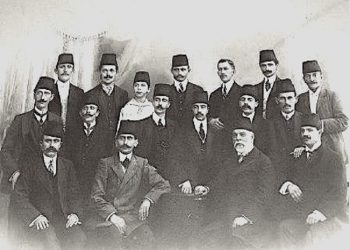
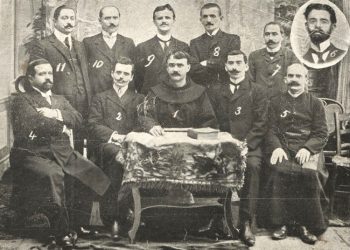
At the beginning of the 20th century, in 1908, still under occupation, prominent personalities of all-Albanian culture and politics gathered in the city of Manastir and “standardized” the alphabet of the mother tongue, the one we have today. With Latin letters, Western ones.
The banning of books and their burning, when Albania was under the Ottoman Empire, was also done to fulfill the chauvinist desires and projects of the neighbors; “Albanianism” was fought, so that the empire could rule by dividing and maintaining the balance it needed in the Balkans, while when Albania was invaded by the Italian fascists in 1939, as books of their propaganda entered in large numbers, others were removed and books were burned again, as happened with the library donated by Lady Carnarvon, even when a writer was minister of education, testifies scholar A. Plasari, because in the meantime Italy had declared war on England and it was not known how much the local writer-minister could be listened to then.
Even when little Albania would become part of the great communist empire, the reasons for burning books would be political as in fascism, but also religious, again in order to rule. Different and opposing thought was fought, one could no longer believe in God, but in the ideals of communism.
The deeds resembled collective, organized madness, which from time to time exploded here and there like forest fires. The new victors would not like old books. They started the war against them during World War II. Partisans had orders to burn the houses of opponents, of those who had property, but who had studied across Europe and had rooms full of books. Libraries were thus burned as well. They were the cause.
In my book, Prisonology “Roads of Hell”, I have shown such infamous actions: even from the libraries of Shkodra, from those of the Franciscans, the Jesuits, the societies, publishers, from private libraries, etc., etc., books were taken, endless books, historical, geographical, archaeological, manuscripts and objects, relics, numismatics, paintings, etc., etc., and with convoys of vehicles they were headed… again to Yugoslavia. What remained was rechecked and a small part was taken to the city’s new library, the rest, the larger part, was burned.
Even the occupiers have not treated our books as badly. The ancient libraries, those of Apollonia and Dyrrhachium from the 1st century BC, were looted during various wars. But where are the libraries of Gjirokastra, Filati, Himara, from the 13th and 14th centuries? Korça in the 18th century had 4,000 volumes. Voskopoja, Vithkuqi, Sevasteri had libraries. In 1922, the national library was created in Tirana. It brought the books of the Literary Commission of Shkodra, about 3,000 it seems to me, and as many from the society “Vllaznia”. The entire fund of Mit’hat Frashëri…
I have shown how the library of Eqrem Bej Vlorë was taken out of his mansions and delivered by trucks to Yugoslavia, while that of the Agaj family in Brusnjë of Vlorë, with books collected over the years by minister Ago Agaj, who had studied in imperial Vienna, was burned together with the house.
We continue. The remaining libraries were strictly controlled as places of conspiracy and secret oaths, books were blocked, confiscated, removed, disappeared, killed… ships loaded with books had gone from the small port of Shën Gjin to Split or other ports in Yugoslavia, to the first ally, first also in danger, because “paper was not enough there to print the newspaper ‘Borba’ (?!)” and old books in Albanian, Albanology and liturgical language, historical evidence and documents, etc., would be shredded with all kinds of presses as once they had wanted to do to their collectors or creators, and thus the old libraries would become pulp to be recycled into white paper like oblivion.
This criminal deed would be repeated in different forms and ways even when relations with Yugoslavia were broken, and later when they were broken with the Soviet Union and with China; the epidemic of breakups became dominant, the reasons would be declared political.
The movements of ’68 abroad across Europe, the cultural revolution even further away, in Asia, made the party-state, that of the Dictatorship of the Proletariat, although the country had no proletarians, incite the youth to tear down temples of religion, churches, mosques, tekes, whatever they found in front of them, and thus Albania would be declared by constitution the first atheist country and the only one in the world. Along with icons and religious images, Bibles and Qur’ans, all religious books, poems, were thrown into the fire.
In our house, there have been two raids, assaults against books. Once in Berat, before my father was arrested, not long after the victors had taken power, a large horse-drawn cart stopped at the gate and the police said they had orders to take books, as many as possible; they filled the cart. And the second time in Lushnja, when I was arrested, they came for inspection, saw the books, “you have forbidden books,” they said, and took several along with my manuscripts, diary, poems, stories, 39 notebooks and pads, etc.
Meanwhile, in prisons, the few books we had, we passed from hand to hand and from prison to prison; the camp libraries themselves – some dark room like the cells – were terribly poor, with Enver’s red books, some Marxism-Leninism, and leftover, shabby literature…!
The prison commands from time to time also spread an epidemic through bad food, by means of their doctor and cooks, a continuation of the war to weaken the prisoners, the enemies of the regime…!
Even the Command of the great prison – Albania – took care strictly that its ideological epidemics, spread everywhere equally, would produce effects as stable and strong as themselves, passing them also through spiritual food, literature and the arts…! Memorie.al