
From Bashkim Trenova
Part Two
NAZBOLSHEVISM – LITERATURE AND THE ARTS
FOREWORD
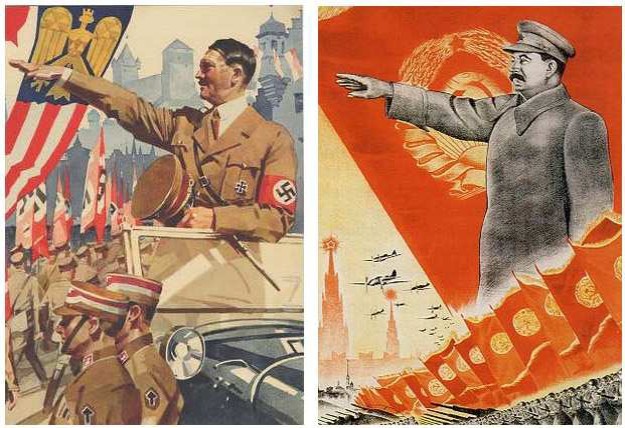
Memorie.al / Historians, political philosophers, intellectuals of different schools or different positions have dedicated thousands upon thousands of pages, entire volumes, studies, and articles to the comparison between Nazism and Communism. Generally speaking, their publications and studies focus on the police control of society by these dictatorships, on the role of the dictatorial state hierarchy and the head of state as suppressors of free thought, on the omnipresent role of official propaganda in society, on the mass massacres and the network of concentration camps, on the activities of the police, the NKVD in the USSR (later the KGB) and the Gestapo in the Third Reich. In his book “Le Passé d’une illusion” (The Past of an Illusion), François Furet notes that Nazism and Communism share the same opposition to liberal democracy and to what they call “capitalist bourgeoisie.” Both ideologies claim to be socialist and use the image of socialism. Communist countries called themselves “socialist.” “Nazism” is an abbreviation of National Socialism.
Continued from the previous issue
The Nazis applied the same practice regarding the censorship of artistic creativity in the countries they occupied, such as France, Belgium, and elsewhere. In France alone, as a result of police operations, “713,382 books were confiscated and destroyed…. More than ten publishing houses deemed anti-Nazi or Jewish were closed…. On September 28, 1940, the Otto List was drawn up and was required to be implemented in all bookstores, publishing houses, and libraries…. As a result, 1,600 titles were banned, including those that criticized Germany or were judged as anti-German…. In July 1941, publications by English, American, and Polish authors were persecuted and destroyed….”
On July 8, 1942, a second list appeared, banning 1,170 books, while on May 10, 1943, Otto List 3 banned another 739 publications.” During the years of the Nazi dictatorship or Nazi totalitarianism, Germany was covered by a true terror that was also supported by law. It is a known fact that from December 1, 1933, the merger of the state with the Nazi Party was legally approved in Germany. And, since truth was a monopoly of the Party — i.e., since only one truth was accepted, since Hitler and the Nazi Party were one, i.e., Hitler — then any thought, any literary or artistic work that infringed upon this “principle,” also called the “Führerprinzip,” was persecuted, imprisoned, suppressed, and destroyed.
A number of writers such as Erich Mühsam, Kurt Hiller, Willi Bredel, etc., were arrested and imprisoned or ended up in the infamous concentration camps. Ernst Wiechert, who in 1933 and 1935 dared to encourage students at the University of Munich to criticize the Nazi regime, was arrested and interned in Buchenwald. Ernst Wiechert is also the author of the novel Der weiße Büffel oder Von der großen Gerechtigkeit (The White Buffalo or Of Great Justice), which in the form of a legend denounces the Nazi regime. Among the most well-known writers of the time persecuted by the Nazi regime for insulting the values defended by the Nazi Party, we can also recall Johannes R. Becher, Hans Lorbeer, Ernst Toller, and Erich Mühsam.
Jean-Michel Palmieri, in his speech at the Seminar of M-A Macciocchi – Paris VIII – Vincennes 1974-1975, UGE Edition-Collection 10-18 1976 – mentions the above, adding that Tucholsky was also subjected to brutal and bloody lynching by young Nazis in uniform, while Else Lasker-Schüler was beaten to death. Others like Ludwig Renn or Carl von Ossietzky were threatened with death or died as a result of inhuman treatment by the Nazi regime. Likewise, writer and poet Alfons Paquet, arrested and imprisoned by the Gestapo in 1935, died in 1944. Faced with such a situation, many scientists, architects, professors from German universities, writers, poets, etc., took the path of exile.
Among them are Bertolt Brecht, the poet and dramatist Franz Werfel, Leonard Frank, a pacifist writer and laureate of several awards, Georg Kaiser, poet and dramatist, Alfred Mombert, poet, René Schickele, anti-militarist novelist, Fritz von Unruh, novelist and dramatist, laureate of several literary awards. In truth, “it is difficult, not to say impossible, to name a single world-renowned German or Austrian author who did not emigrate.” “Hitler’s seizure of power in 1933, as well as the ‘Anschluss’ (annexation) of Austria in 1938, was accompanied by a mass emigration of the intellectual and economic elites of these two countries: about 500,000 people left the country, of which more than a quarter (130,000) went to the United States.”
In this exodus, writers represented only a small minority, about 1,500 people, but among them were the brightest minds of the Weimar Republic…! The historian Peter Gay would express it with the words: “The departures caused by Hitler represented the most significant displacement of intelligence, talent, and knowledge that the world has ever known.” Some writers, opponents of Nazism, remained in Germany nevertheless. Among the best known are Gerhard Hauptmann, Erich Kästner, and Wolfgang Koeppen. At best, they were forced to limit themselves to non-political topics, to write in order to hide their works, or to remain silent — i.e., not to have the right to write.
Thus, for example, Erich Kästner, an author known for his publications for young people, for denouncing militarism and the far right, was forbidden the right to write by a decision of the Reich Chamber of Literature. Let us quote the relevant decision: “The President of the Reich Chamber of Literature, Mr. Erich Kästner… as a result of a new decision of the Chamber, the special authorisation to write that we granted you… are hereby withdrawn. You, therefore, no longer have the right to exercise your activity as a writer within the framework of the competences granted by the Reich Chamber of Literature. Any violation of this professional ban will be punished with severe penalties, in accordance with Article 28 of the first decree implementing the Law on the Chamber of Literature.”
In Nazi Germany, in September 1933, the Reich Chamber of Culture was created. This Chamber controlled all artistic and cultural creativity and activity in the country. It consisted of the Reich Chamber of Film, the Reich Chamber of Music, the Chamber of Theatre, and the Chamber of the Press, the Chamber of Literature, the Chamber of Fine Arts, and the Chamber of Broadcasting. As far as literature is concerned, any type of publication sees the light of day only if it complies with the requirements of the Chamber of Literature, after prior “positive” censorship and its approval. For publications of a theoretical nature, approval is given by the Party Control Commission for the Protection of National Socialist Literature. Through these institutions, authors, as well as the reading public, are required to abandon any critical reflection on reality and to submit entirely to the prefabricated schemes served by Nazi ideology and ideologues.
First and foremost, they are required to instill in the mind of every German, even every child, the “saviour” role of Hitler, the gospel of Mein Kampf. Thus, for example, in the book by Maria Schmidt and Hermine Morgenroth titled: Kinder, was wisst ihr vom Führer? (Children, what do you know about our Führer?), published in 1933, the authors write: “When Germany signed the armistice and had to bow before the demands of its enemies, Adolf Hitler, seriously ill, had taken to his bed. At the end of the war, the English had dropped dangerous bombs filled with poison gas. One of these bombs exploded in front of Adolf Hitler’s face. He felt a powerful burn, staggered, then everything went dark; he was blinded for weeks.
While lying in his hospital bed enduring great suffering, he heard talk of the humiliation of his people. You all know that in these, the most difficult days of his life, Adolf Hitler heard an inner voice in his heart for the first time. It was the great day when the true God chose him as the saviour of his people. When heaven restored his sight, he left the sickroom, unwaveringly determined to lift the German people out of misery and to lead them towards a new brilliance. To work hard to accomplish his mission, Hitler returned to this city, which he loved as his birthplace, to Munich…! Thus day after day, Adolf Hitler sought to convince the masses. They wanted to listen to him and said: ‘He is the one who is right’!”
Also in 1933, Erich Beier published a book about Hitler, written for German children and youth. The book sings hymns and praises to the Nazi leader, his life, his youth in Austria, and the Nazi seizure of power in Germany in January 1933. Another book about Hitler is Mit Adolf Hitler auf Festung Landsberg (With Adolf Hitler at Landsberg Fortress), published in 1939, written by Hans Kallenbach, a participant in the 1923 military putsch organized by Hitler. The book saw at least four editions by 1943. The author writes his memories of the time when, together with Hitler, they were imprisoned after the failed putsch to overthrow the Weimar government. Books dedicated to Hitler are numerous. One such is Adolf Hitler: Das Werden einer Volksbewegung (Adolf Hitler: The Making of a Popular Movement).
Its author is Philip Bouhler, an SS general who, in 1939, was tasked by Hitler with implementing the “Aktion T4” program for the extermination of the mentally ill and those with physical disabilities. The book was published in 1932 and then reprinted several times. On page 49, the author writes: “Worshipped as a god by the mass of his followers, hated by his frightened enemies, admired by his circle for his qualities as a chief, fighter, and man…! Adolf Hitler stands today at the head of the German popular movement, which he knew how to forge. As Chancellor, he has led the German racial community to the threshold of a new era. An unknown, an anonymous figure, undertook to challenge a system, to confront a new era…”
Fritz Steuben is another name on the long list of authors inspired by racist, Nazi ideology. His publications reached a circulation of 790,000 copies in the 1930s. In 1933, under the pseudonym Erhard Wittek, he wrote the novel Durchbruch anno achtzehn. Ein Fronterlebnis (Breakthrough in Year Eighteen. A Front-Line Experience). The events of the novel take place on the fronts of the First World War. At the centre are the 1st Battalion of the von Steinmetz Rifle Regiment, the final victorious offensive of the German army to capture the Chemin des Dames in May 1918, German heroism, the figure of the little volunteer Schmidt I who, with his big heart, withstands all the horrors of war, the figure of von Ravenstein, the battalion chief, courageous, far-sighted, and always attentive.
Although the events are set in the years of the First World War and Hitler is not a character in this book, the cover and the comments made about it in the form of an afterword or supplement make the continuity between the Führer and the Steinmetz battalion perfectly clear. We might also mention here the thanks expressed, also on the cover, to the Führer of the Reich. The author himself, on this occasion, expresses regret and condemns himself for not having conveyed the importance of the Nazi message in the novel from the beginning. He does not hesitate to add that, as he puts it, Germany owes it to Hitler, this “unique man,” who “suddenly made her pure again.”
The Nazi Party daily Völkischer Beobachter and other Nazi press organs, conveying the Nazi opinion on this publication, assess on the front page of the book the fact that: “The Reich has found itself.” According to Nazi criticism, even the concepts missing from the novel are nevertheless present there, especially that of ‘Führertum’ (the fact of commanding). Indeed, this concept, as well as that of ‘Sozialismus der Front’ (Socialism of the Front) present in the book, is assessed as decisive in the foundation of what is known in Nazi terminology as ‘Volksgemeinschaft’ (people’s community).”
Even the Nazi ideologue and theorist Curt Rosten, in his book Vom Bonzentum zum Dritten Reich (From the Era of the Mandarins to the Third Reich) published in 1933, extolls the role of Hitler in the development, within just a few months, of the German economy and even the achievements in the social field. The book’s primary objective is to show the responsibility and guilt of the Weimar government for the ruin of Germany and the corruption of the German spirit! Curt Rosten, author of several books, does not hold back in his eulogies and super-eulogies of Hitler.
Even before turning the first page of Vom Bonzentum zum Dritten Reich, in the foreword written by the author himself, we read: “This work aims to provide an overview of everything our leader achieved for the German people during the few weeks after his coming to power, despite the great difficulties that opposed his ever-sincere wishes. In particular, it will be shown how the leader’s overwhelming will awakened his comrades and led them out of the chaos of the Marxist leaders towards the triumph of the Third Reich. The book aims to be a lasting remembrance of the time when our people’s chancellor, Adolf Hitler, succeeded in uniting the German people after 14 years of maladministration, corruption, and unprecedented fragmentation in the political and ethnic sphere.
May heaven bestow its rich blessings on our esteemed leader as he continues his difficult task? Berlin, July 1, 1933. Dr. Rosten” In the same vein is H. Thimmermann. In his book Der Sturm auf Langemarck (The Storm on Langemarck), he describes the entry of German troops into France, using a familiar Nazi, revanchist language such as: “in the end you won,” “what we once did not achieve, despite our painful devotion, our heirs achieved.” Furthermore, after singing hymns to the Nazi army, he expresses himself in a similar, hymn-like vocabulary, addressing its “truly great Führer.”
Besides prose writers, authors of novels and books with an openly ideological, political, racist character, many German poets of the time also sang to the greatness of the Führer with passion and unbridled imagination. Thus, for example, Josef Weinheber dedicated a poem to the Nazi leader on the occasion of his 50th birthday. The author goes into a delirium. Here are some verses from this poem: “Genius of Germany, heart and head of Germany, / The honour of Germany has long been stolen. / Power of the sword, the only one in whom the land trusts. / Fifty years and an Aryan work. / Superman, you have grown from suffering. / Infallible and saintly, you assault the heavens. / our saviour, our suffering, you who conquer the dark forces, / Gather also the fruits of your work, accept this crown and these songs: / Rest in our love and long life to you.”
Another delirious poet, Herbert Böhme, dedicates a poem to Hitler in the same spirit. Among his verses we read: “A trumpet traverses Germany, / and he who plays it is he, who leads, / and those who follow him follow him in silence, / they are chosen by him. / Under his flag they pledge him faith, / Loyalty and obedience, / with his trumpet, he determines their fate / With an Aryan face. / And if once he marched in darkness / Alone to open the way, / the dawn today breaks, / we surge towards him. / Awakened by the beats of his trumpet, / We are the seed of the new Reich, / We sow our land, / And, by God, we will soon be ready for action, / Our Führer advances towards the light, / With all his energy, / From the tremors of his trumpet, / You, German racial community, / Turn into passion.”
The Nazi poets did not spare their praises for Hitler, but he too did not fail to honour them with titles and with his presence at formal literary festive ceremonies, which in fact served as propaganda platforms for the regime. An article published in the Berliner Lokal-Anzeiger of May 2, 1936, helps to create an idea of the above. The article stems from the magnificent ceremony organised on the occasion of awarding the National Book Prize for 1935-1936 to the poet and SA Lieutenant Colonel, Gerhard Schumann, for his poetry collection Wir aber sind das Korn (We, However, Are the Seed). / Memorie.al