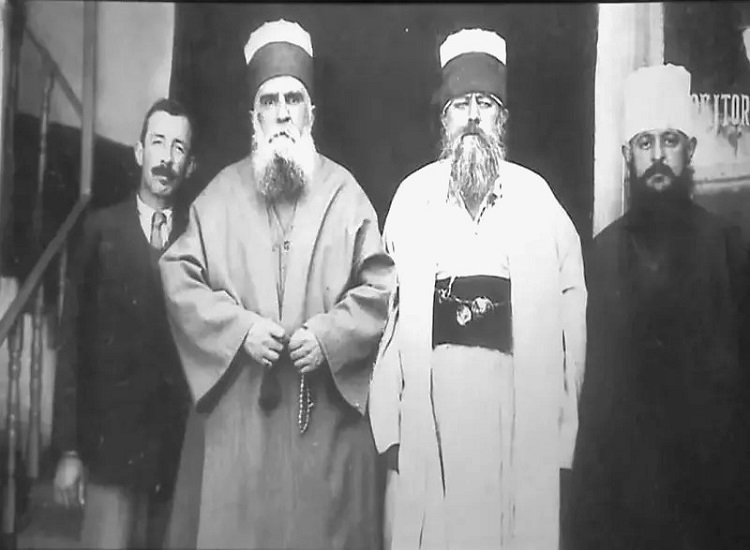

Memorie.al / In the family of Veliko Malile in Gjirokastër, all of life would end the day he was arrested. The year 1947 would mark the end of their peaceful and happy life. He was one of the wealthiest merchants in Gjirokastër, but the communist regime had targeted him from the very first days to arrest him and seize all his wealth. They accused him of being part of a hostile group of five people, led by Baba Kamber of Berat, the Baba of the Suha Teqe. From that group, a death sentence was given to Baba Kamber, who was shot, while Veliko Malile and Milto Lito were sentenced to life imprisonment.
The torture in the investigation would be terrible, and the real reason for it was the surrender of gold. Besides him, his wife was also subjected to torture, about which Sezar Malile testifies: “They even put a cat in my mother’s womb (lap/skirt – idiomatic for extreme duress) to make her hand over the money.”
Veliko Malile would first be imprisoned in the Gjirokastër prison, where he would be held in isolation for 2 years, and then he would be sent to the Burrel prison. In his family, everything would take a turn for the worse in July 1949, when his son, Sezar, was also arrested. He would be held in interrogation for nearly 10 months and then sentenced to 12 years in prison for attempted escape.
Sezar would spend part of his sentence in the terrible forced labour camps of Maliq and Kavajë, but he would serve the rest of his sentence in Burrel, in the prison where his elderly father had also been held in isolation for a long time. Sezar recalls the meeting with his father in Burrel prison like this:
“In Burrel, I also found my father. We became father and son in prison. He was dying. He was old; he couldn’t cook, nor was he able to take care of himself. Very weakened. And he would urge the family members to take care of me, for his son. ‘Look after my son, because I am passing,’ the poor man would tell them. Sacrifice! But when I went to Burrel, we managed somehow because I cooked, washed his clothes, and took care of him.”
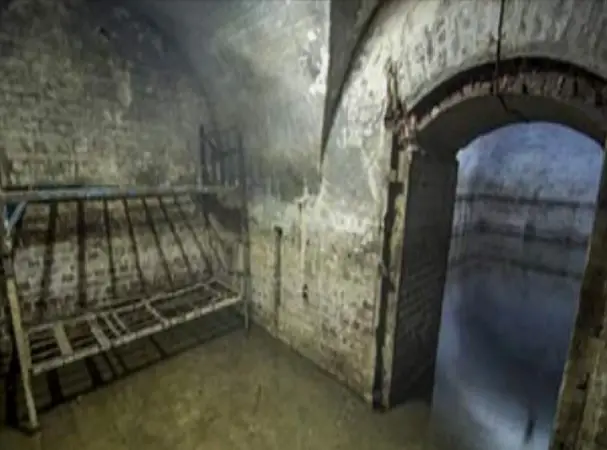
Sezar stayed in Burrel prison for 3 and half years, until December 1957. The terrible living conditions there, he describes with these lines: “Burrel was very harsh, firstly because it was overcrowded. The rooms were packed beyond measure. Secondly, using the bathroom was very difficult. The possibility to relieve oneself was very limited. For that purpose, they had placed two large pots at the end of the room.
For everyone. The old men had a small pot; they urinated in the small pot. The old man urinated in his pot, because he couldn’t wait in the line for the big pot: to take the big pot, go and clean it in the bathroom, wash it and bring it back to the room, which we would do during break time when we went out into the yard. So, the one who was old used the small pot. The rest of us used the big pot, until the pot was full to the brim.
But, when it happened that the pot broke, what were we to do? When the pot broke, the feces would spill onto the floor, and we didn’t have a rag to pick it up with. We would knock on the door, but no one would open it for us. This was the most terrible thing about Burrel: the pot. And going outside was another problem: one hour in the morning, one hour in the afternoon.”
December 27, 1957, would mark the end of prison for Sezar Malile. He should have been happy, but was that possible? In prison, he was leaving behind his elderly father, who had not yet finished his sentence, while outside; an terribly difficult life awaited him. His father would remain in prison for another year, while he himself had to find shelter and a job.
“I left my father in prison. When I came to Tirana, I asked for a residence permit, but they didn’t give me one. They expelled me and sent me to Kavajë. I went to Kavajë with mattresses under my arms. To the Kavajë saltworks. Where was I to stay? I had no money or anything. Where would I go? There at the saltworks, there was a building; I worked and took shelter there… My father came out of prison a year after me.
I was in Kavajë at that time. After a year, I had finally managed to find a room. When my father came, my mother also came, who until then had been staying with my brother. So I made my nest there. Little by little, with one piece of cloth, with one thing here and there, we sort of made a little home. We took some corncob husks and made mattresses, because we didn’t even have a mattress.”
For Sezar, internment or expulsion was even harder than the prison period.
“I didn’t know where to go. In God’s hands. If they interned you, you were completely destroyed. The home was destroyed. When they put you in prison, the house remained, the nest remained. So internment was destruction. The darkest day, that was it.” / Memorie.al