
By Bashkim Trenova
Part One
NAZIBOLSHEVISM – LITERATURE AND ARTS
PREFACE
Memorie.al / Historians, political philosophers, intellectuals from various schools or different positions have dedicated thousands upon thousands of pages, entire volumes, studies, and articles to the comparison between Nazism and Communism. Generally speaking, their publications and studies focus on the police control of society by these dictatorships, the role of the dictatorial state hierarchy, the head of state as a suppressor of free thought, the omnipresent role of official propaganda in society, the mass massacres and the network of concentration camps, the activity of the police – the NKVD in the USSR (later the KGB) and the Gestapo in the Third Reich. In his book “Le Passé d’une illusion” (The Past of an Illusion), François Furet notes that Nazism and Communism share the same opposition to liberal democracy and what they call “capitalist bourgeoisie.” Both ideologies claim to be socialist and use the image of socialism. Communist countries called themselves “socialist.” “Nazism” is a shortening of National Socialism.
There are certainly authors who place an equal sign between Nazism and Communism, but there are also those who see great differences between them, as well as others who accept nothing in common in ideology or in the politico-social systems established in Soviet Russia after the October Revolution and in Germany during the Nazi period.
The object of this publication is limited. It merely seeks to “reconstruct” only an important part of the life of German and Soviet society under the Nazi dictatorship in Germany and the Bolshevik one in Russia. Regardless of viewpoints and positions, it is generally accepted that German society and Russian or Soviet society, respectively during Nazi and Communist rule, were subjected to powerful state propaganda that mobilised and controlled the media.
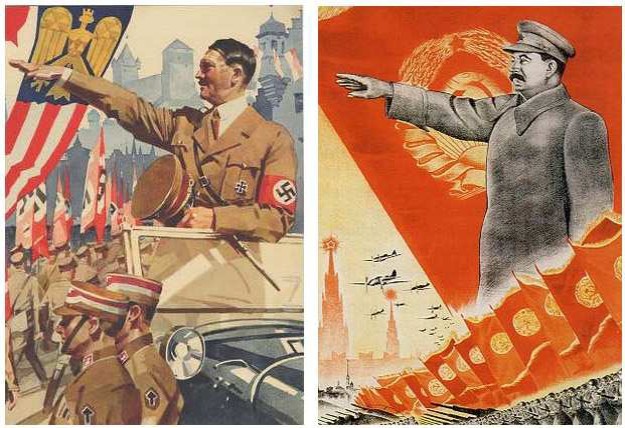
This power also instrumentalised artistic life and turned it into a powerful propaganda tool. Thus, official artistic styles emerge and “flourish”, while what is deemed “degenerate art” is forbidden. The literature and arts of this time, both in Russia and Germany, have the task of hymning the state and party leaders, serving their cult and ambitions, propagating the greatness and strength of the Third Reich and Soviet Russia, making people believe they are happy and joyful, accepting an imaginary world that is trumpeted as real.
Literature and the arts must necessarily serve the creation of a robot human, commanded by the press of a spring from above, without needing to think – indeed, they must not think, it is forbidden, otherwise they are declared enemies, deviationists, traitors, agents of foreigners. And the end is known. “Nazbolshevism – Literature and Arts” also aims to present this gloomy, sad, and suffocating picture. It consists of five chapters, specifically: Chapter I – Literature; Chapter II – Music; Chapter III – Film; Chapter IV – Theatre; and Chapter V – Painting and Sculpture.
The ordering by chapters is subjective. Each chapter reflects the activity of artists in the respective field, their productivity, their obligations to the dictatorship, the themes they cultivated, the pursuits and persecution of many of them, who willingly or unwillingly did not come to terms with the dictatorship, and even of those who served it diligently. Each chapter also deals with the decisive, medieval-despot role of the Führer or Vozhd regarding the fate of a novel, drama, film, painting, sculpture, and their authors.
“Nazbolshevism – Literature and Arts”, by chapter, first treats Nazi Germany in the respective field, and then Soviet Russia or the Soviet Union. Bolshevik Russia has a longer lifespan than Hitler’s Germany. Thus, it occupies a larger place and a more extended time span in this publication. At the end of each chapter, references for the cited works and authors are placed. This does not include the political leaders, works, authors, press, etc., that are cited in the text during its exposition.
The Author
Chapter I
LITERATURE
At the end of World War I, Germany was gripped by a deep, all-encompassing crisis. The country was threatened to sink into a bloody civil war. The economic oligarchy saw in Hitler, the leader of the German National Socialist Party, the saviour against communism. The German people, in utter despair and misery, also sought their “saviour”. In this vein, alongside political war and firearms, the Nazis used literature and the arts in general as weapons. This is expressed in the creation of a national, “pure” “culture”, and on the other hand, in the prohibition of a series of artistic movements judged as “decadent”, “dangerous”, “anti-German”.
Literature and the arts, according to Nazi criteria and terminology, were limited to two completely different and incompatible categories: “Nazi” and “degenerate”. The Nazi slogan of the time is well known: *Das Buch, ein Schwert des Geistes* (The book, a sword of the spirit), which essentially expresses the Nazi military, combative concept of the role of literature. Let us also recall that Hitler titled his only book “Mein Kampf” (My Struggle).
For Hitler and other Nazi leaders, the writer is seen and valued simply as an obedient soldier, like a medieval knight, who with his sword blindly serves his prince, his king, cutting off heretics’ heads, defeating incompatible, rebellious spirits, “sculpting” everyone’s thought, everywhere and always, according to the ordered model, according to Hitler’s “holy” word and “supreme reason”. The task of literature, in short, is to strip man of the essential, of his identity, of his being human, to denature him, to turn him into a mechanism, into a dangerous button in the hands of the new political religion, Nazism.
For this purpose, among other things, starting in 1934, the Nazis organised every October the “German Book Week”, in which about 60 million people were expected to participate or, to use the language of the time: “a whole racial-popular community”. Meanwhile, “generosity” was not lacking when it came to the book, to getting it to the reader. Not infrequently, certain mechanisms or institutions, e.g., the Literary Chamber, as well as high-ranking Nazi Party officials, instead of food, distributed free copies of *Mein Kampf*, *Our Love for the Army*, *The German Army*, etc. For the Nazis, the book had to be ingested by various strata of society, from all levels: peasants, workers, men, women, adolescents, the elderly, intellectuals, rational or irrational, fanatical or reluctant.
The book itself had to ingest them simultaneously. In this double subordination, the subject matter treated in Nazi literature is varied and not necessarily directly and openly linked to Nazism and only Nazism. To make readers dependent on the book, the Nazis manipulated everything related to or conditioning the activity of the individual or society as a whole: superstition, mysticism, conscience and the subconscious, obscurantism, the subjective, the fictional, history, legends, and everything they judged to serve the foundations of their ideology, their ambitions, especially the cult of the leader as a model, which feeds the “little man’s” dream of ranking among the members of an elite, of being also a kind of “Führer”.
As the Germanist, professor, founder and former director of the collection “Germany Yesterday and Today”, Thierry Feral, writes, German literature of the Third Reich, i.e., during the years of Nazism in power, like any artistic activity, “served not only to glorify the Führer and the superior Aryan race, but also to spread hatred, violence and death… a call for the return to the throne of barbaric and primitive forces”. Obscurantism could not and did not come to terms with progressive, democratic German literature, nor with foreign literature, which was declared heretical or an enemy of the “Germanic renaissance”, i.e., of the Third Reich.
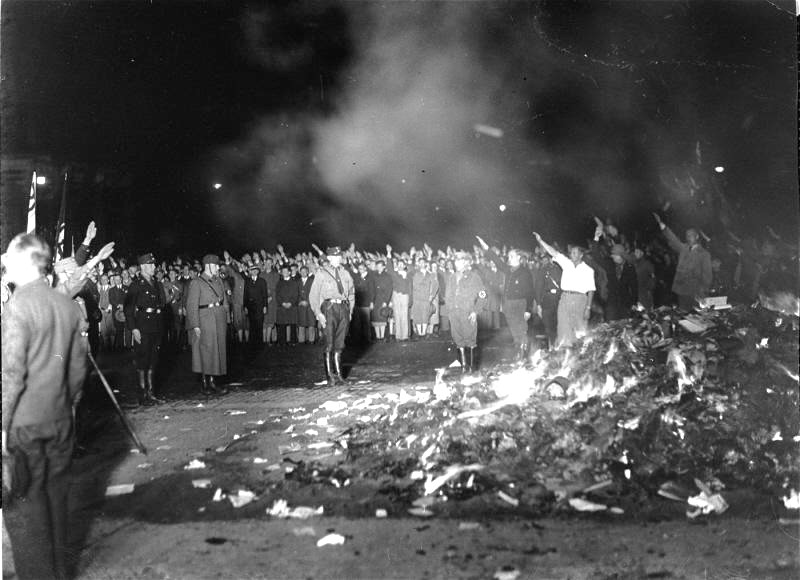
Thus, on May 10, 1933, in the Berlin Opera Square, in the presence of over 70,000 excited people, more than 25,000 books by over 400 domestic and foreign authors were thrown into the flames and incinerated, including works by Heinrich Mann, Ernst Glaeser, Erich Kästner, Sigmund Freud, Friedrich Wilhelm Förster, Emil Ludwig, Werner Hegemann, Theodor Wolff, Georg Bernhard, Erich Maria Remarque, Bertolt Brecht, Lion Feuchtwanger, Alfred Kerr, André Gide, Jack London, Kurt Tucholsky, Carl von Ossietzky, Karl Marx, and Karl Kautsky.
Their selection was made based on the Schwarzen Listen (black list) drawn up in advance by the Ministry of Popular Education and Propaganda. Joseph Goebbels, head of this Ministry, in his speech on the occasion, among other things emphasised: “Students, men and women of Germany,… you act rightly in this late hour by entrusting to the flames the intellectual decay of the past… from their ruins the lord of a new spirit will rise victorious.”
Indeed, as will be expressed 80 years later by Professor of Literature at the Free University of Berlin, Irmela von der Lühe, quoting sociologist Helge Pross, the Nazi book burnings were simply a “decapitation of Germany’s intellect”. We recall that in his speech at the 7th Congress of the Nazi Party, Hitler stated without any hesitation or implication: “It is not cleverness that delves into subtleties that saved Germany from destruction, but your faith… because your heart alone commanded you, because only an inner voice dictated to you…! Reason would not have advised you to come to me, but only your faith commanded you.”
Mass fires for the same purpose were lit in 22 German cities. In each case, books were brought to the squares by truck by the SA (Sturmabteilung – Nazi police). Their burning was accompanied by the same ritual, the same supposedly patriotic extremist phrases, the sound of trumpets, and crowd chants. They were incinerated accompanied by Goebbels’s racist and obscurantist shouts: “Against degradation and immorality, against the humiliation of feelings and political treason, for the welfare of our racial-popular community and the state, against… the corruption of the spirit, for the nobility of the human spirit, against the falsification of our history and humiliation of its great figures, for respect for our past, against literary treason towards the soldier of the Great War.
For the education of our racial-popular community with a warlike spirit, against impudence and arrogance, for respect for the immortal German spirit.” History knows no such burning of books on this scale, not even in the time of the Inquisition, as that done by the Nazis in Berlin, Bremen, and other German cities. In this picture, medieval obscurantism is a modest model if compared to Nazi obscurantism.
A century earlier, Heinrich Heine, one of the greatest German writers of the 19th century, had prophetically warned in his tragedy Almansor (1821): “Where they burn books, they will ultimately burn people.” Hitler and his followers certainly could not be satisfied simply with the incineration of German or foreign literature designated as enemy.
The “sanctification” or inviolability of Nazi ideology could not but touch other areas related to the book, so to speak, the entire literary market (theorists, production, distribution, censorship, etc.). Thus, in parallel with the mass burning of “heretical” books, the Nazis confiscated thousands of books from public and private libraries, bookshops, political and trade union organisations, and religious libraries.
In 1935, they made the first list of “harmful and undesirable writings”. It registered 12,400 book titles and complete works of 149 authors of Marxist, socialist, pacifist literature, and generally of those reflecting humanist and democratic opinions. The literature included in this list, as well as the respective authors, were classified as degrading to the nature and culture of the German people. They were also accused of the “crime” of not accepting the notion of race.
In this vein, books of “degenerate”, “decadent” art were confiscated. Similar actions were repeated during the years 1939-1941. In June 1941, the Nazis institutionalised censorship through a detailed decree addressed to the heads of the Sicherheitspolizei (security police, created in 1936 by Heinrich Himmler) and those of the Sicherheitsdienst (SS secret service, created in 1931 by Reinhard Heydrich under the direction of Heinrich Himmler).
The confiscation of books continued until 1945, i.e., until the end of the Nazi regime. In this framework, Max Amann, chairman of the Reich Press Chamber, closed Catholic and independent magazines or forced their owners to transfer their publishing houses to the Nazi Party, its publishing house Eher-Verlag. Hundreds of magazines were forced to close. In 1933, there were 3,000 magazines in Germany.
Of these, only 6,975 remained in 1944. Eher-Verlag published 80 percent of the German press. Jewish publishing houses, accused of “militating to decompose Germany”, to “Judaize” it, of course, were not spared. They were closed or forced to emigrate. Such is the case of the “Fischer” publishing house. The catalogues of another Jewish publishing house, “Rowohlt”, were banned or destroyed.
The Nazi and pro-Nazi press, among them the magazine Die Neue Literatur (The New Literature), systematically denounced “dangerous” Jewish publishers. “No compromise with the Jews,” writes its publisher Will Vesper, known especially for his odes to the Führer as well as for his stories and reviews. He became a spokesman for Nazi ideology, demonstrating in particular the ugliest nationalism and anti-Semitism. In February 1937, in his brochure *Geschichten von Liebe, Traum und Tod* (Stories of Love, Dream and Death), filled with racist and Nazi ideas, against Jewish publishers.
Vesper writes: “When a young German girl has relations with a Jew, both are rightly condemned for racial defilement (*Rassenschande*). When a German writer and a German bookseller maintain relations with Jewish publishers, is this not an even more serious racial stain, even more dangerous”? Always with the same hatred towards Jewish publishing houses, this Nazi author wrote: “However, it is by no means enough to catch some of these rats and throw them out. We must find a way to absolutely protect the German people against the insidious tricks of all Jewish publishing houses in the world.” / Memorie.al