



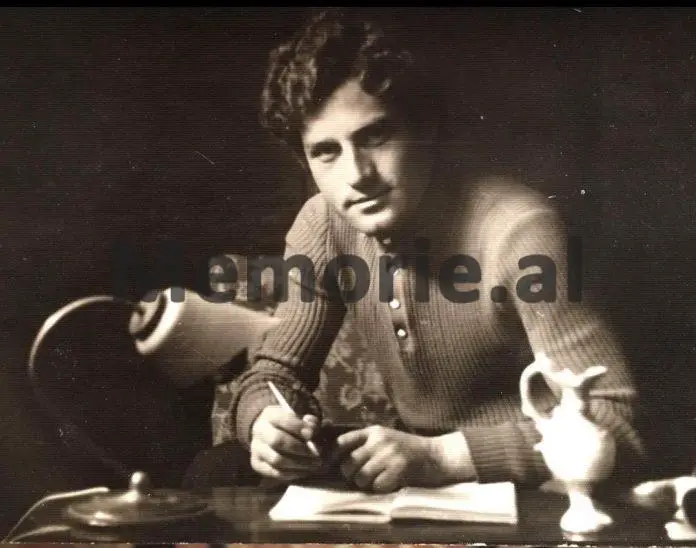
From Visar Zhiti
Part One
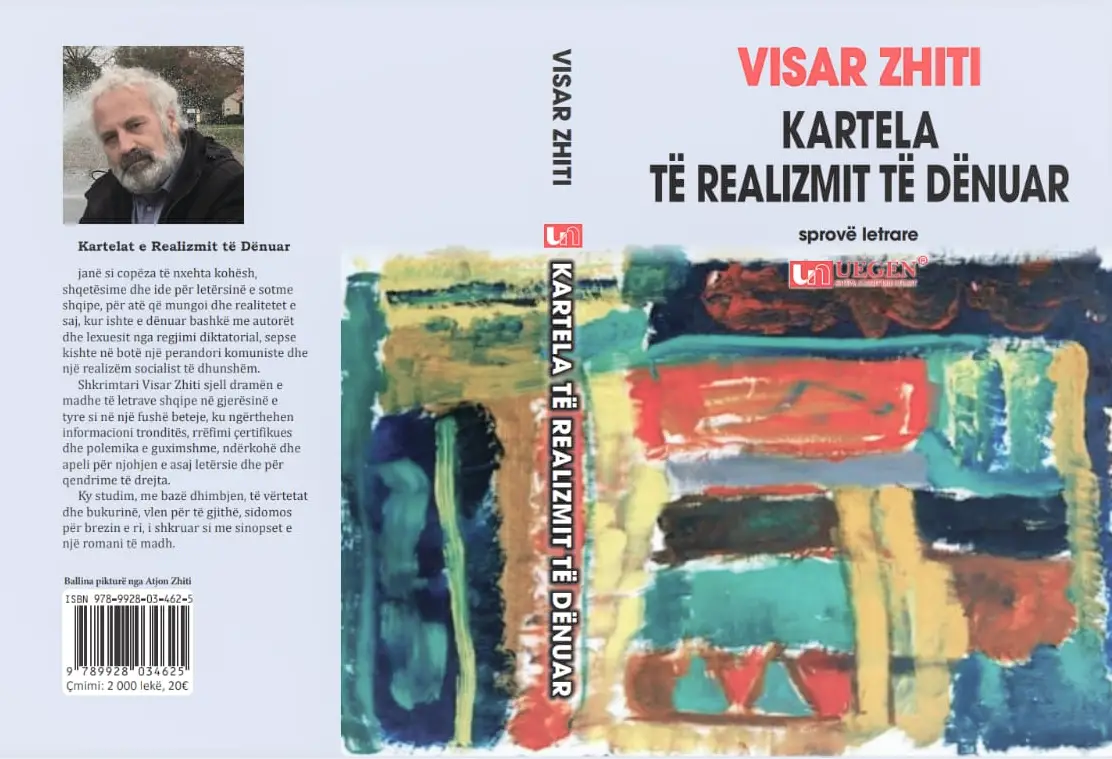
Cards of Condemned Realism
and
The Underground Pantheon
An ordeal after prison for others and myself
2020
Wandering the streets of other cities, you may be a foreigner, a pilgrim or a visitor, perhaps in search of some museum or other bookstore, theatre, or just taking a carefree stroll, it happens that you see small marble plaques on the walls, beside gateways, and also on the pavement where you are walking, on which it is written that a distinguished person once lived there, a writer, scientist, leader, or that right there a great work was written, one that marked an epoch.
It happens that you also find verses beneath your feet; you are stepping on poetry as if on exultation. And you remember having read about this name engraved there, you have his books, and you pause for a few moments. Among the people, you ask the one nearest to you to snap your camera or with your mobile phone you take a selfie.
And you enter that house, a beautiful, warm emotion seizes you, you feel like falling into thought. Where are you then, in some pantheon?
I am seized by a kind of pain, involuntarily I recall the underground pantheon of my homeland, above, on the walls of cities, with rare plaques like those, where assassinations and guerrilla actions, historical killings or murdered history were more often commemorated. And the names of streets almost like this.
Then they began to make museums of memory in the post-dictatorship, recently, for example Bunk’Art 1, Bunk’Art 2, “The House with Leaves”, the house of…! But these show the dictatorship, its strength, its sophistications, but what about the museums of resistance, the prisons, the camps, even a simple house where people lived so cramped and secretly listened to foreign stations on the radio, read forbidden books, etc., etc.
But what about writers’ studios, where the works that are studied in schools were written? Indeed, where are the places of Albanian literature? Only in the capital? Only official literature and what about the forbidden one that triumphed over the dictatorship? And what about the other floors of memory and the ranks of the underground of hell? Naturally, it’s not the scribblers’ and armchairs’ that decide, but the values of the written pages, and those from prisons and internments. But where are they?
In the archives? Only those confiscated by the state? What care is shown for the book and for those who will read it?
When the National Library recently was once burned by fire and a year later flooded by waters? At least if they had happened together, so that the water would put out the fire, but some media wrote that there was no major damage, only books from after the 1990s were damaged, that is, those after the fall of the Berlin Wall and the collapse of the communist empire, bluntly said, the literature of Socialist Realism is unharmed, while the others lie in the ruins of their underground pantheon.
Shall we leave the sacks there? Which sacks? The prison sacks…!
Precisely old sacks, patched, with stains of earth and blood, where the condemned once… oh, you’ve taken us far back, to the slave-owning order, no, no, it’s almost now, many of those former prisoners are still alive, who in those sacks, where they kept their clothes, which might have remained even from those who had been killed, among things that were eaten, which they saved for some even worse day of hunger, they would insert pieces of paper, notebooks and pads filled with writing, their own, or of some fellow sufferer, they would keep them for him, they had it as a last request, sometimes without knowing whose writings those were, which could barely be read, they had faded, even mice had gnawed what they could, their primeval or later censorship, internal, it was all the same, all the better, because the police, if they caught them, wouldn’t understand much, nor would the state censors.
But the prisoners knew how to hide the writings…!
It was unbelievable, perhaps even to those who had filled those pages in secret, that in the prison sacks they had pressed future literature, of the suffering kind, the honest kind, saved from exterminating controls, from burnings, from socialist realism.
And it does not matter that in our archives or a library, in museums, there is not yet such a sack, nor pages with stains of earth and blood above the writing. Nevertheless, those sacks are like the mythical bags of Aeolus, full of tempests for Albanian literature.
1.
The condemnation of books: wars and epidemics…!
In the histories of peoples, not only in the early ones, with wars and towering libraries, with half-ruined colonnades and capitals still remaining, with plagues and phantoms that no longer return as before, but differently, even in the misty beginnings of the Middle Ages, when there was much barbarism and dangerous sorcery, repetition of epidemics, etc., while the illuminist light prevailed over crosses in churches and with the marble of the European Renaissance great art was made, immortal paintings and, as nations were formed, but also in more recent times, when man and his ideal renaissance took on a kind of natural halo above them like that of saints, which were meanwhile overthrown, even in the most modern epochs, where, among other things, the right to life, the joy of it, gained constitutional force, freedom of expression continued freedom of thought, preceding freedom of action, as a normal phenomenon, etc., etc., we encounter violence and punishment, exercised upon so many things, so much so that it seems as if history is a history of collective violence and dictatorial punishments, where progress may have been brought by violence against violence and the punishment of punishments. While epidemics seemed to come as a punishment from above.
But also books…!
In this ordeal or attempt, I would like to address the violence and punishment exercised upon letters and the chosen people of letters, the monstrous mechanism of which has sought their defeat and tragic ruin. It is a great undertaking and I would like the effort to show what did not submit to violence and challenged punishment as best it could, for that little literature, but not negligible, that was created in secret, in hell, underground, by the condemned.
Precisely that which I don’t know what to call better. Meanwhile, seeing and feeling marginalization, the lacks and the contrary zeal, the trampling, the oblivion and even the denial of it, I, as a witness, would be content to show that there is a literature which has come to us from the prisons, it exists, and it matters even beyond literature. But necessarily also for literature. It was achieved at the time of the ideological pandemic of totalitarianism.
Naturally, this undertaking begun early cannot end with this work, but by summarising and expanding my contribution, I want to raise awareness and encourage. To remind. I recall those scientists, anthropologists and zoologists, who with a piece of prehistoric bone found, a limb from the time of the dinosaurs, reconstruct the monster and the time of the monsters, they find out how they walked and crawled shaking the earth, how they shrieked and fed. On grass? But also on humans. Inside the remains of their bones they have distinguished human bones. And thus the epochs and the battles for life can be understood.
I shudder when I recall broken human bones, not metaphorical, found here and there, in the pits of Dajti mountain above the capital or on the plain of the Ballsh prison, of other prisons, on the lands that were once swamps, on the terrifying slopes of Spaç, in the courtyard of the Burrel prison, on the road where the massacre of Tivar took place, in the pits of the mass graves of the most recent war in Kosovo, very different from the medieval plague pits.
But there are also remaining bones of a poem, of a novel. Can a literature be raised from them?
Obviously, violence and punishment upon books and their people have not been exercised only in our country, nor are we their first designers, although we have had so few books. Just as people and their names, books too have been banned temporarily or permanently, secretly or openly, censored in whole or in part, mutilated as a slave is mutilated, their arms torn off, nose and ears cut, tongue cut out, eyes gouged out, cursed, both books and language, thrown away, have escaped and been captured again as slaves, have been carried from the land of the vanquished to the land of the victor or from the vassal people to the master people, have been burned, either alone or with others or with entire libraries, crematoria and mass graves, but also with ceremony, with not at all loathsome feasts, with dances and applause, indeed it is true that books have even been chained, for another reason, so that they could not be torn away, so that they would not be stolen, and they were called Concatenati, fastened like Prometheus or like any condemned man… and the chains often and more often changed places, passed to the authors, for longer, preferably forever, now for another reason.
Books have been imprisoned, not metaphorically in the prison of oblivion, but really they have been locked in the libraries of our days, in their Black Fund as in a row of cells like St. Peter’s or like Gregor Zamza of Kafka, like philosophers in madhouses.
In our National Library, they are marked on the front covers with the letters “R.” or “SH.R.” (Reserved or Highly Reserved), so that you would not approach them, as if they were branded with some contagious disease, cholera, hostile ideology, red plague, black plague, that damage the dictatorship and especially the health of the dictator, and this is the report of the Minister of the Interior and the personal doctor of the Great One himself, etc., etc.
Books were condemned, their authors and their readers.
Books for the crime of the truth they should not carry, the author because he charged them thus, dangerously, and the reader because he read them, because he discharged them within himself, took the sin and the curse together. The book was forbidden, thrown into the Black Fund, burned or sent to factories to be recycled into white paper.
The author was denied the right to publish temporarily or forever, was dismissed, interned, imprisoned, also executed.
The reader was punished, unmasked, fired from work, expelled to the mudflats, also imprisoned, also…
The reasons for all this abundance, first inside the human skull and then outside it, inside the entire skull of the country, are many, but also just one: do not oppose us, (…so much so that even the suspension points in sentences, those called reticence, resembled bullet holes, with their silent traces in the night air…).
The forms of massacre, of violence made daily, seem to change from time to time, but the essence remains the same: rule. With its forms.
Therefore fear, silence, ignorance must be enlisted. The ignorant are ruled more easily, so that they may even want to be ruled themselves. Thus, resistance must be hidden. Both as action and as thought.
Therefore, thinkers against thought are needed, ideologues against ideologies, just as police against opposing actions.
Meanwhile, the ignorant above may want and do want to rule the ignorant below and more numerous: a certain group, a clan, representatives of a social class, etc., etc., rule the whole country. Specialists of the word against the word are needed, just as spies who denounce it. Poets against poets, writers against writers, artists against art…t.
The spread of an ideology like an epidemic, the rule of a system that comes to power by force and trickery, also by vote as well as by arms, constitutionalises life in such a way, imposing more constraints than laws, more obstacles than rules, and simplifies it into empty, dreary survival, also taking away the time for dreariness and deceiving you with art forced into moulds that are not of art, to serve ultimately the rule, which, in short, turns out to be against you.
The literary method of Socialist Realism was never the same thing as socialist reality, indeed the opposite, even though socialist realism is part of socialist reality, not as an opposition to it, but as a murder mask. For that is what it remained.
In the communist empire, the book and its makers together with the mass reader were damaged more than anywhere else and at any other time, because literature was demanded to be openly engaged in the service of an ideocracy, alienation, by changing its essence to make it “a screw and a cog” in the great state machinery, thus spreading the flooding mediocrity of the state itself.
The Leninist prescription was surpassed; literature became also a bullet against the enemies of the system, external and internal. Especially internal. But literature was killing itself this way. Its social self. Because it had already committed suicide earlier. The testimonies and proofs still pulse. Especially in Albania.
* * *
…And precisely with the invention of writing, the prohibition of what would be written was invented at the same time, the mutual opposition began, which was resolved with two-sided violence, enlisting the epidemic of silence and disappearances.
Thus across millennia, making would confront unmaking, creation with de‑creation, natural memory with forced oblivion, learning with indoctrination, action with prohibition, disobedience with torture, from prison to the guillotine.
Meanwhile, if over the centuries writing and the material on which one writes have changed – from cave wall we have passed to clay and ceramics, then to parchment, even human skin has been used (metaphorically always one writes upon it), the all-successful paper, the typewriter, the computer, platinum CDs and USBs, etc., etc., and one does not know how far they will go, even to non‑writing and non‑word because one will speak with thought and spirit in the future, the miracle of which astounds us spellbound and leaves us speechless even now – but to return to our present, the anger and jealousies as well as the fire against what is written or the word that remains, are just as alike, just as primeval as in the past…
And I wanted to find cases of how the book has been (mis)treated through the ages, and during my research, data about plagues would come out, as if there were a connection between them.
Athens, 5th century BC. “As for the gods, I am not so competent as to say that they are or are not,” – Protagoras would assert already in the first sentence of his treatise, and immediately they would dismiss him. Get out, they told him, and they burned his treatise…
The Promethean fire that was stolen from Heaven for life on Earth, to light the night for people, to warm them in the primeval cold and make them think around it, to invent crafts, to cook game, but also clay, so that, watching those amazing dances of flames under the stars, they might imagine the dances of their beginnings, of courage and harsh joys – that fire, if you did not know how to keep it well, would become wilder than beasts and would lunge to burn your dwellings, your works, the skins on which you had drawn, the signs, the letters…
What the devil would turn fire against books?
…and Socrates would be condemned to death. Because he did not accept the gods proclaimed by the state and presented new gods. He introduced doubt as a philosopher. And Plato would suggest that in his ideal republic, above all, the creation of fables and legends should be supervised; only those that would be approved should be accepted.
Meanwhile, there were also plagues, just like wars.
I find that in Athens one fell in the years before Christ, 430–426. Typhus fever, when the Peloponnesian battles were being fought, for four years wiped out a quarter of the population. While in Rome, the “black sickness” as it was also called, shook the whole empire. The “Antonine Plague” of the years 165–180 AD, which the armies brought back with their victories when they returned from Asia, ravaged the empire, killing about 5 million people.
And another plague with the imperial name of Justinian, of the years 541–750, etc. And as if these were not enough, in Rome at that time, Homer’s “Odyssey” would be banned, for the dangerous liberties it claimed, and the state with its magistrates would place religious faith under strict control. The Senate burned piles of books of prophecies, Livy testifies.
Those who died from plagues were also burned. The apocalyptic state demanded salvation, demanded the heavenly book, and they were forced to allow the spread of Christianity.
And the persecuted books, even as far as China, from ancient manuscripts, might be allowed to remain one or at most two copies, the others were definitively annihilated. Plague also in books. They repeated themselves. That of Ethiopia and Egypt in a single day managed to devour 10,000 people, and from Constantinople it crossed the border into Europe. In France, in the year 588, the outbreak of the Black Death took 25 million people.
Pandemics until the 8th century ate half the population of Europe and the Mediterranean. While the one that came from Asia in 1348, managed to kill 75 million people in Western Europe. Rats. Timeless, of all times, not only ate books, but spread the Black Death.
Around the 14th century, warships brought to Europe, those that managed to arrive, the “bubonic” plague, because a part of them sank, as rats gnawed them so much that cracks and holes opened and water entered like a monster. Memorie.al