
WILSON AND GENC CAME…
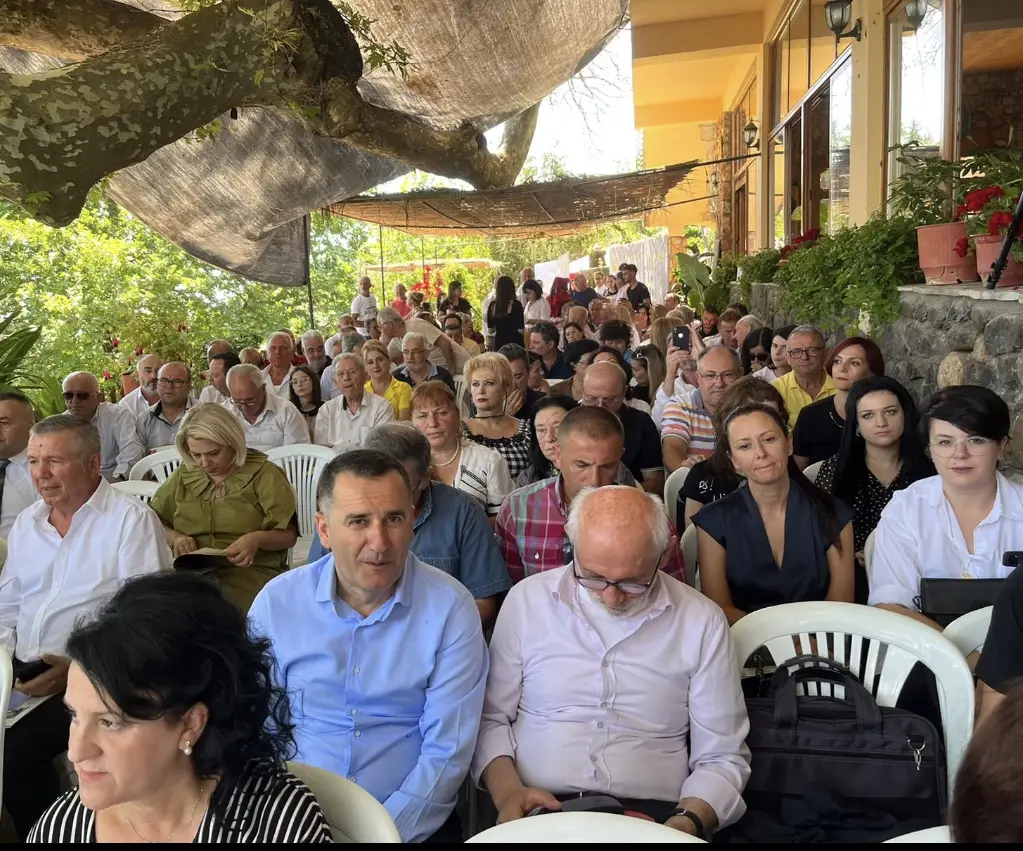
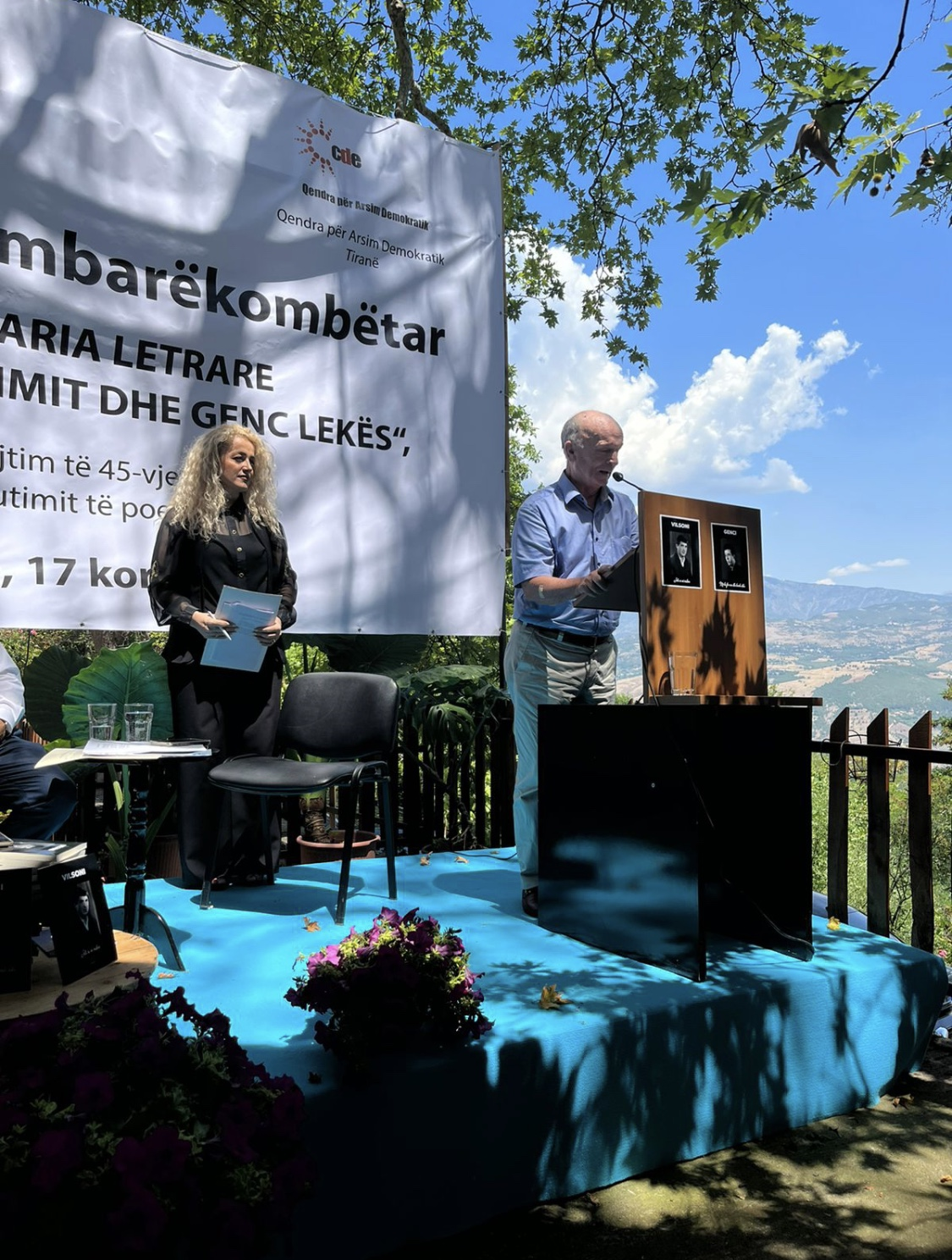
On July 17, at noon, in the village of Bërzeshtë, Librazhd, a nationwide event took place on the occasion of the 45th anniversary of the shooting of two poets, Vilson Blloshmi and Genc Leka, during the long night of the dictatorship. The guests came from all over Albania and from the diaspora around the world.
The event grows ever larger; it is part of the people’s memory, a lesson of their history, while the two martyrs left their poetry as a testament, part of the poetry of freedom.
The speech of Visar Zhiti, as a fellow prisoner and their colleague in poetry, began in Chicago, from America, and arrived in the Homeland and was read in the village of Bërzeshtë. It is the synthesis of the purpose and message of these events; it is like a cry of love, whose echo crosses those gorges and mountains, and must be heard everywhere, so that the world may know that tragedy and that proud resistance – it is ours, and those fiery sparks of poetry are also the honor of our morality.
The speech of writer Visar Zhiti.
DEAR VILSON BLLOSHMI AND GENC LEKA!
I address you first, because I always feel you alive!
DEAR ENRIETA, VILSON’S DAUGHTER, ENKELEJDA, GENC’S DAUGHTER,
OTHER FAMILY MEMBERS AND RELATIVES!
VILLAGE FELLOWS OF BËRZESHTË!
THOSE PRESENT WHO HAVE COME FROM EVERYWHERE,
HONORED ORGANIZERS OF THE SYMPOSIUM,
This gathering and the place where it convenes are very important. Two poets, two heroes, have called us to their own soil, to their home, worthy of this nationwide pilgrimage.
We are very grateful, first of all that this event is taking place – I would call it a mission; it also seems to me like a holy mass – and thank you for the invitation. For what I felt, perhaps the most accurate word is: I was shaken. But I also felt pride. Two extremes that they both know very well how to unite, as poets and as heroes.
I want to repeat what another great European poet, a Life Senator in the Italian Parliament, Mario Luzi, used to say: We are what we remember.
Today we are Vilson Blloshmi and Genc Leka! And not only us here. And the sooner others join us, the sooner as a people we will be closer to the dream and to cultured Europe.
We have gathered to speak about their poetry. It is written in blood – rarely has anyone else in the world had such a poem. 45 years ago, on July 17, the dictatorship executed them by firing squad – the most brutal dictatorship in the entire communist empire. It chose them as the best, the most beautiful in spirit, because they were poets and felt the missing freedom, because they spread the poetic word, full of pain, the forbidden, the spiritual; they were ahead of their time, courageous.
And I dare say they were not innocent, as is commonly said in post-dictatorial commemorations. No, they were divinely guilty – against evil, against the oppressive regime, against deception, against soulless socialist realism, and against those who served it, from whose ranks also came those who carried out the expert examinations of their poetry, who, even unintentionally, aligned themselves with the firing squad.
Vilson Blloshmi and Genc Leka and their brothers do not have innocent poetry, as some cunningly claim. Their poems have sins before the poems that sang to the murderous system, the dictator, the party-state. Their poems are different; in the end, they honor Albanian poetry. With our poems we show ourselves and the world that we stood firm, we tried to be human when it was difficult, even poets when we were not allowed.
I have written in my books how Vilson Blloshmi and Genc Leka stood before their execution; facts have emerged. They were unbreakable. Mythical heroes. Their souls, from the bloody clay surrounded by barbed wire, immediately went among the stars. And they became stars to shed light on the future, to show the way.
When I received the invitation to Bërzeshtë, I was going to a European country to take part in a world poetry festival, in Romania – a country that also suffered dictatorship, prisons, but not because of poetry, and there are no executed poets there…
I went to carry our poetry there, from hell to its Olympian heights. As I looked at the poets gathered from the world – young, old, beautiful women – the poet from Ukraine was missing because of war; among them appeared the faces of Vilson and Genc… but also of Dom Lazër Shantoja, the first executed Catholic cleric, just as they also executed Baba Ali Tomori, a Bektashi – both poets. I also recalled the rebel Trifon Xhagjika – “Give me a cannon to hit your system!” he shouted at his trial – or Havzi Nela, with whom I was in Spaç prison, the last man hanged in the entire communist empire.
In prison I also knew their brother, Bedri Blloshmi, a steadfast rock. In America, in New York, I met a young Blloshmi, Ilir – I mean to say that they are a clan with strong roots, now spread far and wide. The historian Ago Agaj, in one of his books, even traces them back to the one the Serbs called Miloš Kopilić, the Albanian assassin of Sultan Murad I at the Battle of Kosovo in 1389.
I also knew the son of the lyric poet Genc Leka, and his sister. I was a student when I went to her house in Lushnjë; she was the wife of one of our teachers; they lived where the zone of internment began; they gave us a memorial lunch…
I did not know them then. But their names now, Vilson and Genc, resound as in a European ballad – I also told this to the poet Sadik Bejko, and he used it as the title of the book he wrote about them, a work of great value and importance. Our fellow sufferer, the writer Zyhdi Morva, also published a novel about them. And so on.
At the world poetry festival in Romania, in the city of Craiova, I had to speak before participants from around the world and the cameras of local television. “I am here,” I said, “also for Vilson Blloshmi and Genc Leka. They could not come… they were executed at approximately the age of Christ, but they are everywhere where the blood of poetry flows, in every poet’s book, wherever poets gather…”
This heart flings itself like a slain bird
Like a sea with waves, the soul with ballads…
Wrote Genc Leka, at a time when such writing was forbidden. He thus revealed his fate and what he carried inside.
If I could not withstand the sorrow,
I still have fire burning in my soul.
If I am more dead than any living one,
Then well, I am more alive than any dead.
Wrote Vilson Blloshmi – before the fateful July 17, 1977. How can one not be stunned before these verses? They have a shattering, superb sincerity; pain and invincibility; they are testament and epitaph; they are a credo; they are also what this symposium is doing, as a continuation of their behest.
Such verses should be written on the road to their house, on the walls – I have seen verses like that at the house of a Nobel Prize-winning poet in Sicily. They should be included in school textbooks, carved into stones, into marble, together with those of other poets and writers, both from the National Renaissance and modern times, who together brought “the other literature” from prisons and internments – the truth and the morality that were missing – and, I emphasize, together, with everyone, gave Albania spirit and light.
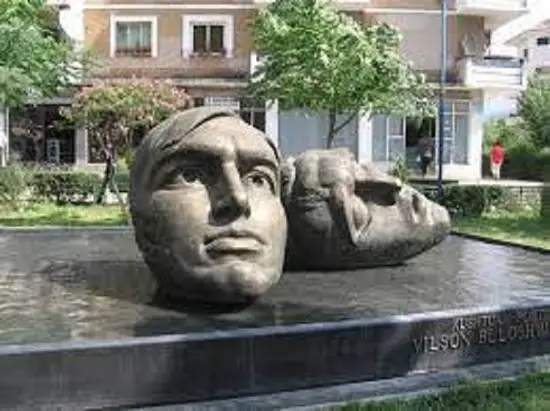
Once, at another poetry festival, “Naim’s Days,” when the bus carrying poets from many countries of the world crossed from Tetovo into North Macedonia – and South, for us – to continue the event in Krujë, I was with my wife and son. We asked to stop in Librazhd, at their monument – a masterpiece, those large bronze heads like two planets on the water’s surface, like memory itself. When we explained to the other poets what had happened to their two colleagues in Albania, they were stunned and speechless. And perhaps they felt more strongly what it means to be a poet. And what poetry is.
Vilson and Genc call us on a spiritual pilgrimage of sublime memory. We must go where they point us…
I am certain that the gatherings for Vilson Blloshmi and Genc Leka will not only be to commemorate and honor them as martyrs of the poetic word – they are honored for life – nor only to highlight the value of their anthological poetry, but also to help us know ourselves better as a people, and to know what we will do henceforth. With freedom and its poets. Therefore, there must be an echo… Not just in the media. But within each person. Like breathing. Even if not all of us can be present. But we are there.
It is true that for many reasons I could not come, but for all reasons I am there with you and I am listening. What matters is what will happen afterwards…
Finally, I want to repeat what a Nobel Prize-winning writer said, one who was in the Nazi extermination camp of Auschwitz – thus a fellow sufferer – the Hungarian Jew Imre Kertész.
According to him, “The Holocaust – that is, persecution, in my view – is a universal experience… it does not divide; on the contrary, it unites… and … has created a culture,” he says, “which now cannot be denied, that has come and is still coming; and the literature of this culture has been able to inspire the Holy Scriptures and Greek tragedy – the two pillars of European culture – so that the unforgivable reality might give birth to forgiveness, or to the spirit itself, and to catharsis.”
[…] “Whoever seeks to become part of this spirit must overcome, among many trials, also that of moral and existential confrontation with the Holocaust” (i.e., persecution.)
In place of the Nobel laureate’s name, insert the names Vilson Blloshmi or Genc Leka or Arshi Pipa, yours, mine, our wounds, our tears. This is the message that Bërzeshtë must give today. Best wishes!
Embraces to all from afar, from Chicago, USA, but also from nearby, from the heart.
Yours,
Visar Zhiti
IN HONOR OF THE MARTYRS,
VILSON AND GENC
By Visar Zhiti
They were executed 45 years ago, on this day, July 17, 1977… Two young men from a village in Librazhd, two poets, Vilson Blloshmi and Genc Leka – see, their very names are like those in ballads – beloved family members. They were torn from the bosom of their families: Vilson, 29 years old, left a wife and daughter; Genc, 36 years old, left a son and daughter… even today they would be… with many books… but they are, more beloved than ever, martyrs.
They left us their poetry as a testament, and their heroism. In my “prisonology” The Torn Hell, the execution is described – a shattering majesty, an unquenched flame that emits light…
After midnight – because executions are done that way, before dawn – they stopped at the secret place predetermined, a desolate ravine in the wilderness.
Those of the firing squad got down from the army truck. From the jeeps came the chiefs: the commander of the firing squad, the head of the Department, the district prosecutor, the doctor…
And they brought the two of them, Vilson and Genc – emaciated, tortured. Shorn, with blackened faces and torn limbs, their tattered clothes barely covering them. They could barely stand. Almost pushed, they went to that small, bleak clearing among shrubs and rocks. Darkness and mountain shadows worse than darkness. Silence, broken only by the steps of military boots or by a small stone rolling downhill. Groooopaaa…
The Firar stream – truly a devil’s place. The hand flashlights cast a terrible light, or the lights of one of the vehicles were turned on.
The two stood, gloomy and contemptuous, shaken to the point of incomprehension and a kind of suppressed panic, stiff as wood. That is how they appeared to those facing them, the firing squad. For they would never again see those trees around them, nor the world, nor their people. One could not think any further; every thought was cut short; you did not know what you were or what those about to be shot were.
Vilson and Genc. To the side stood the leaders of this murderous, terrible, unprecedented ceremony. As if on duty, as if at work.
The preliminary order was to shoot only Genc Leka. From very close.
– Fire!
Genc fell and writhed on the grass wet with his own blood. He moaned. Streams of blood gushed from the wounds just opened by the bullets in his body. Vilson, half-closed eyes, stunned, standing.
– Do you see your comrade? – a voice was heard. One of the chiefs approached the corpse – still standing – of Vilson. – That is how you will fall too, but give in. We want your cooperation… You know foreign languages; you can serve us, the great cause…
– I have said no. Finish quickly, – Vilson spoke defiantly.
– Think it over, but quickly. You don’t have much time. The mud awaits you.
– Better mud than with you, – the mud itself seemed to reply.
– Your comrade is finished. Look at his feet. You can reach your dreams… – Did the officer dare speak like that? How despicable!
– Nooo! – Vilson’s shout cut everything off. – I started with my comrade, and with him I will finish it! – And he was yelling at them; it seemed he wanted this tragedy to end as soon as possible. He had surrendered himself to death long ago, when they were arrested, during interrogation, at the trial, when they passed the sentence: death by firing squad. Even earlier, he had wandered into the kingdom of death from the moment he wrote his first poem, from when he secretly translated one of those accursed poets, from when he fell in love with that actress – but now there was no more time for anything, except to breathe his last breath, with a last curse.
– Murderers… shoot me… for you too… criminals…
– Fire! – the order was repeated, more harshly and with more spite, and a volley of bullets shredded him completely. He fell on top of his comrade. The blood that gushed from him mingled with that of the other, and, as brothers are made by drinking each other’s blood, they became brothers in the infinity of the beyond, just as death itself is.
* * *
Two bronze heads on the surface of the water, large, heavy, like two planets. At the roadside at the entrance to the town of Librazhd. A sculptural group in honor of Vilson Blloshmi and Genc Leka. The water is memory, or time itself, or the clarity of memory. Eyes closed in a bronze sleep. I stepped behind them. Changed position again. I looked for the bullet holes in the skulls. They seemed freshly killed to me, and the water became blood. For it also reflected the sunset.
* * *
The two bronze heads seemed to me as if upon tears. I reached out my hands to caress them./Memorie.al