

By Uvil Zajmi
Memorie.al / “Blue jeans” represent and are linked to entire generations as a clothing icon, initially worn only by boys. The history of “jeans” production is tied to the city of Genoa around the 15th century, due to a textile tradition significant to that area. A “blue fabric” was exported through the old port of Genoa, used for sacks, covering goods at the port, and for ship sails. According to tradition, fabrics were named after their place of origin, and the English term “Blue jeans” derives from the French words “Bleu de Gênes” (Genoa Blue). These were known as “work pants” – practical and resistant – worn by Genoese sailors. This is where the transformation from scraps of cloth and covers into clothing occurred. The English term “Blue jeans” has been used since 1567, when large exports of this material began from the Genoese port.
With quality and low prices, “denim” fabric became synonymous with the pants of the same name in 1871, reaching absolute popularity by 1973 [sic – likely 1873] when tailor Jacob Davis added copper rivets to the most exposed points, such as pockets. Those for cowboys, in particular, were an immediate success; while the original model had five pockets, a small pocket for watches and coins was added in 1890. In 1905, the second back pocket was added. In 1935, the first jeans for women appeared, and by 1937, they were seen on the pages of Vogue magazine for the first time, thus entering fashion history. A modern garment, favored by Americans, especially on Fridays: “Friday – blue jeans day.”
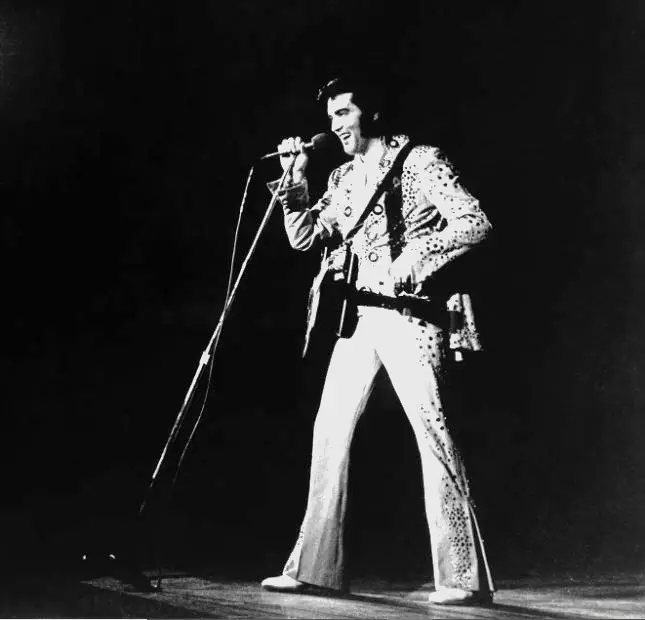
In Europe, jeans arrived at the end of World War II, mostly brought by American soldiers and tourists. The first “Levi’s” entered the market in 1959, and in 1962, the first production factory opened in Belgium. This was the period when jeans conquered the youth world, alongside rock & roll idols and cinema stars like James Dean, Marlon Brando, and Clint Eastwood, who wore dark blue denim pants paired with black leather jackets. Above all, singers like Elvis Presley and Bob Dylan wore them during their concerts. It was a garment that, in a way, also divided different social classes. Blue jeans became the uniform of the youth world, a symbol of “anti-fashion” and the desire of young people to distance them from hypocrisy. By the late seventies, jeans – as a practical yet elegant garment – became the most famous pants, spreading globally as the all-time favorite.
What about Albania? The 70s: a youth entirely in love with a pair of jeans…?!
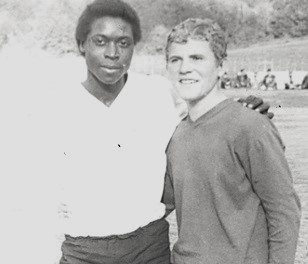
In Albania, blue jeans appeared around the 1970s. Among the first to wear them are thought to have been the few tourists or Marxist-Leninist groups who visited. They were forbidden from entering Tirana wearing such pants; at Rinas airport, they were forced to take them off, or their pockets were ripped out. One of them was Urbain Massena, an African boy who came to Albania in 1967 with a group of 10–12-year-olds from Kenya and was settled in Lezhë, where they lived for many years.
“Through the interest of my mother and an uncle, I used to receive clothing packages from Germany. In one of them was a pair of blue jeans, and when I wore them in Lezhë, it was the first time such pants were seen there. It was 1972. They were tight at the knee and wide at the bottom – typical ‘Cowboy’ style, very popular in America,” Mr. Massena recounted some time ago. But how and when did blue denim appear in Albania? From the fabric sold by the meter at “MAPO” stores, work clothes, hospital mattresses, and sacks from the “Mao Zedong” Textile Factory, to those brought by athletes and artists from abroad.
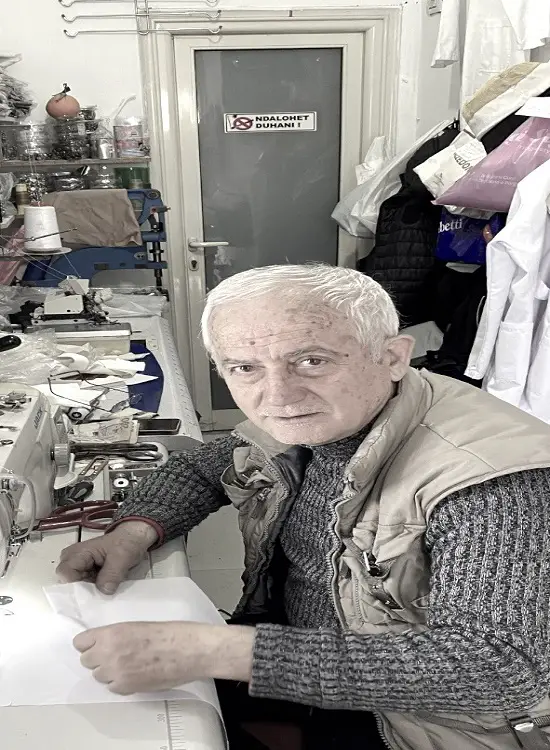
The clandestine sewing, the cost, the trend of owning a pair, and who the famous tailors of Tirana were. The state’s struggle against youth groups, the “fletë-rrufe” (lightning sheets/public denunciations) to stop the wearing and demonstration of blue jeans. From Tim Xhilaga, the “playboy” of the capital, to Beb Daliu – one of the well-known boys who recalls walking down Tirana’s “Broadway” in a pair. Alongside them, the famous composer Gazmend Mullahi says: “I had my first blue jeans sewn by Fatima, the wife of painter Hasan Reçi.” Tailor Fiqiri Haxhiaj recalls the time when he secretly secured the fabric and red thread – an endless ordeal combined with risk. When the neighborhood came knocking at his door: “The Chairman of the Front chained and wax-sealed my sewing machine,” recalls the famous tailor Haxhiaj in this exclusive interview.
Mr. Haxhiaj, who had the opportunity to bring blue denim fabric from abroad,?
Mostly, blue denim was brought by athletes, artists, students, Foreign Trade employees, those working at Fairs, the children of embassy personnel, and those who had relatives in Italy, Greece, Yugoslavia, etc. Customs was strict; it was difficult for anyone to pass a pair of blue jeans, but fabric was different. Blue denim also came from Kosovo, and even as far as China. I remember that some footballers, such as Luan Metani, Sulejman Starova, Arjan Bakiri, Kreshnik Agolli, and Edmond Gëzdari, brought some when they were there in August 1974. I also recall the “Dinamo” volleyball girls; they might have been the first women to bring and wear blue jeans in Albania – among them, Eva Kavaja, Ela Tase, etc.
Do you remember your beginnings as a tailor?
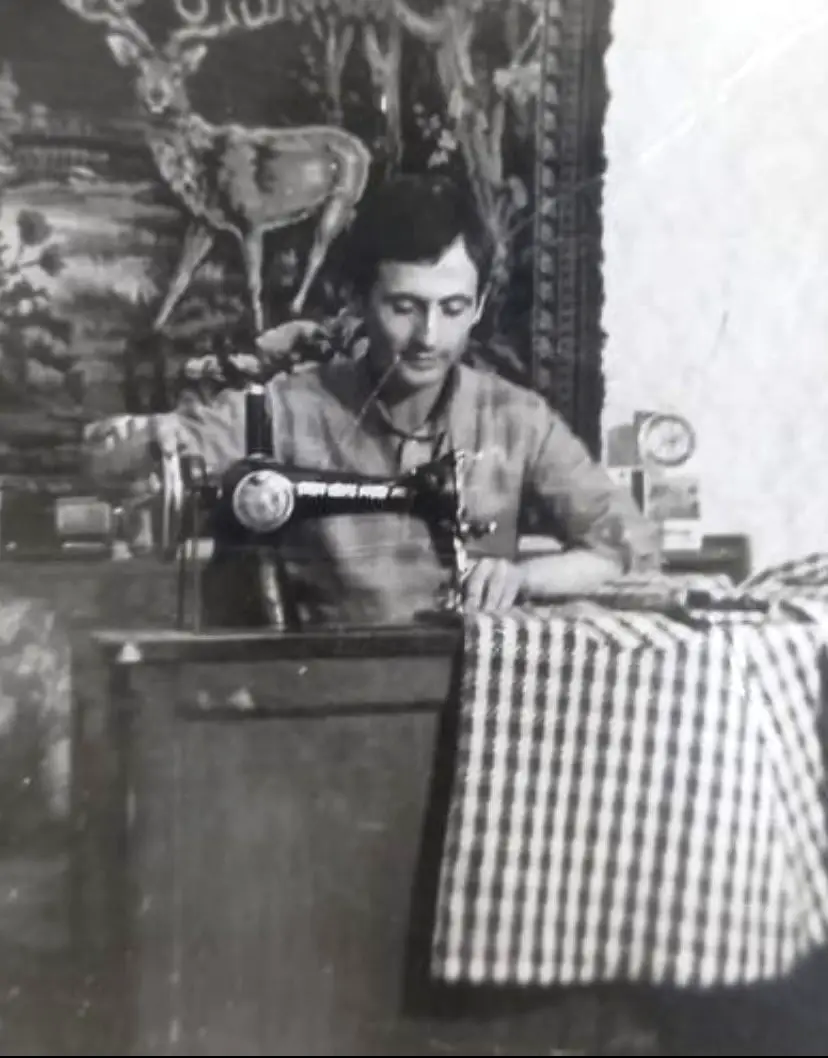
I was 15 when I started, and I began working regularly at 20 or 21. At that time, we lived near the “Medrese,” then moved to “Varri i Bamit.” At home, my mother, a former seamstress, had a “Flutur” (Butterfly) sewing machine, a Chinese brand. Out of two brothers and a sister, only I inherited that profession.
When did blue denim fabric likely appear in Albania?
I believe it was the mid-70s to 80s, and it was produced at the “Mao Zedong” Textile Factory in Berat; however, it wasn’t exported. Initially, it was sold by the meter in shops, and one meter cost 220 lek. But sales were soon banned because people began buying it in bulk to sew pants.
You mentioned it was later used for work clothes or something else?
It was the state that began making work clothes out of blue denim, giving them for free to workers in enterprises like construction materials, workshops, miners, etc. But after receiving them, the workers wouldn’t use them for work; they would unstitch them and bring them to us tailors to sew into pants from scratch. They found a way around this too by banning the sewing of work clothes, and the factory produced blue denim only for military and hospital mattresses.
When did you sew a pair of blue jeans for the first time?
The first denim – fabric brought from abroad – was brought to me by Pirro Koleka, the well-known basketball player for “17 Nëntori” of Tirana and the national team. It was 1975, I believe. He had bought it or had it brought from Yugoslavia. I was afraid and nervous about cutting it, fearing I might ruin it. What I liked most about that fabric was that it was stiff and strong – very high-quality denim. Keep in mind we were used to the factory denim, which was very poor. I sewed him a pair of pants and a jacket. Because Pirro had a great physique, no matter how badly I might have sewn them, they looked beautiful on him.
Meanwhile, the passion and desire to own a pair of blue jeans began to grow. Where and how fabric was found when it was no longer sold in stores?
I’m talking about the time when they were distributed as work clothes. I would buy them from the workers – I had made friends, and they would notify me. As soon as they got them, they’d sell them to me for 300 or 400 (old) lek per work suit. I also got a pair at my enterprise. But it started becoming a problem for the managers because workers weren’t wearing them – they were selling them. They even started taking the hospital mattress covers.
Were flour sacks also used for blue jeans?
Yes, because blue denim began to be used for flour sacks as well. I secured these at “Rruga Bardhyl,” at an enterprise that produced bread for the army and hospitals. I remember a friend of mine there from whom I’d get them. I didn’t buy them; he would give me ten sacks, and I would sew him a pair of pants for free, of course.
What was the quality of the denim produced by the Berat Factory?
There were problems; it shrank a lot in water and faded quickly. But in those years, we didn’t realize that the beauty and uniqueness of jeans was precisely how they faded over time, especially on the upper thigh – that’s what made them modern.
The brick-colored stitching was a big problem. Why?
The thread was the problem; we couldn’t find brick-colored or khaki thread. I remember taking a brick, breaking it, crushing it, and putting white thread into hot water so it would take on the red color. Since blue jeans had to be sewn with a different thread – mainly red – even though I improvised with the red color, I would double the thread to make it thicker and use a larger needle in the machine.
Did everyone want to imitate Elvis Presley’s style?
They referred to a “Cowboy” model; the wider they were at the bottom, the more modern and eye-catching they were considered. But often the fabric wasn’t enough because the pants we got from the enterprise were a maximum of 23–24 cm at the bottom, while we had to make them up to 30 cm or more. For this reason, we were forced to add a triangular wedge at the bottom. At the knee, they were tight – 22 – 23 cm – depending on the person’s height and build. Jeans were sewn or preferred in two types: Straight and Cowboy, with the aforementioned dimensions.
How much did it cost? Did sewing these pants have a monetary value?
Sewing a pair of blue jeans cost between 200 and 250 (old) lek if the person brought the fabric themselves. If I provided it, the price doubled. There were enthusiasts who would pay up to 500 lek. You needed about 1 meter and 20 cm for a pair of pants. I wore a pair myself that everyone admired because I had sewn them so beautifully.
Which category of people sewed blue jeans the most?
Mainly young people and students. Women, only in rare cases. The state tried to stop their spread, and in schools and universities, they were banned. Anyone who wore them risked trouble, including expulsion from university or losing their job. Jeans quickly became something more than just a simple garment; at that time, owning a pair gave you a different status—it set you apart. A pair of such pants was a trend for a boy, ensuring success and making him liked by girls. People even borrowed them from one another. They were always worn with a thick belt.
It was said that even the students of the “Skënderbej” military school were very passionate about them?
The “Begsat” [Skënderbej students] would have them sewn when the school season ended in spring, and they would leave for their hometowns for a few months. I had a lot of work, and the influx of them created a huge queue; you had to be a friend of mine to get your pants sewn. But I never refused them, partly because they were poorer.
Were a pair of blue jeans considered a “foreign manifestation” (shfaqje e huaj)?
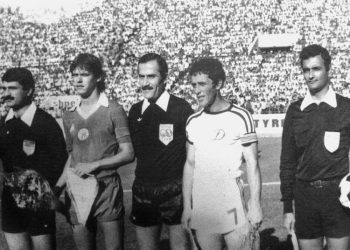
Yes, absolutely, and it all started and continued after 1973. This was a situation where any imitation of foreign fashion – even owning a pair of jeans – was considered a “foreign manifestation.” This harsh campaign began after a speech by Enver Hoxha at the beginning of that year. The youth groups were very aggressive. Not to mention the “fletë-rrufe” and other means of punishment and threats everywhere – at work, school, and in the neighborhood. I remember the well-known referee Plarent Kotherja, whose mother was Italian; they brought him a pair, but he was forbidden from wearing them to work.
Who were these groups, and what did they represent?
Three or four young people who moved around and would appear suddenly. Especially during the summer, when a pair of blue jeans and slippers were considered modern attire. They would watch for young people, waiting for you as you got off the train for the beach. Everything was part of the campaign against foreign manifestations – they would stop you and ask where you had them sewn. Some would tell; others wouldn’t. They carried large scissors and would cut them, making them unusable. They even appeared during the great evening stroll (xhiro) of Tirana, as Professor Ylli Pango recalls when his pants were torn and cut. They even went into cinemas to identify people, take names, etc.
Was there a lot of fear regarding sewing in clandestinity?
In that total isolation, in a country where the trade of foreign goods was restricted, one had to act in secret for rare items. We sewed at home, in cramped conditions, and the neighborhood would see young people coming and going. The slogan “We work and we keep watch” was everywhere. The family lived in anxiety. My father, an engineer, had a problem with me: “They’ll put you in jail, stop sewing,” he would say. In fact, the bigger problem was if the Police came. We were cautious. In one case, they even blocked me.
So, a knock on the door meant added anxiety?
Every knock on the door was added anxiety. I worked until late at night, and having the light on past midnight raised suspicions, but people knew. When the door knocked, my grandmother, who helped me sew, would take the pants and hide them under her dress. I managed to sew up to 5 or 6 pairs of jeans a day.
Were there punishments for a tailor sewing secretly?
They could sentence you to prison because they viewed it as a challenge. I remember that in those years, a story circulated that scared us: in the Soviet Union, two people had been sentenced to death for the illegal trade of jeans. Later, after the Soviet Union shifted toward the West and the Americans, a brand of jeans was named after them.
How did you act in this high-risk situation?
I often sewed for the children of the Chairmen, leaders, and neighborhood communists for free because they liked them too. I did it to protect myself, so their parents would turn a blind eye and not give me trouble.
Do you have a specific case where you were stopped?
As a warning, I remember the Chairman of the Neighborhood Front once came to my house and blocked my sewing machine with a chain and a wax seal. I kept it that way until a client came to bring me pants to sew. I would dismantle it; remove the chain, and work – mounting it all back again whenever the Chairman came for a check-up.
You worked in an enterprise; how did you organize your time for sewing?
Although I worked three shifts at the enterprise, I often skipped the third shift. My quota would be completed by a friend of mine in exchange for a pair of pants or a payment. There was a period when I became a problem: “Why isn’t he coming? Where is he? Why is he absent?” I would justify it by saying, “Look, I’ve met my quota.” But they knew; they had information – nothing escaped them.
How did tailoring work in those years – both public and private?
Everything was state-owned; private tailoring was forbidden. In state tailor shops, they didn’t sew blue jeans – they were afraid; they only did standard clothes. Professional tailors who worked there would sew secretly at home in the evenings; it was a way to make a living. It was different for us, who worked in other enterprises during the day, had different professions, and sewed in our spare time, albeit secretly. There were cases where, to discredit both state and private tailors, they would hold public “people’s trials,” criticisms at workplaces, in neighborhoods, with “fletë-rrufe,” etc. Nonetheless, tailors – especially those who sewed blue jeans – were very popular, well-known, and had built a large clientele.
What distinguished a simple pair of blue jeans from modern ones – the rivets?
Not rivets, as there weren’t any. It was a huge deal to find a zipper, as buttons were used until then. But over time, the zipper emerged as a modern detail “on the scene.” There were none for sale. It was also difficult for tailors because they lacked experience in installing zippers, being used to buttons.
Did you have clients not just from Tirana, but from other cities too?
Young people came to me from Durrës, but especially from Shkodra. They would travel by train, get measured, and return in the evening. Then they’d come back to pick them up, usually without a fitting. I had quite a reputation; besides the neighborhood youth, the “Skënderbegasit” came to me since my house was nearby. With the money I earned, I remember buying a “Vespa” scooter – I’m talking about the years 1977–’78.
Who among the frequent clients do you remember most?
There are endless names; it’s hard to remember them all. Footballers, cyclists, shooters, referee, etc. Skënder Hyka – the “17 Nëntori” and national team footballer – Agim Murati, Perlat Musta, Ilir Lame, Fehim Breca, basketball player Pjerin Bushati, referee Bujar Pregja, actor Sadush Ylli, etc. Even Dashamir Shehi, the well-known LZHK deputy, was one of those who frequented the blue jeans scene.
Do you remember the famous blue jeans tailors?
At the “Medrese,” there was Kasem; in Tirana e Re, the Dinamo basketball player Lul Tela was very famous; at the “Shkolla e Kuqe,” there was the Reçi family – Fatime (Loshi’s mother), then Ahmet (Tushi), another master. Then there was Peçi, the famous tailor from “21-shi,” a short man who, out of fear, would even take measurements in building entrances. Even Kujtim Gjuzi (the deputy) sewed for a time, as did Tirana footballer Luan Zengla, Ilir Linxa, and others.
In closing, this month and year coincide with the 150th anniversary of the first modern blue jeans. How long did the passion for a pair last in Albania?
From the mid-80s to the 90s, the momentum and passion for them declined. Meanwhile, I was working at “Qyteti Studenti” (Student City) in a tailor shop, and I sewed pants for students, but not many blue jeans, as they started getting them ready-made from abroad. The restrictions and bans were no longer what they used to be. I would only adjust or shorten them. Although time passes, the period of the 70s – with the burning desire to own a pair of blue jeans – remains a part of a great nostalgia. Especially for those of us who lived through it. Owning a pair was a dream. Memorie.al