By Prof. Dr. Alfred Frashëri
Part One
– Without bread and without oil, there is no independence and progress for the Homeland! –
Memorie.al / Life, activity and the events within it are preserved in our memory and reawaken over the years, to remind us how we lived and worked, how we behaved in society and family, our achievements, our mistakes, but above all, the people, comrades and friends with whom we shared joys and sorrows on our life’s journey. In my life, work in the oil fields began in September 1953, when I received my appointment as “Electrical Technician at the Drilling Enterprise, Patos”, signed by minister Shefqet Peçi, and continued in various institutions and roles related to oil exploration until the end of the 1980s. Now that we are on the threshold of the 100th anniversary of the discovery of oil in Albania, I remember with respect the people who with devotion, enthusiasm and sacrifice worked in the 1950s at the Patos oil field, among whom I also worked. I felt a spiritual need to tell about them and the great work they did. This anniversary stirred my memory and gave me the desire to take up my pen and write my memories, to express the feelings I had and have for those years.
Over sixty years have passed since that period of my life; the years and age take their toll, so I apologise to anyone I may have forgotten, or for any dates. These are the memories of an eighteen-year-old youth who worked in Patos in those years, as a technician operator of well logging. I remember those people, workers of the maneuvering tower, at the top of the derrick and the head drillers, well cleaning workers, technicians, those few engineers, administrators, but also the doctors, the pharmacist and the teachers of Patos in those years. I remember their work, their will and their behaviour with great love and respect, because they were also my first teachers in the great school of life and work.
That sunny day, in the first week of September 1953, after arriving in Fier, I set out on foot for Old Patos near Margëlliç, which was later named after the hero “Patos, Mustafa Matohiti”. It lies about 9.5 km east of Fier. I had with me a small suitcase with my personal belongings and a bundle of the “7 Nëntori” Polytechnic’s dispensations, which I would need at work. I had seen Patos on a map, but there I already knew from the Polytechnic the first oil technicians: Adem Cani (Nurja), Anesti Spiro (Qirinxhi), Asti Papa, Hamdi Bejtja, Niko Goxhobashi and Veronika Meko, who were the first generation of oil technicians and had gone to Patos in 1951.
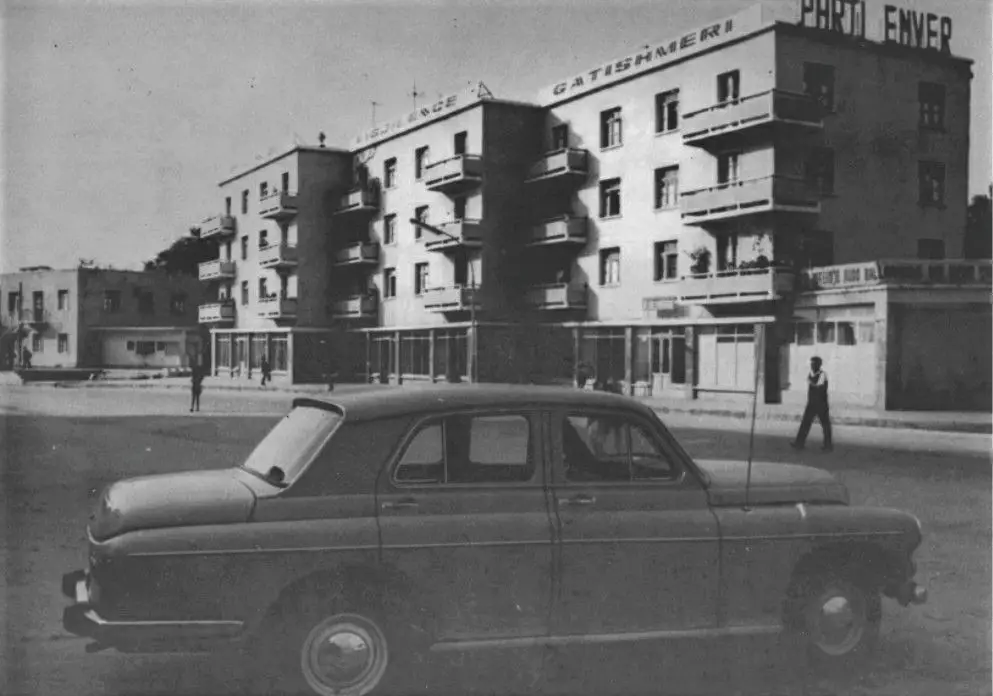
On the road I met a villager with his son, who was also climbing up to Old Patos, up on the hill. He saw me loaded down and after asking where I was going, he said: “Put your things on the donkey’s pack-saddle.” He lightened my load and I remember this noble man even today with great respect for his generous heart. New Patos, which lies 7 km southeast of Fier, had begun to be built in the first years after the liberation of the country, to provide a normal life for the oil workers and their families who would come to work in the oil field. One-storey houses were built, as well as some two-storey ones along the road. There was a school, a canteen-restaurant-café, as well as a small cinema. We passed New Patos and continued climbing towards Old Patos. Going up towards Dukas, we passed by the church and as soon as we took the turn at Rërës, Old Patos appeared before my eyes.
Old Patos was built in the 1930s, after the oil field was discovered. It was located within the oil field itself, among the wells. There were one-storey houses and on some slopes the houses had a half-basement. The administrative and technical personnel lived there. Families lived in small houses, while single workers lived in two- and three-bed rooms in hangars. There was the workers’ canteen, as well as the technicians’ and engineers’ canteen, which stayed open waiting for the technicians and engineers who worked without set hours at the well. Whenever they returned from the well, day or night, they found the canteen open and the meal warm. We are grateful to the canteen staff, the women cooks, who treated us like their own children.
The two Enterprises, Drilling and Production had their own one-storey buildings. The Geological Service also had its own building. A club-café-restaurant and the fire station were at the entrance of Patos. In the centre was also the cinema barrack. The electrical station was on the eastern periphery of Patos. The mechanical workshop was located south of Patos, near the valley of the Shushica River. After the 1950s, Old Patos was given the name of the “Hero of the People”, Mustafa Matohiti. At the entrance to Patos, I presented my documents at the police post-checkpoint and asked where the technicians lived. They showed me the hangar, and in one room I met Tomi Kristo and Hamdi Bejtja, whom I knew from the Polytechnic. They had heard of my coming and welcomed me very warmly. They invited me to stay in their room, because the bed of Anesti Spiro (Qirinxhi), who had been transferred to the Kuçovë Oil Combine, was free.
Thus, I became a resident of Patos until August 1956, when I went to study at the Polytechnic Institute of Tirana. The next day I reported to the Directorate of the Drilling Enterprise, to its director, Polikron Cane, and the chief engineer, Pirro Bozdo. They informed me that I would work as a technician operator in the logging group, together with the other operator, Hamdi Bejtja, who was also the logging supervisor. They welcomed me, and I retain the greatest respect for their work and behaviour over the years. In those years, photography was not allowed in the oil fields, so I am placing a photograph I took sixty years later, on 3 April 2016, when nostalgia and longing made me revisit Patos.
After I was informed of my workplace, together with Hamdi we went to the building of the Geological Branch, where we met the chief geologist Asti Papa, whom I had known since the Polytechnic. He spoke to me about the work I would do, its importance and the precision with which it had to be done. Then we took the road to the premises where the Logging Group was located. The Group had three large vehicles, like buses: one for the winch with 3000 m of cable to lower the instruments into the well; the second with the measuring and recording instrument station; and the third with the winch and cable to lower the perforators which, with bullets, created the filter in the well casing. Therefore the logging group was located in the Vehicle Park, west of New Patos.
We walked from Old Patos to Transport, as the Park was called, on foot, as we did every day, back and forth, winter and summer, several kilometres of road, from the top of the hill down to the plain. In the Park, a space that had been an abandoned toilet, where the holes were covered with wooden lids, was made available for us to place our work equipment. There we kept the equipment, repaired it, and stayed ourselves when there was no work at the well. The diagrams recorded in the wells were delivered within the day to the Geological Branch. This continued until 1957, when a new, suitable building with offices and sufficient laboratories was built for the logging base.
In Patos of the 1950s, it was every day for workers, technical-engineering and administrative staff, whether from home or office, to walk to and from the wells, in summer days and nights, and during winter, through the famously thick mud of Patos, distances of one to four or five kilometres. Boots were put on with the first autumn rains and taken off in spring, after a few days when the rains stopped. The Enterprise had only two “Gaz” vehicles: one for the director, with driver Sotir Stefë, then Agathokli – whom we called Agai – and the other for the chief engineer and the foreign advisors. We in logging had the “privilege” of going from the Transport Park to the wells in our work vehicles.
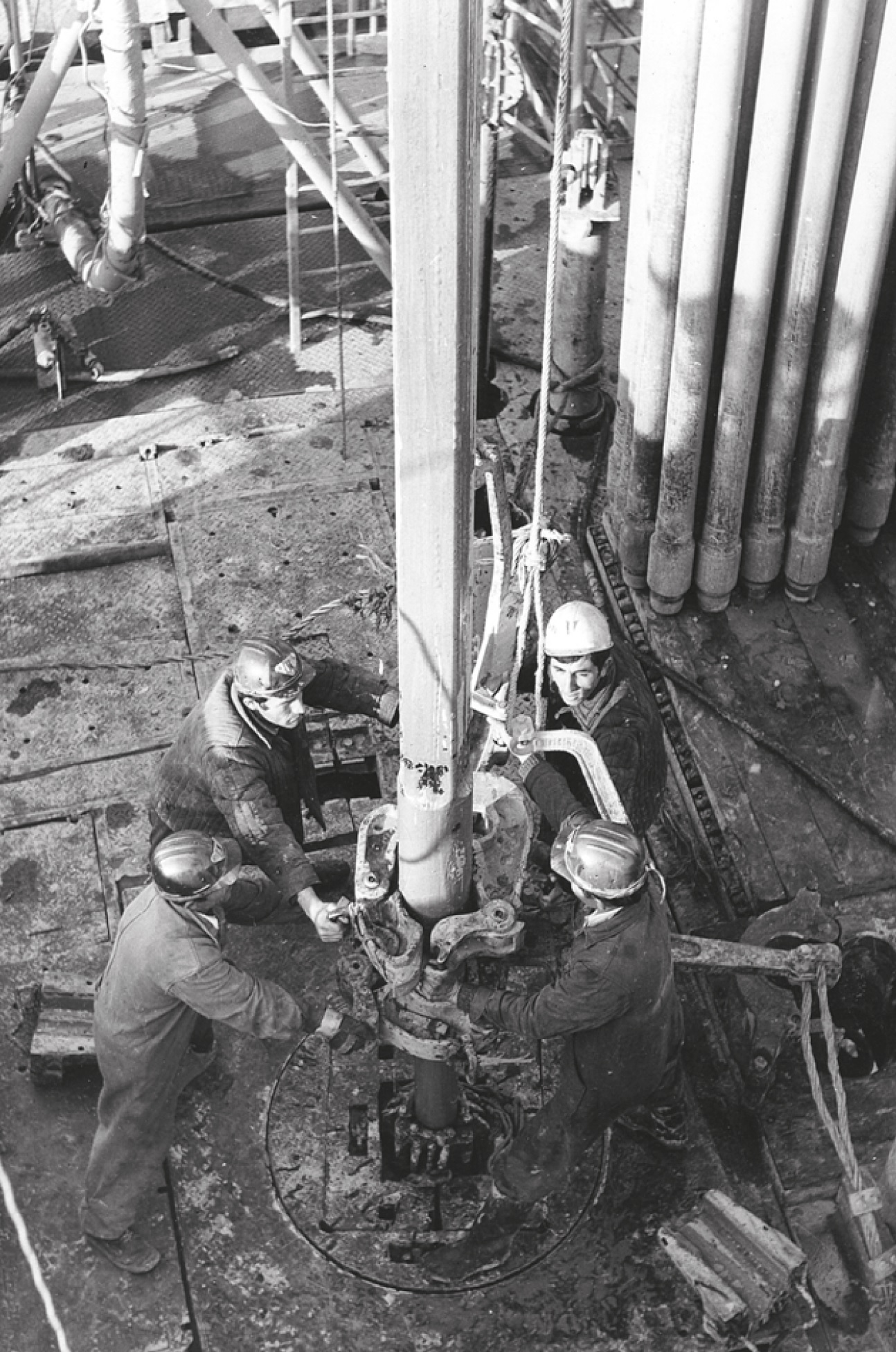
In winter, the logging vehicles’ passage on unpaved and muddy roads was a nightmare: the vehicles were pulled by tractors through the mud, sunk up to half their wheels in sludge; on dangerous roads, they were pulled by two tractors, one pulling from the front, the other holding from behind so that it would not slip off the road, overturn and destroy the equipment. Another characteristic of work in the oil fields was that the workers had three fully defined work shifts. The technical-engineering personnel and the well supervisor did not have shifts. They went to the well, worked there according to the processes that needed to be carried out, and left the well only after finishing the work process they had to perform, regardless of whether that work lasted 8, 16 or more hours, or days, day or night. This intensive work of the oilmen, from the worker at the top of the derrick to the engineer, was successfully faced only by will, devotion, sacrifice and readiness.
The oil workers in Patos, their objectives and achievements during the 1950s
Aware of the vital importance of oil for the homeland, the oilmen worked with dedication, knowledge, dignity and sacrifices to achieve the objectives and resolve the tasks in several directions in the 1950s. The Patos oil field, discovered at the end of the 1920s and the beginning of the 1930s, posed special tasks for its full exploitation, among which the main ones were:
First, to delineate the field and evaluate its oil reserves. Second, to complete the network of production wells in accordance with technical requirements. Third, to apply complex study methods of the wellbore during the drilling process and upon its completion, such as logging and study of samples from strata, as well as phenomena appearing in the well. Fourth, to apply modern drilling technology, cementing of the casing without a filter, as well as the application of modern technology for strengthening and torpedoing the cemented casing in the well, to open the communication path between the oil-bearing layer and the wellbore. Fifth, to build the oil gathering and transportation system. (Biçoku T., 1953, Meko Z. 1953, Pasho S., 1956, Papa A., 1953):
In addition to these objectives concerning the Patos field itself, it was also necessary to explore other areas of the country to find new oil and gas fields. To properly understand the importance and necessity of achieving these objectives and resolving the tasks of the time, let us briefly recall the history of Albanian oil, about which Academician Prof. Dr. Teki Biçoku, engineers Zenel Hamiti and Borguçi Ineichen have written extensively and in detail in their books (Biçoku T. 2004, Hamiti Z. 1966, Borguçi I.), Beqiraj I. et al., in their study (Beqiraj I. et al., 2013), Perhati R. 2014, 2016, Çollaku A., 2016), etc.
The presence of oil, or as it was called in Persian ‘nafta’ or ‘nafdha’, in ancient Greek, in Albanian soil has been known since antiquity. Well known are the “ancient fires at Nymphaeum, in present-day Selenicë near Vlorë, which the ancient historian Strabo described very beautifully” (Hamiti Z., 1966, p. 14). Over the centuries, these reports attracted researchers to come to Albania, together with rulers who extended their claws over our homeland. A 19th-century notice is very interesting: The letter of Mösyö Waterfield, an official of the London Branch administration of the Ottoman Bank, states that; in relation to the oil discovered on land parcels and imperial estates located in a place called Selenicë, near Vlorë, the Ottoman Bank will undertake the expenses needed for drilling and processing the oil and will deposit into the Sultan’s account the necessary amount of revenue to be gained from this trade, if the imperial government concludes a contract for its sale. (Istanbul 1870). [Osmanli Arsiv Belgelerinde Arnavutluk, “ALBANIA IN OTTOMAN ARCHIVAL DOCUMENTS”, Istanbul 2008].
In the twentieth century, from its very beginning, the territory of Albania was studied by geologists and engineers from various countries for oil exploration and exploitation. In the books of Academician Biçoku T. and Engineer Hamiti Z., all these studies and their results are presented in detail. Among these studies and researches are those of the Italian geologist Leo Maddalena and oil engineer Moreti, in the area between the Vjosa River and the Bay of Vlorë, in 1917. Based on the results of their research, they designed the first well for oil exploration in Albania, which was drilled in Drashovicë, Vlorë, in 1918. The well had a depth of about 200 m.
During its drilling, at depths of 71.6 m; 84.6 m; 101.6 m; 119-121 m; 168 m; and 179 m; the presence of oil shows was confirmed. From the depth of 101.6 m, 3,500 litres/day were extracted (Z. Hamiti, 1966). In Drashovicë, the first oil field in Albania was also set up. These litres of oil, like the first swallow, announced the great wealth that nature has bestowed upon the Albanian land, our homeland. In 1928, the first well in Kuçovë was drilled, yielding 750 tons of oil. In that period (1925-1930), the Anglo-Persian Oil Company, APOC, drilled several wells also in the Patos area, discovering the presence of oil in sandstone layers. In the 1930s, drilling of wells for the exploitation of the new Patos field also began. In those years, the three prospective oil-bearing regions and areas of the country were granted under concession to foreign companies, which also carried out their exploitation. About these concessionary companies, Z. Hamiti (1966), T. Biçoku (2004), as well as Benita Stavre, in her doctoral thesis (2013), has written. In the Patos field, many Italian workers worked; there were even soldiers during the period after the occupation of Albania. In Kuçovë, in those years, 1,385 Albanian workers and 2,200 Italians worked (Z. Hamiti, 1966).
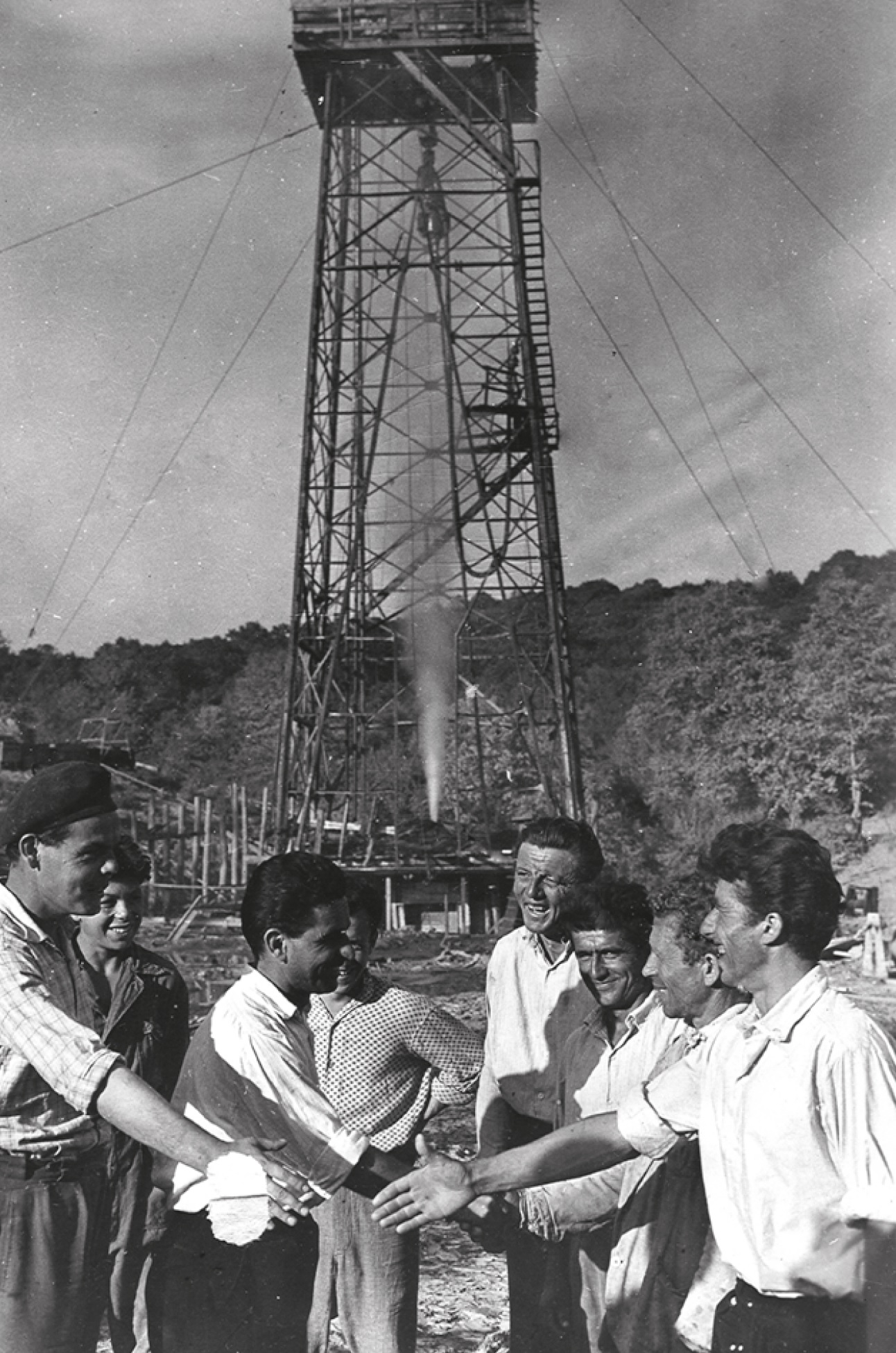
The occupation years during the Second World War brought destruction to the oil fields in Kuçovë and Patos in our country as well. Appreciating the importance of oil and gas for the independence and progress of the country, like bread, the Albanian state after the liberation mobilised the Albanian oil workers of that time and appealed to other professionals, such as mechanics, electricians, hydrotechnicians, etc., living in various cities of Albania, to work in the oil fields. Many specialists and masters responded to this appeal, and together with the oil workers, they rebuilt the oil fields and put them into working order. Among them, I remember Sotir Skorovoti, a drilling and liquidation master, whom the workers called ‘engineer’ for his knowledge and work. The oil industry was built and developed over the years to the levels of the time.
When I went to Patos, wells 1,500–2,000 m deep were being drilled and oil was being extracted. Already qualified drillers worked there, the first generation of technicians from the “7 Nëntori” Polytechnic, and the first five Albanian oil engineers had arrived, having just completed their studies abroad. This broad collective of oil workers now worked to resolve the tasks and achieve the objectives mentioned above, to fully exploit the Patos field, as well as to search for new oil and gas fields. Gradually over the years, a powerful oil industry was built, employing 25,000 workers, among them 2,800 engineers and technicians. They worked with self-denial, will and devotion, day and night, in sun and rain, with great responsibility.
The Drilling Enterprise and the Production Enterprise were established in Patos, under the Directorate of the Oil Combine, whose centre was in Kuçovë; the electrical station was put back into operation; the mechanical workshop and transport park were reorganised; two scientific institutes – the Institute of Geological Studies and Projects for Oil and Gas and the Institute of Technological Studies and Projects for Oil and Gas – were established, as well as two geophysical enterprises: the Seismo-gravimetry Enterprise in Fier and the Geophysical Well Studies Enterprise in Patos, which carried out projects for oil and gas exploration at a contemporary scientific and technical level, designing over 80,000 linear metres/year of deep exploration drilling, etc., as well as studying and generalising their data. The Faculty of Geology and Mining at the University of Tirana also collaborated widely with this institutes./Memorie.al