
Part Five
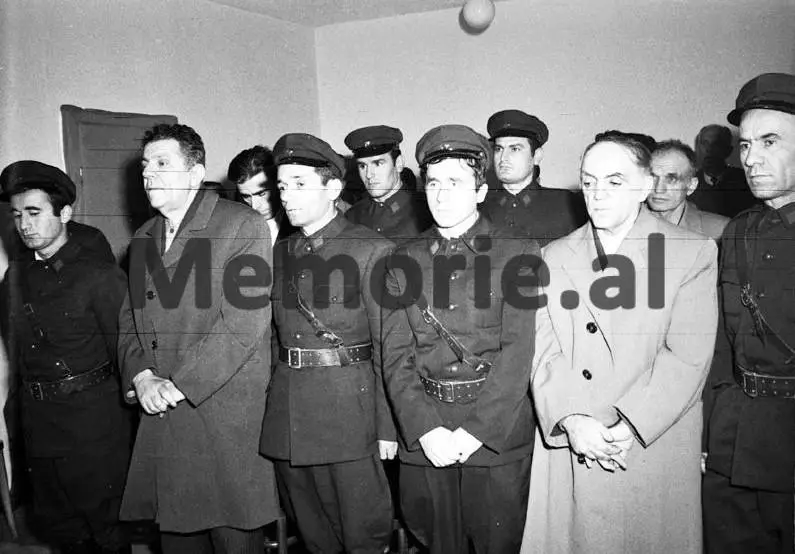
Memorie.al / “The black night of 5 November 1975 is the night when the three highest military men of the Albanian Army were executed,” said one of our colleagues at the time, in a half-voice. And indeed, “this black night” lasted a full 11 months. It began on 25 November 1974 and ended on 5 November 1974. On 24 November 1974, at 10:00, Mehmet Shehu entered Enver Hoxha’s office. He was pale and talking to himself. For two hours straight, he stayed in the Commander’s office. They discussed for a very long time and when he came out, his legs trembled and he seemed to walk like a drunk…! Since 4 July 1974, the Politburo had been deeply shaken to its foundations. After the Durrës meeting, where the “Black Theses” were first revealed, the Sixth Congress of the Party of Labour of Albania had condemned them very harshly, as well as the authors of those theses. They were Beqir Balluku, Petrit Dume, Hito Çako and Rrahman Parllaku.
Continued from the previous issue
Enver asks the People’s Assembly to pardon Balluku’s life!
Six months after Beqir Balluku, Petrit Dume and Hito Çako had been executed, Enver Hoxha, at the People’s Assembly meeting on 6 May 1976, made one of his great gaffes. The three generals, from prison, had written a letter to the First Secretary of the Central Committee of the Party of Labour of Albania, Enver Hoxha, and to the Chairman of the Presidium of the People’s Assembly, Haxhi Lleshi, asking for their lives to be spared. In this letter, Beqir Balluku requested that the Supreme Court’s death sentence be commuted to a lighter penalty. This letter is located in the Archive of the Ministry of Internal Affairs, Box No. 611.
The letter arrived at the Central Committee apparatus and Enver Hoxha’s personal secretary (Haxhi Kroi), in order to apply the rules, or rather the bureaucratic routine, forwarded the letter to the People’s Assembly. The letter travelled a long way and on 6 May 1976, at the top of the agenda of the People’s Assembly’s proceedings was the discussion of the letter from Beqir Balluku and the two other generals requesting a pardon. As soon as the meeting opened, Enver Hoxha took the letter in his hand and said: “Well now, what do you say, shall we have these men shot?” He read out the names of the three generals and a deathly silence gripped the hall, because the three generals had been executed three months earlier!
The worst part was that no one knew their grave, while in the hall of the Presidium of the People’s Assembly; a very shameful comedy was being played out. A comedy that shocked everyone present. No one better than Enver Hoxha knew how to mock and despise the death of his victims. The only one who dared to say that the three generals had been shot three months ago was the hero of the novel “On Your Feet Again”, Nuredin Hoxha, a worker at the Automotive Goods Park in Elbasan. After about two minutes of deathly silence, the Commander (Enver), with his characteristic smile, which in such cases took on a kind of otherworldly glow, said: “Since the first point seems to have been executed, then let us move to the second point…”
What did Beqir Balluku write in his letter to Enver?
“Dear Comrade Enver. Convinced that I am not an enemy of the people and the party, that I have committed no crime of any kind, and being a determined and devoted communist, I request that you review the measure of my punishment by the Supreme Court. In the courtroom they read me the court decision: ‘Death by firing squad.’ I never thought that a day would come when I would be condemned as a traitor to the ideals of my party and my people. I say this because I have never dealt deceitfully with the party. You know me very well, that I have been a comrade-in-arms in difficult days, with you and all the other comrades of the Bureau.
I have been condemned unjustly and without a thorough analysis of my mistakes. After a long investigation of 11 months, I have only told the truth. I have made mistakes, but I have never been an enemy. I have never crossed the party line. Under these circumstances, I request that my life be spared.” So it is written in Beqir Balluku’s last letter to Enver Hoxha. Balluku, even in the courtroom, opposed the judicial body and refused to answer many questions. On the contrary, he told the judges that he had sent everything to Enver Hoxha in a large number of letters and had clarified his position in great detail and with thoroughness.
These letters, in the courtroom, were used by the judges against Beqir Balluku and the generals. The judge in the courtroom told them: “You are now sworn enemies of the people and the party, and Enver Hoxha has no need for such trifles. He has great faith in people’s justice.” The location of the letter has been confirmed not only by former Minister of Internal Affairs Spartak Poçi, but also by three other former socialist Ministers of Internal Affairs. All Ministers of Internal Affairs since 1992 have devoted much time to studying the files of the murders of the communist dictatorship. In his diary, former Minister of Internal Affairs Perikli Teta attaches particular importance to and unravels many, many mysteries.
The three generals had no news from their families!
But another great pain for the three generals sentenced to death was the fact that they had no news of their families! Likewise, their families had no news of them. In the courtroom and during the 11 months of investigation, the three generals faced about 200 witnesses, but they never met their families. (How and where they met the generals with the witnesses and how their investigation was conducted, we will write about in future issues). All three generals asked to know something about their families.
They asked for information about the place where their families had been interned, but they never learned where their families were or what their fate was. They were executed without seeing their dearest ones. An inhuman method of the dictatorship. Enver Hoxha personally took care of them, and they were isolated by all means from contacts with their families and relatives. The three generals’ families were also victims of this mechanism. Through this isolation, Enver Hoxha was able to once and for all erase many traces of his dictatorial crimes./Memorie.al