

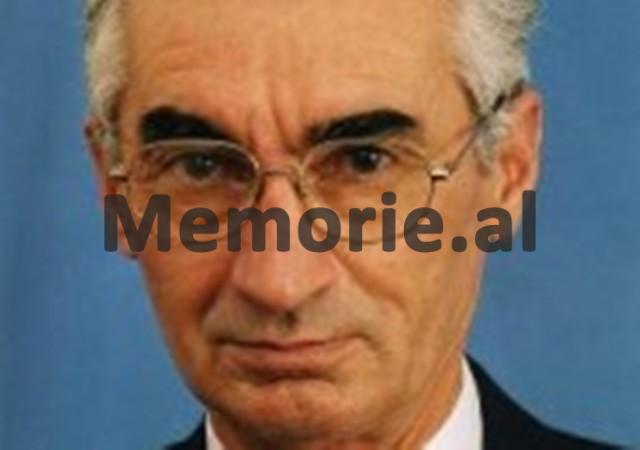


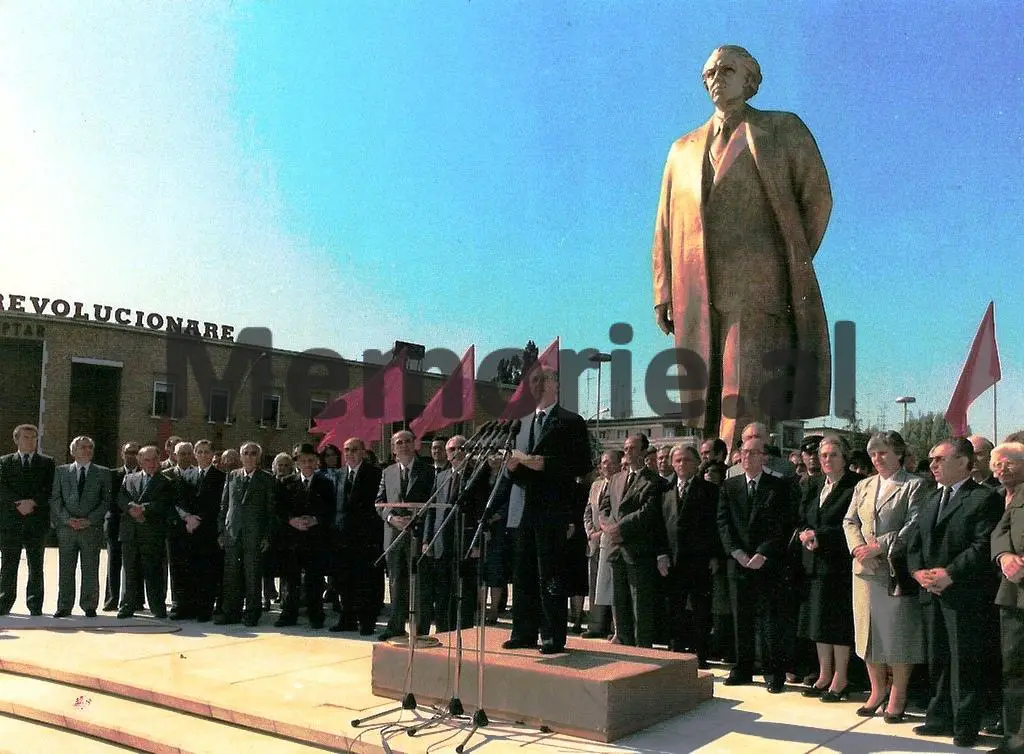

Prof. Dr. Albert Frashëri
(A Tragedy in Two Acts)
Memorie.al/The 20th century created a giant, absurd, and violent experiment that claimed to bring happiness to man by distributing poverty among citizens in equal shares. This naivety brought only misery and disillusionment. Life, the Universe, and their evolution consist of the spontaneity of differences which, in turn, create movement, development, conflict, war, and peace. The victims of the tragedy of the years 1944–1990 clearly understand this universal principle. Future generations, on the contrary, will fail to understand the pain and the deepest meaning of that tragedy without convincing individual and collective analyses. This lack of knowledge may push the citizen toward a kind of nostalgia for the past and create fatal consequences for the entire nation.
Whoever has lived through suffering beyond the dimensions tolerable by man enters an endless phase of meditation. The persecuted first and foremost, but not only them. Initially, immediately after the liberation from Evil, one lives in a state of immense joy that overwhelms and almost instills fear. This would be the trauma of liberation. A trauma that resembles an ever-deepening, calm sea. Precisely when the drama has ended, the shocking enlightenment of consciousness arrives: the humiliation of total submission turns into an endless suffering. Then you feel submerged in the calm and deep sea of awareness for a violated and failed life, a wound from which there is no healing. Further on, your horizon remains dark and the soul eternally wounded until death takes you.
It was a death in these recent days that revived the anxieties of that life which Albanians have known on their backs and in their souls.
The death of a citizen is an extreme event of life, the meaning and value of which depend on two aspects of his existence: the morality and humanism that inspired his personal life, on one hand, and his biophysical essence. The latter has the same value for all people who cast a shadow upon the weary soil of this world. Conversely, humanism, kindness, honesty, and transparency, however modest they may be, constitute the value he brings to the collective memory. It is precisely this value that determines the honor each deserves in the final act of life. But not all people deserve this value and honor.
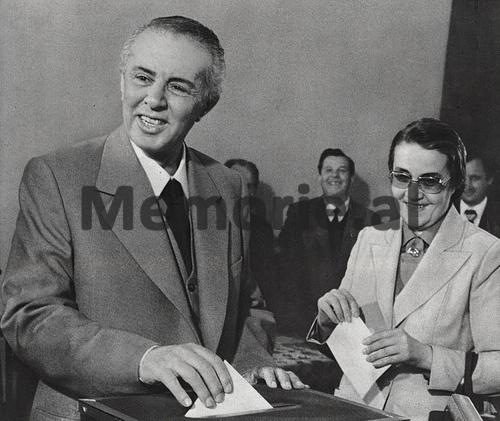
From a cultural perspective, the dictator’s wife was formed and inspired by the ominous, anti-human work of her husband. Her death could not bring grief to the Albanian environment – as the citizens clearly understand – precisely because her existence was a total vacuum of human sensitivity, of virtue, even as a mother. The latter convinces me because a woman who gives birth to and raises three children cannot coexist with the extermination of former colleagues, or with the endless internment of Albanian families without trial. These are innocent families like that of the Merlikas, whose son, Eugjen, was interned together with his parents at the age of three for 45 endless years.
The death of dictator Hoxha’s wife should restore to the entire nation the awareness of the need for meditation and a genuine understanding of the destruction that couple brought to the fatherland. Their end brings to mind the tragedy of Macbeth. Lady Macbeth, deeply repentant for her crimes, goes mad but still retains a ray of light in her conscience. In her dreams, she speaks aloud, constantly rubbing her hands as if seeking to wash them. In the presence of the doctor and the lady-in-waiting, she confesses the crimes she committed together with her husband. Immediately after the confession, Lady Macbeth dies. Her husband receives the news of her death on the battlefield and, in a typical Shakespearean monologue, bitterly expresses the futility and bloody madness of life.
We have surpassed the Shakespearean moral tragedy. The Lady Macbeth of the Albanian nation and her husband did not have the slightest spiritual temptation. Not even a ray of light to reveal the hypocrisy and cynicism of their personal existence – an existence that does not deserve to be called life.
Naturally, this meditation does not claim to discover the truth that which the people know only too well. These are simply the thoughts of a citizen who, like most Albanians, lived with fear and loathing through that calvary of hypocritical cheers and terror, of poverty and misery that made people close within them and vegetate, followed by the shadow of persecution everywhere and always. Only in the role of an independent man can anyone express an objective thought.
I am speaking of the totalitarianism of a rogue from the alleys of noble Gjirokastra and later of his wife, assisted by the last lackey of the Hoxhas, a sort of bloated petty man, Ramiz Alia. The latter, two or three years before his death, declared with impudence and cynicism: “We also made mistakes in the economy, but the killings – whether they are many or few – it is of no importance to remember them.” This statement confirmed the opinion of the entire nation, which considers that regime as a gang of criminals so heartless as to call mass killings, sentences, and internments of citizens “unimportant.”
In the life of society, the denial of individual and collective freedom, poverty, and spiritual misery deserve – as in any civilized country – that justice which history has confirmed in many cases: the Nuremberg Trials (1945–1946), the trials against Serbian genocides in Bosnia, Croatia, and Kosovo, the European political and historical process at the turn of this century that recognized the Turkish crimes against Armenians, the trials against war criminals in Germany after 1945, etc.
Hoxha’s totalitarianism essentially constitutes a modern, ominous, and failed form of despotism. I refer to that despotism which the Enlightenment and history condemned theoretically and concretely according to the principle of human justice. The right to life, property, and liberty are the foundation of natural human rights. The “rule of law” devised by Hoxha was despotic and immoral because such are the laws that betray the natural rights of man. History has condemned these forms of tyranny in all ages.
The despotic King of England, Scotland, and Ireland, Charles I (1600–1649), was subjected in January 1649 to a trial for high treason against the people and was sentenced to death. He was beheaded on January 30, 1649.
The King of France, Louis XVI (1754–1793), accused of despotism, was judged in January 1793 and sentenced to death. He was beheaded on January 21, 1793, and shortly thereafter, his wife, who had committed abuses under her husband’s shadow, followed.
The significant sentences of the two sovereigns, the Bill of Rights (1689) in England, the U.S. Declaration of Independence (1787), and the Declaration of the Rights of Man and of the Citizen (France, 1789) characterized an enlightened century for Western civilization.
Passing over the criminal wickednesses of the dictator Hoxha in silence should weigh heavily on the conscience of society. This silence does not belong only to the years immediately following the dictatorship, but to the entire so-called “time of democracy.” Three decades have passed, but the persecuted have yet to receive the proper support for their rights from the political class and general public opinion. A state, a nation that lacks the ability to form coherent opinions on vital problems and its historical memory, can have nothing but a blurred future.
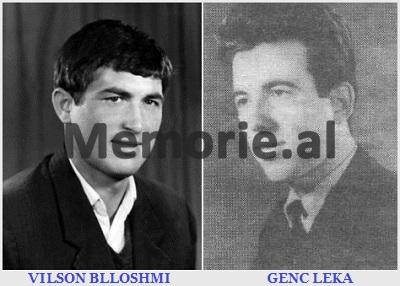
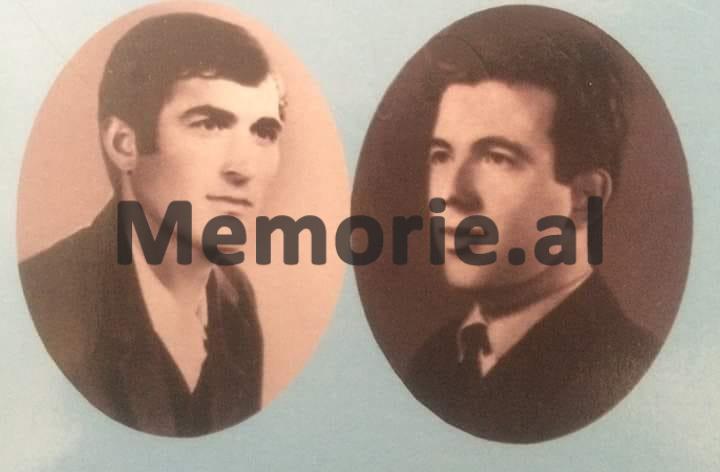
Let us remember the martyr poets Vilson Blloshmi (1948–1977) and Genc Leka (1941–1977), executed in 1977. Their fault? They had expressed pessimism about life in verse. Such monstrous, criminal, and absurd sentences did not occur even in the middle Ages. This sentence in the flower of their youth could not have been carried out without the attention of N. Hoxha, who, together with Ramiz Alia, directed and politically supervised art and culture in general. They knew even the breath of every artist and intellectual in all fields. Is it possible, then, for a woman and her husband to express affection and love for their children when their hands and consciences are bloodied with the life and misery of a nation? To love one’s child is not a merit, for even an animal cares for its offspring. To love one’s neighbor is a duty and a virtue.
I regret to express it, but in fact, their children were raised by two parents – stealthy and heartless killers, two criminals who escaped human justice amid the untold indifference of the whole society. They have almost never expressed any thought on the tragedy the nation lived through for half a century. But there are rare cases such as, for instance, Bashkim Shehu or Fatos Lubonja. These two intellectuals, free and independent men, have clearly and publicly expressed critical thoughts against Hoxha’s totalitarianism, even though their fathers belonged to that regime. So, this was possible, but not everyone did it. Indeed, some among them did not even understand it because they were molded with the conviction that power and privilege belonged to them as a royal right.
The year 1991 marked the ruin and the undignified collapse of the totalitarian regime. Undignified, like all the communist cliques of Eastern Europe. In modern history, in most cases, dictatorships have suffered this fate along with perverse and heartless dictators. How did Ceaușescu and his wife end up? Hitler did not have the courage to face the judgment of justice and set himself on fire, dragging into that fatality the life of a young girl. Perhaps so as not to find he alone, but to make love in the biting misery of the afterlife – that love he had not known while alive. Likewise, Mussolini, who so feared death. He tried to flee accompanied by a young woman, but he did not succeed and ended up on a rope together with his mistress. Dictators hide and die like rabbits. They enjoy the hypocritical glory of a moment only to be covered in shame for eternity.
The death of Nexhmije Hoxha deserves a retrospective to recognize her role in the macabre extermination of the political class in Albania and its replacement with new, often mediocre and incapable figures. Ours was a tragedy in two acts, abandoned in oblivion as if it were a curiosity of a bygone time.
At the beginning of the 1970s, Enver Hoxha suffered a heart attack that changed the roles of the spouses in relation to power. The number one problem concerned his “afterlife” (legacy). Let us see how the situation evolved, starting from the time of the war and following the sequence of events before and after the dictator’s death.
Act I (Enver Hoxha)
The first phase of crimes is the entire period of the war, during which they killed and slaughtered wherever they stepped. Documents are available proving Hoxha’s orders, such as: “Find and arrest them wherever they may be, bourgeois and intellectuals,” he orders Dali Ndreu and Mehmet Shehu, “and execute them without trial and immediately. Let them know from now on that we are in command.” [The book “E. Hoxha”, B. Fevziu, page 140, Tirana, 2011]. There are tens of thousands of victims, including the vast majority of patriots who were still in Albania.
The second phase, immediately after November 1944: Hoxha arrested, interned, and killed all those who knew his past – schoolmates, fellow citizens from Gjirokastra, witnesses to his wickedness and lifestyle: fellow students and honored professors like Farudin Angoni, Hasan Jero, Foto Bala, Fejzi Dika, etc. Particularly significant is the crime against Sabiha Kasimati, a former high school classmate. She had studied in Italy and is known as Albania’s first woman scientist. Sabiha had gone to Enver’s office to express her concern about the grave situation and the terror the country was experiencing after the war. He did not forget his former friend’s criticism and, at the first opportunity, included her name on a list. Sabiha was only 39 years old when a firing squad shot her without any verdict or death sentence. She did not die from the bullets, and the soldiers killed her with rifle butts. It was the ill-fated February 22, 1951. Twenty-two innocent people were executed without trial.
The post-war period periodically saw pogroms among the people of the regime and innocent citizens, in search of the permanent enemy, until the threshold of the 1970s was reached. The nation was weakened by that environment of continuous sentencing that began from ordinary citizens up to the ranks of the party nomenclature. Hoxha’s paranoia and boundless ambition, his lack of wisdom and political mediocrity, turned this long-suffering and martyr country into a concentration camp. Let us see the second act of the Albanian tragedy.
Act II (Nexhmije Hoxha)
After the blow dealt to art and culture with severe and undeserved sentences in the period 1972–73, the worsening of Hoxha’s illnesses took irreversible forms. His ability was compromised not only physically but also mentally. In some speeches, from available videos, it is seen that he often talks nonsense, and Ramiz stands by him in the role of a prompter. For the Hoxha family, securing power even after the father’s death became the priority. His wife, as events testify, resolutely embodied this ambition, aiming to eliminate popular figures. She did this by using one of the lackeys of that regime, Ramiz Alia, as her proxy.
- Year 1974 – Elimination of the main figures of the army, starting with B. Balluku. For this purpose, the zeal of Mehmet Shehu was utilized. The most well-known cadres of the army were arrested and executed. All as agents of the UDB and Anglo-American imperialism.
- Year 1975–77 – Important figures of the economy were eliminated. Cadres of the oil industry and key ministers were arrested and sentenced to heavy imprisonment, executions, and the internment of their families. They were arrested in 1975 and executed in 1977. These too as agents of the UDB and Anglo-American imperialism.
- Year 1981 – There remained Mehmet Shehu, who was used against military enemies. To eliminate Mehmet, the zeal of the criminal Kadri Hazbiu, Minister of Defense, was used. Mehmet too was declared an agent of the Anglo-Americans and the Soviet KGB. Whether he killed himself or they killed him, this does not change the essence of the tragicomedy.
- Year 1982 – From the old gang of Hoxha’s followers, Kadri Hazbiu remained, the Minister of Defense who was to put the “lid” on that hysterical and criminal slaughter. He apparently did not know that the pot is washed from the top, then comes the turn of the lid. So he too was arrested along with the Minister of Internal Affairs, Feçor Shehu, and another hated and unscrupulous figure of that time. They were executed, they too, as agents of the Anglo-Americans and the Soviet KGB.
In this period, the condemned figures were replaced by new people, even drivers or field workers without any ability or experience in active politics. They were figures distinguished only by blind obedience and the inability to think for themselves. Thus, in the transitional period of the dictator’s waning, his wife and her proxy R. Alia brought a bunch of mediocre people to the head of the country. This was the second act of the deeds of the Hoxha couple.
The tragedy of Hoxha’s totalitarianism must not be forgotten, but that is not enough. It must first be studied and understood with wisdom, dignity, and determination.
At the foundation of that totalitarianism, we see two conflicting views. On one hand, the citizens who suffered with fear of the present but with hope for a light in the future. This reality of the citizen had an anti-symmetrical view: the Macbeth couple of Albania who, day by day, saw their power debased, bruised, and rotting from crime. They lived to preserve that present with fear to the marrow for the future. So great was their fear that they were forced to kill without mercy. On the contrary, the victims of that clique, the simple people, hoped in the light of the future and were not dragged into the quagmire of killings and vendettas. They kept pure their nobility, dignity, and convictions about life and society./Memorie.al
Another issue is justice. A man and a nation with dignity must defend the historical truth at all costs and judge the wickednesses of the despot, even after his death.
Terni, March 1–11, 2020