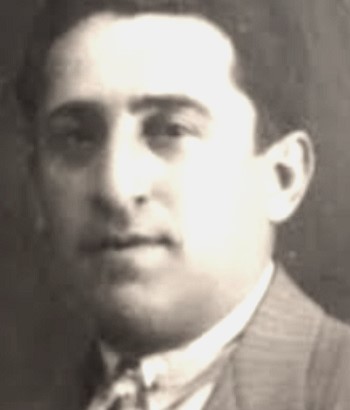
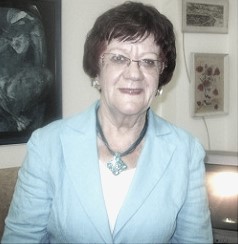

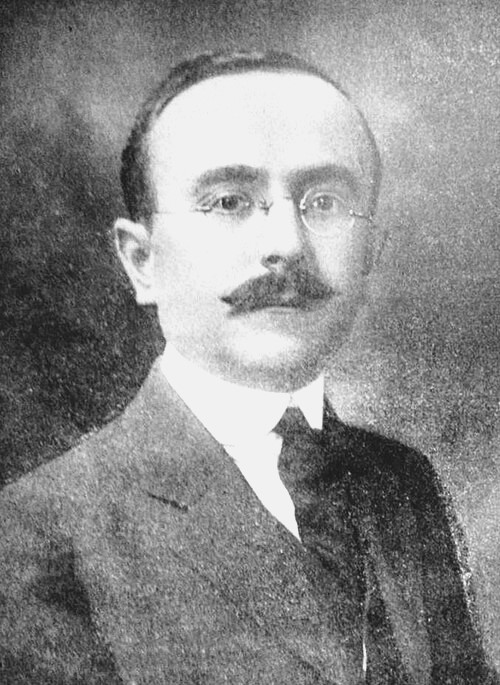
Memorie.al / For years I have carried in my memory the name of the writer, publicist and translator Andon S. Frashëri. In 1964, as a young woman who had just completed her higher studies, I was appointed English teacher at the Korçë high school, and I was teaching this foreign language in that city for the first time. In the very first month after I had started working, one day after classes one of my students (later an excellent student), Aleks Jani – a short boy with blond curls – approached me timidly, blushing, and told me that a man who knew English wanted to meet me, and he took me to Andon Frashëri’s house.
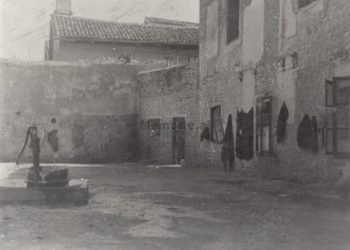
It was an old house with an outer gate that had been ruined for years; there was a courtyard, and after climbing a few steps you reached another door, which was always open because several families lived there, and to one of the doors on the right lived Andon Frashëri, in a room not very large, with peeling walls and books everywhere. In this house he had been born; it was his parents’ home.
Thus began my friendship with Andon Frashëri. I learned that for seventeen consecutive years he had been, at times, secretary to His Grace Fan Noli in 1924, when the latter was Prime Minister of Albania, and earlier an activist in the “Vatra” society in America, simultaneously a journalist and publisher of the newspaper *Dielli*. Andon Frashëri writes:
“Memories of Fan Noli: In 1915 I was appointed his assistant as deputy director of the newspaper ‘Dielli’. At that time I felt as if I had taken God by the hand. And the years that flowed in cooperation with him gave me the chance to know Noli root and branch…! With Noli as leader, the hardest task becomes easier than a pen, sweeter than honey. Without falsehood he inspires you, encourages you, gives you heart!”
We both talked about the books I was reading; he would show me the letters, books and dictionaries that Noli sent him, and from time to time a small cheque at Christmas or Easter, and always behind the envelopes a different address was written, with a woman’s name “Mary” (perhaps using the name of Noli’s secretary, Mary Johns) or some other fabricated surname so that it would not be understood that the two of them corresponded; who knows, the content of the letters must also have been such that only the two of them could understand.
I touched the letters, the books with my hand and felt as if I were touching Fan Noli’s hand, thousands of kilometres away. We talked about the wonder of Noli’s translations: Shakespeare’s dramas, the Rubaiyat of Omar Khayyam, H. Longfellow’s poem “Skënderbeu” with its brilliant verses: “He fights the fight and wins the day / King Ladislaus thunders away…”, and others.
My friendship with Andon Frashëri was perhaps a somewhat timid, persecuted friendship. Others, or he himself, told me that he had been in a political prison for ten years after the liberation, but I did not ask him about this and we did not talk about it, and I continued to visit him. His wife, Maria (Meri), a Romanian, was arrested after him and spent two years in prison; while in prison she also attempted to kill herself. Later, after his release, around 1959, Mrs. Frashëri left Albania for Romania, leaving Andon alone and childless.
In prison Andoni had undergone surgery for a stomach ulcer and had many problems with eating food. In the afternoons, there in his small room, he gave English lessons to some intellectuals of the city, to some girls from Korçë families affected by the communist regime, and, surprisingly, to a little girl with blue eyes who looked at you with curiosity – Doloreza AliPirgu (Dhima). I remember one day he invited me for lunch; it was Christmas, and we clinked cups of red wine.
Andoni was extremely courteous in his behaviour; he treated me as if I were his equal in knowledge. I had been a student of Skënder Luarasi and at that time I knew by heart so many verses by Noli, from his wonderful translations, and I also had knowledge of many other distinguished men of our nation who had striven to make Albania. There, above the fireplace in his room, instead of keeping an icon (for we had not yet become the only atheist state in the world), he kept a large photograph of Fan Noli and would light a candle holder with oil on feast days.
Fan Noli was the idol of his life. There, above the fireplace, I saw for the first time Noli’s book *Psalms*; he showed me a large Webster’s dictionary with which he worked, the book *Beethoven and the French Revolution* in English, and other books. I did not dare ask to borrow books to read; likewise, he never told me that he had written books which had been removed from circulation after he was imprisoned, and that he was a banned author.
In Professor Nasho Jorgaqi’s book Fanoliana, we read a letter from Andon Frashëri sent to Noli on 4 March 1938, which, among other things, says: “You’re Grace… just as Albania once awaited Skënderbeu, so we await you today with the same longing…! Albania today needs patriots like you. Remember also that you have a duty toward your old comrades; with your coming, these men will become men. I do not say this for myself, but for the comrades, who on every occasion ask with yearning about your coming. Your union with Faik has touched us; it was necessary, and there is no doubt that the two columns bound together are for us the greatest guarantee…”!
Later, in the Pogradec Archive, I came across, in the pages of the magazine “Përpjekja Shqiptare:, which intellectuals of the time published in the 1920s, a photograph of Andon S. Frashëri head‑to‑head with Bahri Omari. In Enver Hoxha’s book When the Foundations of the New Albania Were Laid, precisely on page 106, I have read: “Fazlli Frashëri could be seen in the afternoons, winter and spring… conversing with the same professors of the Korçë Lyceum… with Andonaqka of Frashëri, an agent of the Americans and immoral.”
Also in the book Fanoliana, we read another long letter from Andon Frashëri addressed to Fan Noli: “Tirana, 28 September 1945. Dear Your Grace, Some months ago I sent you a letter in which I begged you – in the name of our comrades – to intercede with the Government here for the salvation from death of the late Kol Tromara and Bahri Omari, who were sentenced and executed together with Akif Përmeti, Dhimitër Bala, Haki Tatzati, Zejnel Gjoleka, General Mirdaçi, Fejzi Alizoti, Toçi, etc.
I doubt it reached you. The situation here…! The power in hand is 100% held by the Communist Party with Enver Hoxha, Koçi Xoxe, Sejfulla Malëshova, Bedri Spahiu, Mehmet Shehu, etc.; these are in full cooperation with Tito…! Ghegs are counted on one’s fingers, and a catastrophic propaganda is being carried out between Tosks and Ghegs, and infidel versus Turk! The two‑headed eagle has been covered by the Red Star. They carry out propaganda openly, missing no opportunity to exalt even the smallest news that comes from Belgrade or Moscow, and belittling everything that comes from the West.”
Whereas in the letter dated 30 January 1964, Andoni writes to Noli in a restrained tone, complaining about his health and old age, and naturally expressing opinions about various books that concerned the two of them. Eventually I went to the National Library and borrowed Andon Frashëri’s books to read. As soon as I opened the first book, the novel Patrioti, 160 pages, published in Korçë in 1933, on the very first page my eye caught a stamp “Mitrush Kuteli, Library” (meaning that this book had belonged to the writer Dhimitër Pasko), and at the top of the page a dedication: “Mr. Mitrush Kuteli, in friendship A. Frashëri.” For a moment I had a vision as if I were seeing the two writers shaking hands with one another.
His novel Patrioti, the author dedicates “To the Martyrs of the Nation who gave their lives with joy for the national ideal I dedicate this small work as a remembrance.” This novel is based on facts from the events of the early 20th century, those turbulent wars of Albania in those years, and especially in the city of Korçë and its surroundings. The book is dedicated to the patriot Themistokli Gërmenji, who sacrificed himself so that Albania could be created. About Themistokli Gërmenji, Lasgushi said these verses: “He spoke the three words and then he ceased / And quickly gives the order: ‘Fire! / There where the hero falls he dies / The Albanian Homeland is reborn’!”
The book ”I funtmi i Kastriotëvet” (The Last of the Kastrioti), published in Tirana by the publisher Ismail Mal’Osmani in 1944, consists of 113 pages. This novel Andon S. Frashëri dedicates: “To Fan S. Noli, Knight of Albanian Literature, as a token of gratitude His Disciple.” In this book, with the fire of his heart, the author writes about the events that followed the death of the Leader Gjergj Kastrioti, about his only son Gjon and the uprisings that began in Krujë, to save Albania from the Turkish yoke; and although many brave men fought and fell on the battlefield, they could not win because they were betrayed by Albanians sold to the Turks for ranks and offices. Although the book ends tragically, we look the truth straight in the eye and we are proud of Skënderbeu’s only son, who performed his duty to the Homeland with honour.
Andon Frashëri also distinguished himself as a translator of the book “The Captain of the Janissaries or Skënderbeu”, written by James Ludlow, first published as a literary supplement in the newspaper “Dielli”, then as a book in Korçë by the “Drita” Bookstore in 1934 (and published in 1967 under the title “Konstandini dhe Morsinia”, again on the subject of our Great Hero Gjergj Kastrioti), as well as the book “Paul and Virginia” by Bernardin de Saint Pierre.
In a letter sent to Andon Frashëri by Fan Noli on 30 May 1964, published in “Noli Vepra 6”, among other things it is written: “These last four years I have been learning Hebrew in order to translate the Old Testament from the original, and that is what I am working on now. To date I have finished the Psalms and I will send you a copy of them. Read the book and write to me what you think of it.”
And here is what Andon Frashëri wrote about Fan Noli in the magazine Shkëndija, 1942, Nos. 9‑10: “Those who have had the fortune to hear him – writes a witness who has followed the triumphal progress of Nolian oratory – in meetings, in church or in parliament, foreigners and Albanians here and abroad, have come away enthusiastic about the power of his oratory.
Noli’s speeches thrill you and give you heart; at one moment they lift you to heaven, at another they dash you to the ground; they ignite you and excite you to frenzy, they make you fantasize to the point of madness, but they also soften and calm you, and often make you laugh and shed tears of joy…! His words he accompanied with a finished smile, with human tact; he knew how to create a bond with the audience.”
One day I went to his house – whose gate bore the number 13 – and found Andon Frashëri ill in bed; I squeezed two oranges that were on the table and gave him the juice to drink; the doctor’s prescription for medicine was there too. I went to the pharmacy and bought it. I did not know what more to do. In the spring, after Noli’s death on 13 March 1965, Andon Frashëri was hospitalized; I went to see him together with a friend of mine, a high school teacher. His eyes filled with tears of emotion: “Look here,” he told me, “the bed number is 13. Noli died on the 13th, and I will die soon; how can I live when he is no longer alive…?!” This was our last conversation. On a gloomy, rainy day, a friend of mine, Irenë Mëria – whose grandmother had been Andoni’s sister – stopped me by the roadside.
“Have you heard? Uncle Andoni has died!” And after a while those few things that remained of Andon Frashëri’s books and manuscripts were carried away to Tirana by his nephew Robert Ballauri. “A notebook of memoirs written by my uncle’s hand, 130 pages, I found torn with only 5 or 6 sheets left,” Mr. Robert told me.
In the winter after his death, I took from the Korçë Library the book *Beethoven and the French Revolution* (this copy Noli had sent to the Metropolitan of Korçë, and on the first page he had written a few words by his own hand), I sat down and translated it in one breath in memory of Fan Noli and Andon Frashëri (it was not published, even though it remained for two years at the “Naim Frashëri” Publishing Enterprise). Writing these lines, I think I am lighting a candle for your soul, Andon Frashëri! / Memorie.al